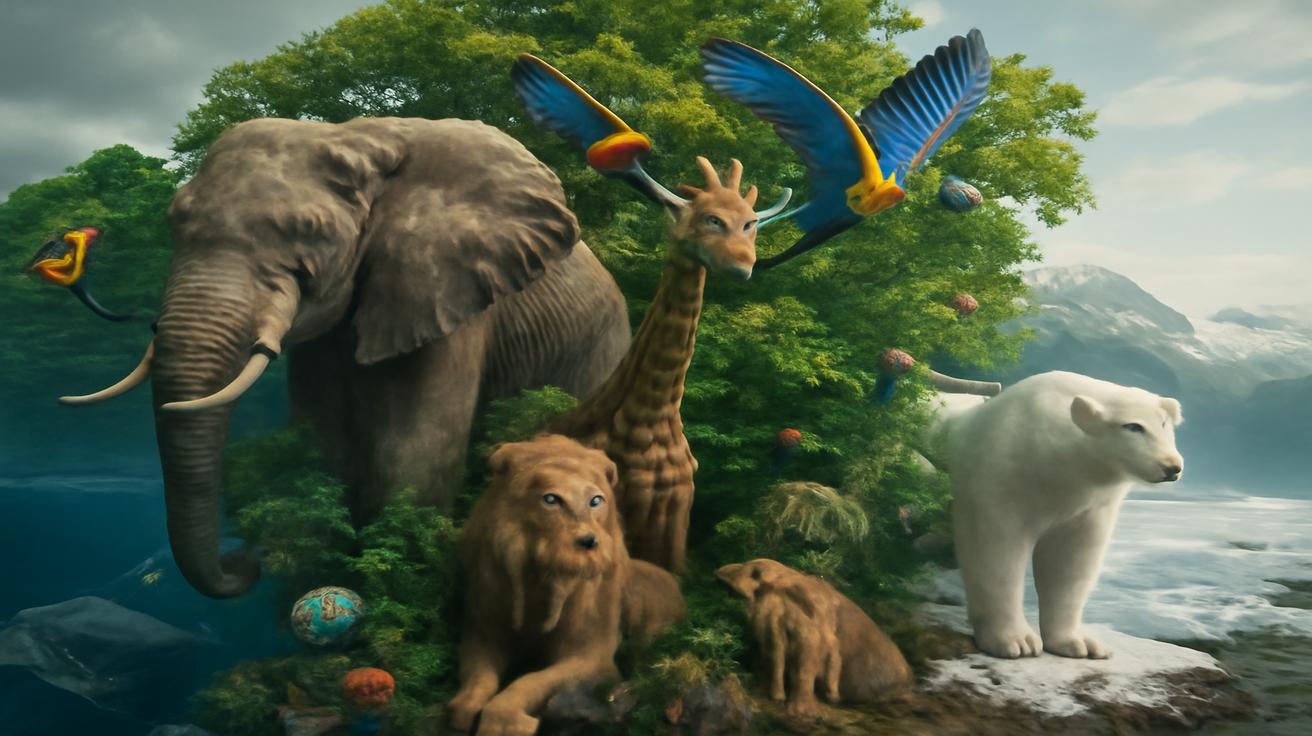
By the time you finish reading this sentence, somewhere in a dark forest soil a beetle larva will have decided, without thinking, how much energy to spend on growing and how much to spend on simply staying alive. A coral polyp in the Pacific is doing the same arithmetic. So is a pine tree on a mountain slope, a fungus threaded through the roots of an oak, and the algae on a sunlit rock. None of them knows they are following a rule—a rule so simple that, once scientists finally saw it clearly, it felt less like a discovery and more like lifting a veil from something that had been in plain sight all along.
The quiet pattern hiding in 30,000 lives
The story starts not with a jungle expedition or a deep-sea submersible, but with spreadsheets—thousands of rows of measurements taken by hundreds of researchers over decades. Biologists had weighed insects and trees, recorded the metabolic rates of fish, tallied growth in mushrooms and corals, logged life spans of birds and mammals. Each data point was a pinprick window into how a species uses energy to build its body, make babies, and endure the wear and tear of existence.
At first glance, the dataset was chaos. There were tiny organisms that pulsed with frantic energy and giants that burned so slowly they might as well have been made of stone. A hummingbird heart hammers away hundreds of times a minute; a tortoise seems to idle through time. How could one rule possibly connect a seagrass meadow and a tiger, a parasite and a redwood?
Yet when researchers pulled together information for some 30,000 species—plants, animals, fungi, microbes—and began to look not at the particulars of who eats whom, but at the simple bookkeeping of energy, a strange calm emerged from the noise. No matter the ecosystem, no matter whether the organism swam, crawled, blossomed, or decomposed, the same basic pattern appeared:
Life, it turns out, runs on an almost universal budget.
The simple rule: spend energy, share energy, keep the books balanced
Stripped to its bones, the rule looks like this: every species allocates its energy between three great demands—maintenance, growth, and reproduction—and across a whole ecosystem, those energy investments follow a consistent, predictable pattern.
Maintenance is the cost of staying alive: repairing cells, pumping ions, mending DNA, running a brain if you have one. Growth is building new tissue: leaves, muscle, shells, spores. Reproduction is the boldest gamble of all: seeds, eggs, sperm, flowers, fruit, parenting, courtship. If you think of an organism as a tiny economy, these are its three ministries: keep the lights on, build infrastructure, and invest in the future.
What scientists found is that no matter how bizarre or different a life form looks, it faces the same trade-offs along the same curve of energy use. Grow fast, and you tend to die young. Reproduce furiously, and you may skimp on repairs. Live slowly and carefully, and you’ll likely invest more in staying alive and less in a population boom. Across tens of thousands of species, the numbers fall along near-identical relationships, as if every life on Earth received the same budget template with different line items filled in.
It’s not just within species, either. Zoom out to the scale of forests, coral reefs, grasslands, and lakes, and that simple rule blossoms into something even more striking: ecosystems themselves seem to arrange their total energy use in a remarkably uniform way. The amount of energy captured from sunlight or food, the fraction absorbed by plants, then passed to herbivores, then to predators, then to scavengers and decomposers—it flows in patterns that repeat from Amazonian forests to Arctic tundra.
From tiny plankton to elephants: everyone on the same curve
Imagine lining up 30,000 species by body size, from the smallest bacteria to the heaviest whale, and asking a single, nosy question: “How do you spend your energy?” If you could listen closely enough—not to words, but to chemical reactions and heat—you’d hear a choir singing different verses of the same song.
Small-bodied species, like plankton or tiny insects, burn hot and fast. Their metabolism is rapid, their generations quick, their lives risky and short. They pour energy into reproduction like a gambler pushing their chips all in, because their odds of survival are slim. High risk, high reproductive rate.
Large-bodied species live on the other end of the bargain. An elephant calf grows slowly across years. A great oak spends decades laying down rings of wood before it fills a forest gap with acorns. When these organisms reproduce, they typically do so cautiously, with fewer offspring but more investment in each one: thick shells, fat-rich seeds, attentive parents, protective herds. Their energy is weighted toward maintenance and long-term survival.
In between lies a continuum: mice, sparrows, salmon, lizards, daisies, mushrooms. Each species settles at its own spot on the curve, but the curve itself—how body size, metabolism, growth rate, and reproduction fit together—hardly changes. Across animal groups, across plant lineages, the same mathematical relationships keep appearing. It’s as if evolution is endlessly improvising melodies, but always in the same key.
To make that visible, researchers often turn reality into a simple table—something that tames the wild diversity of life into a few repeating numbers and trade‑offs you can see at a glance.
| Body Size Category | Typical Strategy | Energy Focus | Example Species |
|---|---|---|---|
| Very Small | Fast life, many offspring | Reproduction & rapid growth | Bacteria, phytoplankton |
| Small | Short-lived, opportunistic | Growth, quick breeding | Mice, annual weeds, flies |
| Medium | Balanced strategy | Mixed between survival & reproduction | Songbirds, rabbits, shrubs |
| Large | Slow life, fewer offspring | Maintenance & long-term survival | Deer, large trees, eagles |
| Very Large | Long-lived, highly invested | Survival, care of few young | Whales, elephants, giant sequoias |
What’s remarkable is not that different species fall into different rows, but that they do so in such a regular way. These are not random choices. They are evolutionary responses to the same physics of energy: how quickly it can be gathered, how efficiently it can be used, and how easily it can be lost.
Energy, the invisible thread tying ecosystems together
If you walk through a forest on a summer afternoon, your senses are overwhelmed by form and color and sound: the thud of your boots on damp soil, the spice of crushed needles, the flick of a warbler in the canopy. It’s easy to think of these trees and birds and fungi as separate units, each wrapped in its own bubble of life. The universal rule of energy use says otherwise.
Every leaf you pass is a solar collector, drawing photons out of the air and turning them into sugar. Each of those sugars is a parcel of chemical potential—the same sort of energy that will power a beetle’s flight, a squirrel’s leap, or the growth of a mushroom tomorrow. That energy doesn’t just appear; it is portioned, passed, and ultimately spent.
When scientists map out who eats whom and add in how quickly each species grows, reproduces, and dies, ecosystems look less like a web of relationships and more like a vast, throbbing economy of energy. And across wildly different habitats, that economy is strangely familiar. A forest and a coral reef, for instance, will both channel only a slice of their available energy—often a similar fraction—into building new biomass each year. The rest keeps the current living cast on stage.
This is where the rule becomes more than an academic curiosity. It suggests that there are natural “limits” baked into how much life a given amount of sunlight or nutrients can support—and that species, no matter how creative evolution gets, end up sharing that limited pot in predictable proportions. It’s not just that everything is connected. It’s that those connections obey the same bookkeeping from mountaintop to marsh.
Why one simple rule emerged from 30,000 tangled stories
Standing under that forest canopy, it may feel almost insulting to reduce a towering cedar or a sly fox to “energy budgets.” We are drawn to stories, personalities, drama. Yet the deeper researchers dug into the data, the more they saw that underneath every dramatic narrative of predator and prey, bloom and bust, migration and hibernation, there were the same three questions being asked again and again: How much energy can I get? How fast? And how should I spend it?
The universality of the rule comes from constraints more fundamental than evolution’s creativity. The laws of thermodynamics do not care whether you are a fern or a falcon. Moving molecules, building complex structures, keeping gradients of salts and charges across membranes—these things have costs determined by physics and chemistry. Over billions of years, life has experimented with countless designs to pay those costs. Most have failed. The survivors are the ones that found workable trade‑offs—combinations of maintenance, growth, and reproduction that fit on the narrow road allowed by energy itself.
That is why, in those sprawling datasets, growth rates and body sizes and metabolic rates don’t scatter randomly. They fall along power laws and scaling relationships that reappear across lineages. Double an animal’s mass and its energy use doesn’t double; it goes up more slowly, along a predictable slope. Something similar happens in plants: leaf size, root depth, trunk thickness, and growth rate aren’t independent quirks; they are interlocked in a system tuned by the same underlying constraints.
In this light, the 30,000 species are not a menagerie of unrelated curiosities. They are 30,000 different answers to the same exam, all graded by the same strict teacher: energy.
What this means for a planet in flux
Knowing that life follows a simple energy rule doesn’t just satisfy intellectual curiosity. It gives us a sharper instrument for understanding what happens when we tug on the world’s energy flows—by burning fossil fuels, clearing forests, overfishing oceans, or reshaping rivers.
When a forest is logged, for instance, we’re not only removing trees. We are disrupting the entire local energy economy. The sunlight that would have been captured by old, tall canopies now hits bare ground or low shrubs. The community of species that evolved around a steady, predictable pattern of energy capture and use finds itself dealing with a sudden windfall or deficit. Some will sprint into the gap—fast-growing, short-lived plants soaking up new light. Others, tuned for a slower, shadier life, suddenly don’t fit the new budget.
Climate change is a similar upheaval at a global scale. Temperature is the pace-setter of many metabolic reactions. Warm the planet, and the biochemical clocks of many species tick faster, altering how much energy they need just to maintain themselves. In some places, plants may grow more quickly with added warmth and carbon dioxide, at least for a time. In others, heat and drought throttle their ability to capture energy from the sun at all. These shifts ripple through ecosystems, rearranging who gets what share of the finite pot.
Because we now understand that ecosystems tend to organize themselves along consistent energy patterns, we can begin to predict when a system is being pushed off its usual track. If the total energy being captured by a grassland plunges, or if too much of it is shunted into a few opportunistic species at the expense of long-lived ones, it can be a warning flag: the energy books are being cooked, and the usual rule is starting to fracture.
Seeing ourselves inside the universal rule
Humans like to imagine ourselves as exceptions, but when it comes to energy, we are very much part of the same story. Our bodies obey the same scaling laws as other mammals. A human baby, like any young primate, is an energy-intensive project, and our species has bet heavily on maintenance and long-term care: slow childhood, long life spans, investment in learning.
Yet we’ve also done something new. With technology, agriculture, and fossil fuels, we have blown past the local energy limits that bound other species. Where a wolf is restricted to the calories it can chase down, we tap into sunlight stored millions of years ago in coal seams and oil fields. In terms of raw energy use, each of us in an industrialized society now functions more like a small, always-on machine than a traditional mammal.
That extra energy has given us medicine, art, cities, global communication. But from the perspective of the planet’s energy economy, it is still subject to the same accounting. The more we divert energy and materials into supporting our own population and infrastructure, the less is left to maintain the intricate mesh of other species that share our ecosystems. We are not outside the universal rule; we are bending it around us—and in doing so, we risk breaking the patterns that kept Earth habitable for so long.
There is a sobering clarity in seeing ourselves this way, but also a kind of relief. The decisions we face—about how much energy we use, where we draw it from, how we share landscapes with other forms of life—are not floating in moral or cultural abstraction. They are grounded in the same plain physics that governs a mushroom or a mayfly. If we overdraft the planetary account, the consequences will follow just as surely as they do when a tree leans too far into growth at the expense of its roots.
A universal rule, and a renewed sense of wonder
Knowing that life follows a simple, universal rule could, at first, seem to flatten the world, to make forests and oceans feel more like equations than mysteries. But return to that forest path, or sit by a city pond at dusk, and listen with this new knowledge in your pocket.
The dragonfly skimming the water is not just a blur of iridescent wings; it is one of millions of species that have struck a specific energy bargain: grow fast, hunt on the wing, die soon. The turtle nosing through the shallows has taken a different bet: thick shell, slow heartbeat, decades of quiet endurance. The reeds at the shore, the microbes in the mud, the algae tinting the stones—all of them are solving the same problem with different answers, linked by invisible threads of energy passing from sun to plant, from plant to animal, from life back to soil.
The discovery drawn from those 30,000 species does not erase their uniqueness. Instead, it adds a deeper layer of meaning to it. Every organism becomes both an individual story and a verse in a much older song: the song of how to turn fleeting sunlight and scattered nutrients into a body, a lineage, a momentary assertion of “I am here” against the pull of entropy.
If there is a kind of humility in recognizing that we, too, are bound by this universal rule, there is also comfort. We are not guests in an alien house, nor rulers of a separate domain. We are participants in the same grand experiment of energy that began billions of years ago in the dim, warm water of an ancient Earth. To understand the rule is not to step outside that experiment, but to finally see it clearly—and perhaps, with that clarity, to choose how we live within it more wisely.
Frequently Asked Questions
What is the “simple, universal rule” life on Earth seems to follow?
In essence, the rule is that all organisms must allocate limited energy among three competing needs—maintenance, growth, and reproduction—and those trade‑offs follow consistent, predictable patterns across species and ecosystems. Despite vast diversity, life obeys similar scaling relationships in how it uses and shares energy.
How did scientists identify this rule from 30,000 species?
Researchers combined large datasets on body size, metabolic rate, growth, reproduction, and life span from tens of thousands of species across major groups: plants, animals, fungi, and microbes. When they analyzed the relationships among these traits, they found recurring patterns and mathematical “scaling laws” that held across very different types of organisms and environments.
Does this mean evolution is constrained?
Yes, but in a specific way. Evolution can generate enormous variety in form and behavior, but it must work within the fundamental limits set by physics and chemistry. Energy can only be captured, transformed, and used so efficiently. Those constraints shape which combinations of traits are viable, leading to repeating patterns in how life is organized.
How does this energy rule affect entire ecosystems?
At the ecosystem level, the rule shows up in how total energy—often from sunlight captured by plants—is divided among species and trophic levels. Similar fractions of energy tend to go into plant biomass, herbivores, predators, and decomposers in many different ecosystems. This helps determine how many organisms can be supported, how quickly they turn over, and how resilient the system is to disturbance.
What does this understanding mean for conservation and climate change?
Recognizing that ecosystems follow consistent energy budgets helps us predict how they will respond when we alter key factors like temperature, nutrient supply, or habitat structure. If we know the “normal” pattern of energy use for a system, we can see when it is being pushed into an unsustainable state—through deforestation, overfishing, or rapid climate warming—and act to restore balance before critical functions are lost.