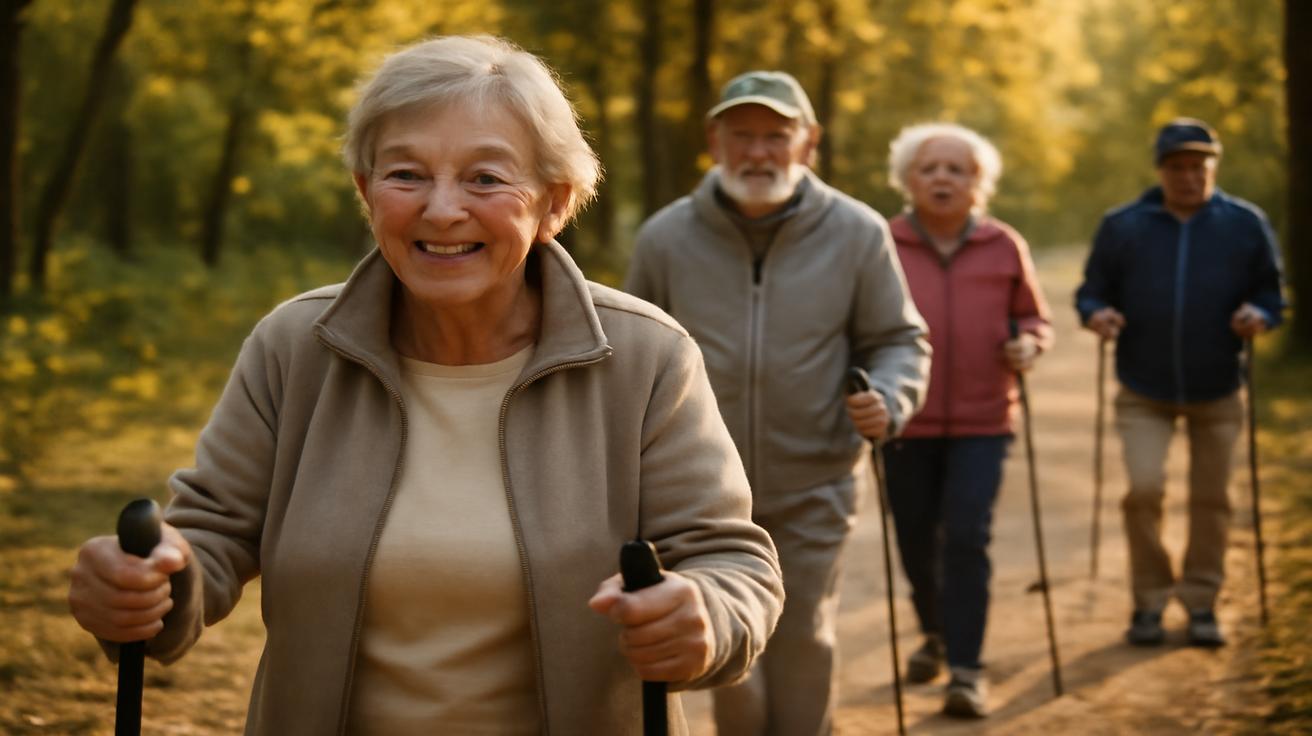
The first thing you notice is the sound. A soft, rhythmic scritch… scritch… scritch, like a broom gently sweeping the forest floor. Then you see them: a loose line of older adults moving in easy, gliding steps along a lakeside path. Their arms swing with unusual purpose, hands loosely holding a pair of slim poles that keep tapping the ground in a quiet, steady tempo. No one is breathless. No one is wincing. Yet you can tell—by the color in their cheeks, the easy laughter floating above the reeds—that something real is happening in their bodies.
At the end of the line, an older man with steel-gray hair pauses to adjust his hat. He’d stopped running years ago, when his knees cried mutiny. “I thought my active days were over,” he says, leaning lightly on his poles. “But this? This I can do. I don’t feel broken afterward. I feel… strong.”
His secret—and the one more and more movement experts are quietly excited about—is not swimming, not Pilates, not the usual suspects you’ve been told are “gentle on the joints.” It’s something different. Something that looks almost too simple, until you try it yourself and realize your heart is working, your muscles are engaged, and your joints? They’re surprisingly content.
The Low-Impact Activity Experts Keep Pointing To
Ask a room full of physiotherapists, geriatric trainers, and arthritis specialists a question that seems deceptively basic: “What’s the best low-impact activity for seniors with joint pain?” You’ll hear the familiar answers—water aerobics, chair yoga, stationary biking. You might hear a quick nod to Pilates. But listen a little longer, and one recommendation keeps slipping into the conversation with growing enthusiasm:
Nordic walking.
If you’ve ever seen cross-country skiers in the off-season marching briskly down a path with poles in hand, you’ve already had a glimpse. Nordic walking takes the simple act of walking and layers in a powerful upper body component using specially designed poles. The result is a form of movement that feels as natural as walking, but works the body more like a full workout—without the harsh impact of running or jumping.
For older adults nursing cranky knees, delicate hips, or stiff lower backs, Nordic walking is turning out to be an unexpectedly elegant solution: a low-impact, high-payoff practice that strengthens muscles, builds stamina, improves balance, and soothes the nervous system instead of rattling it.
Why Nordic Walking, and Not Swimming or Pilates?
Swimming and Pilates have earned their reputations as joint-friendly favorites. But they’re not always practical—or even enjoyable—for every senior living with joint pain. When experts compare them side-by-side with Nordic walking, the differences become striking.
| Activity | Pros for Joint Pain | Common Challenges |
|---|---|---|
| Swimming | Very low impact, great for cardio and flexibility. | Need pool access; changing, wet floors, and cold can be tough; not weight-bearing (less bone benefit). |
| Pilates | Good for core strength, posture, and control. | Learning curve; mat transitions may hurt knees/hips; some moves need serious modification. |
| Nordic Walking | Low impact, full-body workout, supports joints, improves balance, weight-bearing for bone health. | Need poles and basic technique instruction; weather-dependent if outdoors. |
When physical therapists talk about real-life movement—getting out of a chair, climbing a curb, carrying groceries—they’re not picturing a perfectly controlled Pilates studio or the suspended lightness of a pool. They’re thinking of gravity, uneven sidewalks, and the small stumbles that can turn dangerous with age.
That’s where Nordic walking shines. It mimics and enhances how we naturally move, but adds four points of contact with the ground instead of two. The poles distribute load away from vulnerable joints, while still tapping into the health benefits of weight-bearing exercise, which swimming, for all its grace, simply can’t provide.
The Science Hiding Inside Those Simple Poles
From a distance, a Nordic walker might look like they’re “just walking with sticks.” But the biomechanics tell a more interesting story. Proper technique uses a deliberate arm swing: the pole in the left hand plants as the right foot steps forward, and vice versa, creating a gentle twist through the torso and activating the core.
So what does this mean for someone with aging joints?
1. Reduced Joint Load, Especially in Knees and Hips
Because the poles help share the work, some of the force that would usually slam into the knees and hips with each step is redirected through the arms and upper body. Studies measuring joint forces show lower impact patterns in Nordic walkers compared with traditional walkers at the same speed.
For seniors with osteoarthritis, that difference can be the fine line between “manageable soreness” and “I won’t be able to move tomorrow.”
2. Heart and Lungs Work Harder—Without Feeling Miserable
Here’s one of the surprising perks: Nordic walking can significantly increase oxygen consumption (how hard your heart and lungs are working) compared with regular walking, while feeling about the same in effort. Because more muscles are sharing the load, the body can do more work without any one area screaming for mercy.
For someone who’s been told to “get your heart rate up” but finds traditional exercise too punishing on the joints, this is gold.
3. Better Balance and Confidence
Four points of contact with the ground (two feet, two poles) create an instant sense of stability. Tiny trip on an uneven path? The pole catches you before your hip hits the pavement. Subtle wobble on a hill? The poles act like discreet, athletic handrails.
That stability becomes more than physical; it grows into confidence. People who were afraid of walking outside alone—the fear of falling never far from their minds—often find themselves looking up again, noticing birds, clouds, and neighbors’ gardens instead of scanning every crack in the sidewalk for danger.
What It Actually Feels Like (And Why Seniors Stick With It)
Picture this: You step outside on a cool morning, poles in hand. Your first steps are small, cautious, as you figure out when to plant the tip, how firmly to press, how far to swing your arm. The motion feels slightly awkward for about three minutes… and then, like a remembered dance, your body starts to sync up.
Your stride lengthens. Your arms fall into an easy rhythm. The poles begin to feel less like tools and more like extensions of your body. You hear that soft scritch of rubber tips on pavement or dirt, the comforting metronome of movement. You’re walking—but also somehow skiing across the solid ground.
Here’s what many seniors quietly report after a few weeks of Nordic walking:
- “My knees ache less afterward than they did after my usual walk.” The load-sharing is real.
- “I feel like my posture is better; I’m not hunched over my cane.” The poles invite a proud, upright stance.
- “I’m not as scared of falling.” More points of contact mean fewer bad surprises.
- “I sleep better on the days I go out.” Moderate outdoor activity has a calming effect on the nervous system.
And maybe most importantly: it doesn’t feel like a medical assignment. It feels like an outing. Nordic walking sneaks exercise into something that feels like a walk with added purpose—especially when you’re joined by a friend or a small group, the poles setting a shared rhythm as conversation ebbs and flows.
Getting Started Without Making Your Joints Angry
If the idea of adding yet another exercise “should” to your list makes your shoulders tense, take a breath. Nordic walking, when approached gently, meets your body where it is. You do not need to be fit. You do not need to be coordinated. And you definitely do not need to power through pain.
Choose the Right Poles
Nordic walking poles are different from hiking poles. They’re lighter, with angled wrist straps that let you release and re-grip naturally as your arm swings back. Many are telescopic, so you can adjust the height. As a rough guide, when you stand the pole upright and hold the handle, your elbow should be bent at about 90 degrees.
For joint-sensitive walkers, look for:
- Shock-absorbing features if available.
- Comfortable, padded straps that don’t dig into the wrist.
- Rubber tips (also called “paws”) that grip on pavement and reduce noise.
Learn the Basic Technique Slowly
Good form isn’t about perfection—it’s about ease. Start with these simple cues:
- Stand tall, imagine a string gently lifting the crown of your head.
- Let your arms hang naturally at your sides, poles pointed diagonally back.
- Begin walking as usual. Then, add a gentle arm swing—right arm forward with left foot, left arm forward with right foot.
- As your arm swings forward, plant the pole lightly by your side; as your body passes over it, press gently on the handle and let the pole push you forward.
- Release your grip slightly as your arm swings back, letting the strap catch the handle.
The goal is to feel like you are propelling yourself forward, not stabbing the ground. Your steps stay comfortable; you never need to overstride or march.
Let Your Body Set the Pace
For joints that already feel tender, the first weeks are about trust-building with your body. Try this gentle ramp-up plan, and always check in with your doctor or physical therapist if you have complex medical conditions:
- Week 1: 10–15 minutes, 3 times per week, at a light, conversational pace.
- Week 2–3: Gradually increase to 20–25 minutes, still at an easy effort.
- Week 4 and beyond: Work up to 30–40 minutes if comfortable, maybe adding one or two very short “brisk” sections in the middle.
Joint pain rule of thumb: mild discomfort that fades within 24 hours is usually acceptable adaptation. Pain that spikes sharply or lingers, especially deep in a specific joint, is a signal to reduce duration or intensity—or check in with a professional.
The Hidden Emotional Benefit: A Return to Outdoors and Agency
Some of the most powerful changes Nordic walking brings don’t show up on fitness charts. They’re quieter, but they matter deeply—especially to those who’ve slowly withdrawn from movement because of pain and fear.
When you walk with poles, you reclaim a kind of agency in your own movement. Instead of leaning on a cane that can feel like a symbol of decline, you’re wielding tools that look and feel athletic. There’s pride in that stance, in those planted tips and purposeful strides.
The outdoors, too, becomes accessible again. Seniors who once hesitated to walk around the block alone start exploring local parks, forest paths, or waterfront trails. With every outing, the world shrinks just a little less. The horizon moves a little farther away. You’re no longer just “a person with bad knees”; you’re a person who goes out, who notices the wind in the trees, who has a favorite route at sunrise.
One trainer likes to say, “The poles aren’t just supporting your joints; they’re supporting your life.” Over time, that doesn’t feel like hyperbole.
Who Should Be Cautious—and How to Stay Safe
While Nordic walking is remarkably joint-friendly, no single activity is a perfect fit for everyone. If you live with any of the following, extra care is wise:
- Severe balance disorders or recent frequent falls – Start with supervised practice, possibly indoors or on very flat terrain.
- Uncontrolled heart or lung disease – Get clearance from your doctor; begin with very short, low-intensity sessions.
- Severe shoulder, wrist, or hand arthritis – You may need modified pole grips or different strap styles to avoid irritation.
- Recent joint replacement surgery – Follow your surgeon’s and physiotherapist’s timeline; many actually encourage Nordic walking later in recovery, but timing matters.
Simple safety habits go a long way: choose well-lit, even surfaces at first; wear sturdy shoes with good grip; avoid icy or slick routes; and let someone know your planned route and time if you walk alone.
And remember, the goal is not heroics. The goal is consistency. A modest 20-minute Nordic walk, most days of the week, will do more for your joints, heart, and mood than a single “epic” push that leaves you limping for three days.
Bringing It All Together: A Gentle Revolution in Motion
When experts talk about “the best low-impact activity for seniors with joint pain,” they’re not looking for something flashy. They’re looking for something sustainable. Something that respects the realities of aging bodies while still challenging them enough to stay resilient.
Nordic walking fits that strange, important middle ground. It’s gentle, but not passive. Supportive, but not coddling. Familiar, but with just enough novelty to feel interesting. It invites the whole body into the conversation—arms, legs, spine, lungs, heart, even the mind that lifts when the scenery changes and fresh air fills the chest.
Back on that lakeside path, the gray-haired man with the worn cap straightens up as the group prepares to head home. His poles tap once, twice, before he settles into stride. “I used to dread exercise,” he admits. “It hurt too much. This doesn’t feel like punishment. It feels like getting my life back, one step at a time.”
If you’ve been waiting for something kind to your joints but strong for your heart—something that doesn’t require a gym membership or a swimsuit, something that lets you move through the world instead of around it—those slim, quiet poles might just be your next, best companion.
FAQ
Is Nordic walking really better for joint pain than regular walking?
For many people with knee, hip, or lower back pain, yes. The poles help share the load between the upper and lower body, which can reduce stress on sensitive joints. At the same pace, Nordic walking often feels more comfortable while giving you a better overall workout.
Do I need special poles, or can I use hiking poles?
You’ll get the most benefit from true Nordic walking poles. They’re lighter, have different straps, and are designed for the specific arm motion of Nordic walking. Hiking poles are built more for stability on rough terrain than for the rhythmic, propulsive motion you want here.
How often should a senior with joint pain do Nordic walking?
Many experts suggest aiming for 3–5 sessions per week, starting with 10–20 minutes and gradually building to 30–40 minutes as comfortable. The key is regular, moderate movement rather than occasional long or intense outings.
Will Nordic walking hurt my shoulders or wrists?
With correct pole height and gentle technique, it shouldn’t. The motion is meant to be fluid, not forceful. If you feel strain in the shoulders or wrists, adjust the pole length, loosen your grip, shorten your stride, and slow down. If pain persists, consult a professional before continuing.
Can I do Nordic walking if I already use a cane?
Sometimes yes, sometimes no—it depends on why you use the cane and how stable you are. Some people transition from a cane to Nordic poles and feel more balanced; others need the specific support a cane provides. It’s wise to talk with a physiotherapist who can assess your gait and help you try the poles safely.
Do I need a class to learn, or can I start on my own?
You can absolutely start on your own with simple instructions, as long as you keep the pace easy and listen to your body. However, a short beginner class or a session with a knowledgeable trainer can speed up your learning, fine-tune your technique, and give you extra confidence.