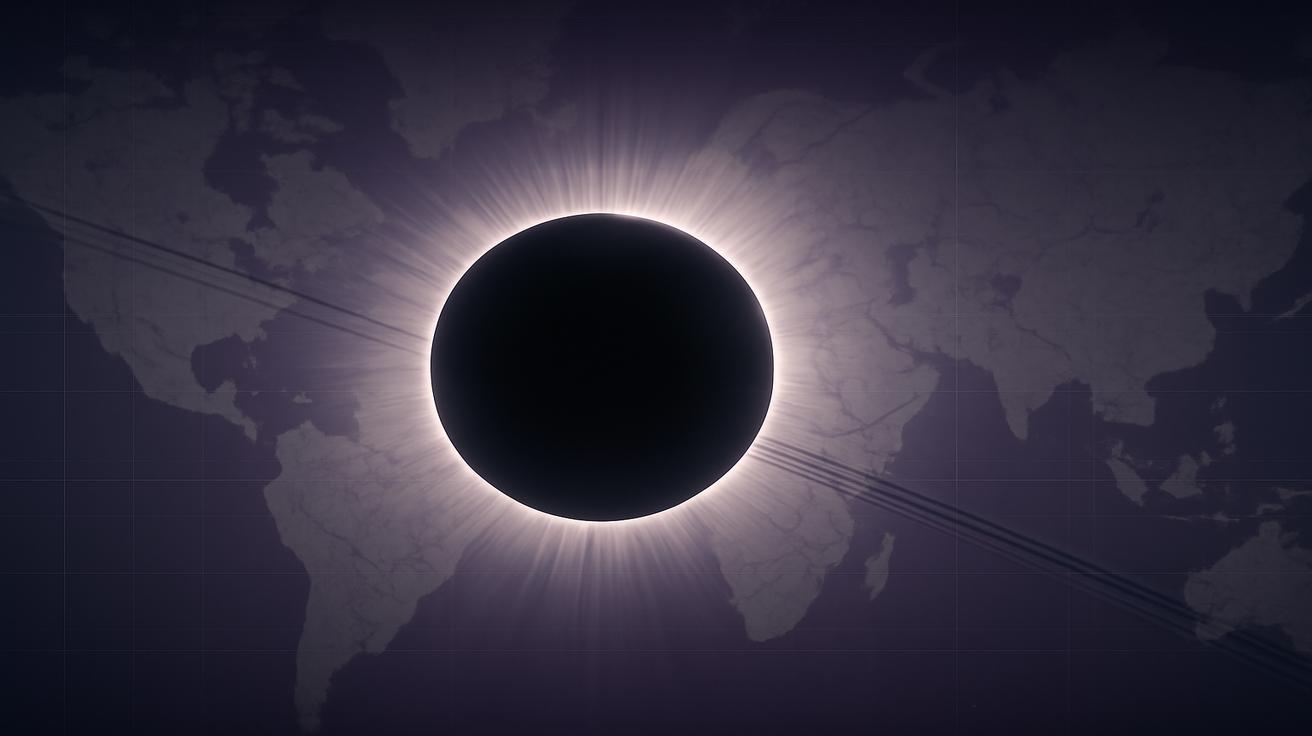
The day the Sun goes dark will not sneak up on us. It is already circled on calendars in labs, observatories, and kitchen refrigerators across the world: a day set to turn into night, when the longest solar eclipse of the century will sweep a moving shadow across Earth. Long before it happens, people are dreaming about it. Children, now just learning to read, will be teenagers when they step outside and watch afternoon turn to twilight. Scientists are tuning their instruments for a show they know they will never see again in their lifetimes. And somewhere out there, the Moon is gliding along the same indifferent orbit it has traced for billions of years, destined—on that particular alignment—to slip perfectly between us and the Sun, and hold back daylight for an extraordinary stretch of time.
Waiting for the Longest Shadow
Imagine waking up on that morning knowing the Sun will vanish. The air will feel ordinary at first—cool maybe, or humid, depending on where you stand along the eclipse path. People will still make coffee, hush sleepy kids into clothes, scroll through the day’s headlines. Birds will sing their normal songs. The sky will be just sky, blue and unaware.
But somewhere, a little after breakfast, someone will step outside and sense the first change: the light will go… strange. Not darker exactly—at least not yet—but thinner, as if the day has been run through a filter. Colors will lose some of their saturation. Shadows will sharpen, their edges cutting more cleanly across pavement and grass. You might not be able to say why, but you will feel it: the Sun is no longer whole.
Unlike eclipses of the past, whispered about by people who weren’t quite sure when or why they would come, this one has a schedule down to the second. Astronomers have already charted the path of totality—the narrow road of the Moon’s deepest shadow. Airlines will eventually sell window seats on flights timed to meet it. Tour buses will trace routes through deserts, over mountains, along coastlines. Campsites that sit under that dark path, quiet and half-empty on ordinary nights, will become sold-out pilgrimage grounds. No one will need to be surprised. And still, when the Sun finally disappears, we will be.
The Math of a Miracle
To understand why this eclipse is so special, you have to imagine a universe obsessed with coincidence. The Sun is about 400 times wider than the Moon, but it is also about 400 times farther away from us. That astonishing near-match means, from Earth’s surface, the Sun and Moon appear almost the same size in the sky. Most of the time, they mind their own business. But every so often, the Moon crosses the Sun’s face just right, and for a few impossible minutes the little world that orbits us hides the star that keeps us alive.
Usually, total solar eclipses are short-lived performances. Two minutes is common; three or four counts as luxurious. This coming one will push toward the limits of what our geometry allows. The Moon will be at just the right point in its orbit—close enough to loom large from our perspective. The Earth will be near the right point in its own path around the Sun. The alignment will be precise, the line of shadow crossing our spinning planet at just the right angle, stretching totality into a rare, extended darkness. For a small set of lucky places, day will be erased not for a blink, but for a breath, and then another, and another.
On the ground, you won’t see the math. You’ll feel the result. As the last sliver of Sun narrows to a thin, eerie crescent, the temperature will begin to fall. It can drop several degrees in a matter of minutes. The wind may shift; breezes can reverse direction as warm air stops rising and the atmosphere moves differently. Animals will notice before you do: bees may rush back to their hives; birds will fall silent or fly to roost. Pets will pace, lift their noses, stare. Insects that usually sing at dusk may start their chorus early. Nature, tuned to the rhythms of light and dark, will misread the script and switch to night mode.
The World Pauses Under a Moving Night
When totality finally hits, it doesn’t just arrive—it sweeps. The Moon’s inner shadow, the umbra, will race across the planet at thousands of kilometers per hour, turning landscapes from noon to night in seconds. If you stand in its path, you may see the darkness running toward you, a bruised ripple on the horizon swallowing familiar landmarks, a curtain drawn over hills, farms, cities, seas.
The moment the Sun is fully covered, the world will exhale. People who have watched partial phases with careful caution will suddenly be able to look up, naked-eyed, and see something almost no one ever sees: the Sun without its blinding face. In its place will hang a black disk ringed by a ghostly white halo that seems to stretch and twist into the sky. This is the solar corona, the million-degree outer atmosphere of the Sun, pale and intricate, streaming out in tendrils and loops shaped by invisible magnetic fields.
The sky itself won’t be truly night-black, but a deep, bruised indigo, as if twilight has been fast-forwarded and then paused. Around the horizon, you may see a ring of color—a 360-degree sunset, bands of orange and pink circling you like a distant fire. Bright planets and a handful of the boldest stars will puncture the dimness. Venus may blaze into view first, then Jupiter, maybe Mars or Mercury depending on where everything is that day. If you’re standing in a field or high plain, the effect will be dizzying: midday overhead, sunset all around, night in the Sun’s place.
In that strangeness, time will become slippery. Normally, totality feels heartbreakingly brief—a minute or two that passes like a held breath. But this one, the longest of the century, will stretch the experience. You will have long enough to notice details, to swing your gaze from the trembling corona to the turbulent horizon, to listen for the sudden quiet or sudden shouts of the humans around you. Maybe you will take a moment halfway through just to yourself: to register the chill on your skin, the goosebumps on your arms, the way your heart is pounding like you are both terrified and overjoyed.
| Eclipse Element | What You See | What You Feel |
|---|---|---|
| First Contact | Tiny “bite” taken out of the Sun’s edge (with eclipse glasses) | Subtle excitement; light still feels normal |
| Partial Phase | Sun becomes a crescent; crescent-shaped leaf shadows on the ground | Light turns sharp and silvery; a faint unease in the air |
| Totality Begins | Sun’s disk disappears; corona blooms; stars and planets appear | Sudden chill, goosebumps, a collective gasp around you |
| Mid-Totality | Deep twilight sky, 360° sunset glow on the horizon | Suspended time; awe, quiet, or wild cheering |
| Totality Ends | A single brilliant “diamond ring” flash on the Sun’s edge | Relief, laughter, maybe tears; warmth slowly returns |
The Human Choreography of Wonder
Long before the Moon’s shadow touches land, humans will begin to move. You can already picture the choreography. Astrophotographers will pack telescopes, filters, and cameras, plotting exposures months in advance, rehearsing their setup in their backyards. Families will book small cabins or pitch tents in fields, turning the event into a wandering holiday. Science teachers will print diagrams and worksheets, trying to capture in lines and arrows what words can barely reach.
There will be arguments about the best place to stand—high on a ridge for a sweeping view of the shadow, or low in a meadow for the encircling horizon glow. Some people will pick their spot for practical reasons, choosing the most statistically sunny location, combing through decades of cloud data. Others will pick it for meaning: the town where their grandparents lived; a coastline they’ve always wanted to see; a mountain they once climbed as a child.
On the day itself, the path will be a flowing, temporary nation of eclipse-chasers. Cars and vans will crawl down rural highways, rest stops filling with people comparing weather apps and paper maps, trading stories of past eclipses in line for coffee. In farm fields, makeshift parking lots will bloom: rows of vehicles, lawn chairs unfolded, picnic blankets thrown across the grass. Strangers will offer each other spare eclipse glasses and snacks, lend jackets when the temperature drops, warn each other when it’s time to stop staring at the Sun. For a few hours, the divisions and distractions that usually fill our days will thin, replaced by a shared, simple plan: look up when the time comes.
Science in the Sudden Dark
For scientists, this particular eclipse is more than a spectacle; it’s a laboratory that the universe wheels past us only rarely, and never in quite the same form again. The extra-long duration of totality will open windows that are usually slammed shut almost as soon as they’re opened. Instruments that barely have time to grab a few snapshots during typical eclipses will get to record long, continuous streams of data.
Researchers will study the solar corona in exquisite detail, trying to understand why it is so much hotter than the Sun’s visible surface. They will track how it writhes and reshapes itself, looking for clues about the Sun’s magnetic fields and the origins of solar storms that can rattle our power grids and satellites. Others will aim sensitive cameras at the sky to study how Earth’s atmosphere responds to such a sudden loss of energy—how temperatures drop layer by layer, how winds swirl and re-form, how clouds respond.
Some will use the eclipse to test technologies rather than theories. High-altitude balloons may ride the changing winds, carrying sensors into the darkened sky. Radio telescopes will listen for changes in the ionosphere. Machines will be pointed upward in place of eyes, taking advantage of a moment when the Sun dims just enough to reveal its hidden structures but not enough to actually go away. And somewhere, in a quiet corner, an astronomer will step back from their screen and simply look up, remembering why they chose this work in the first place.
The Old Fears, the New Reverence
In older times, the day turning to night was a terror, not an event. Stories from cultures around the world describe dragons, jaguars, demons, or great cosmic frogs devouring the Sun. People banged pots, lit fires, shouted and sang to scare the darkness away. The idea that anyone would voluntarily travel to meet that shadow would have sounded like madness.
Now, we know the dragon is just the Moon, gliding along the path we have mapped with astonishing precision. We know the Sun is not actually wounded, just briefly hidden. We know, to the second, when the light will come back. And yet, when it happens, the feeling in your chest may not be so different from what your ancestors felt: a primal lurch at the sight of the sky breaking its promises.
The difference is that most of us will meet this fear with reverence, not panic. We don’t have to invent monsters to explain what’s happening; the reality is wild enough. A ball of rock, circling our planet, passes in front of a ball of fire, circling our star, and for a few minutes the geometry of this arrangement becomes perfect. That perfection lands, by pure chance, exactly where your feet are. You were born on a planet that offers this kind of show—at this particular era in its history, when the Moon is still close enough to cover the Sun completely, but slowly drifting away. Distant descendants, if we have them, may know only annular eclipses, “ring of fire” events where the Moon is too small in the sky to put out the Sun entirely. Totality is a privilege of our moment in cosmic time.
Standing under that future, record-breaking eclipse, you may feel this awareness creep up on you. The chill on your arms will not be just air; it will be perspective. You are one animal among billions, on one planet among countless others, watching an alignment of three spheres that care nothing for you and yet give you this staggering gift of beauty.
Planning Your Own Journey Into Darkness
By the time this eclipse arrives, you might be ready, or you might have only just heard about it. Either way, it is the kind of event that rewards a little planning. The path of totality will be a narrow ribbon across Earth’s surface; just a short drive can make the difference between everything and almost. A 99 percent partial eclipse, where a thin sliver of Sun remains, is a dramatic dimming—but it is not the same as totality. Only in the full shadow will the corona leap into view, the planets shine, the air plunge abruptly into false night.
If you choose to go, think of it as planning a small, personal expedition. Find where the shadow will pass and imagine yourself into that landscape. Do you want to watch from a crowded festival or a quiet hillside? Are you willing to chase last-minute gaps in the clouds, or do you want to sink into whatever the sky offers, clear or not? Eclipses have a way of softening our insistence on control. You can pick your spot and pack your gear, but in the end, the weather decides. Even under a stubborn layer of cloud, though, the twilight will come, the temperature will drop, the world will still hold its breath. The experience may be muted, but not erased.
There is one non-negotiable detail: your eyes. Whenever any part of the Sun’s bright face is showing, even a slim crescent, you will need proper eclipse glasses or another certified solar filter to watch safely. Sunglasses are not enough. The only time it is safe to look with unprotected eyes is during totality itself, when the Sun’s disk is fully covered. In that strange, brief window, you can and should look up directly—because that is when the eclipse reveals its full, impossible self.
The Eclipse That Stays With You
Long after the Moon’s shadow has slid away into the ocean or off the edge of the map, long after traffic has cleared and postcards have been sorted into drawers, the memory will persist in small, surprising ways. You might find that on ordinary days, at noon, you occasionally glance up and imagine the Sun as a hollow ring, the corona blooming wide. A cool breeze on a hot afternoon may remind you of that sudden, eclipse-born chill. Birdsong at twilight may echo the confused silence they fell into when day abruptly vanished.
Eclipses have a reputation for converting casual sky-watchers into lifelong wanderers. Someone who drove two hours to stand in that longest shadow may find themselves, a decade later, booking a flight halfway around the world for just two minutes of totality somewhere else. It is not an addiction exactly; it is more like an imprint. Once you have felt the sky tilt like that, part of you will always be waiting to feel it again.
The longest solar eclipse of the century, whenever you meet it—on a lonely hill, in a cheering crowd, or in a quiet backyard—will be more than an astronomical record. It will be a story you carry. You will remember who stood beside you when the world went dark. You will remember the exact sound in the air at the moment the Sun came back: the cheer, the hush, the one person behind you who simply whispered, “Wow.”
And maybe, on some distant day when life feels small and ordinary, you will remember this: once, in the middle of your everyday existence, the clockwork of the cosmos lined up just so. Once, the Moon took the Sun away from you and then gave it back, and for a few long, extraordinary minutes, you stood in the moving night and felt the universe turn.
FAQ
How long can a total solar eclipse actually last?
In theory, the maximum possible duration of totality is around 7 and a half minutes. Most eclipses are much shorter, often one to three minutes. The longest eclipse of this century will push close to that theoretical limit, making its total phase exceptionally long compared with typical events.
Why is this eclipse longer than most others?
An eclipse lasts longer when several conditions line up: the Moon is near its closest point to Earth (so it looks larger), Earth is near its farthest point from the Sun (so the Sun looks slightly smaller), and the path of the shadow crosses near the equator and at a favorable angle. All of these help stretch out the time the Moon fully covers the Sun.
Is it safe to look at a solar eclipse?
It is only safe to look directly at the eclipse with the naked eye during totality, when the Sun’s bright surface is completely covered. Before and after totality, you must use proper eclipse glasses or a certified solar filter. Regular sunglasses, smoked glass, or homemade filters are not safe and can cause permanent eye damage.
What’s the difference between a partial, annular, and total eclipse?
In a partial eclipse, the Moon covers only part of the Sun, so the Sun looks like a bitten disk. In an annular eclipse, the Moon is too small in the sky to cover the Sun completely, leaving a bright “ring of fire.” In a total eclipse, the Moon fully covers the Sun’s face, revealing the corona and turning day into twilight.
Will I be able to see the longest eclipse of the century from where I live?
That depends on whether the path of totality passes over your region. Places outside that narrow path will see only a partial eclipse or none at all. As the event approaches, national observatories, planetariums, and news outlets typically publish maps and timing charts to help people find the best viewing locations.
What if it’s cloudy on eclipse day?
Clouds can hide the Sun and block the view of the corona, but many of the atmospheric effects—dimming light, falling temperature, animal reactions—will still happen. Some people choose to travel along the path shortly before totality to dodge local clouds, while others accept the risk and simply let the weather decide their experience.
Why do people travel so far just to see an eclipse?
For many, a total solar eclipse is unlike any other natural event: it combines science, beauty, and a visceral sense of standing inside cosmic machinery. The sudden darkness, the corona, the reaction of the world around you—it all creates a powerful memory. Once people experience that feeling, they often decide it’s worth crossing countries or oceans to feel it again.