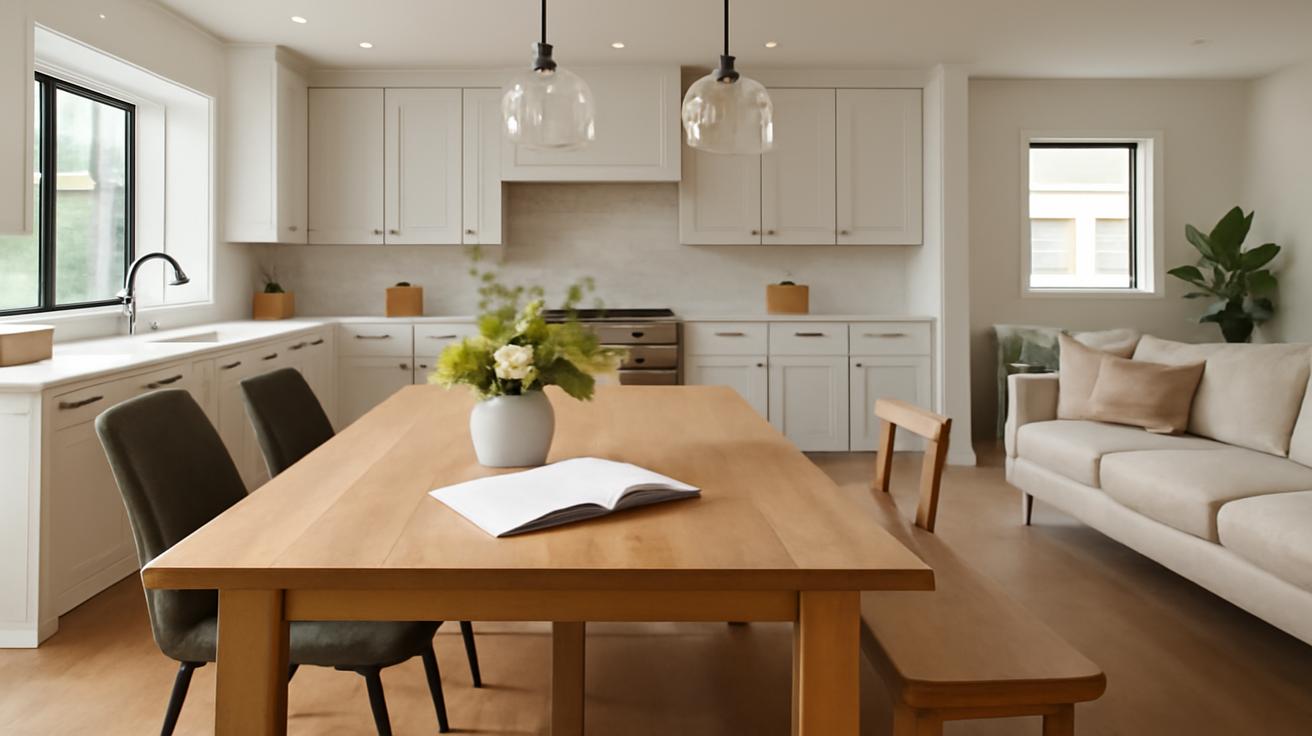
The first thing you notice when you walk into the house is that something is missing. There’s no hulking rectangle planted in the center of the kitchen, no granite-topped island claiming space like a parked SUV. Instead, the room feels… open. The air moves differently. Sunlight slips from one corner to the next without crashing into a bulky block of cabinetry. And right there, where an island “should” be, is something quietly radical: a graceful, double-sided worktable that seems to hover between cooking and living, a bridge instead of a barrier.
The Quiet Farewell to the Kitchen Island
For two decades, the kitchen island has been the unquestioned star of modern home design. Realtors sold houses with the phrase “massive island,” like it was a non-negotiable amenity, somewhere between a roof and running water. Designers drafted endless configurations: waterfall countertops, wine fridges tucked into the side, gleaming bar stools lined up like theater seats.
But if you’ve ever tried to cook in a busy home, you know the secret truth: islands can be awkward. They’re magnets for clutter and conflict. Someone’s always standing exactly where you need to open a drawer. Kids spread homework across the only clear prep space. Guests hover around the perimeter, unsure whether they’re allowed to cross that invisible line between “kitchen” and “everywhere else.”
Now, as we move toward 2026, a different shape is emerging. It’s less of a monument, more of a subtle companion: the multifunctional, furniture-like kitchen worktable and its cousin, the kitchen atelier zone—a flexible, open, layered approach to cooking, living, and gathering. Together, they’re quietly replacing the island in homes that prioritize flow, light, and real-world practicality.
The Rise of the Kitchen Worktable
In one renovated row house, the island was the first thing to go. The homeowners, a photographer and a ceramic artist, had grown tired of squeezing past each other in the narrow space between island and appliances. “We realized the island was treating the kitchen like a fortress,” they said. “We wanted a studio, not a checkpoint.”
So the designer proposed something that felt almost old-fashioned: a long, narrow table, open underneath, stationed proudly in the center of the room, floating between kitchen and living area. But this wasn’t a flimsy dining table. It was crafted like a piece of working furniture: solid wood top, integrated power strip hidden in the leg, smooth drawers for everyday tools, hooks underneath for hanging baskets and pans.
Suddenly, everyone found new ways to inhabit the space. The table became a chopping station in the morning, a laptop desk by noon, a clay-sculpting surface on soggy Sunday afternoons. Friends gathered on both sides, not standing in a ring around a bulky block but flowing naturally through the room, drifting from sofa to table to window bench as conversations unfolded.
This is the heart of the trend: not just swapping one object for another, but rethinking the kitchen as livable instead of merely presentable. The emerging replacement for the kitchen island isn’t one single product. It’s a set of design ideas that favor mobility, softness, and sociability over fixed, monolithic mass.
From Monument to Movable: Why 2026 Loves Flexibility
Our homes are doing more than ever: offices, classrooms, dining halls, quiet retreats. A heavy, permanent island locked in the center of the room feels like an anchor to a way of living we’ve already outgrown. The new central feature—call it a worktable, a chef’s table, a kitchen studio bench—embraces change.
Picture this: a long, beautifully made table on slim legs, just the right height for kitchen prep but gentle enough in appearance to feel equally at home hosting candles and books. Maybe there’s a low shelf below for baskets of linens. Maybe one end overhangs slightly, where two stools tuck away without dominating the room. It’s designed to flex, not dominate.
Instead of one hyper-built island, many homeowners are opting for:
- A generous perimeter counter with deeper work zones near appliances
- A freestanding worktable or pair of smaller tables in the center
- Wall-mounted storage and open shelves that keep tools within reach
- Movable carts that glide in when needed, vanish when not
This frees the middle of the room to behave like a plaza rather than a roundabout—a place to linger, not just circulate.
The Kitchen Atelier: A More Human-Centered Layout
Walk into one of these new kitchens and it feels less like a showroom and more like an artist’s studio. There’s still a sink, a cooktop, a fridge—of course. But instead of clustering everything around an island, the functions spread thoughtfully around the room, like stations in a creative workshop.
Along one wall, a deep, uninterrupted counter with a window above might hold the sink and the main prep area. On another, tall cabinets hide pantry goods, small appliances, and cleaning supplies. The central worktable floats between these zones, letting you shift effortlessly from chopping to sautéing to serving without the hard stop of corners and cabinets.
The effect is surprisingly calming. Less collision, more collaboration. Kids can sit at one end of the table, drawing or studying, while you work at the other. A partner can assemble salads facing you, not with backs turned across an expanse of stone. You regain eye contact, shared tasks, the small rituals of being together in a room that’s no longer carved into strict quadrants.
How the New Trend Changes the Way We Move
A well-designed atelier-style kitchen reshapes your daily choreography:
- Fewer bottlenecks: No more everyone crowding the island for snacks, chargers, and conversation all at once.
- Softer edges: A table, especially with rounded corners, feels safer and kinder to move around than a block of stone.
- Clearer zones: Cooking, working, and gathering can overlap without competing for the same hard, shiny surface.
Instead of orbiting the island, you drift smoothly from wall to table to window, like following a gentle current through the space.
The New Aesthetic: Elegant, Light, and Less “Kitcheny”
There’s another reason this trend is gaining power: the modern kitchen no longer wants to look purely like a kitchen. Especially in open-plan homes, the harsh visual weight of a large island can feel out of sync with the rest of the living area. People are asking for something quieter—and more furniture-like.
The 2026 replacement for the kitchen island leans into:
- Slender legs instead of full bases, so light passes through
- Warm materials like wood, linen, honed stone, and matte metals
- Textural contrast—maybe a lightly worn timber top paired with smooth cabinetry
- Integrated but invisible power, so devices can plug in without cords sprawling everywhere
The room starts to feel more like a conversation between spaces than a single statement piece shouting in the middle.
Islands vs. Worktables: A Quick Comparison
Here’s how the old hero and the new favorite stack up in everyday life:
| Feature | Traditional Kitchen Island | 2026 Worktable / Atelier Zone |
|---|---|---|
| Visual Presence | Heavy, solid, often dominant | Light, open, furniture-like |
| Flexibility | Fixed; hard to reconfigure | Adaptable; can be moved or changed |
| Social Interaction | People gather around the edges | People sit or stand on both sides, facing each other |
| Storage | Lots of closed storage, can become a “junk magnet” | Smarter, minimal storage that encourages editing |
| Space Feel | Segmented, more “kitchen zone” | Open, blurred lines between cooking and living |
Living with Less Bulk, More Life
It’s in the small, daily moments that the shift away from islands really proves itself. Early mornings, for example: no one wants to navigate a maze before coffee. With a central worktable and generous perimeter counters, the first path of the day is simple. Grind beans near the window. Set your mug on the table. Sit for a moment, elbows resting on wood warmed by the first light of the day.
Or picture the slow chaos of a weekend dinner. In an island kitchen, there’s usually a traffic jam: one person trapped at the stove, someone else pinned at the fridge, guests hovering awkwardly, unsure where to stand that doesn’t feel in the way. In the new layout, people naturally spread out. The table becomes the heart of shared tasks—herbs to be picked, bread to be sliced, candles to be arranged—while the deeper counters handle the messier work. The room holds more people, but somehow feels calmer.
Children climb into stools at one end, their papers and crayons spreading into the soft grain of the wood. When it’s time to serve, dishes simply slide across the same surface. No elaborate transition, no mental shift from “prep zone” to “presentation zone.” It’s just one long, continuous story unfolding on a single piece of furniture.
Practical Benefits You Actually Feel
Beyond the aesthetics and the poetry of movement, the post-island kitchen offers tangible, day-to-day benefits:
- Easier cleaning: Fewer tight corners and less cabinetry in the center mean faster sweeps and less dust-trapping.
- More light: Open undersides and slimmer forms let natural light reach across the room, especially crucial in smaller, urban homes.
- Improved accessibility: A table can be designed with varied heights or clear leg space, accommodating different bodies and abilities more gracefully than a one-height island block.
- Long-term adaptability: As family needs shift, the table can move, be replaced, or repurposed; a built-in island is stubbornly permanent.
In uncertain times, a room that can evolve with you feels like a quiet form of resilience.
Designing Your Own Island-Free Future
If you’re standing in your current kitchen, eyeing that big block in the middle, you might be wondering what it would feel like to let it go—or to simply not build one in the first place. The transition doesn’t have to be dramatic. You’re not declaring war on storage or surface area. You’re fine-tuning the balance between solidity and openness.
Start with a few guiding questions:
- Where do you genuinely move in this room—and where do you constantly collide?
- How often do people sit at your island versus simply leaning on it?
- Could the functions your island performs be reimagined along the perimeter and a central table instead?
- What would it feel like to see the floor stretch unbroken across the room?
Sometimes, all it takes is taping out the shape of a slimmer table on the floor to feel the possibility. The space breathes differently, even before anything actually moves.
Designers working on 2026-forward projects are playing with:
- Narrower central pieces (around 30–36 inches wide instead of 42–60)
- Longer, lighter forms that emphasize flow rather than mass
- Hybrid pieces—half worktable, half dining table
- Soft dividers, like open shelving or low benches, instead of bulky cabinetry
The goal is balance: enough structure to feel grounded, enough openness to feel free.
What This Means for “Modern” Homes
For years, the island was shorthand for modernity, a kind of visual guarantee that the house belonged to the present, not the past. But design is a living language, and our needs are quietly rewriting the grammar. The new marker of a truly modern kitchen isn’t a giant slab of stone—it’s a room that understands how you live now, and how you might live tomorrow.
In this language, the central hero is not a built-in block but a more humane idea: a shared table that works harder than any island but asks for less space, less attention, and less performance. A place where cooking and living blur together without competing. A place where elegance comes not from size, but from ease.
Goodbye, Island. Hello, Everyday Grace.
At the end of a long day, the kitchen tells the story of what happened there. An island kitchen often looks like a battlefield: splatters, stacks, a parade of things stranded on the surface because there’s nowhere else in the house that feels as central, as available.
In the homes embracing the island’s 2026 replacement, the story tends to be softer. There’s still a mess—real life doesn’t vanish with good design. But it’s spread more gently across surfaces designed to hold it, work with it, usher it away. The big table in the middle is rarely pristine, and that’s the point. It’s a living surface, a witness to everything from hurried breakfasts to midnight tea, from solo journaling to noisy card games.
We’re not losing something by letting go of the kitchen island. We’re gaining a different kind of center: one that isn’t about showing off, but about showing up. About carving out a space that bends and stretches with the shifting rhythm of a day, a year, a life. The kitchen doesn’t have to be a stage anymore. It can be a studio, a workshop, a refuge—anchored not by a monument of stone, but by a table that quietly invites you in, again and again.
FAQ
Are kitchen islands really going “out of style” by 2026?
Not overnight, and not everywhere. Islands will still appear in many homes, especially large ones. But in design-forward projects and smaller or more flexible spaces, islands are being replaced or reduced in favor of central worktables and atelier-style layouts that feel lighter, more adaptable, and less bulky.
Will I lose storage if I remove my kitchen island?
You might lose some cabinet space in the center, but it can often be regained—sometimes improved—through deeper perimeter counters, taller pantry units, wall-mounted rails, and smarter internal organization. Many people find they were storing rarely used items in island cabinets anyway.
Can a worktable include a sink or cooktop like an island?
It can, but many designers prefer to keep plumbing and major appliances along the walls. That preserves the table’s flexibility and furniture-like feel. If utilities are added to the table, they’re usually integrated with extreme care so the piece still feels light and approachable, not like a shrunken island.
Is this trend only for large, open-plan homes?
No. In fact, smaller homes and apartments often benefit the most. A flexible central table can act as prep space, dining surface, homework zone, and office desk in one, without the visual weight of an island that dominates the room.
What if I already have an island and can’t renovate soon?
You can still borrow from the new trend. Treat your island more like a table: clear off upper cabinets above it if possible, add softer seating, use open trays instead of permanent clutter, and rely more on wall counters for heavy prep. When the time comes to renovate, you’ll already know which functions you truly need in the center of the room—and which you’re ready to release.