The first time I watched an old gardener turn a pile of wilted stalks and shriveled tomato vines into what he called “black gold,” I didn’t believe him. The air smelled like rain on iron and overripe fruit, and the heap looked more like a crime scene than a miracle. Flies hovered, a wheelbarrow creaked nearby, and the late afternoon light slanted across a patchwork of beds crowded with kale, zinnias, and stubborn carrots that refused to pull straight. He dug his fork into the pile, turned it once, and the center steamed in the cool air. “That,” he said, grinning, “is better than anything you can buy in a bag.”
I had come expecting talk of balanced N-P-K ratios, glossy fertilizer labels, maybe some secret store-bought tonic. Instead, I found a quiet rebellion built from onion skins, corn stalks, bean roots, and fallen leaves. Here, at the back of the garden, among cracked buckets and leaning tools, was the real engine of the harvest. Not in the shimmering promises printed on plastic, but in the leftovers everyone else was throwing away.
The Quiet Revolution in the Compost Pile
Seasoned gardeners rarely brag about it. They’ll chat about tomatoes, argue about pruning, compare notes on slug traps—but when the conversation drifts to fertilizers, a small, knowing smile appears. If you linger long enough, or offer to help clean up after the season’s last harvest, you’ll usually stumble upon their secret: a slow, earthy habit of feeding the soil with what the garden itself gives back.
It starts simply. Harvest day ends: the crates are full, the kitchen table overflows, and on the ground remain all the bits that don’t make it into your dinner. Corn stalks with their leaves shredded by wind. Cabbage outer leaves, tough and speckled. Pea vines slumped drunkenly over their supports. A grocery mindset says this is trash. A gardener’s mindset says this is tomorrow’s fertility.
Walk through an experienced gardener’s plot in late autumn and you’ll see it everywhere. Beds speckled with chopped stems. Leaves raked, but not to the curb—pulled into low, rustling drifts along the soil. Buckets of onion skins and carrot tops emptied into quiet corners. The garden looks messy to an untrained eye. To a gardener, it looks busy, working, alive even as the season winds down.
Ask them why they go through all this trouble when there are neat, concentrated bags of fertilizer at every garden center, and you’ll usually get the same answer in some form: “Fertilizer can feed plants. Leftovers feed the soil.” There’s a world of difference tucked into that sentence.
From Scraps to Sustenance: How Leftovers Actually Work
What happens to all that plant debris once it leaves your basket and hits the soil? It’s easy to imagine it just “rotting,” an unceremonious decay into nothing. But seasoned gardeners see something much richer—a slow choreography between weather, microorganisms, fungi, and tiny soil creatures that turns dead matter into a living resource.
Picture a carrot top pressed gently into the soil at the edge of a bed. First, it softens. The outer tissue collapses, releasing a faint, sweet-earthy scent you’d never catch unless your nose was right there. Microbes—bacteria and fungi you’ll never see—arrive in a silent swarm, drawn by simple sugars and softening cellulose. They begin to break down the tissue, dividing complex plant structures into smaller and smaller pieces. Worms and springtails and beetles wander through, nibbling what’s left, turning plant into droppings, droppings into humus, humus into the dark, crumbly texture gardeners dream about.
In a store-bought fertilizer, nutrients arrive like a delivery truck—fast, focused, efficient. In harvest leftovers, nutrients arrive like a forest cycle—layered, slow-release, and woven into a much larger story. Nitrogen from green leaves becomes available gradually, just when new roots reach out in spring. Phosphorus locked in old stems and roots leaches out gently, settling into the soil structure instead of rushing away with the first heavy rain.
Gardeners who use leftovers aren’t just feeding their current crop; they’re building a reservoir of fertility that lingers in the soil structure itself. The soil becomes spongier, darker, milder in temperature. It holds water better, drains better, and smells—if you scooped up a handful—like a forest after rain. You don’t get that from a bag alone.
Why Seasoned Gardeners Trust Their Own “Fertilizer Factory”
On warm evenings, you’ll often find experienced gardeners leaning on their forks beside a half-finished compost heap, talking about the year’s weather and which tomato cracked first. They don’t brag about fancy amendments; they brag about how “the soil’s finally come around.” That soil improvement is the dividend of years of feeding it leftovers.
There’s practicality in it too. Those who’ve gardened through decades of price spikes, product shortages, and shiny new “miracle formulas” tend to develop a protective skepticism. When one year’s must-have slow-release pellets are replaced by next year’s bio-enhanced concentrate, they just keep turning their piles, year after year. A leaf is still a leaf. A bean vine is still a gift. The biology of decay hasn’t changed.
Many will confess that they do keep a bit of purchased fertilizer on hand, like a medicine cabinet for plants—something to turn to when a crop looks particularly hungry or the season demands a quick rescue. But they’ll also tell you those bags last a very long time. When your main nutrient supply comes from your own garden’s cast-offs, fertilizer turns from the main course into an occasional supplement.
The Subtle Superpowers of Harvest Leftovers
Ask an experienced gardener to list exactly what their harvest leftovers provide, and they might struggle to answer in chemical terms. They’ll tell you stories instead. About how the bed they mulched with old bean vines stayed moist through a dry spell. How the corner where they buried squash vines suddenly became the most fertile spot in the garden. How their compost-fed tomatoes taste richer, more complex, as if they’re carrying a memory of all the seasons that fed the soil beneath them.
Still, beneath the stories, some patterns emerge. Different types of harvest leftovers have different “personalities” in the soil. Over time, gardeners learn these the way a cook learns the temperament of spices: not from reading labels, but from watching what happens.
| Type of Harvest Leftover | How Seasoned Gardeners Use It | Main Benefits to Soil |
|---|---|---|
| Leafy greens & soft tops | Chopped and layered into compost or used as a thin mulch | Quick nitrogen boost, fast decomposition, early-season food for microbes |
| Corn stalks & sunflower stems | Chopped small, added to the “carbon” side of compost | Long-lasting organic matter, improved soil structure and drainage |
| Bean & pea vines | Laid on beds or lightly dug in after harvest | Gentle nitrogen, supports soil life, great for following heavy feeders |
| Fruit & veg scraps (non-oily) | Buried in compost or in small trenches between rows | Balanced nutrients, attracts worms, boosts microbial diversity |
| Dry leaves & straw | Season-end mulch, mixed with green materials in compost | Moisture regulation, weed suppression, long-term humus formation |
Over seasons, this mix of materials doesn’t just add nutrients—it changes how the soil behaves. A bed that has been regularly fed with harvest leftovers becomes forgiving. It bounces back faster after a pounding rain. It holds onto fertility instead of letting it wash downstream. Roots slip into it more easily, breath and drink more comfortably. Gardeners watching this happen become reluctant to pour high-concentration fertilizers on such carefully built ground. It would be like pouring syrup on a fine broth.
When “Cheap” Outperforms “Premium”
There’s a quiet satisfaction in leaning on your shovel, watching a lush bed of tomatoes or cabbages, and realizing you did it mostly with things you used to throw away. Many long-time gardeners will tell you that their turning point came not with the first bag of fancy fertilizer they bought, but with the first year they committed to using every bit of garden residue thoughtfully.
They’ll remember the season when they stopped burning corn stalks, stopped stuffing black trash bags with leaves, stopped scraping plant debris into the far corner just to forget about it. Instead, they began to see the end of each harvest not as waste, but as a deposit into next year’s bank of fertility. And year after year, the soil quietly kept its side of the bargain.
Meanwhile, they learned, often through trial and error, that expensive fertilizers can be strangely fragile. Misjudge the dose, and plants surge too fast, their leaves lush but their roots shallow. Apply at the wrong time, and rain shuttles their investment out of reach. Some crops seem to sulk under high-input regimes, their flavor flattened, their resilience dulled. The soil itself can grow dependent, like a system fed on energy drinks instead of meals.
This doesn’t make all fertilizers villains. But season after season, gardeners discover that the true “premium” product is the one that builds resilience. Fertility that doesn’t just flash and vanish, but accumulates, deepens, and holds. Harvest leftovers, properly handled, do exactly that—quietly, inexpensively, and reliably.
A Season in the Life of a Leftover
To understand why gardeners grow almost protective of their scraps, follow a single leftover through a year. Take a spent tomato vine, yellowed and brittle by autumn frost. Once it might have been piled and burned or bagged for trash. In the hands of a seasoned gardener, its story continues.
First, it’s cut into manageable lengths, the way one might chop firewood. Those pieces are layered with fallen leaves and a scattering of kitchen peelings in the compost heap—the pile warm at its center, cool at the edges. Rain wets it. Sun dries its surface. The gardener turns the heap now and then, more by feel than by schedule. Steam lifts when the fork bites into the center on a cold morning.
By late winter, that tomato vine is unrecognizable. Its fibers have softened, darkened, merged with countless other former plants. When the snow, if there is any, finally pulls back, the gardener spreads this transformed matter on the spring beds, a thin blanket of almost-soil that crumbles between fingers and clings to skin in a way store-bought compost rarely does. Underneath, overwintering worms wait, pale and slow in the chill, ready to pull the goodness down.
Come spring planting, new tomato seedlings take their place near the very spot their ancestor grew. Their roots slide into soil rich with the last vine’s remains. The flavor, the flesh, the vigor of this year’s crop will carry a memory of last year’s plant—not in a mystical sense, but in a physical one. At the scale of molecules and microbes, yesterday’s vine feeds today’s fruit.
Fertilizer could have jumped in at any point. Quick-release pellets could have jolted those seedlings into rapid growth. But the seasoned gardener has seen what long, patient feeding can do. When heat waves come, these plants handle it. When heavy rains hit, their well-structured soil drains just enough and holds just enough. Their stems thicken, their leaves deepen in color, their fruits set with an assurance that feels like gratitude.
A Different Kind of Abundance
There’s something almost subversive in discovering that your most powerful gardening tool doesn’t come from a catalog but from your own cutting board and compost corner. In a world that insists improvement comes in more expensive packaging, seasoned gardeners quietly stack proof against that story every autumn, armful by armful of stalks and stems.
They’ll tell you they garden this way because it works, because it’s cheaper, because it’s kinder to the earth. But stay long enough, and another reason slips out. It feels right. It feels honest to let the garden complete its own circle, to allow each harvest to pay its dues back into the soil. You can taste it, they’ll say, in the snap of a pea, in the weight of a potato, in the way an old apple tree leafs out more eagerly each spring.
No glossy fertilizer bag can quite compete with that feeling. It doesn’t fit neatly into a nutrient chart or a marketing slogan. It shows up instead in small, persistent ways: fewer pest outbreaks, steadier yields, a soil that doesn’t quit after a run of difficult seasons. Gardeners who watch that happen find it hard to go back.
Turning Your Own Leftovers into “Better Than Bought” Fertility
You don’t need acres, special equipment, or decades of experience to start using harvest leftovers in the way seasoned gardeners do. You only need to change how you see the end of the season—and the end of each meal. Instead of asking, “How do I get rid of this?” start asking, “Where can this feed the soil next?”
Gather your spent plants thoughtfully. Avoid anything obviously diseased or heavily infested; those can be discarded separately. Chop what you can—smaller pieces break down faster and more evenly. If you have space for a simple compost pile, begin there: layer green, moist leftovers with drier materials like straw and leaves. Keep it as damp as a wrung-out sponge, and turn it when you remember. Don’t worry about perfection; gardeners have been doing this by feel long before thermometers and calculators entered the picture.
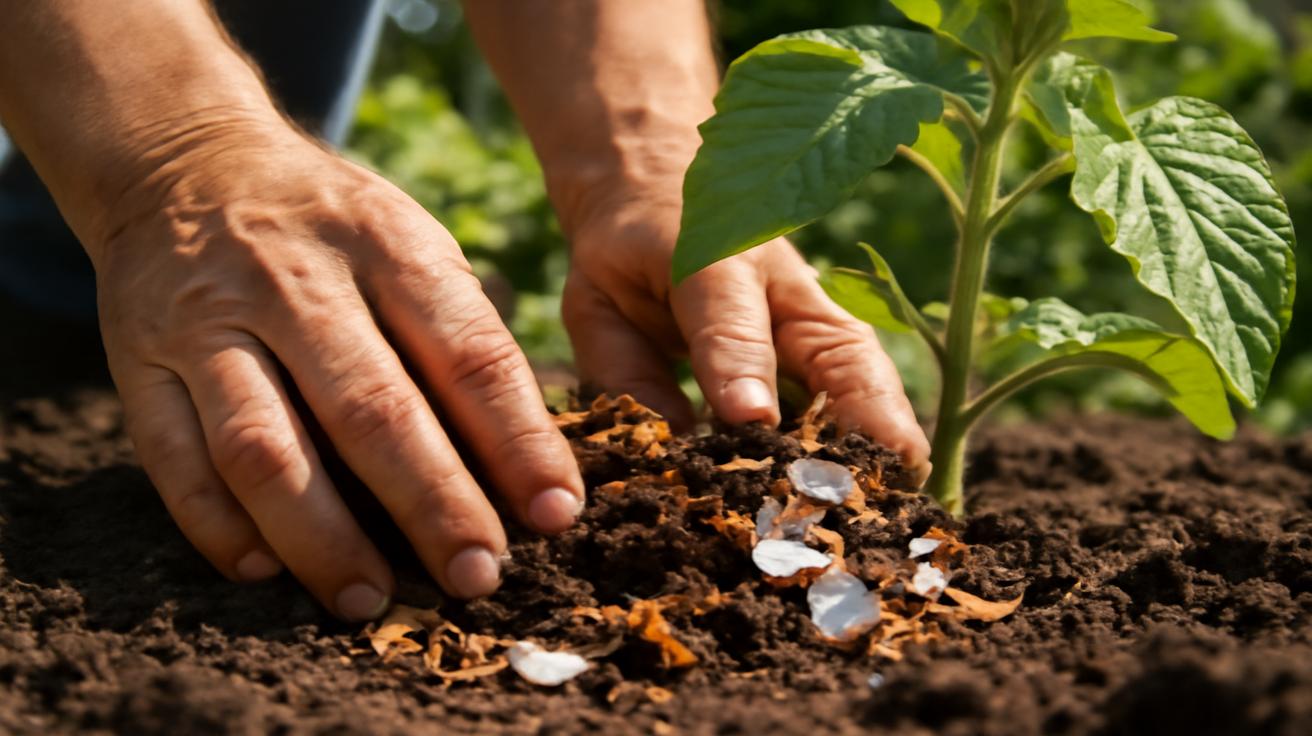
If you’re short on space, use the soil itself as your composter. Bury small amounts of chopped plant matter in shallow trenches between rows, or tuck kitchen scraps under a thin layer of earth at the edges of beds. Let leaves gather as a winter blanket rather than a problem to be solved. In spring, fold what remains into the top few inches of soil and plant right through it.
As you do this year after year, pay attention. Taste your harvests. Notice how quickly the soil dries after a storm, how long it holds moisture in a drought. Watch whether weeds pull easier, whether your plants seem less desperate for quick fixes. Over time, you may find yourself walking past the fertilizer aisle more often, trusting your own slow-made reserves instead.
FAQ
Do harvest leftovers really replace fertilizer completely?
In many gardens, they can provide most of the fertility needed, especially over several seasons of consistent use. Some gardeners still use small amounts of supplemental fertilizer, but far less than they would without a steady supply of decomposed plant matter.
Isn’t decomposing plant waste too slow to feed hungry crops?
Decomposition is slow at first, but the goal is to build up a background level of fertility in the soil. Once your soil is rich in organic matter, it releases nutrients steadily. You can pair this with occasional quick-acting inputs if a crop shows clear signs of deficiency.
What about plant diseases—can I compost all my harvest leftovers?
Seasoned gardeners usually avoid composting obviously diseased plants, especially if they struggle with recurring issues like blight. Healthy harvest leftovers are safe. If you’re unsure, you can hot-compost (maintain higher pile temperatures) or discard heavily infected material separately.
Will using leftovers attract pests or create bad smells?
Strong odors and pests usually come from exposed, wet, and unbalanced piles. Burying kitchen scraps lightly, covering fresh waste with dry materials like leaves, and keeping your compost aerated prevent most problems. Properly managed, a compost pile should smell earthy, not rotten.
How long does it take to see results in the soil?
You may notice small improvements in the first year—better moisture retention, easier digging. Significant, deep changes often emerge after two to three seasons of consistently returning leftovers to the soil. The process is gradual, but the benefits tend to accumulate and persist.