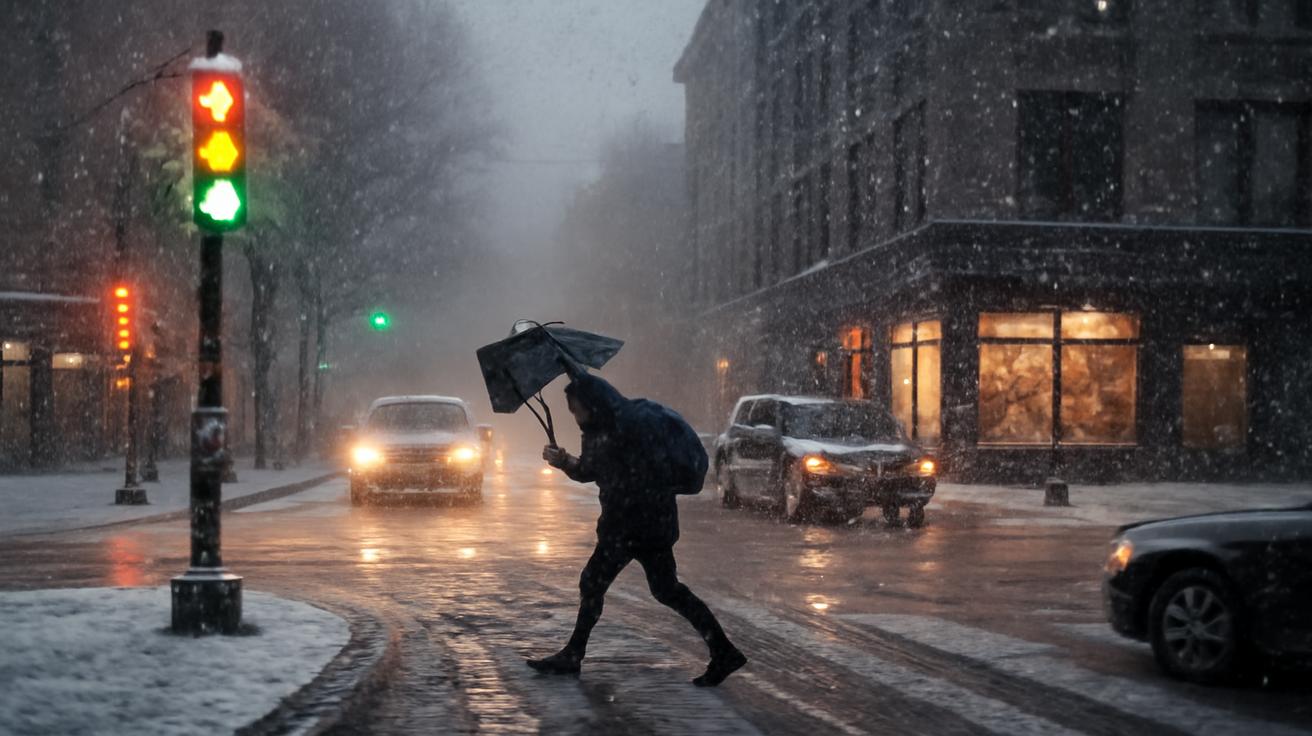
The snow started as a rumor before it ever touched the ground. It showed up first as a red band on radar apps, as half-finished conversations over coffee, as a low murmur in grocery store aisles where carts nudged closer to the canned soup and bread. By late afternoon, the sky turned the color of wet wool, heavy and expectant, and the town collectively inhaled—waiting to see whether the storm would live up to the story already being told about it.
The First Flakes and the First Warnings
By early evening, the snow begins with a kind of politeness. A few shy flakes drift past office windows, catching in the glow of parking lot lights. People press their faces to the glass for a moment, check their phones, and see the same push alerts lighting up the screen: “Heavy snow expected tonight. Nonessential travel discouraged.”
At the transportation department, the mood is more clipped. Maps are spread across a long table, glowing screens reflected in tired eyes. A supervisor, jacket still zipped up to his chin though he’s been inside for hours, draws a finger along a highway line.
“After nine, it’s going to be bad,” he says. “We’re telling people to stay home. If they’re out, they need to be where they’re going by then.”
Outside, plow trucks idle in a neat row like a squadron waiting for takeoff. Salt already cakes their orange blades. Drivers stand around in small knots, hands wrapped around gas station coffee, talking about past storms like old soldiers trading war stories. This is not their first long night. It will not be their last.
Across town, though, the mood feels more conflicted. In an office above a strip of downtown storefronts, a small business owner leans over her laptop, watching the same forecast with a different kind of anxiety. The storm isn’t just an inconvenience for her—it’s a ledger line.
“We can’t close every time it snows,” she says, rubbing her forehead. “January’s already slow. If we shut down, that’s another day of no revenue. But if we stay open and no one comes…”
Her email draft is open: We plan to maintain normal operations tomorrow. She hesitates on the word “normal,” staring out at the thickening curtain of white.
The Town Splits in Two
By dinnertime, the storm has become something you can hear. Snow patters softly against windows, a dry crystalline hiss. Cars roll more slowly down residential streets, tires crunching over the first thin crust. Headlights smear into long, soft halos in the swirling flakes.
On local radio, the message is clear. The county sheriff’s voice—a familiar presence in calmer news cycles—sounds uncharacteristically stern.
“If you don’t have to be on the roads tonight, don’t,” he says. “Give the plows room to work. Stay home, stay safe, and let us get ahead of this thing.”
It’s the kind of simple guidance that feels almost parental in its directness: stay in, wait it out. And for many, it lands exactly that way. Text chains light up with friends canceling dinner plans, rescheduling game nights, and deciding that tonight, couch and blankets win.
But the storm doesn’t fall evenly on everyone’s life. At the edge of town, the lights in a distribution warehouse burn bright. Forklifts weave between towering racks of boxes. Orders don’t stop for weather; supply chains don’t believe in snow days.
Inside the break room, a handwritten sign is taped to the microwave: “TONIGHT: PLAN FOR FULL SHIFT. ROADS MAY BE SLOW.” It tries to sound neutral, but the meaning is clear—show up if you can.
There’s a quiet frustration threaded through conversations here. A young worker stares at the weather app on his phone, jaw tight.
“They say, ‘safety first,’” he mutters, “but then they tell us it’s business as usual. Which is it?”
This is where the town splits—not into good and bad, or careless and cautious—but into those who can choose to stay home and those who can’t.
The View from the Kitchen Window
In a small house on a side street, a woman stands at her kitchen window, watching the snow fall harder. The world outside is turning softer and stranger, familiar edges rounded off by white. Streetlights shine down on a street that’s losing its color, asphalt disappearing under an increasingly thick blanket.
Her car, parked at the curb, is already wearing a cap of snow.
Her phone buzzes. A notification from the local news: “Officials repeat: Avoid driving if at all possible.” Immediately after, a message from her manager: “We’re planning to open at normal time tomorrow morning. Please allow extra time for your commute.”
The two messages sit side by side on the screen, completely at odds and yet somehow expected. She thinks about her route to work—two miles of hilly side streets before she even reaches the main road. No plow has been down her block yet.
She scrolls through the email from corporate again. Phrases jump out: “commitment to our customers,” “continuity of service,” “weather-related challenges.” Then she glances back at the news alert. Just three words echo in her head: Stay home tonight.
It is not a simple equation. Behind her, a stack of bills sits clipped together on the counter. Taking a day off is more than a safety choice; it’s a financial hit. The storm outside her window is made of snow and wind and low visibility. The one on her phone is made of expectations, policies, and pressures.
When Normal Isn’t Really Normal
Out on the interstate, the snowstorm moves from suggestion to certainty. Visibility drops. Tail lights blur into ghostly red smears. Tractor-trailers crawl in the right lane, hazard lights blinking. Onramps become small acts of bravery.
Road crews move slowly but persistently. Salt fans out behind the trucks in faint, glittering arcs. The world narrows to a tunnel of falling white. Drive long enough in it and you begin to feel like you’re stationary and the storm is rushing past you instead.
In town, many storefronts go dark early. Chairs are flipped upside down on tables in diners. “Closed Due to Weather” signs appear in handwritten marker. Yet a surprising number of businesses post on social media with a defiant cheeriness: “We’ll be open for our regular hours—come see us!”
The phrase “normal operations” appears again and again, almost like an incantation, an attempt to keep chaos at bay by saying the right words enough times. But outside, nothing is really normal. Sidewalks vanish under half a foot of snow. Cars spin their wheels at intersections. A wind picks up, turning loose flakes into tiny, stinging projectiles.
The tension plays out in hundreds of small decisions: Does the barista who lives twenty minutes away really have to open the coffee shop at 6 a.m.? Does the office that could function remotely insist people come in anyway “if they feel safe to do so”? Does the big-box store on the edge of town stay open because it’s “essential”—or because closing is bad for the bottom line?
In practice, “normal” becomes a sliding scale, highly dependent on who you are and what kind of work you do. For some, normal operations mean answering emails from the couch, laptop balanced next to a mug of tea. For others, it means navigating unplowed streets in the dark, hoping the snow hides no black ice beneath.
The Choice to Stay, the Pressure to Go
At a small grocery store wedged between a laundromat and a pharmacy, the owner stands by the front window, arms crossed as he watches the snow swirl under the streetlight. He’s proud that they stay open when bigger chains close early. It’s part of the store’s identity as a neighborhood lifeline.
He also knows that some of his regulars count on them. There’s an older man up the block who walks with a cane, who comes in twice a week for a single bag of items. There’s a single mom who works late shifts and picks up milk on the way home. For them, a closed sign is more than an inconvenience.
But he’s thinking about his staff too. Two cashiers, both young, both relying on public buses that are already running late and reducing service. A stock clerk who has to drive from the next town over.
“I can stay,” he says to himself, fingertips drumming against the glass. “I live five minutes away on foot. But can I really ask them to come in tomorrow morning if the plows haven’t even hit their streets?”
This, more than any one emergency declaration or business memo, is where the storm’s ethical weight sits—in the gap between what’s technically possible and what’s truly fair.
| Perspective | Main Concern | Tonight’s Likely Choice |
|---|---|---|
| Local Authorities | Prevent crashes, keep roads clear for emergencies | Urge everyone to stay home and avoid nonessential travel |
| Small Businesses | Lost revenue, loyal customers, payroll | Try to stay open or reopen quickly, even if traffic is slow |
| Large Employers | Continuity, productivity, national schedules | Maintain “normal operations” with cautious wording |
| Workers | Safety vs. income, job security | Weigh risk of roads against risk of missing a shift |
| Emergency Crews | Access, response times, crew fatigue | Work through the night, hope others stay off the road |
Each row in that table is a different relationship to the exact same storm. Same snowflakes, different stakes.
Night Deepens, Roads Disappear
By late evening, the storm has found its full voice. Snow no longer drifts; it drives. It slants in hard under streetlights, forming fast-growing drifts against parked cars and front steps. The world looks like someone has dimmed the contrast; edges blur, distance shortens.
From apartment windows and front porches, people watch plow trucks lumber past. The heavy machinery is oddly graceful, blades curling thick ribbons of snow off to the side. For a few minutes, the road reappears: asphalt, lane markings, a sense of order. Then the sky throws more white at it, and the edges soften again.
Inside homes, time stretches. The evening news loops the same footage—sliding cars, stranded vehicles, interviews with earnest officials in reflective jackets. The advice remains consistent: stay in if you can. Avoid driving. Let the storm pass while you’re safely tucked away.
Phones buzz with new messages from employers. Some surprise their workers with unexpected gestures of sanity and care: “We’ll open late tomorrow,” or “Work from home if you’re able.” Others double down: “We expect everyone to make every reasonable effort to report as scheduled.” That last phrase, “every reasonable effort,” settles like a small stone in the gut of anyone staring out at roads that have all but vanished.
In a house near the top of a hill, a nurse sets out her scrubs anyway. Healthcare doesn’t pause for snow. She’s already arranged with a coworker to carpool with a four-wheel-drive truck. She’ll leave before dawn, long before the plows make it to her neighborhood.
Down in a basement apartment, a line cook flips through channels, then gives up and silences the TV. His restaurant manager texted hours ago: “We’ll see how it looks in the morning, but plan on a full shift.” He thinks about the fifteen miles between his front door and the restaurant. About the one time his beat-up sedan fishtailed on a ramp in a lesser storm. About how much he needs the money. It’s not a heroic story; it’s just the math of his life.
The Morning After That Hasn’t Happened Yet
What nobody can fully see in the middle of the night, with the storm still raging, is what the morning will demand. For now, it’s speculation and habit, old patterns shaping new decisions.
Authorities picture crash reports, blocked intersections, ambulances stuck behind spun-out cars. They think in maps and risk assessments. That’s why their message is blunt: stay home if at all possible, so that those who must move can do so more safely.
Businesses, especially those teetering on thin margins, see a different kind of morning. They see spreadsheets and rent invoices. They see shelves that need stocking, orders that must ship, customers who may or may not show up, but whose needs and habits underpin someone’s paycheck.
There’s a kind of invisible negotiation happening between these forces—a push and pull between caution and continuity. Each snowstorm becomes a live experiment in where that line gets drawn this time.
Somewhere between the salt trucks and the storefronts is a version of “normal” that acknowledges the storm rather than pretending it isn’t there. That version looks like flexible hours, clear communication, genuine permission to put safety first. It looks like big decisions made with small lives in mind.
Listening to the Storm, and to Each Other
Outside, the snow keeps insisting on its own reality. It doesn’t care about quarterly earnings or staffing charts. It simply piles up, flake by relentless flake, on mailboxes and roofs and uncollected trash cans lined up at the curb.
Standing at a window anywhere in town, you can feel two truths at once. The first: the authorities are right. The roads are bad. The snow is heavy. The risk is real. Staying home, for those who can, is an act of collective responsibility, a way to reduce the load on those who don’t have that choice—paramedics, plow drivers, nurses, utility crews climbing iced-over poles.
The second truth: for many people, the idea of simply “choosing” to stay home is a luxury. The storm intersects with rent due dates, with unpaid sick days, with employers who talk about family but write policies that say otherwise. For them, the snow doesn’t cancel reality; it just makes it harder to move through.
Maybe the real story of a heavy-snow night isn’t just the drama of jackknifed trucks or heroic rescues. Maybe it’s also the quieter recalibrations: the business that decides to close even though it hurts, the manager who tells hourly employees their pay is secure whether they make it in or not, the city that coordinates with major employers to align safety messages instead of talking past each other.
On nights like this, with the sky still pouring down its complicated blessings and burdens, there’s a chance to listen—to the storm, but also to the people whose lives move through it. The snow makes everything visible: which roads get cleared first, which neighborhoods are left waiting, whose work is deemed “essential” in practice, not just in name.
By morning, the plows will have carved paths through the drifts. The sun, if it appears, will set a billion tiny crystals sparkling on every surface. Children will beg for one more hour outside. Dogs will bound through snowbanks like it’s their personal gift.
And the town will tally up what the night cost: damaged fenders, overtime hours, canceled plans, near misses. Quietly, it will also tally what was learned. The next time the radar shows that same ominous band sweeping toward the map, the conversation might sound a little different. Or it might not.
For now, as heavy snow thickens against the dark windows and the announcements keep looping on screens and radios—stay home, stay safe, stay off the roads—the storm asks an uncomfortable question of everyone who has the power to say “business as usual”: In weather like this, whose usual are you talking about?
FAQs About Heavy Snow, Safety, and “Normal Operations”
Should I drive if authorities urge people to stay home but my job expects me there?
If officials are clearly discouraging travel, your safety truly is at higher risk. Start by communicating with your employer: describe road conditions where you are, share any local advisories, and ask about remote work, adjusted hours, or using paid time off. Document the guidance from authorities. Ultimately, you have to balance job security against personal safety, but clear, early communication often leads to more flexible solutions than people expect.
What makes heavy snow so dangerous for driving?
Heavy snow reduces visibility, hides ice and lane markings, and makes stopping distances much longer. It can quickly cover any salt or sand that’s been laid down, and at night, it’s harder to see drifts or black ice. Even experienced drivers in good vehicles can lose control if conditions change suddenly.
Why do some businesses stay open in severe weather?
Reasons vary: financial pressure, corporate policies set far away from local conditions, obligations to customers who rely on them, or simply habit. Some industries—healthcare, utilities, emergency services, certain retail and logistics operations—play critical roles that don’t pause easily. Others stay open out of fear of lost profit or lost ground to competitors.
How can employers balance safety with the need to operate?
Good practices include allowing remote work where possible, offering flexible start times, guaranteeing pay for scheduled shifts even if staff can’t safely travel, coordinating with local advisories, and avoiding vague phrases that subtly pressure employees. Clear, honest communication and genuinely putting safety first build long-term trust.
What can individuals do to prepare for nights like this?
Keep an emergency kit in your car, maintain good tires, and track local forecasts and advisories. At home, have basic supplies—food, water, medications, flashlights—in case travel or power is disrupted. Talk with your employer ahead of winter about expectations during storms, so you’re not negotiating from scratch in the middle of bad weather.