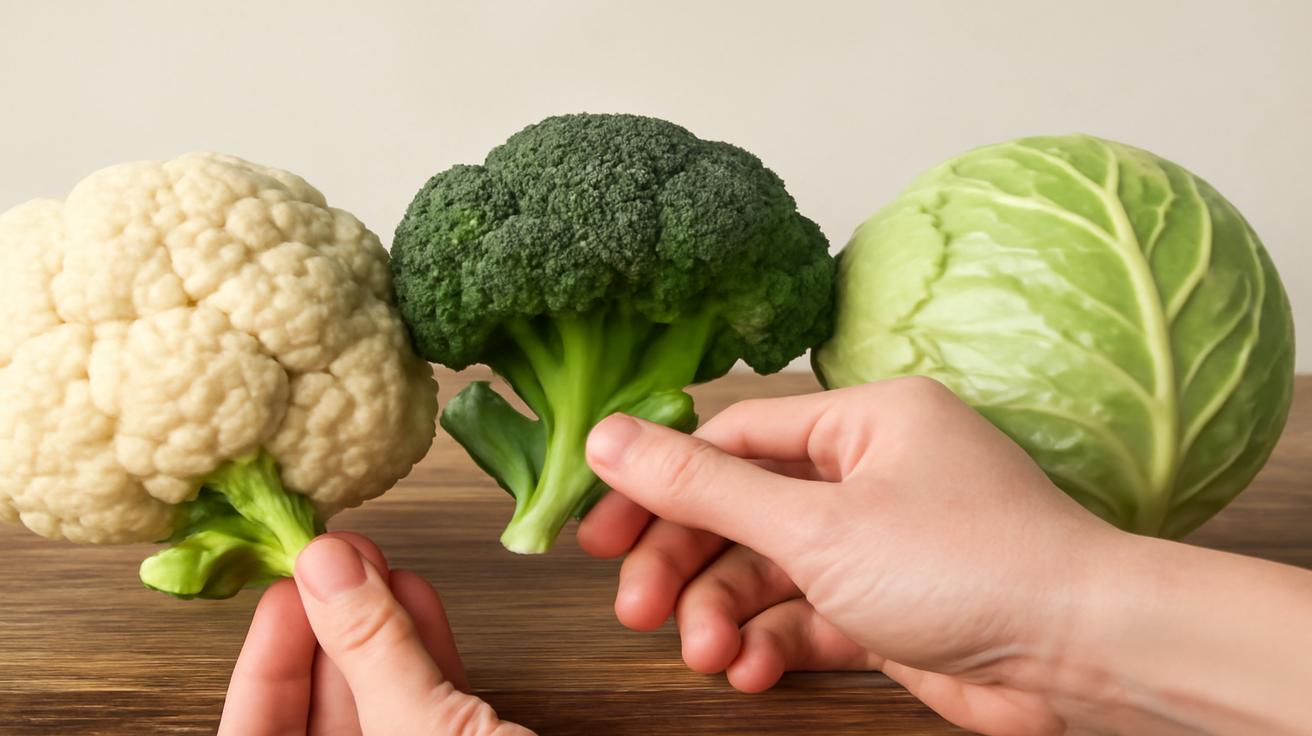
The first time you see it, it feels like a small betrayal. You’re standing in the garden section of a nursery, or maybe scrolling past a diagram online, and there it is: a single Latin name that looks like it belongs in a botany textbook—Brassica oleracea—quietly sitting underneath a row of familiar faces. Cauliflower. Broccoli. Cabbage. Brussels sprouts. Kale. Kohlrabi. Different shapes, colors, and flavors… yet all of them, you’re told, are the same species. The same plant. It sounds wrong, almost like being told your cat, your goldfish, and your favorite houseplant are close cousins. But once you start looking more closely, once you learn how humans gently—and sometimes ruthlessly—nudged this one seaside weed into a family of vegetables, the whole produce aisle starts to look like a story of patience, imagination, and appetite written over thousands of years.
The Wild Plant Hiding in Plain Sight
To understand how cauliflower, broccoli, and cabbage can all be versions of the same thing, we have to go back to where Brassica oleracea began: on windswept coastal cliffs of Europe. Wild cabbage still grows there, clinging to rocky soils along the Atlantic coasts of England, France, and the Mediterranean. It doesn’t look like much—no tight cabbage heads, no frothy white cauliflower curds. Just a scruffy clump of bluish-green leaves, waxy and thick, designed to shrug off salt spray and stiff wind.
Early humans noticed a few important things about this rugged plant. It tasted better than many other wild greens—mildly peppery, a little sweet after frost—and it survived almost anything: cold snaps, poor soil, neglect. Some plants had bigger leaves. Others were naturally more compact. Some sent up thicker flowering stalks. None of that mattered at first, until people started doing something that would change the plant’s destiny: saving seeds from their favorites.
There was no master plan. A farmer simply wanted a plant with more edible leaves for their stew, or a stem that survived longer into winter. Year after year, seeds were kept from plants that performed a little better, looked a little different, fit a particular taste. Over generations, those tiny human decisions pulled wild cabbage in different directions—like a sculptor finding more and more shapes inside the same lump of clay. That’s how one species slowly fractured into all these familiar vegetables. Not through sudden mutation or high-tech genetic engineering, but through patient, everyday choosing.
The Great Brassica Makeover
Once people began steering wild cabbage, evolution got a partner: human desire. And desire, as it turns out, can be very specific. What we now see as different vegetables are actually the result of humans favoring different plant parts to exaggerate.
When Leaves Became Dinner: Cabbage
Some ancient farmers were obsessed with leaves. They saved seeds from plants with large, tender foliage that curled inward slightly. Over centuries, that slight curl became a tight swirl. Leaves that once spread outward began folding in on themselves, wrapping around a hidden heart. The result was the dense green globe we know as cabbage—a vegetable that is, anatomically speaking, a head of massively overdeveloped leaves. Peel it open and you can almost see the plant’s story, each layer a record of a season of selection.
The Cult of the Flower Bud: Broccoli and Cauliflower
Others looked not to the leaves, but to the plant’s flowering stems. Wild cabbage blooms with clusters of yellow flowers, pretty but unremarkable. Yet some plants made especially thick, meaty flower stalks with tightly packed little buds. Farmers who liked the taste of those immature buds began choosing for them, generation after generation, until those buds swelled and multiplied. That’s how broccoli emerged: a forest of still-sleeping flowers, frozen in time before bloom.
Cauliflower took this idea even further—and stranger. In some plants, the floral tissue became a dense, white curd, a brain-like mass where clear flower shapes had almost dissolved into a smooth, convoluted surface. Again, humans said “yes, more of that,” and nature obliged. When you slice open a head of cauliflower, you’re looking at flower structures arrested in growth, coaxed into a new form by nothing more than the steady hand of human preference.
Same Species, Different Personalities
It’s easy to think of cauliflower, broccoli, and cabbage as separate beings because they feel so different when we cook with them. Broccoli brings a green, almost grassy note; cabbage can be sharp and crunchy or soft and buttery; cauliflower is mild, ready to disappear into soups or stand in for grains. But under the surface, they are astonishingly alike.
All of them are Brassica oleracea. They share the same basic chromosome structure and can cross-pollinate and interbreed. The difference isn’t about vast genetic distance—it’s about which genes are turned up or down, nudged or silenced over time. Imagine a single melody that can be rearranged into a waltz, a lullaby, and a marching band anthem. You still recognize hints of the original tune, but each version feels unique. That’s what selective breeding did to this one wild plant.
Scientists sometimes call this phenomenon “morphological diversity”: huge variation in outward form built from a shared internal blueprint. In the case of the brassicas, that diversity is almost theatrical. Leaves became cabbages. Stems became kohlrabi. Buds became broccoli and cauliflower. Side shoots turned into Brussels sprouts—each little sprout a miniature cabbage growing along the stem like buttons on a coat. One blueprint, many costumes.
A Family Portrait in Your Grocery Cart
The produce aisle suddenly becomes a family reunion once you know what you’re looking at. Cabbage is the sturdy older sibling, round and reliable. Broccoli is the lanky cousin with a wild green mop of hair. Cauliflower is the pale dreamer, all soft curves and quiet flavor. If kale is the rugged athlete of the group, Brussels sprouts are the tiny, intense child who demands attention. They all share the same last name: Brassica oleracea.
Even their quirks match. They all carry the faint sulfurous scent that hits the air if you overcook them, thanks to the same family of sulfur-containing compounds, glucosinolates. They all hold on to bitter notes, especially when raw, because bitterness helped their wild ancestors survive. And they all brightened when frost bit at their leaves, converting starches to sugars—a sweet survival trick we still appreciate in winter cabbages and kale.
The Invisible Hand of Taste
We tend to imagine evolution as purely wild and harsh, a survival-of-the-fittest contest between tooth and claw. But in the story of cauliflower, broccoli, and cabbage, human taste is just as powerful as frost or drought. In some ways, we have been co-evolving with this plant for thousands of years. As we shaped it, it shaped us.
Consider bitterness. Early wild cabbages were likely much more bitter and pungent. Bitterness often signals toxins, so humans are naturally cautious around it. Over time, people chose to eat and replant the least bitter plants—those that still had flavor but didn’t scream “danger!” to our tongues. Slowly, the wild bitterness softened. But not too much. The remaining compounds turned out to be useful: many glucosinolates, which give brassicas their bite, also have protective effects in our bodies. The plant’s chemical defense system, originally aimed at insects and grazing animals, became one of the reasons nutritionists today love to recommend these vegetables.
At the same time, the plant gained something from us. On its own, wild cabbage could only scatter its seeds along coastlines, surviving where salt and stone left space. With humans as partners, its descendants now grow on mountainsides in Asia, in backyard gardens in America, in fields stretching across Europe. By making itself edible, it expanded its empire.
A Quiet Act of Domestication
Domestication can sound dramatic—wolves turning into dogs, teosinte turning into modern corn—but often it happens through small, repeated gestures. A farmer keeping seeds from the cabbage that lasted longest in the cellar. A gardener in ancient Italy preferring a plant with thicker flower heads, unknowingly edging toward broccoli. A cook in the eastern Mediterranean choosing the paler, stranger-looking floral clusters that would eventually become cauliflower.
No single person set out to create this vegetable family tree. Yet when you place a head of cabbage next to a head of cauliflower and a bunch of broccoli, you’re seeing the layered outcome of countless personal choices made by people, most of whose names we will never know.
Seeing the Plant Behind the Vegetables
Once you know their shared identity, it’s oddly satisfying to stand in your kitchen and look for signs of the original wild plant. Slice through a head of cabbage and you see the same central core and radiating leaves that a botanist might see in wild coastal brassica. Cut broccoli lengthwise and you can trace the main stem branching upward into flower-bearing shoots, the same architecture, just exaggerated. Break open cauliflower and there’s that dense branching pattern, compressed and repeated, like coral made from plants.
The similarities become even more vivid if you ever grow them yourself. Seed packets lined up in a row—cabbage, broccoli, cauliflower—show pictures of dramatically different vegetables, but when the seedlings first emerge, they’re nearly indistinguishable: the same heart-shaped baby leaves, the same soft green, the same modest reach for the sun. Only as they mature do they tilt into their separate roles, each one following its own script written by thousands of seasons of selection.
| Vegetable | Plant Part Emphasized | Notable Traits |
|---|---|---|
| Cabbage | Leaves | Tight leafy head, great for storage, crisp or buttery when cooked |
| Broccoli | Flower buds & stems | Green clusters of immature flowers, earthy flavor, tender stalks |
| Cauliflower | Compact floral tissue | Dense white (or colorful) curd, mild taste, versatile texture |
| Brussels Sprouts | Axillary buds | Miniature cabbage heads along the stem, intense flavor |
| Kale | Open leaves | Curly or flat leaves, hearty texture, cold-hardy |
Cooking with a Single Species in Disguise
Knowing that these vegetables are all the same plant doesn’t just satisfy curiosity—it can subtly shift how you cook. If they’re different expressions of one species, then they share certain instincts in the pan and on the plate.
They all respond beautifully to high heat. Roasting cabbage wedges, broccoli florets, or cauliflower steaks at a high temperature brings out a similar sweetness, the edges caramelizing into crisp, browned bits. That faint bitterness, which can be off-putting when boiled to mush, becomes complexity when browned: deeply savory, a little nutty, hard to stop picking at straight from the tray.
They all love acid. A squeeze of lemon over roasted broccoli, a splash of vinegar in braised cabbage, a sharp yogurt sauce spooned over seared cauliflower—they all wake up in the same way, those shared brassica flavors brightened, softened, made lively. It’s as if the plant’s ancient coastal roots still remember salt and tang.
And they all benefit from contrast. Crunchy cabbage slaw against something rich and fatty. Silky cauliflower purée under crisp-skinned fish. Charred broccoli beside a creamy sauce. You can think of them as different textures and intensities of the same core note, like varying the volume and pitch of a single instrument in your kitchen orchestra.
Little Experiments, Big Realizations
Try this sometime: cook a simple dinner built from nothing but variations of Brassica oleracea. Shred cabbage and toss it with lemon juice and salt until it softens. Roast cauliflower florets with olive oil until they’re golden and sweet. Steam broccoli briefly until it’s bright green, then drizzle it with garlic and chili oil. Three dishes, one species. When you eat them side by side, you can taste both the unity and the individuality—the way one plant can stretch itself like a dancer into so many shapes without losing its core identity.
What This Plant Teaches Us
There’s something humbling about realizing that your dinner plate holds a quiet history of curiosity and care. Cauliflower, broccoli, and cabbage remind us that the world we see as fixed—the categories we assume are natural and separate—is often much more fluid than it appears. Boundaries blur. Identities overlap. A single plant can become many things without ever stopping being itself.
In an age obsessed with novelty, this story is a gentle argument for looking deeper rather than farther. The marvel isn’t always in some rare exotic specimen; sometimes it’s tucked into the vegetables you pass without a second glance. The ordinary can be astonishing when you know how to read it.
Next time you stand in the produce aisle, pause for a moment in front of that familiar trio. Let your eye move from the chalky white curve of cauliflower to the emerald clouds of broccoli to the tight green heart of cabbage. Behind them all, imagine a plant clinging to a cliff above a gray sea, leaves rattling in the wind. Imagine hands, generation after generation, choosing seeds—not with a scientist’s precision, but with a cook’s longing: more leaves, thicker stems, stranger flowers.
In that space between wild plant and dinner table, a thousand small acts of attention unfolded. And now, quietly waiting in your kitchen, is the result: one plant, many faces, and a story that stretches from rugged coastlines to the cutting board in front of you.
Frequently Asked Questions
Are cauliflower, broccoli, and cabbage really the same species?
Yes. Cauliflower, broccoli, cabbage, kale, Brussels sprouts, and a few others are all cultivated forms of the same species: Brassica oleracea. They look different because humans selectively bred them for different traits over many generations.
If they are the same plant, why do they look so different?
The differences come from selective breeding focused on different plant parts. Cabbage emphasizes leaves, broccoli emphasizes flower buds and stems, and cauliflower emphasizes dense, compact floral tissue. The underlying genetic blueprint is the same, but certain traits have been amplified.
Can these vegetables cross-pollinate with each other?
They can. Because they are the same species, broccoli can cross with cabbage, cauliflower with Brussels sprouts, and so on. Gardeners sometimes see unexpected hybrids if different brassicas bloom near each other and seeds are saved.
Do they have similar nutritional benefits?
They share many nutritional qualities: high in fiber, vitamin C, vitamin K, and various antioxidants and glucosinolates. Each type has its own specific strengths, but overall, they are all considered nutrient-dense, health-supportive vegetables.
Is wild cabbage still around today?
Yes. Wild forms of Brassica oleracea still grow along coastal cliffs and rocky shores in parts of Europe. They look more like a leafy, open plant than any of the tightly formed vegetables we see in stores, but genetically they belong to the same species that gave rise to broccoli, cauliflower, and cabbage.