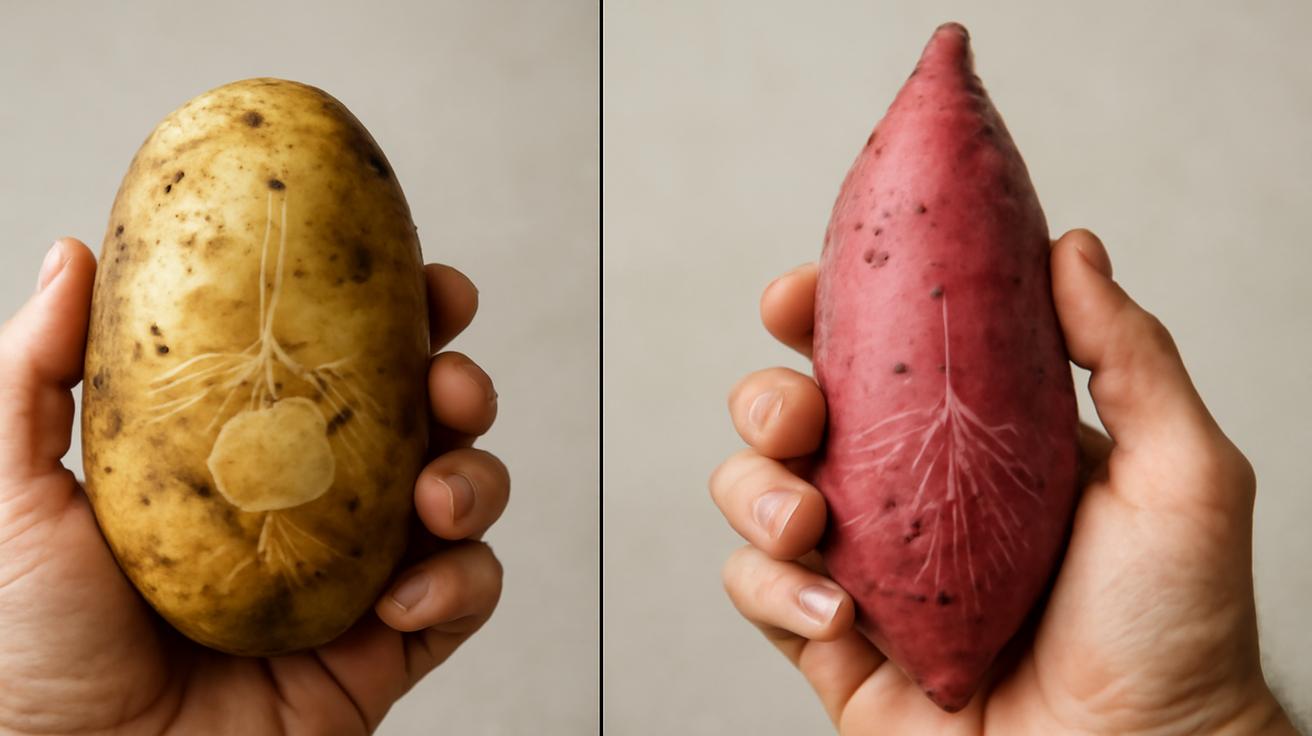
The first time I saw sweet potato vines in a friend’s backyard, I did a double take. The leaves were heart-shaped, almost ornamental, tumbling over the edge of a raised bed like ivy trying to escape. I remember kneeling down, brushing aside the soil, and finding a pale, knobby root—not orange, not yet. Somewhere in the back of my mind a thought flickered: this doesn’t look like the same thing as those russet potatoes rolling around in my pantry. It felt like I was meeting a distant cousin of a very familiar friend, someone who shared the same last name, but none of the facial features.
Two “Potatoes,” Two Different Families
In the grocery store, they sit side by side like siblings: big dusty russets, buttery Yukon Golds, jewel-toned sweet potatoes piled in nearby bins. We mash them, bake them, fry them, and talk about them as if they’re variations of the same thing—just “regular potatoes” and “sweet” ones.
But botanically speaking, that’s a bit like putting a dolphin and a goldfish in the same family because they both swim.
Regular potatoes—the kind that end up as fries, chips, and mashed potatoes at Thanksgiving—belong to the Solanaceae family, often called the nightshade family. Sweet potatoes come from a very different lineage: the Convolvulaceae family, which is the morning glory family. Yes, the flower you might see climbing a fence in summer is more closely related to sweet potatoes than any “normal” potato will ever be.
It’s an odd, almost disorienting truth. Two vegetables that we use in almost identical ways, sold in the same aisle, cooked in the same oven—yet, underneath, they carry completely different family trees. Literally.
One Grows with Flowers, the Other with Nightshades
If you’ve ever grown potatoes, you might have noticed their delicate star-shaped flowers and small green fruits that look eerily like cherry tomatoes. That’s because potatoes, tomatoes, peppers, and eggplants all share a family connection: they’re nightshades, and many of their wild relatives can be toxic. The potato we know today is a heavily domesticated, carefully tamed version of what once was a far more dangerous plant.
Sweet potatoes, on the other hand, grow like vines. Their relatives include morning glories—those trumpeting flowers that open with the sunrise. If you let sweet potato vines flower, you may get blooms that look like pale purple morning glories, a quiet little hint of their true identity.
So while your baked potato and your baked sweet potato may arrive at the table dressed alike in foil, with butter melting into their steaming centers, their lives in the soil are worlds apart.
Why They Taste So Different (Even When Cooked the Same Way)
On a cold evening, roast both in the oven and your kitchen will tell you their story before your taste buds do.
The regular potato sits on the sheet pan, skin wrinkling, flesh turning soft and fluffy. The smell is mild, earthy, a little nutty. It’s a quiet aroma, comforting in its simplicity. The sweet potato, though, changes as it roasts. Its aroma thickens, darkens, like caramel starting to stir in a hot pan. When you cut it open, a glossy sheen sometimes oozes out—a sugary sap that baked itself to the surface.
This isn’t just about flavor preference. It’s chemistry whispering in the background.
Starch Versus Sugar, Comfort Versus Dessert
Both types of potato are rich in carbohydrates, but they carry and handle them differently. Regular potatoes are mostly starch. When you cook them, those starch molecules swell and break apart, giving you that beloved fluffy or creamy texture. Sweet potatoes carry more natural sugars and a different mix of starches and fibers that break down into sweetness when heated.
That’s why a long-roasted sweet potato tastes almost like nature’s candy, especially when it caramelizes at the edges. It’s also why you can comfortably eat a plain baked sweet potato and feel like you’re eating dessert, while a plain baked russet begs for salt, butter, maybe sour cream.
Even though both are “potatoes” in name, they’ve evolved for different roles. One grew into a reliable, starchy staple. The other evolved as a sweeter, nutrient-packed root—a survival package in orange, purple, or white.
How Far Apart Are They, Really?
This is where the family tree becomes almost comical. Imagine a huge branching diagram of plant life. Somewhere along one branch, the nightshades split off, eventually giving us potatoes and their tomato relatives. Far, far away, on another branch, the morning glory family goes its own direction, ending up with those twisting vines and their tucked-away sweet roots.
They’re both flowering plants, yes. Both angiosperms. Both dicots. But botanically, that’s like saying two people are “both mammals.” True, but not exactly proof of a close relationship.
A Tale of Two Lineages
Here’s a simple way to think about it: regular potatoes are to tomatoes what sweet potatoes are to morning glories. They don’t share a recent common ancestor that was anything like a “potato” at all. Their similarities—both forming underground storage organs, both being rich in carbs—are an example of convergent evolution. Different plant families, facing similar environmental challenges, independently evolved a similar solution: stash energy underground where frost, fire, and hungry animals are less likely to destroy everything.
That’s why they look vaguely similar once harvested: knobby, earthy, humble shapes. But beneath the surface, from root structure to flower form to the chemicals they produce, they’re built on different blueprints.
| Feature | Regular Potato | Sweet Potato |
|---|---|---|
| Botanical Family | Solanaceae (nightshade) | Convolvulaceae (morning glory) |
| Closest Common Garden Relatives | Tomato, eggplant, pepper | Morning glory vines |
| Type of Edible Part | Tuber (swollen underground stem) | Storage root (thickened root) |
| Primary Carbohydrates | Starch, less natural sugar | Starch plus more natural sugars |
| Color Range | White, yellow, red, purple skins; white to yellow or purple flesh | Brown, red, or purple skins; orange, white, or purple flesh |
| Notable Compounds | Glycoalkaloids in leaves, sprouts, and green skin | Beta-carotene (especially in orange varieties) |
The Underground Architecture: Tuber vs. Root
It’s easy to think of both as “roots,” but that’s only half true.
When you slice a regular potato and look at the little dimples spotted across its surface, you’re looking at nodes—places a stem can grow from. A potato tuber is actually a swollen stem, storing energy along stems that happen to be tucked underground. Plant a chunk of it with an “eye,” and it sprouts because, structurally, it already is a stem.
Sweet potatoes, by contrast, are genuine roots. They don’t have eyes in the same way. They swell from roots that thickened over time, storing the sugar and starch the plant makes with its climbing, sun-seeking leaves. When sweet potatoes sprout, it’s often from tiny buds on the skin, but you can’t chop one up and expect every piece to grow a new plant the way you can with regular potatoes.
This difference in architecture explains some of their behavior in the kitchen, too. Potatoes hold their shape in a very particular way when boiled or fried; they can fall apart into fluffy chunks when overcooked because of the way their starch is organized. Sweet potatoes, being roots, often become creamy, velvety, even stringy in some varieties, with fibers that remind you that what you’re eating was once part of a living, feeding root system.
Why One Can Hurt You Long Before the Other
People sometimes worry about whether sweet potatoes are “nightshades.” They’re not. However, regular potatoes share the nightshade family’s habit of producing defensive chemicals—glycoalkaloids like solanine. When potatoes turn green from light exposure or sprout aggressively, those compounds can reach uncomfortable levels. We’re taught to cut away green spots, toss heavily sprouted tubers, and never, ever eat the leaves.
Sweet potatoes don’t follow that same rulebook. Their defenses are different, their weak spots different. They can certainly rot, spoil, or grow mold, but they don’t carry the same nightshade toxins in their structure. It’s another quiet reminder that, however similar they may look in your pantry basket, they are not cousins travelling under different names; they are near strangers from different worlds.
Travelers from Different Corners of the World
Walk through the history of human agriculture and you’ll find both kinds of “potato” turning up as staples—but in distinct cultures and landscapes.
Regular potatoes come from the high Andes of South America. People living at dramatic altitudes, in thin air and cool nights, gradually coaxed wild potatoes into the fat, edible tubers we recognize. They invented methods to freeze-dry them on mountain slopes, turning them into preserved food that could last through harsh seasons. From there, potatoes traveled across the Atlantic, transformed European diets, fueled population booms, and left deep marks on history—from the Irish potato famine to countless casserole dishes on modern tables.
Sweet potatoes likely originated in tropical or subtropical regions of the Americas, thriving in warmer, more humid climates. They made their own astonishing journey, crossing oceans and taking root in places like Polynesia long before European explorers arrived. By the time sweet potatoes reached parts of Asia and Africa, they were embraced as hardy, filling, and adaptable—a crop that could survive weather swings and poor soils.
Shared Roles, Separate Stories
What’s striking is that in many cultures, each became a sort of lifeline. Potatoes fortified cold climates; sweet potatoes nourished warmer ones. They stepped into the same role—reliable, storable, calorie-dense—but took different paths to get there. When you eat them side by side, you’re tasting two separate agricultural revolutions that just happen to end up on the same plate.
So Why Do We Call Them Both “Potatoes”?
Names are messy. They cling to what something feels like, how we use it, more than to what it truly is inside.
European colonizers meeting these crops for the first time didn’t have a neat taxonomy chart. They had comparison. “This thing is like that thing.” Sweet roots that behaved like the potatoes they already knew? Easy enough: call them “potatoes,” too—just sweet ones. Over centuries, that label stuck, embedding itself into recipes, menus, and even arguments at family dinners over which kind of “potato” belongs on the holiday table.
The name hides the deeper truth: “potato” is more of a culinary category than a botanical one. It’s a word we use for starchy underground things that roast well, mash well, and make us feel nourished. Nature, of course, is under no obligation to match our grocery store vocabulary.
Knowing the Difference Changes How You See Your Plate
Understanding that sweet potatoes and regular potatoes are distant relatives—if they’re relatives at all—does something subtle. Suddenly, your plate isn’t just “meat and potatoes” or “veggies and sides.” It’s a small museum of plant evolution. You can imagine one ingredient climbing up through the cool fog of the Andes, another winding its way like a vine through tropical heat, both eventually landing in your oven at 400°F.
Next time you hold a potato in one hand and a sweet potato in the other, you might feel that contrast more vividly. The slightly rough, matte skin of the russet; the smoother, often taut skin of the sweet potato. One feels like a stone; the other, more like a root that was recently alive. Different histories, different families, both showing up to dinner as if they were always meant to be served together.
Frequently Asked Questions
Are sweet potatoes and regular potatoes related at all?
They are only very distantly related. Both are flowering plants, but they belong to completely different botanical families. Regular potatoes are nightshades (Solanaceae), while sweet potatoes are in the morning glory family (Convolvulaceae).
Are sweet potatoes nightshades?
No. Sweet potatoes are not nightshades. They do not share the same family as tomatoes, eggplants, peppers, or regular potatoes, and they do not contain the same glycoalkaloid toxins that nightshades do.
Why do we call both of them “potatoes” if they’re so different?
The name is mostly historical and culinary. Early European explorers and settlers labeled new plants based on familiar ones. Sweet potatoes behaved like potatoes in the kitchen—starchy, filling, stored underground—so they were given a similar name, even though they were not close relatives.
Is the part we eat the root in both plants?
No. In regular potatoes, we eat a tuber, which is a swollen underground stem. In sweet potatoes, we eat a true storage root, which is a thickened root designed to store energy. They may look similar, but they grow from different plant structures.
Are sweet potatoes always healthier than regular potatoes?
“Healthier” depends on what you’re looking for. Sweet potatoes, especially orange ones, are rich in beta-carotene (a form of vitamin A) and tend to have more natural sugars and fiber. Regular potatoes are richer in certain minerals like potassium and can be very nutritious when prepared simply. Both can be part of a healthy diet; it’s preparation and portion that usually matter most.
Can I grow sweet potatoes and regular potatoes the same way?
They have different needs. Regular potatoes prefer cooler conditions and are usually grown from “seed potatoes” (pieces of tuber). Sweet potatoes are grown from “slips,” which are sprouts taken from a mature sweet potato, and they prefer warmer soil and a longer growing season. Their vines and growth habits in the garden are quite different.
Why do some sweet potatoes look and taste different from others?
There are many varieties of sweet potatoes, with skin and flesh that can be orange, white, yellow, or even purple. Each variety has a slightly different balance of starch, sugar, and fiber, which changes texture and sweetness. That’s why some bake up fluffy and sweet, while others are denser or milder in flavor.