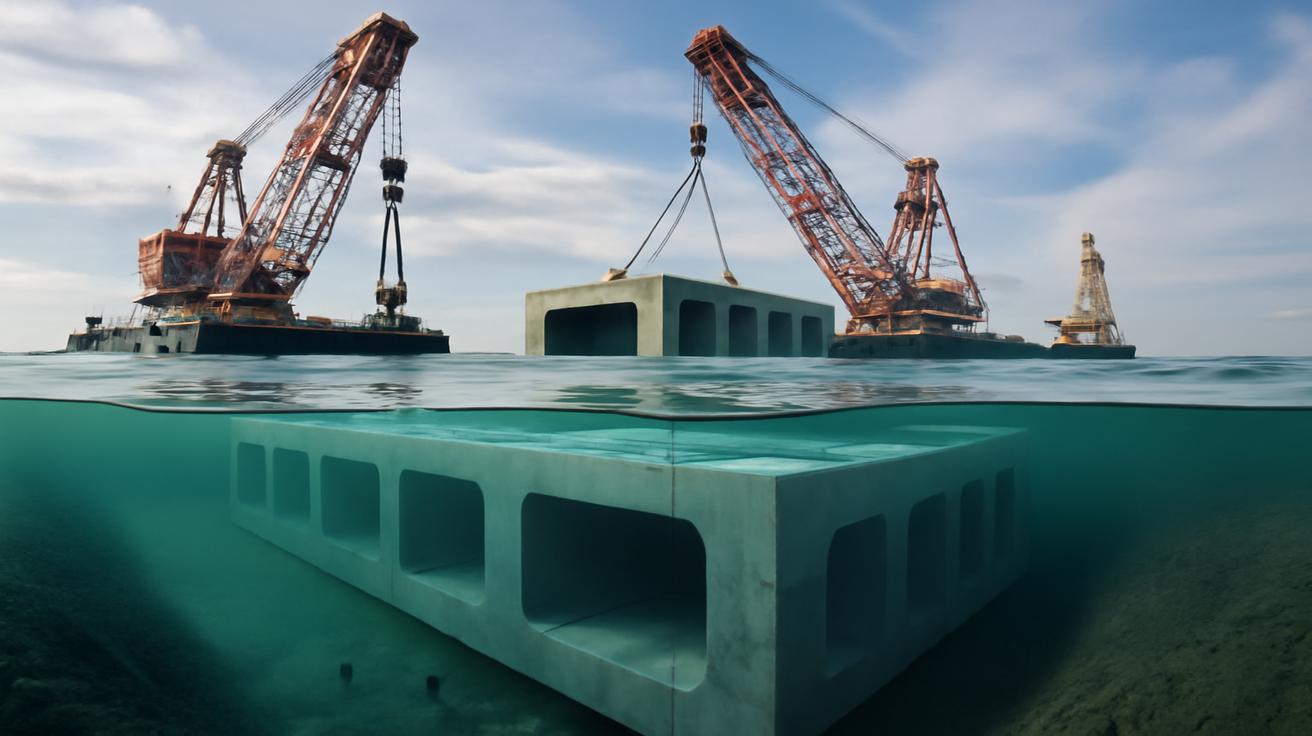
The sea is a strange place to carve a road. Nothing about water invites straight lines or steady ground, yet that’s exactly what a group of engineers are trying to draw beneath the Baltic Sea right now—a ruler-straight, 18-kilometer lifeline of concrete and steel known as the Fehmarnbelt tunnel. It will be the world’s longest immersed tunnel when it’s finished. But it’s not just the scale that has people talking. It’s the method. The way this tunnel is being built has split the engineering world into something close to rival camps, each convinced they know the right way to break the sea.
The Quiet War Under the Waves
Stand on the windy shore of Rødbyhavn in Denmark on a winter morning and the scene is deceptively ordinary. The Baltic lies steel-grey and flat, like a patient that has finally stopped resisting the surgeon. Seagulls wheel overhead. Ferry horns sound in the distance. There’s no heroic arch of bridge rising against the sky, no gothic towers spearing the clouds. Just low, temporary buildings, the hum of machinery, and—if you know where to look—a long scar etched into the seabed, a trench waiting for something unprecedented to be laid inside it.
This is where the Fehmarnbelt tunnel is being assembled, piece by leviathan piece. Not drilled through rock like a classic tunnel. Not hung in the air like a suspension bridge. Instead, entire sections of tunnel are being built on land, floated out onto the sea, and then gently sunk into a prepared trench. It’s called an “immersed tunnel,” and it’s the kind of method that reads like science fiction until you see the engineering drawings.
And that’s where the trouble begins. Because while immersed tunnels have been used before—think the Øresund connection between Denmark and Sweden, or the tunnel under the Bosphorus in Istanbul—Fehmarnbelt pushes the method so far that the old rules begin to wobble. Some engineers praise it as a masterstroke of efficiency; others mutter that it’s a dangerous overreach of a technique better suited for shorter, shallower crossings.
The Anatomy of a Giant
On paper, the basic idea sounds almost simple. Instead of drilling under the seabed for years, you build huge concrete tunnel elements in a dry dock onshore. Each piece is like a hollow, rectangular ship, stuffed with roadway and railway space, sealed with temporary bulkheads at each end. When an element is ready, you flood the dock, float the massive block out, tug it into position out at sea, and then carefully sink it into a pre-dug trench. Once each piece is aligned and connected, the joints are sealed, the water is pumped out, and the inside becomes a dry, continuous tunnel. Then you bury the whole thing under layers of sand, gravel, and rock, and the sea forgets you were ever there.
The numbers, though, tell a more awe-inspiring story. At roughly 18 kilometers, Fehmarnbelt will outstretch every other immersed tunnel on the planet. Its concrete elements weigh tens of thousands of tons each. Some of them are “standard” sections, repeating like vertebrae in a spine; others are special, cavernous boxes with extra space for technical equipment and emergency systems.
The construction site itself feels like a strange coastal shipyard that builds vessels that never sail. Cranes trace lazy arcs in the sky. Giant steel molds wait like open mouths to be filled with concrete. Workers in bright jackets—ant-sized against the backdrop of cured segments—move along scaffolding. There’s the smell of wet cement, diesel fumes, and salt air, all mixed into an oddly industrial kind of sea breeze.
Everything about this kind of project is choreography. The elements must be cast with almost surgical precision; if they are even a little warped, the joints between them will leak. The trench in the seabed must be cut to the right depth and width, its bottom carefully leveled. And when the time comes, the sea itself must be tamed—currents studied, weather patterns tracked—so that the process of floating, positioning, and submerging these enormous blocks can unfold without tragedy.
Why Immersed—and Not Bored or Bridged?
That’s the question quietly fueling the debate. The Fehmarnbelt could, in theory, have been crossed with a bored tunnel—one drilled deep beneath the seabed with tunnel boring machines, like the Channel Tunnel between England and France. Or a colossal bridge, vaulting across the water in a series of sweeping spans, could have been designed to carry road and rail traffic.
Each camp has its loyalists. Tunnel drillers argue that bored tunnels handle geology better and avoid many of the technical complications at the seabed. Bridge designers point to the elegance and ease of inspection of structures that stand in the open air. Immersed tunnel proponents counter with construction speed, operational safety, and a geometry that works well for combined road-and-rail corridors at relatively shallow depths.
The Fehmarnbelt strait sits in that awkward middle ground. It’s not as shallow as a simple causeway, nor as deep as some oceanic trenches. The seabed geology is a mess of layers—glacial deposits, soft sediments, and stiff clays. Weather is harsh but not extreme. And there’s another constraint that doesn’t show up in the engineering drawings but lurks in every political meeting: time.
Immersed tunneling, when it works smoothly, is fast. You can build multiple elements at once on land, away from storms and swells. While one team digs the seabed trench, another team pours concrete and installs equipment in a sheltered basin. A bored tunnel, in contrast, proceeds relentlessly but slowly from a limited number of access points. If something goes wrong deep underground, recovery is complicated and costly.
Below is a simplified comparison that’s often tossed around in discussions, though every project, of course, breaks the rules a bit:
| Method | Typical Use | Key Benefits | Main Challenges |
|---|---|---|---|
| Immersed Tunnel | Shallow water crossings, up to medium lengths | Fast construction, good quality control on land, direct alignment | Complex seabed works, sealing joints, marine ecology impacts |
| Bored Tunnel | Deep crossings under water or cities | Less seabed disturbance, minimal surface impact | Slower, high risk if ground conditions vary, difficult emergency access |
| Bridge | Shallower, shorter crossings with navigational clearance | Easier inspection, iconic architecture, no underwater works | Visual impact, wind and weather exposure, shipping constraints |
Engineers in the Crossfire
Inside meeting rooms, the conversation is less romantic and more tense. On one side of the table sit engineers who have built immersed tunnels before and see Fehmarnbelt as an incremental leap—a big one, yes, but within the same language. On the other sits a quieter but persistent group warning that scale is not just a number. Scale changes everything.
They point to the sheer length of the crossing: the more joints you have between elements, the more potential weak points you create. They worry about settlement—the way the seabed might slowly sink or shift under the tunnel’s enormous weight. They talk about climate change, about rising sea levels, stronger storms, and unpredictable wave patterns. Is it wise, they ask, to build a record-breaking submerged structure at a time when the seas themselves are becoming less predictable?
There are also concerns about maintenance and inspection. A bridge wears its wounds in public: a rusty cable, a cracked joint, a sagging span. An immersed tunnel hides its secrets under water and rock. Sensors can be embedded, of course. Regular inspections can be performed from the inside. But if something goes wrong with the exterior shell—if erosion exposes part of the structure, or a ship anchor scrapes the protective layer—it’s much harder to see, and even harder to fix in rough seas.
Supporters of the immersed approach are not naïve to these risks. In their view, though, the method offers a more controlled environment in which to confront them. Casting elements in a factory-like setting means better quality control than concrete poured in cramped underground chambers. Standardized design elements simplify analysis and monitoring. And the shallow depth of the crossing, compared to a bored tunnel, offers shorter evacuation routes and more straightforward emergency response.
The disagreement isn’t just technical. It’s philosophical. Is it better to go deep and hide from the sea, or to lie close under its skin and try to manage the relationship? For now, the immersed-tunnel camp has won the argument for Fehmarnbelt. But the debate hasn’t gone away; it just follows the project like a second, invisible shadow.
The Sea, the Sand, and the Silence
Step away from the spreadsheets and into a survey boat above the trench, and the tunnel feels less like a machine and more like an intrusion. The water here often looks calm, but the seabed tells a different story. Dredging vessels have scooped out a precise, grave-like channel: a cut through layers that took the ice ages millennia to lay down. Suspended sediment turns the water milky. Sonar images show a geometry nature never intended.
Environmentalists have been some of the loudest critics of the project’s construction method—not because immersed tunnels are inherently worse than bored ones, but because the way they are built directly disturbs the seabed over a long, linear footprint. Every bucket of dredged sand and clay releases trapped nutrients and pollutants; every noise from pile-driving and heavy machinery ripples through the water column, startling fish and marine mammals.
To its credit, the project has wrapped itself in environmental monitoring. There are sensors tracking turbidity—the cloudiness of the water—so dredging can pause if thresholds are exceeded. There are seasonal windows meant to protect spawning fish and migrating birds. There are offset measures: restored habitats, artificial reefs, and careful placement of protective rock layers intended to become, over time, new underwater ecosystems.
Yet even the best mitigation is still, at its core, a response to a harm already decided. The sea will be changed. Species will adapt, move, or vanish. Benthos—those small, often overlooked organisms living on or in the seabed—will see their world scrambled and reassembled. For some, the thought of an invisible tunnel under the waves is comforting; for others, it’s a reminder that even where we can’t see concrete, it’s there.
Time, Distance, and the Human Thread
When you step back from blueprints and policy briefs, the Fehmarnbelt tunnel is also just this: a promise to make two coasts feel less far apart. It will cut travel time between Copenhagen and Hamburg by hours. Freight that once lumbered along circuitous rail routes or waited on ferries will shoot under the sea in a matter of minutes. Families will visit more easily. Commerce will flow more smoothly. The abstract lines on a European map—corridors and axes, networks and nodes—will harden into something you can drive through at 110 km/h.
Inside the finished tunnel, travelers won’t see its controversies. They’ll see asphalt and rails, safety lights, emergency exits. They’ll hear the hum of engines, the muffled roar of wheels—maybe the soft echo of a train on the parallel track. The walls will be anonymous concrete, the air filtered and dry. Somewhere beyond those walls, just meters away, cold seawater will press against steel and stone with quiet, relentless weight.
For most people, that’s enough. It works, or it doesn’t. It feels safe, or it doesn’t. The method? The arguments in distant conference rooms? Those will vanish into the background hum of modern infrastructure, like the plumbing in a high-rise or the fiber-optic cables beneath a city street.
But for the engineers, planners, and environmental scientists wrapped up in this project, the choice of method isn’t just a line item. It’s a statement about how we see ourselves in relation to the landscapes—and seascapes—we cross. It’s a wager on which risks we decide we can handle, and which we place in the “too difficult” box.
What This Tunnel Says About Us
In one sense, the world’s largest immersed tunnel is an act of staggering confidence. It insists that we understand the behavior of water, soil, and concrete well enough to stitch them together into a structure that must hold, decade after decade, under pressures both physical and political. It assumes we can predict, to a usable degree, the storms that will batter the Baltic and the ships that will crisscross above this buried artery.
In another sense, it’s a monument to our restlessness. The sea has always been both barrier and invitation. We’ve responded with rafts, sails, steamships, steel hulls, suspension bridges, drilling rigs. Now we add to that catalogue a new species of structure: long, silent, and hidden. Not a bridge to admire at sunset, but a vacancy in the map of obstacles—a piece of ocean floor that, in a few years, will be as unremarkable in everyday conversation as any highway over a river.
Yet the arguments tearing at the engineering community hint at a deeper uncertainty. We are building bigger, faster, and more intrusively at a time when our environmental and climatic foundations feel less stable than ever. The question is no longer “Can we?” but “Should we, and how carefully?” For every engineer excited by what the Fehmarnbelt tunnel proves is possible, there is another wondering what it will mean to maintain—literally and figuratively—such a commitment beneath a changing sea.
One day, perhaps, a traveler will doze off in a train crossing this tunnel, lulled by the darkness and motion. Outside, the Baltic will press down, indifferent. Above, wind will sweep across the same quiet shoreline where, years earlier, concrete giants were floated out and slowly allowed to sink, carefully, deliberately, into a man-made wound in the seabed. The arguments will have settled. The tunnel will simply be there, humming along beneath the waves, a product of all those late-night calculations and heated debates.
Until the next project comes along—deeper, longer, more ambitious—and the whole argument begins again.
Frequently Asked Questions
What is an immersed tunnel?
An immersed tunnel is built from large prefabricated sections made on land, floated out to their final position in the water, and then sunk into a dredged trench on the seabed. The sections are joined, sealed, and buried, creating a continuous tunnel under the water.
How is an immersed tunnel different from a bored tunnel?
A bored tunnel is excavated deep underground using tunnel boring machines or drilling and blasting. An immersed tunnel, by contrast, is assembled from pre-built elements placed in a trench at relatively shallow depth. Bored tunnels disturb less of the seabed but take longer and are harder to access for construction and rescue.
Why did engineers choose the immersed tunnel method for Fehmarnbelt?
Engineers considered factors like water depth, seabed geology, construction time, environmental impact, and cost. The immersed method allows parallel construction of tunnel elements on land, offers a direct alignment for both road and rail, and avoids very deep underground works, which would have been required for a bored tunnel.
What are the main risks of building such a long immersed tunnel?
Key risks include ensuring watertight joints between many tunnel elements, controlling seabed settlement, protecting the structure from erosion and ship impacts, and managing environmental disturbance during dredging and immersion. Long-term inspection and maintenance of the submerged structure also pose challenges.
How does the construction affect marine life?
Construction can increase water turbidity, generate underwater noise, and disturb habitats on the seabed. Projects typically use monitoring, seasonal work windows, and restoration or compensation measures to limit and offset impacts, but some changes to local marine ecosystems are inevitable.
Will travelers notice anything special when using the Fehmarnbelt tunnel?
From a traveler’s perspective, it will feel like a modern road and rail tunnel: lighting, ventilation, emergency exits, and normal traffic noise. The fact that it is an immersed tunnel under the sea, rather than a bored tunnel or bridge, will not be obvious from inside.
Why is this project so controversial among engineers?
The controversy stems from pushing the immersed-tunnel method to an unprecedented length and scale, in a changing marine environment. Some engineers see it as a bold but logical extension of proven techniques; others worry that the scale amplifies risks related to durability, climate change, and maintenance beneath a busy shipping lane.