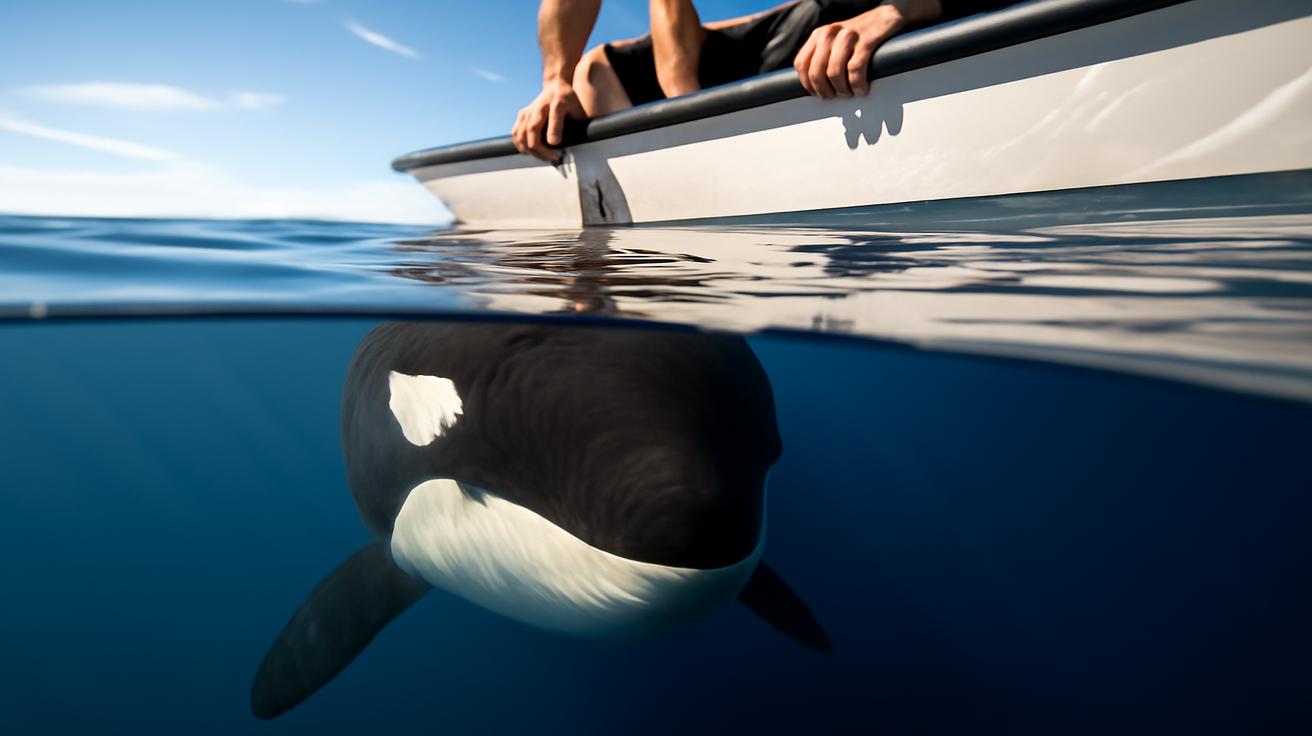
The first thing you notice is the sound—or rather, the sudden absence of it. One moment, the sea is a soft hiss against the hull, a low thrum of engine and wind. The next, it’s as if the entire ocean has paused to listen. Out of the glossy chop, a black fin as tall as a doorway rises with a quiet authority that steals the words from every mouth on board. An orca. Then another. Then more, slicing around the vessel in crescents of white foam, their wet backs catching the light like liquid obsidian. Somewhere out here, just off a popular sailing route, the rules of engagement between humans and these apex predators have started to change—and not in ways anyone fully understands.
A New Story on the Water
For decades, orcas have been the glittering icons of the ocean, framed in coffee table books, documentaries, and postcards. We’ve called them “killer whales,” then tried to soften it with “orcas,” as if renaming might rewrite the relationship. We’ve followed pods with hydrophones, matched individual fins with photo-ID catalogs, and recorded their distinctive dialects like treasured songs in a growing marine archive.
But in recent years, especially in certain parts of the world, a different kind of story has started to surface—one that feels less like a calm nature documentary and more like an unfolding mystery. Marine biologists are now warning of a troubling shift in how some orcas are interacting with vessels. Not merely approaching, not just swimming alongside, but actively engaging with rudders, hulls, and keels—sometimes damaging boats so badly that they need to be towed back to port, and in rare cases, are left to drift and sink.
These incidents are not uniform and not yet fully understood, but the pattern is strong enough to ignite urgent conversations in labs and marinas alike. Are the whales playing? Teaching? Warning? Or is this something darker—a response to stressors we’ve yet to fully grasp?
The Strange Dance Around the Rudder
Picture yourself at the helm of a sailboat on a cloudless afternoon. The sea is a translucent green, sunlight feathering through the waves. A sudden jolt rips through the wheel, so sharp you gasp and grab for balance. The boat shudders. Another impact, this time a heavy push from below that feels like driving over a submerged rock. Only, this rock moves.
Soon you see them: a tight group of orcas, surfacing in short, deliberate arcs, their breath a forceful whoosh that smells faintly of fish and cold iron. They’re not just passing through. They seem focused, purposeful, drawn to the stern. One slips underneath, and you feel the rudder grind and complain as if seized by an invisible hand.
Sailors describe these encounters with a mix of awe and terror. The whales aren’t ramming the side of the boat in frenzied aggression; they’re concentrating on the parts that control movement—the rudder, the keel, the steering systems. Sometimes they push the rudder side to side, like testing a hinge. Sometimes they bite or ram at it directly. In a few cases, they’ve broken it clean off.
From a distance, it can almost look like play, the orcas rolling and circling, calves mimicking adults, white patches flashing just below the surface. But for those on board, watching the steering fail as the shoreline drifts uncomfortably far away, it feels more like being caught in a game whose rules no human helped write.
What the Science Is (and Isn’t) Saying
Walk into a marine biology lab tracking these events and you’ll find walls lined with maps, each pin a dot marking another vessel encounter. Time, location, type of vessel, damage, behavior notes: all logged in patient, meticulous script. Scientists are careful with their words—they have to be. The ocean resists simple explanations, and orcas, with their intricate societies and cultures, resist them even more.
There are a few things most researchers agree on. First, these behaviors appear to be highly localized, specific to certain populations or pods rather than a global orca trend. Second, the patterns suggest social learning: a few individuals begin interacting with vessels in a certain way, and the behavior spreads, especially among younger whales who learn by watching older pod members.
Third, and perhaps most unsettling, the whales appear to be extremely focused on control. Steering. Direction. When they damage a rudder or disable a propeller, the boat can no longer choose where to go. Whether the whales understand this exactly as we do is unknown—but it’s hard to ignore the consistent targeting of that critical piece of hardware.
Beyond that, the theories fracture into uneasy possibilities. Some scientists suspect the behavior began as curiosity or play—a powerful animal discovering that a small push in just the right place can alter the path of a large, noisy intruder. Others suggest it may be rooted in a negative encounter: a ship collision, noise trauma, or an injured whale associating pain with the deep, mechanical heartbeat of boats. In socially complex animals, one traumatic event can echo across generations.
The Role of Culture Underwater
Orcas are not just animals; they are carriers of culture. Different pods have distinct hunting techniques, dialects, even preferences for specific prey. They pass down behaviors like heirlooms. In some regions, orcas have been seen wearing dead salmon on their heads like strange, aquatic hats—a behavior that swept through a population for a season and then faded, much like a passing fashion trend.
Researchers are now asking: is targeting boat rudders a cultural fad, a phase that might eventually fade? Or is it becoming a stable tradition, embedded in pod identity—a new chapter in the long story of how orcas navigate a human-dominated ocean?
The stakes of that question are very real. Cultural behaviors in orcas can persist for decades, even centuries. If this particular behavior is reinforced—consciously or not—it could fundamentally reshape how we travel through their territory and how safe both whales and humans will be in those shared waters.
How Boats Look, Sound, and Feel to an Orca
Step out of your human body for a moment and slip into the black-and-white skin of an orca. Vision still matters, but it’s sound that paints your world. Every click you send out ricochets off the seafloor, fish, kelp forests, and yes, the smooth, unnatural planes of a boat hull. In those echoes, a vessel is not just a shape; it’s a sprawling set of reflections, hollow cavities, rotating props, and metallic bones.
To an orca’s finely tuned sonar, a rudder is a fascinating anatomical quirk of this clumsy, hard-shelled creature. It moves. It directs. Its angle changes the geometry of the wake. The deep churn of an engine, the rhythmic pulse of the propeller, the sharp clack when the rudder hits its limit—all of it is sensory data, information that begs to be explored.
Humans often assume that wild animals will either flee from us or ignore us. Orcas rarely fit into those simple boxes. Curiosity is woven into their daily lives. They investigate floating logs, ice, seabirds, and occasionally, the odd human creation drifting through their range. For a species that learns socially and solves complex problems, a boat is less an obstacle and more a puzzle.
But even puzzles can have a darker edge. Our vessels bring more than novelty: they bring noise, chemical pollution, and the constant risk of collision. In busy shipping lanes, whale calls and echolocation clicks have to compete with the low, unrelenting roar of engines. There is mounting evidence that chronic noise can alter feeding success, communication, and stress levels in whales. Against that backdrop, the spectacle of orcas taking control of a boat’s steering might be read not just as play, but as a kind of pushback against an ever-louder sea.
| Aspect | What Humans Experience | What Orcas May Perceive |
|---|---|---|
| Sound | Engine hum, water against hull, occasional thuds | Complex acoustic landscape of engine tones, prop pulses, hull echoes |
| Movement | Smooth forward motion, turning via wheel or tiller | A large “animal-like” object whose direction changes when the rudder shifts |
| Rudder | Hidden mechanical control beneath the surface | A movable appendage that responds immediately to physical force |
| Boat Hull | Protective shell for people and gear | Large reflective surface altering echoes, wake, and local hydrodynamics |
Fear, Fascination, and Responsibility at Sea
The human response to these shifting interactions is mixed, sometimes contradictory. There’s a visceral thrill in being close to wild orcas, in hearing their breath and seeing their eyes briefly break the surface. For many, it’s a life-defining moment. But layer that wonder with the gut-deep fear of losing control of your vessel, of hearing fiberglass crack or feeling the wheel go slack, and it becomes something more complicated.
Some sailors talk about these encounters in hushed, reverent tones, as if they’ve brushed against an alien intelligence. Others speak with raw frustration and anger, their boats damaged, their families shaken, their sense of safety at sea fundamentally altered. Amid the tangle of stories, one uncomfortable truth emerges: when the relationship between a powerful wild animal and a human-built machine shifts, we are rarely in charge of the outcome.
Marine biologists are quick to emphasize that reacting with fear or retaliation would be disastrous—for both sides. Orcas are already facing immense pressure from dwindling prey, climate change, industrial noise, and pollution. To cast them suddenly as villains in a simplified narrative of “boat-attacking whales” risks justifying responses that could harm populations already under strain.
Instead, scientists and conservation groups are calling for a different approach: one built on adaptation, not domination. That might mean altering routes during certain times of year, slowing vessel speeds in sensitive areas, or redesigning rudders and steering components to be less vulnerable or less interesting to whales. It may also require something more subtle and difficult: a cultural shift in how we see our entitlement to move through every corner of the sea, unchallenged and uninterrupted.
What Sailors and Boaters Are Being Asked to Do
Guidelines are beginning to circulate through yacht clubs, sailing schools, and harbor master offices—pragmatic, quietly urgent instructions for sharing water with animals capable of outswimming, outmaneuvering, and outthinking us.
They often echo the same basic principles:
- Slow down in known orca hotspots to reduce noise and collision risk.
- Avoid sudden changes in speed or direction when whales are near; erratic movement can trigger curiosity or heightened attention.
- Refrain from trying to “interact,” feed, or lure whales closer for a better look or photo.
- If orcas begin to focus on the rudder, safely reduce speed, place the engine in neutral when possible, and avoid panicked maneuvers.
- Report encounters to local marine authorities or research groups so scientists can better track patterns.
None of these measures promise absolute safety. The ocean resists guarantees. But they represent an emerging acknowledgment that our presence has weight—and that with presence comes responsibility. To be at sea is to be a guest in a domain where we are not, and never have been, the apex species.
Listening to the Whales—and to Ourselves
In the end, this troubling shift in orca–vessel interactions might be less about “attacks” and more about communication, however unintentional. Something is being expressed in the way these whales now meet our boats: curiosity, yes, but also perhaps frustration, experimentation, and a testing of boundaries in a changing ocean.
Standing on a deck with the wind clawing at your jacket and the sun bouncing hard off the water, it’s tempting to seek a simple story. The orcas are angry. The orcas are playful. The orcas are teaching their young to hate us. The orcas are just bored. But real ecosystems—and real relationships between species—are rarely that clean.
Instead, we might try holding two truths at once: that orcas are capable of both gentle investigation and destructive power; and that humans, too, hold a double-edged influence over the ocean—capable of immense harm, but also of restraint, adaptation, and care.
There’s a quiet humility in admitting that we don’t yet understand these behaviors fully. It means giving space for mystery, for the possibility that a being with a brain larger than ours and a lifespan measured in human generations might have inner lives and social dynamics we can’t easily map onto our own. Yet humility doesn’t mean inaction. It means listening harder, changing course when necessary, and leaving room for a future in which coexisting with another intelligent species requires not dominance, but negotiation.
For now, the orcas will keep surfacing, their dorsal fins cutting through sun and spray like dark sails. Boats will keep tracing white lines across blue maps. At the intersection of those paths, in the trembling space where a rudder shudders under a whale’s push, a new chapter of our shared story is being written—one jolt, one breath, one choice at a time.
Frequently Asked Questions
Are orcas really attacking boats on purpose?
Marine biologists avoid the word “attack” because it suggests clear intent that we can’t confirm. What we know is that some orcas are deliberately interacting with specific parts of boats, especially rudders. The behavior appears focused and repeated, but whether it stems from play, curiosity, trauma, or a mix of factors is still under study.
Is this happening everywhere or only in certain regions?
The concerning interactions with rudders and hulls are highly localized to specific orca populations and regions, rather than a global trend. That’s part of why scientists think social learning and culture within pods play a big role in how the behavior spreads.
Are humans in serious danger during these encounters?
Most incidents result in damage to boats rather than injury to people, but there is genuine risk. A disabled or sinking vessel, especially far from shore, can quickly become a life-threatening situation. That’s why authorities emphasize prevention, preparedness, and reporting.
Could these behaviors be a response to human impact on the ocean?
It’s possible. Orcas are exposed to growing noise, reduced prey, pollution, and vessel traffic. A negative encounter—such as a collision or intense acoustic disturbance—may have helped trigger these behaviors in some pods. However, linking specific causes to the current patterns requires more data.
What should I do if orcas approach my boat?
Stay calm, reduce speed, avoid sudden movements, and do not attempt to chase or interact with the whales. If they focus on your rudder, shifting to neutral when safe and minimizing steering movements can sometimes reduce their interest. Afterward, report the encounter to local marine authorities or research groups to assist ongoing studies.