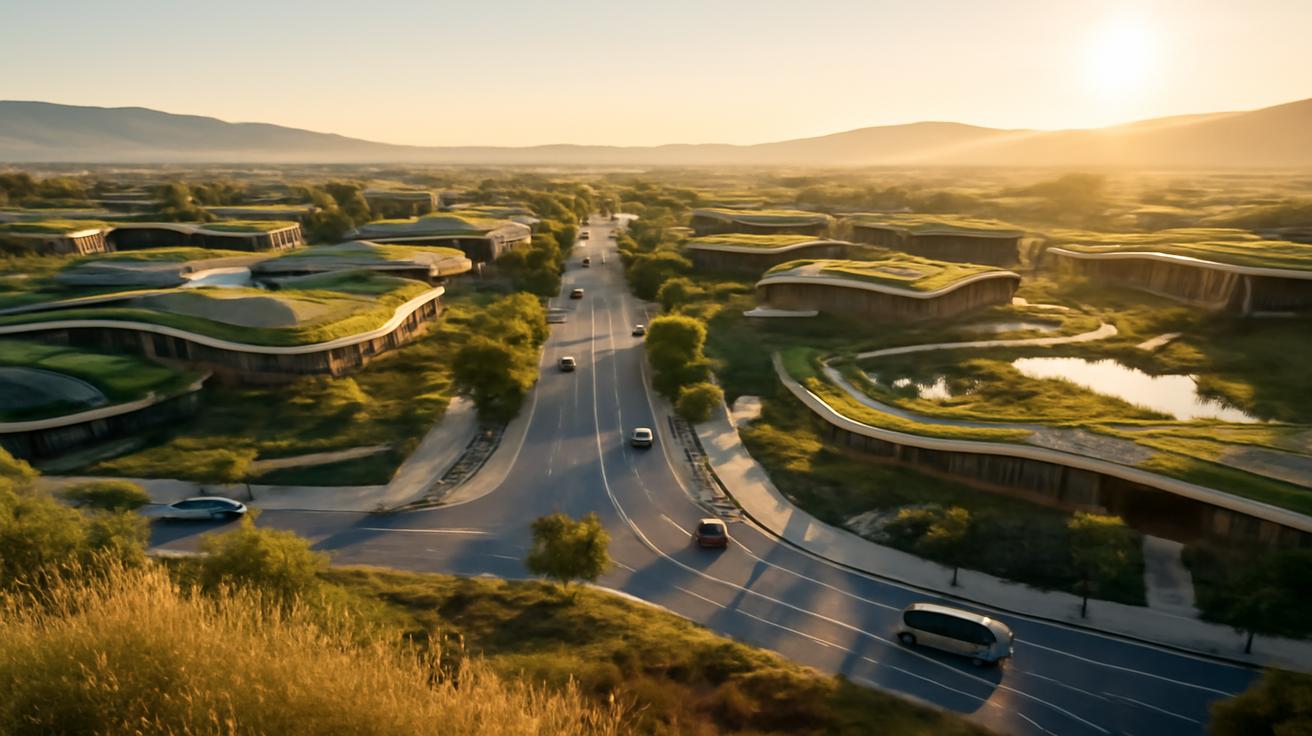
The first time you hear the phrase “a brand-new 400,000-resident city,” your instinct is to laugh a little. It sounds like a movie pitch, or the sketch of a utopia on the back of a napkin. But out in the quiet, wind-swept fields of Solano County, California—between the clamor of the Bay Area and the quiet order of farmland—a group of investors, planners, and former government insiders are trying to make that napkin sketch real. They call it Solano Foundry, a proposed city that some say could one day outshine even Silicon Valley in its ambition.
A City That Starts With a Question
Stand on one of those Solano hills at dusk and you can see why this empty space tempts dreamers. The sky turns shades of apricot and deep slate blue. Far off, traffic on the interstate low-roars like the ocean. A tractor hums somewhere unseen. The wind smells faintly of dry grass and soil. It feels like a place waiting for a story.
Solano Foundry begins, more than anything, with a question: What if you could start over?
Not “start over” in the way tech founders usually mean it, as in “disrupt an industry.” This is more radical: wipe the planning slate clean. Reimagine housing, transit, jobs, schools, water, and energy all at once, instead of layering fixes on top of mistakes made in the 1950s and 1960s. If the United States could design a new city from the ground up in the 2020s, drawn with everything we’ve learned about climate, equity, and technology, what might it look like?
The people behind Solano Foundry believe their answer is a high-density, mixed-income, transit-first city for 400,000 people—built largely on privately assembled land, pitched as a kind of living laboratory for the next era of American urban life.
The Land Between Two Worlds
To understand the proposal, you have to understand the place. Solano County stretches between the forest of office towers in San Francisco and Sacramento’s marble and glass political core. It has always been a kind of in-between space. Fields of alfalfa, orchards, and pastures sit under the same sun that reflects off Bay Area glass facades, but life runs at a different speed here. Tractors outnumber Teslas. Grain silos tower higher than most office buildings.
Over the past decade, a company backed by influential Silicon Valley investors quietly began buying this land plot by plot—tens of thousands of acres—raising eyebrows and speculation. Was it a data center? A secret military project? A billionaire bunker? The truth is both simpler and wilder: they want to build a new city from scratch, a place they hope will be as economically potent as Silicon Valley but physically and socially designed for a future that Silicon Valley itself did not plan for.
Solano Foundry, as a name, nods to the old industrial foundries that shaped metal and machinery. But here the raw material isn’t steel; it’s landscape and policy, code and culture. The plan imagines a place where an agricultural valley folds into an innovation hub without sacrificing the soil beneath it—a new American city rising from a patchwork of ranches and wheat fields.
From Asphalt Nightmares to Intentional Streets
Most American cities grew like spilled paint. Streets were extended, widened, reconfigured, and then choked with cars and parking lots. Housing sprawled outward, jobs clustered in strange pockets, and transit—if it arrived at all—usually came late. Solano Foundry’s biggest selling point is that it claims it will not repeat these mistakes.
Picture, instead, a city designed backwards from the daily life of a resident. You wake up in a mid-rise apartment where cross-ventilation and thick insulation keep the temperature comfortable without blasting air conditioning. You walk downstairs and across a shaded plaza to a daycare or school, passing by a bakery and a co-working space. The street smells like coffee and fresh bread rather than exhaust.
Instead of a six-lane arterial road at your doorstep, there’s a narrow, tree-lined street where buses glide by on dedicated lanes and bikes outnumber SUVs. Ground floors are alive with small businesses, not just glassy lobbies or parking garages. Instead of cul-de-sacs curling into the distance, you have a deliberate network of short blocks designed for feet, bikes, and electric shuttles first—and only then for cars.
This is the core promise: a different kind of urban fabric. Solano Foundry’s planners talk about “15-minute living”—the idea that most of what you need day-to-day should be reachable within a quarter of an hour by foot, bike, or transit. It’s not a brand-new idea in urbanism circles, but what makes it remarkable here is the scale: 400,000 people, all woven into neighborhoods where the default mode of movement is not a private car.
The Numbers Behind the Dream
Ambition, however, has to live with arithmetic. A city of this size requires not only imagination but physical and political infrastructure. Schools, hospitals, water lines, power grids, waste systems, parks, roads, and transit must be built in a coordinated choreography. It means decades of construction, billions in investment, and a governance structure that doesn’t just work in theory.
| Aspect | Solano Foundry (Proposed) | Traditional U.S. City Growth |
|---|---|---|
| Population Goal | Approx. 400,000 residents | Slow, incremental over decades |
| Planning Approach | Comprehensive, built from scratch | Patchwork zoning and retrofits |
| Transit | Transit-first, walkable design | Car-centric streets and highways |
| Housing | Mixed-income, higher density | Suburban sprawl, rising prices |
| Energy & Climate | Clean energy, climate adaptation from day one | Retrofitted systems, aging grids |
On paper, the math is enticing. If you can lock in density, transit, and sustainable infrastructure at the beginning, you avoid costly retrofits later. If you can set aside land for parks and green corridors before the first foundation is poured, you can literally embed nature into the map. And if you can plan for floods, fires, and drought, you can give future residents a buffer against a harsher climate.
More Ambitious Than Silicon Valley?
Silicon Valley is not a city—it’s a sprawl of suburbs, office parks, and freeways stitched into a myth. What made it powerful was not its buildings but its belief system: that technology could move faster than tradition, that risk was fuel, that tomorrow’s tools could be built in someone’s garage.
Calling Solano Foundry “more ambitious than Silicon Valley” sounds like marketing bravado, but in some ways it’s accurate. The Valley tried to change the world from within a familiar landscape of ranch houses and cul-de-sacs. Solano Foundry wants to change the landscape itself.
Its backers talk about the city as a “foundry for ideas,” a place where climate tech, new materials, advanced manufacturing, and AI-driven services can live right next door to the fields and waters they’re supposed to protect. Imagine a startup working on low-water agriculture tools opening its office a few hundred yards from actual active farmland. Or a company building grid-scale batteries testing prototypes inside a city that depends on them day to day.
It’s a vision of innovation that’s less about smartphone apps and more about physical systems: buildings that pull their own weight energetically, streets that harvest and filter rainwater, transit that’s as reliable as electricity. In this framing, Solano Foundry is Silicon Valley’s sequel: less “move fast and break things,” more “move deliberately and build things that last.”
The Emotional Economics of a New City
Yet there’s another, quieter kind of ambition at work—the emotional pull of a clean start. For many Americans, the cities we live in feel like compromises. Too expensive. Too car-choked. Too segregated. Too vulnerable to fire, flood, or heat. The promise of a brand-new place presses on a soft bruise: what if our parents’ and grandparents’ planning mistakes did not have to be ours?
Solano Foundry markets not just square footage but a feeling: safety without sterility, density without claustrophobia, technology without coldness. It asks you to imagine children walking to school on safe, shaded paths; grandparents sitting in parks that are a stroll away, not a 40-minute drive; neighbors who actually cross paths because the city design nudges them into shared spaces instead of isolating them in big-box parking lots.
Frictions in the Field
Of course, the story doesn’t unfold on a blank canvas. Those windswept hills are not empty—legally, culturally, or historically. Farmers whose families have worked Solano soil for generations are understandably wary of glossy renderings that replace pastures with plazas. Local residents ask whether this is a solution to their housing and jobs needs, or a playground for outsiders with deep pockets. County officials fret about traffic, water, and who pays for what.
Every bold plan runs into friction, and Solano Foundry is no exception. Rural infrastructure was never meant to carry the weight of a new metropolis. California’s water politics are notoriously tangled. And locals have seen big promises before, from tech booms to housing initiatives, that somehow leave everyday people squeezed while investors cash out.
There is also the ecological question: the land here is not inert. It’s habitat, carbon sink, and food source. Can a city truly honor the agricultural and natural richness of the valley, or will “green” rhetoric be used to justify a very old-fashioned kind of land conversion—turning farms into subdivisions with better branding?
Listening for the Cracks in the Dream
Planners and backers insist they want to partner with local communities rather than steamroll them, but trust is not built in a press conference. It’s built in months and years of meetings, negotiations, and visible compromises: preserving key tracts of farmland, protecting wildlife corridors, committing to water conservation, ensuring affordable housing for existing residents, not just hypothetical future ones.
For many observers, the key question is not “Can they draw something beautiful?” It’s “Who will this city really be for?” Will teachers, nurses, grocery clerks, farmworkers, and service staff be able to live where they work? Or will Solano Foundry slide into the same pattern that haunts the Bay Area—innovation on one side of the glass, invisible labor on the other?
Climate on the Blueprint
If there’s one area where a new city has an undeniable advantage over old ones, it’s climate planning. Today, California lives with climate on its skin: summers of heat waves and wildfires, winters of floods and atmospheric rivers. Any 21st-century city pitched as “the future” has to grapple with this reality from day one.
Solano Foundry’s pitch leans heavily into climate resilience. Solar can be embedded on rooftops and parking structures from the start. Microgrids can give neighborhoods backup power when the main grid stumbles. Streets can be designed to channel heavy rains into cisterns and wetlands instead of basements and storm drains. Building codes can require passive cooling, fire-resistant materials, and energy efficiency that beat today’s standards by a wide margin.
Even the layout of parks and tree canopies can become a climate tool, shading streets and lowering urban heat. Water reuse systems—greywater recycling, advanced treatment, and careful landscape design—could stretch every drop. If done honestly, Solano Foundry could become a working prototype for climate-adapted urbanism in a warming West.
But “if done honestly” carries a lot of weight. Climate features that exist mainly as marketing design flourishes can amount to little more than greenwashing. The true test will be in binding commitments: legal standards, measurable goals, and transparency about energy use, emissions, and resilience over time.
Life Between the Buildings
There’s another aspect of climate that’s harder to quantify: how it feels to live in a place built for the new normal. Imagine walking through a neighborhood where shade is not an afterthought, but a birthright—trees heavy with leaves along every route. Imagine bus stops designed as cool refuges, not bare metal posts. Imagine community centers that double as cooling and emergency hubs during heat waves, with backup power and stocked supplies.
It’s in these smaller, everyday details that a city’s soul lives. A brand-new “ambitious” city that nails the infrastructure but forgets the small gestures of comfort, culture, and beauty would feel hollow. The real test for Solano Foundry will be whether its boulevards, plazas, and alleys invite people not just to move efficiently, but to linger—sharing food, stories, and art under a sky that grows harsher each decade.
Why This Story Matters Beyond California
It might be easy to dismiss Solano Foundry as a local curiosity, a one-off experiment fueled by West Coast money and politics. But the questions it raises travel far beyond that valley. Across the United States, cities are straining under the weight of housing shortages, inequality, expensive retrofits, aging infrastructure, and a changing climate.
Do we try to endlessly patch and densify the places we already have? Or do we occasionally start fresh—building entirely new urban centers designed with the benefit of hindsight? Solano Foundry does not answer this question for the whole country, but it turns up the volume on the debate.
If it succeeds, even partially, it could become a reference point for other regions facing pressure: Texas metros ballooning with new residents, Southeastern cities grappling with sea-level rise, interior states trying to attract talent without recreating the same car-first patterns. If it fails—overpromising, underdelivering, or deepening inequities—it will serve as a cautionary tale for decades.
Perhaps the most important thing Solano Foundry offers right now isn’t its blueprints, but its audacity. It reminds us that cities are not accidents we have to accept; they are choices, revisable and deliberate. For a country that often feels trapped by past decisions etched in concrete and asphalt, the idea of drawing a new map—carefully, imperfectly, but intentionally—has its own quiet power.
A Future You Can Walk Through
Picture yourself returning to that Solano hillside 20 or 30 years from now. The wind still pushes through the grasses, but now, in the distance, there’s a web of light: streetlamps, apartment windows, trains gliding past. You hear not just tractors, but the brief whoosh of electric buses and the murmur of evening crowds headed to a park concert or a late dinner. The smell of soil mixes with the scent of jasmine and street food.
Perhaps you walk down into the city from the hill, step by step, feeling the pavement warm under your shoes, passing rows of buildings that did not exist when this was all open sky. Some will love what they see; others will mourn what was lost. That tension is built into the DNA of every city that has ever risen from fields or forests.
Solano Foundry, if it becomes real, will not be a utopia. No city is. It will have arguments, noise, imperfect buses, policy fights, rent struggles, and all the frictions of human life. But the question that lingers, even now, is whether we are willing to attempt cities that are failures of intention—or failures of neglect.
Out in Solano County, in the space between plowed earth and high-tech dreams, the United States is flirting with the boldest version of that question it has asked in a long time. A brand-new, 400,000-resident city more ambitious than Silicon Valley is not just a project; it’s a test of what we think the American future should feel like—underfoot, in the air, and across the skyline.
Frequently Asked Questions
What is Solano Foundry supposed to be?
Solano Foundry is a proposed new city in Solano County, California, envisioned to eventually house around 400,000 residents. It aims to combine dense, walkable urban design with advanced technology, clean energy, and climate-resilient infrastructure, positioning itself as a next-generation innovation hub.
Why is it called “more ambitious than Silicon Valley”?
Silicon Valley transformed technology without fundamentally rethinking the physical form of its cities and suburbs. Solano Foundry is more ambitious in that it tries to redesign the physical city itself—streets, buildings, transit, and energy systems—around 21st-century needs like climate resilience, housing affordability, and sustainable mobility.
Where would Solano Foundry be located?
The proposed site is in Solano County, an area of farmland and open space between the San Francisco Bay Area and Sacramento. Developers have quietly purchased large tracts of land in this region with the intention of building the new city there, subject to local and state approvals.
Who is behind the project?
The project is led by a group of investors and planners with deep ties to the technology and finance sectors. While individual names and entities vary, the backers generally come from the world of Silicon Valley entrepreneurship, venture capital, and policy—people accustomed to large, high-risk ventures.
How would Solano Foundry be different from a typical American city?
Unlike most U.S. cities, which grew incrementally and car-first, Solano Foundry is designed from scratch around transit, walking, and cycling. Housing would be denser and more mixed-use, with jobs, schools, shops, and parks located close together. Clean energy, water reuse, and climate adaptation measures would be integrated into the city’s design from day one.
What are the main concerns about the project?
Concerns include loss of farmland and open space, impacts on local water and infrastructure, traffic, and whether the city will truly be affordable and inclusive. Many locals also worry about who will control decisions, how benefits will be distributed, and whether promises of environmental stewardship will be kept.
Is Solano Foundry definitely going to be built?
No. While land has been purchased and high-level concepts have been shared, the project still faces multiple hurdles: local political approval, regulatory review, environmental impact assessments, infrastructure planning, and community negotiations. Its future depends on how those processes unfold over many years.