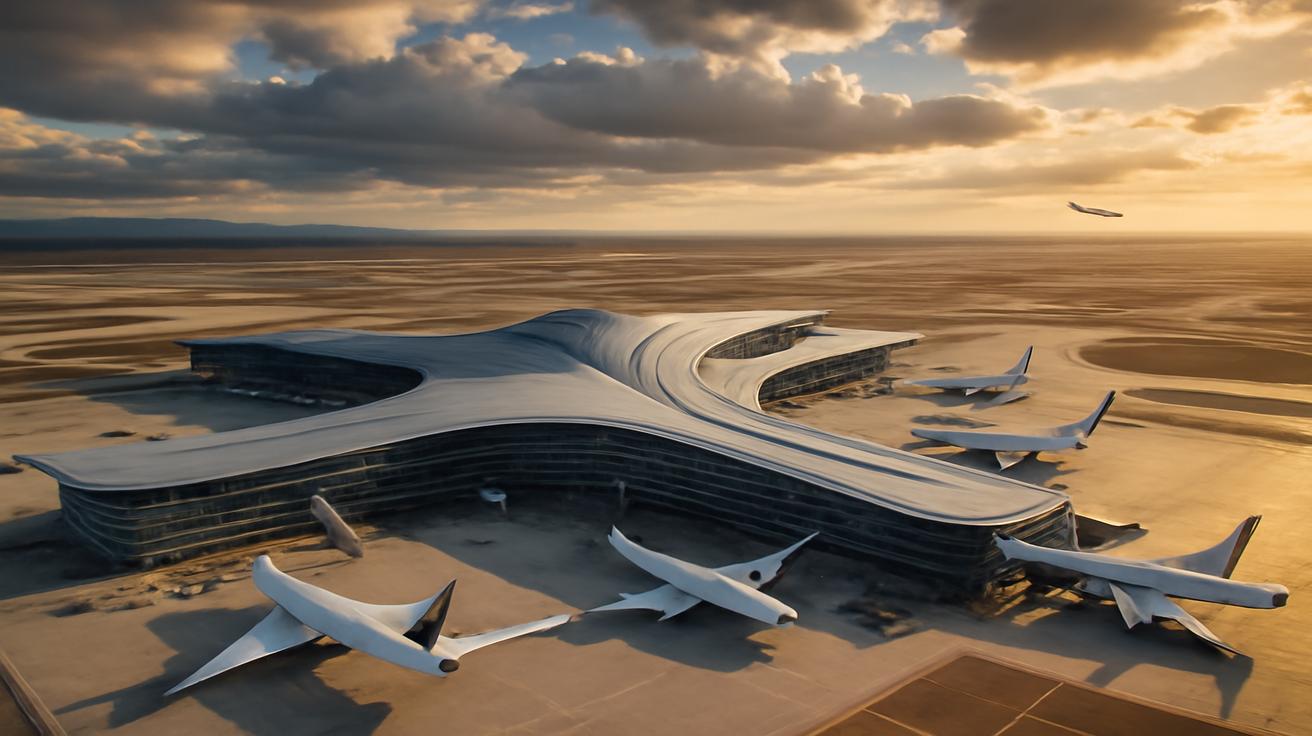
The morning air over central Ethiopia feels thinner, somehow, than anywhere else. High on the plateau, the light arrives early and hard, the sky stretching in a blue so clear it seems freshly minted. On the horizon, beyond the outskirts of Addis Ababa, a pale haze curls upward where red earth has been scraped open and leveled flat. It looks, for now, like an immense construction scar. But within a decade, if Ethiopia’s leaders and engineers have their way, that scar will become one of the busiest crossroads in the sky—a $12.7 billion mega-airport that could tilt the balance of global aviation toward the Horn of Africa.
The Plateau That Wants to Catch the Sky
Stand on the highlands outside Addis Ababa and you immediately understand why people keep calling this country a “natural hub.” The air is cooler than you’d expect this close to the equator, thanks to elevations that nudge 2,300 meters above sea level. The sweeping grasslands are broken by clusters of eucalyptus trees and the muted glint of tin roofs in nearby villages. Somewhere out there, beneath the quiet hum of bees and the distant bark of dogs, surveyors have driven stakes into the earth, tracing invisible runways on a scale that feels almost mythic.
The new airport—planned for an area near Bishoftu, southeast of Addis Ababa—is more than just an infrastructure project. It’s a statement of intent. For decades, the gravitational center of global air travel has hovered over Europe and the Gulf: Heathrow and Frankfurt, Dubai and Doha, Istanbul and Abu Dhabi. These are the places where flight paths converge, where jet-lagged travelers stumble through cavernous terminals chasing the next connection to Asia, Africa, or the Americas.
But if you draw lines on a globe—actual lines, from São Paulo to Mumbai, from Johannesburg to Beijing, from Lagos to Riyadh—you start noticing something. Many of those arcs cross right over Ethiopia. This high plateau sits startlingly close to the geometric heart of the Eastern Hemisphere. For planners and dreamers in Addis Ababa, that’s not trivia. It’s destiny.
Today, Addis Ababa Bole International Airport already punches far above its weight. Once a modest facility, it has grown into one of Africa’s busiest hubs, home base to Ethiopian Airlines: the continent’s most consistently ambitious carrier. But Bole is running out of room. Aircraft idle on crowded aprons; peak-hour congestion squeezes the timetable; terminal expansions, however shiny, feel like bandages on a rapidly growing organism.
So Ethiopia has decided to start almost from scratch—a fresh field, a blank slate, a mega-airport designed not for yesterday’s travel patterns but for those of 2050.
The Vision: A City of Runways in the Rift Valley
Talk to aviation planners involved in the project and they rarely use small words. The numbers, like the altitude, are head-spinning. Up to four runways. A design capacity projected in tens of millions of passengers per year—enough to rival many established hubs. A price tag of roughly $12.7 billion, making it one of Africa’s largest single infrastructure investments.
Yet the raw figures only tell part of the story. Imagine this new airport not just as a transit point, but as a city-state of movement. Picture the sun rising over long ribbons of concrete, illuminating rows of wide-body aircraft lined nose-to-tail like patient beasts. The air vibrates with the low thunder of engines spooling up; heat shimmers off the tarmac. Somewhere inside the terminal, a traveler from Buenos Aires stares, bleary-eyed, at a departure board that lists destinations most people still map in their minds through Dubai or Istanbul—but now connect through a place he’s barely heard of: Ethiopia.
For the country’s leaders, the hope is simple and enormous: to transform Ethiopia from a destination on the fringes into a central chord in the world’s transport symphony. For Ethiopian Airlines, the stakes are just as high. Already the carrier uses Addis as a continental spiderweb, connecting more African cities than almost any rival, and linking them onward to Europe, the Middle East, North America, and Asia. But to grow further—to add more frequencies, absorb more passengers, and compete with the scale of the Gulf giants—it needs a bigger stage.
The new airport promises exactly that. With roomier runways, more taxiways, and expanded cargo capacities, Ethiopian could deepen its role as an intercontinental bridge not just for people, but for goods. Fresh flowers flown to Europe, chilled meat heading for the Middle East, electronics bound for West Africa: much of this already pulses through Addis. A mega-airport would turn that flow into a torrent.
Why Ethiopia, and Why Now?
The timing of this ambition is not accidental. Global aviation is at a subtle turning point. Emerging markets in Africa and Asia are producing a new wave of travelers: students, entrepreneurs, migrant workers, middle-class families on their first international vacation. Airline traffic forecasts suggest that, in the coming decades, growth will shift away from legacy North Atlantic corridors and toward south-south routes, linking the developing world to itself.
Ethiopia sits at the junction of many of those future currents. Flights from southern Africa to the Middle East, from West Africa to India, from Europe to East Africa, from Asia to Latin America—all can plausibly bend through Ethiopian airspace with minimal detour. Where older hubs thrived by connecting former imperial cores to their peripheries, the next generation of hubs may thrive by linking a multipolar world: Lagos to Guangzhou, Nairobi to Jeddah, Kinshasa to Delhi.
That’s the logic underpinning this vast construction venture: to be ready when the river of future demand changes course. The question is not just whether people will fly, but where they will choose—or be routed—to change planes.
Inside the Mega-Hub: Terminals, Technology, and the Texture of Movement
The plans, as they’ve been teased in official comments and industry circles, describe an airport built to modern tastes and future pressures. Think high ceilings of glass and steel that pour daylight across vast check-in halls. Think automated baggage systems, biometric boarding gates, and digital wayfinding that shepherds you, almost gently, from security to gate. Think of lounges where Ethiopian coffee is roasted, ground, and brewed a few feet from the window where aircraft taxi past like living machinery.
In such a place, the sensory rhythm of travel shifts. The familiar anxiety of tight connections could ease if transfers are engineered for speed and clarity from the start. The stale smell of recycled air might give way, at least briefly, to the smoky floral aroma of coffee ceremonies, injera sizzling on flat griddles in food courts, the spice-laced breath of berbere and cardamom. Even as screens flash with destinations—Seoul, Johannesburg, Riyadh, São Paulo—the identity of the airport itself could remain distinctly Ethiopian.
And then there is cargo. Behind the scenes, in vast hangars and refrigerated warehouses, pallets of goods move with almost military choreography. Ethiopia has already made itself a global player in air-freighted horticulture, especially cut flowers; every day, in pre-dawn dark, flower farms load delicate blooms onto aircraft bound for European supermarkets. With a new mega-airport, those cold-chain arteries can tighten and thicken, connecting Ethiopian farms and factories with markets as far-flung as Shanghai or Chicago.
To visualize the scale and ambition more concretely, imagine a simple comparison of how such a hub might fit into the global system:
| Hub Airport | Region | Strategic Role | Key Strength |
|---|---|---|---|
| Dubai (DXB) | Gulf | Europe–Asia & Africa connector | Ultra-long-haul reach, luxury branding |
| Istanbul (IST) | Eurasia | Europe–Asia–Africa tri-continental hub | Massive connectivity footprint |
| Addis Ababa New Mega-Airport | Horn of Africa | Africa–Asia–Middle East pivot, south–south routes | Central African geography, growing home carrier |
Where Europe once served as the default bridge between continents, the new architecture of air travel is being built elsewhere—and Ethiopia wants a prime seat at that table.
Shifting the Centre of Gravity: What Changes in the Sky
To say that a single airport could “shift the centre of global aviation” might sound like hyperbole. Yet aviation history is full of such pivots. Once, New York and London dominated long-haul traffic; then, as Asia boomed and aircraft grew more efficient, hubs in the Gulf and Turkey rose, re-routing the world through their deserts and straits. Now, as African economies grow and south-south traffic intensifies, the gravitational field is poised to move again.
If the Ethiopian mega-airport delivers on its promise, the change will be felt less as a sudden jolt and more as a quiet drift. Airlines planning new routes will start to pencil in Addis—or its new cousin southeast of the capital—as a logical stopover. Travelers from West Africa heading to India might find themselves sipping macchiatos in a vast, bright concourse in Ethiopia instead of Qatar. Cargo planners might find that, for certain routes, the fastest path from China to Lagos or Nairobi is not through Europe or the Gulf, but through the high plains of Oromia.
The center of aviation is not a fixed dot; it’s a weighted average of where people and goods actually move. As more of that flow arcs across Africa’s skies, the map will re-balance. And unlike many African countries that largely host foreign carriers, Ethiopia has a home airline ready—and eager—to exploit that shift.
Ethiopian Airlines has spent decades building a reputation as Africa’s quiet overachiever, expanding cautiously but relentlessly. As other national carriers on the continent faltered or collapsed, Ethiopian invested in new aircraft, training centers, and partnerships. The mega-airport is the missing puzzle piece: physical capacity to match strategic ambition.
The Human and Ecological Story Beneath the Flight Paths
Of course, no mega-project rises from empty land. Beneath every new runway is a patchwork of human lives, ecosystems, and histories rearranged. Around Bishoftu and its neighboring communities, the talk of a new airport brings both hope and unease.
For some local residents, there is the promise of jobs: construction work today, service and logistics roles tomorrow. An airport can act like a magnet for secondary industries—hotels, catering, maintenance, training academies—that ripple outward into the regional economy. A young mechanic-in-training might imagine a future spent servicing aircraft instead of minibuses. A farmer might find new buyers for fresh produce delivered directly to airport hotels and staff cafeterias.
But there are also quieter fears: of displacement, of rising land prices that push smallholders off ancestral plots, of noise and pollution changing the character of once-rural landscapes. A runway is, in a blunt sense, a long scar on the earth—a place where nature is forced into submission in the name of connectivity.
The ecological stakes echo beyond the immediate footprint. Aviation, globally, is grappling with its carbon-heavy reality. As much as modern jets are more efficient than their predecessors, the industry’s total emissions keep growing with demand. A massive new hub in Ethiopia will, inevitably, feed that growth. The question, being asked with increasing urgency, is how such a project can align with a warming planet.
Ethiopian planners speak of building “green” terminals, of using renewable energy where possible, of exploring sustainable aviation fuels. Solar panels could shimmer atop vast car parks and maintenance sheds; rainwater could be harvested and filtered; landscaping could restore pockets of native vegetation around the concrete expanses. None of this cancels out the environmental cost, but it shapes its magnitude.
The most nuanced view of this mega-airport recognizes it as a paradox: a catalyst for development in a region that has long been on the margins of global trade—and a contributor to a global problem that disproportionately harms places like Ethiopia, where climate shocks already fracture lives.
What It Could Feel Like to Fly Through Ethiopia in 2035
Project yourself into a future flight. The year is 2035. You board in Lagos at sunset, the sky bruised purple over the Gulf of Guinea. Your ticket reads “Addis Ababa – Connection” in small print. Three hours later you descend through thin clouds into the highland night, the lights of the new Ethiopian mega-airport glittering like a constellated river.
From your window seat you catch a last glimpse of wings sliding past each other, tails painted in vibrant greens, golds, and reds. The aircraft’s doors open to a breath of cool, dry air—sharper than the humid blanket you left behind. In the terminal, polished floors reflect a wash of movement: pilgrims bound for Jeddah, business travelers speaking rapid French and Amharic, students comparing boarding passes to Delhi and Guangzhou. Announcements crackle first in English, then in Amharic.
You follow a stream of passengers through a transfer corridor. On one side, glass walls reveal the airfield: a latticework of taxiways, pushback tugs gliding like industrious ants, aircraft from every corner of Africa nosed into gates. On the other, a café spills out the scent of freshly roasted Ethiopian coffee. A barista in a crisp uniform pours the dark liquid into small cups, steam curling upward like incense. You have 90 minutes until your flight to Mumbai. You decide to taste the country you’re glimpsing only between gates.
As you cradle the warm cup, you realize that this place—this high-altitude junction you might never step out of into the actual city—is reshaping how you move through the world. Twenty years earlier, this same journey would almost certainly have sent you through the Gulf or Europe. Now your layover is on African soil, in an airport expressly designed to claim that role.
Outside, another plane lifts into the cold night, its landing lights carving a brief, brilliant path into the darkness before fading to a small star. One more datapoint in a shifting constellation of routes that, taken together, redraw the center of global aviation a few hundred kilometers closer to the Horn of Africa.
Unfinished, Uncertain, and Utterly Transformative
For now, the mega-airport remains partly an act of imagination. Funding structures evolve, timelines shift, and the realities of politics, economics, and regional instability all tug at the edges of grand visions. The price tag is huge for any nation, let alone one navigating debt pressures, post-conflict recovery, and development demands that extend far beyond the aviation sector.
But even in its incomplete state—even as blueprints, environmental assessments, and construction schedules—the project has already changed how people talk about Ethiopia. No longer just the land of ancient churches and rugged highlands, or a cautionary tale of famine broadcast in grainy 1980s footage, Ethiopia is positioning itself as an architect of tomorrow’s air routes.
In that sense, the $12.7 billion airport is less a finished object than an ongoing story: a narrative about who gets to sit at the center of things in a century when global power is less and less anchored to old capitals. Whether or not every runway and terminal wing is built exactly as first imagined, the idea has taken flight.
And somewhere on that high plateau, as the afternoon wind flicks dust across survey markers and distant cattle bells ring faintly, the earth waits to be remade into a place where the paths of millions will briefly cross—a new hinge in the sky over Ethiopia, swinging the world’s journeys, degree by degree, through its thin, bright air.
Frequently Asked Questions
Why is Ethiopia building a new mega-airport instead of just expanding Addis Ababa Bole International Airport?
Bole has been expanded several times and is approaching its physical and operational limits. The new site offers more space for multiple runways, larger terminals, and long-term growth, allowing Ethiopia to plan for future traffic rather than continually patching an already busy airport.
Where will the new Ethiopian mega-airport be located?
The proposed location is near Bishoftu, southeast of Addis Ababa, on the Ethiopian highlands. This area provides relatively flat terrain and room for expansion while remaining close enough to the capital to function as its primary international gateway.
How much will the new airport cost, and who is paying for it?
The project is estimated at around $12.7 billion. Funding is expected to come from a mix of government investment, loans, and potentially partnerships with foreign investors and development finance institutions. Specific financing structures may evolve as the project advances.
How could this airport change global air travel patterns?
Thanks to Ethiopia’s central location in the Eastern Hemisphere, the new hub could become a favored connection point between Africa, the Middle East, Asia, and parts of Europe and Latin America. This may shift some traffic that now routes through Gulf or European hubs to an African center instead.
What role does Ethiopian Airlines play in this project?
Ethiopian Airlines is the main driver of demand for the new airport. As one of Africa’s largest and most successful carriers, it needs greater capacity to expand routes, increase frequencies, and grow its cargo operations. The mega-airport is being designed with its hub-and-spoke model in mind.
Are there environmental concerns about building such a large airport?
Yes. Aviation is a significant and growing source of carbon emissions, and constructing a mega-airport has local environmental impacts, including land use changes, noise, and pollution. Planners have discussed integrating renewable energy and sustainable design features, but the overall climate impact remains an important concern.
When is the airport expected to be completed?
Timelines can shift due to funding, construction challenges, and political or economic factors. While some projections aim for significant progress within the next decade, the exact completion date and phased opening schedule will depend on how smoothly the project proceeds.