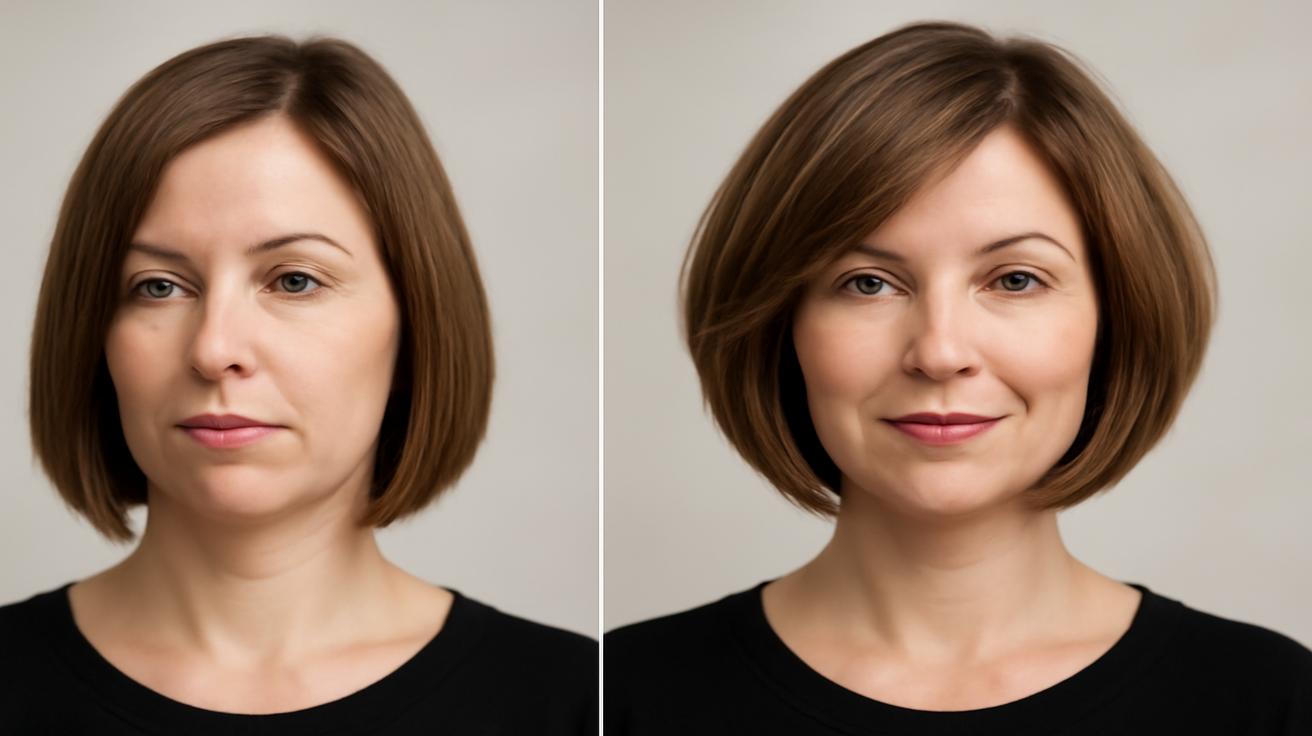
The first grey hair arrived on a Tuesday, glinting in the bathroom light like a tiny streak of lightning. By the time fifty-five rolled around, there were more of them—silver threads weaving their way through what used to be a dense, obedient bob. And then one morning, standing in front of the mirror, you notice something else. It isn’t just the colour quietly changing; it’s the shape. The angle of that once-sharp bob looks… deflated. Flatter at the crown. A little limp at the ends. You style it the same way, you coax and curl and blow-dry, but the volume just doesn’t quite come back. It’s not that you’ve “let yourself go”; it’s that your hair has decided to tell its own story.
The day the angled bob stopped working
Maybe you’ve worn some version of the angled bob for years—the sleek, swingy cut that made you feel polished and a bit daring. It framed your jawline, showed off your neck, and looked good with lipstick and a pair of earrings. For a long time, it was your secret weapon. But then, somewhere around menopause—or the slow fade into it—you notice the hairline at your temples receding just a touch. The crown looks sparser. The ends that once appeared thick and full now gather into a noticeably slimmer line.
In the soft light of the bedroom, you tilt your head to one side, then the other. The angle that used to look so sharp now has a way of drawing the eye down, right to the finest, thinnest part of your hair. The front looks heavy, the back feels flat, and somehow the whole cut is competing with your changing hair rather than working with it.
The truth is, the classic angled bob relies on thickness. It asks your hair to stack, to build weight in the back and glide forwards in a polished sweep. When density drops—as it often does after 55, thanks to hormonal shifts, slower follicle cycles, and a lifetime of colouring and heat—it stops behaving like the flattering, ageless staple it once was. Instead, it can make every strand you’ve lost feel somehow… visible.
This is where the story of your hair can change, not into a tale of loss, but of strategy. Instead of clinging to the cut that used to work, there’s a chance to discover the one that works now: softer, airier, and designed to cheat volume back into every layer.
The “anti-ageing” cut that isn’t trying to be 30 again
Let’s pause on that phrase: “anti-ageing.” It’s thrown around a lot, especially when it comes to hair. But there’s something far more powerful than trying to rewind the clock: working with what you have today, in a way that honours where you are, not where you’ve been.
The most flattering, volume-restoring haircut after 55 isn’t really about pretending your hair is thicker than it is. It’s about smart architecture. It’s about shifting the eye, lifting the silhouette, and letting the natural movement of finer, more delicate hair become an asset rather than a frustration.
The new hero isn’t the sharp, angled bob that slopes down towards your chin like a precise line drawn with a ruler. Instead, imagine something more diffused, more dimensional:
- A softly layered bob or lob (long bob), with gentle graduation instead of a steep angle.
- Built-in volume at the crown through subtle texturising, not chunky, obvious layers.
- Ends that are slightly curved in or out, so they don’t sit in a heavy line against your jaw.
- A fringe or soft face-framing pieces that skim the cheekbones or sweep over the forehead, where thinning near the hairline is most noticeable.
Think of it as a “cloud bob” for mature hair—a cut that creates an illusion of fullness, like air is living between the strands. It’s light, it moves, and it doesn’t require you to wrestle with it every morning to make it look alive.
Instead of being angled and severe, this cut is rounded and uplifted. It doesn’t drag your features down; it floats around your face. It makes the neck look long, the jawline softer, and the eyes brighter—not because it’s erasing age but because it’s redirecting attention to where the light is: your expression, your energy, your presence.
Why thinning hair after 55 needs a different kind of cut
If you listen closely, thinning hair has a language of its own. It whispers about hormones, about the slow-down of oestrogen that kept follicles in their active phase for longer. It mentions the thyroid, sometimes quietly off-balance. It reminds you of those years of ponytails pulled tight, the perms, the colour, the heat. None of it is about blame; all of it is about understanding why your hair behaves differently now.
Here’s what’s happening behind the scenes:
- Each strand is finer. You might not be losing dramatic clumps, but the actual diameter of each hair can shrink, making the overall “mass” feel reduced.
- The growth cycle is shorter. Hair spends less time in the growth phase, more in the resting and shedding phases, so you see more fall-out and slower regrowth.
- The scalp becomes more visible. Particularly at the crown, parting, and temples—exactly where an angled bob often exposes it most.
Now imagine placing a heavy, geometric cut—like a classic angled bob—on top of that more fragile foundation. The weight drags the hair down, flattening the roots. The sharp line at the bottom emphasises how little hair there is to support that sleek shape. The front, where the bob is longest, can start to look stringy instead of swinging. It’s like asking a delicate branch to hold the shape of a thick tree trunk.
The “anti-ageing” cut that truly works after 55 isn’t about severity; it’s about support. It redistributes bulk away from the ends and brings it back towards the mid-lengths and crown, where you need it most. It uses illusion: a little lift at the root here, a shorter piece there, a few whisper-light layers that encourage hair to sit off the scalp instead of collapsing against it.
And perhaps most importantly, it understands that your hair is not just thinner—it’s often drier, more porous, and more prone to frizz. A good cut will account for that too, offering a shape that still looks intentional on the days you don’t feel like blow-drying it into oblivion.
Shape-shifting: from angled bob to volume-lifted cut
Picture the scene in the salon. The cape is snapped around your neck; your angled bob hangs in the mirror, familiar and a little tired. You tell your stylist, “I want more volume, but I don’t want to go short-short.” You confess, maybe, that you’re not ready for a “grandma cut,” whatever that even means. You want your hair to look like you—just a version of you who slept eight hours, drank a lot of water, and somehow has more hair than you did yesterday.
Here’s how the transformation often unfolds when you move away from the angled bob and into a more volume-friendly shape:
- The back is softened and lifted. Instead of a stacked wedge that needs density to look good, you get gentle graduation—shorter at the nape, but not dramatically so. This subtle stacking gives lift without exposing too much scalp.
- The front length is eased. That long, face-heavy front section is brought up a little, so it doesn’t pull everything down. The focus shifts from the ends to the mid-lengths, where hair can more easily hold shape.
- Invisible layers are added. Not choppy, obvious layers, but airy, interior ones that live inside the shape of the bob. These encourage movement and prevent the dreaded “helmet” effect.
- Face-framing pieces are tailored. Your stylist might cut a soft, side-swept fringe or eyebrow-grazing curtain bangs. These disguise thinning at the hairline and bring instant freshness to the face.
When the blow-dryer finally clicks off and the mirror reveals the new cut, it’s not a radical change in length. It’s a change in lift. Your profile looks different—the crown slightly higher, the ends less heavy, the face somehow more open. You turn your head and the hair follows, instead of clinging close to your scalp like it’s afraid of the world.
On a practical level, this kind of cut also respects your morning routine. You don’t need a suitcase of tools. A round brush or hot brush, a root-lifting spray, maybe a dab of light mousse—that’s enough. The architecture of the cut is doing most of the heavy lifting; you’re just adding a bit of polish.
Small daily rituals that make a big difference
Hair after 55 is a practice in gentleness. It doesn’t respond well to punishment, and it doesn’t bounce back from neglect as quickly. The right cut is the foundation, but how you treat it, day after day, is the quiet chorus supporting the main melody.
Here are some simple, realistic rituals that protect volume and help your new cut stay full and buoyant:
- Wash for the scalp, not the foam. Focus your shampoo on the roots, not the entire length, and choose a formula that’s light enough not to weigh hair down. Rinse thoroughly so there’s no residue flattening your crown.
- Condition like a stylist. Apply conditioner from mid-lengths to ends only. Finer, thinning hair doesn’t need heavy moisture near the scalp.
- Dry with intention. Flip your head upside down while blow-drying, or lift sections at the root with your fingers or a brush. Let hair cool in that lifted position to “set” the volume.
- Be kind with tools. Lower heat, good quality brushes, and minimal tugging. Thinning hair will thank you with less breakage and more consistent fullness.
- Sleep as if your hairstyle matters. Consider a silk or satin pillowcase to reduce friction. Pineapple your hair loosely on top of your head if it’s longer, to preserve lift.
You don’t have to become someone who spends an hour on their hair. Instead, think of it as five to ten focused minutes of care—with a cut that amplifies your effort instead of demanding more from you than you can comfortably give.
A quick comparison of cuts for thinning hair after 55
To make this easier, here’s a simple comparison between the beloved angled bob and some volume-restoring alternatives:
| Style | Best For | Volume Effect | Maintenance |
|---|---|---|---|
| Classic Angled Bob | Thick, dense hair; minimal thinning | Can look flat at crown; heavy at front | Requires precise styling and regular trims |
| Soft Layered Bob | Fine to normal hair; early thinning | Adds lift at crown and movement through lengths | Moderate styling; easy day-two refresh |
| Textured Lob (Long Bob) | Those wanting some length with volume | Soft, undone fullness; avoids heavy ends | Flexible; looks good straight or wavy |
| Bob with Fringe / Face Framing | Thinning at hairline or temples | Draws attention to eyes; disguises sparse areas | Needs fringe trims; quick daily shaping |
Letting go as an act of style
Saying goodbye to the angled bob isn’t really about the haircut itself. It’s about waving off an old version of yourself that you may have been holding onto without realising it. For years, that sharp angle probably made you feel efficient, pulled-together, a little bit fierce. Letting it go can stir up more than hair clippings; it can tap into questions about visibility, desirability, and who you are now that “young” isn’t the adjective everyone reaches for first.
But here’s the quiet, subversive truth: there’s enormous style in accepting change and then styling it to your advantage. Choosing a cut that restores volume to thinning hair is not surrender—it’s strategy. It’s you saying, “This is my hair now—finer, softer, silver-streaked—and I’m going to give it the shape that lets it look its best.”
There’s a kind of rebellion in refusing the narrative that ageing hair must either be fought or hidden. Instead, you can work with it: coaxing lift where there is none, softening edges that feel too harsh against skin that has grown kinder with time, and letting movement replace severity. The most powerful “anti-ageing” move might not be chasing youth, but leaning into ease, intelligence, and a cut that looks like it belongs to the person you’ve become.
Standing in front of the mirror with your new, volume-boosting bob or lob, you might notice it first in the way your profile changes. The crown doesn’t cave in; it rounds out. The ends don’t hang in a heavy line; they ripple a little, catching the light. Your face looks less framed by a hairstyle and more in conversation with it.
You tuck one side behind your ear, turn your head, and for a moment you see it—the woman who has lived more than half a century and still has the audacity to care about beauty, about hair, about how she shows up in the world. Not because she’s competing with anyone, but because she understands that feeling good in your own skin—and under your own hair—has never belonged to any one age.
Goodbye, angled bob. Hello, lift, softness, and shape that moves like you do now: lighter, freer, wiser.
FAQ: Your questions about volume-restoring cuts after 55
Isn’t any shorter haircut automatically better for thinning hair?
Not necessarily. Very short cuts can expose more scalp if not carefully shaped. The key is balance: short enough to keep weight from dragging hair down, but long enough to create a sense of density. A softly layered bob or lob often hits that sweet spot.
Will layers make my hair look even thinner?
Heavy, choppy layers can, but invisible or internal layering does the opposite. Strategic, subtle layers inside the cut help your hair lift away from the scalp and create movement, which visually increases fullness.
Can I still have an angled bob if I love the look?
You can, but ask your stylist for a softer angle and more structure at the crown. A gentle, almost imperceptible angle with interior layers can preserve the modern feel without flattening your profile or emphasising thinning ends.
How often should I get my hair cut to maintain volume?
For most people with thinning hair, every 6–8 weeks works well. Regular trims keep the shape intact and remove fragile, splitting ends that can make hair look wispy and sparse.
Do I need lots of products to keep volume in my hair now?
No. One light root-lifting spray or mousse and perhaps a weightless finishing spray are usually enough. The cut should be doing most of the work; products are there to support, not replace, good architecture.
Is a fringe (bangs) a good idea if my hair is thinning?
Yes—if it’s cut thoughtfully. A soft, wispy or side-swept fringe can camouflage a receding hairline and draw attention to your eyes. Avoid very blunt, heavy bangs if your hair is very sparse at the front.
What should I tell my stylist if I want this kind of “anti-ageing” cut?
Describe what you want the shape to do, not just a photo to copy. Try phrases like: “I’d like more lift at the crown, lighter ends, and soft layers that make my hair look fuller, not choppy.” Mention that you’re noticing thinning and want a bob or lob that builds volume and movement, rather than a sharp, angled line.