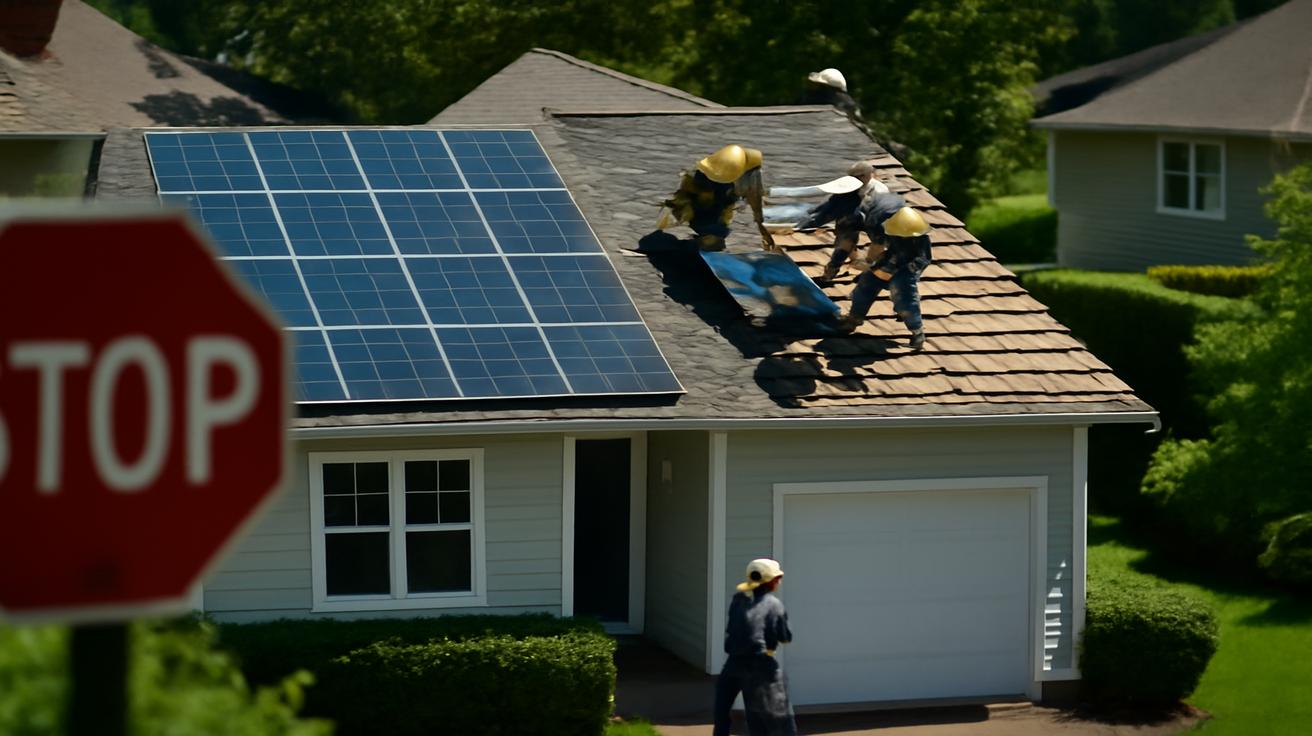
The letter was printed on ordinary city stationery—black ink, municipal seal, polite bureaucratic tone. But to Alex, standing barefoot in his kitchen with sunlight pouring through the window, it might as well have been a thunderclap. The rooftop solar array he’d saved for, argued for, and watched get bolted into the bones of his old row house was, according to the letter, now an infraction. A “violation of neighborhood character.” A “visual intrusion.” A few lines later came the gut punch: the system must be removed within 30 days.
The Solar Panels That Started a Quiet War
The panels had gone up in a single, bright week the previous autumn. Alex still remembered the smell of hot tar and metal, the muffled thud of boots on the roof, the crane’s slow ballet in the narrow street below. He’d signed the contract in a rush of optimism—finally, he thought, his monthly power bill would shrink, and his carbon footprint would follow. It felt like joining a quiet resistance, one rooftop at a time.
His neighbors had watched. Some had waved to the workers. Others had stood in their driveways, arms folded, eyes fixed upward, as if the panels were not simple rectangles of dark glass, but a challenge.
He didn’t think much about those looks at first. Cities are made of small frictions. Someone always hates something—the new dog, the louder car, the different paint color. But this was clean energy, he thought. This was the kind of thing cities were supposed to want. Banners downtown urged residents to “Go Green!” The mayor’s last campaign had featured a photo op in front of a solar-powered library.
So the letter felt less like a correction and more like a betrayal. Not only of Alex’s wallet, but of the city’s own promises.
The Neighbor Who Hated the Sun
The complaint, he learned, had come from the house directly behind his. The property sat slightly uphill, its back windows looking over a flutter of backyards and a scattering of rooftops. Until the panels were installed, those windows had held a view of chimneys and treetops, and in the distance the serrated outline of the city skyline.
Mrs. Harwood, the complainant, had lived there for thirty-three years. Her garden was legendary on the block—tidy rows of herbs, a small stone fountain that drew sparrows, roses that leaned against the fence like gossiping neighbors. She was polite but firm, the kind of person who still preferred hand-written notes over texts.
What she saw when she looked out now, she told the city inspector, was not a view. It was a “glare factory.” The dark-glass rectangles, she said, were ugly, industrial, alien. They reflected late-afternoon light into her kitchen. They made her dining room feel like the inside of a computer screen. She liked the idea of clean energy in theory, she reportedly said. But this? On her block?
There it was—that quiet disclaimer that lives in so many city debates: I support progress, just not if I have to see it.
When the inspector came, he walked the perimeter, checked a few measurements, leafed through papers on a clipboard. He mentioned that a formal complaint had been filed about “aesthetic interference” and “nonconforming rooftop structure.” He did not say the words, but they hung in the air like invisible punctuation: Not In My Backyard.
The Rules Written Before the Future Arrived
On paper, the situation wasn’t as simple as a cranky neighbor and a timid city official. The local regulations that governed rooftop structures—the obscure planning codes and historic-district guidelines—were written long before solar became a mainstream option. They treated anything new on a roof the way a body might treat a foreign object: with suspicion.
The codes talked at length about sight lines, “visual uniformity,” and the importance of preserving the “esthetic fabric” of the neighborhood. In an era when the biggest rooftop fear was someone plastering up a giant billboard, those words made sense. But now, applied to slim rectangles harvesting sunlight, they felt anachronistic. Like forbidding smartphones because rotary phones were more appropriate for the character of the city.
The inspector pointed to a clause about “mechanical equipment visible from public rights-of-way or neighboring properties.” By that definition, a solar array could be treated no differently than a rusty air-conditioning unit or an unsightly satellite dish. Never mind that one of those items quietly belched emissions by proxy, while the other silently reduced them.
Alex argued. He showed his permit paperwork. He noted that nothing in the documents said his panels had to be invisible. He pointed out that every rooftop in sight was already a jumble of vents, skylights, antennas, and ductwork—a patchwork of human necessity. To call solar panels the lone offenders felt arbitrary at best, malicious at worst.
But the bureaucracy didn’t argue. It simply followed its own outdated script.
When Rooftops Become Battlegrounds
There’s a particular sound cities make when they shift. You can’t hear it in a single noise—it’s not a crash or a shout. It’s more like a hum that rises from a thousand small decisions, each one a quiet tilt in one direction or another. A zoning rule updated here, a building permit denied there, a neighborhood association vote held under fluorescent lights in a school gym.
The battle over Alex’s rooftop was one tiny node in a wider grid of similar skirmishes playing out in cities everywhere. If you zoom out from his block—past the peeling paint, the gutter gardens, the stubbornly parked cars—you can trace a pattern:
| Issue | NIMBY Concern | Clean Energy Impact |
|---|---|---|
| Rooftop solar | “Ugly, ruins neighborhood character” | Reduces household emissions and grid demand |
| Small wind turbines | “Too noisy, eyesore on skyline” | Local renewable power, especially in windy areas |
| EV chargers on street | “Takes parking, clutter on sidewalks” | Supports shift away from fossil-fuel vehicles |
| Battery storage units | “Industrial vibe, safety worries” | Stabilizes grid, stores clean power |
| Community solar farms | “Loss of views, property value fears” | Shared clean energy for renters and low-income households |
In each case, the pattern is almost painfully predictable. People endorse the transition in the abstract. Ask them on a survey whether they support climate action, and the approval numbers soar. But ask if they’re willing to see a sliver of that action from their kitchen window, and the mood shifts.
The Right to a Roof, the Right to a View
At the heart of Alex’s fight was a simple but combustible collision of rights. Whose claim mattered more—the homeowner who wanted to use his own roof to produce clean power, or the neighbor who wanted the comfort of an unchanged vista?
Property law has long indulged a kind of romanticism about views. Lawsuits have been fought over blocked sunsets, over lost sightlines of water, over skyscrapers that turned a distant hill into a memory. But we’re entering an era where another kind of romance—the dream of a decarbonized city—demands its own legal language.
In some states and countries, so-called “solar access” laws have already started rewriting the script. They carve out a basic expectation: that a homeowner who installs panels won’t find them suddenly shaded or outlawed because a neighbor decided that the old view was better. Some cities reclassify solar panels not as optional “equipment,” but as protected, climate-critical infrastructure.
Alex’s city had no such clarity. Its rules were caught in a temporal tug-of-war, written for a past that no longer fit the physics of the present. Emissions already released into the atmosphere don’t care if a block looks “cohesive.” The sun doesn’t adjust its intensity because two households can’t agree about glare.
Yet daily life does happen at that microscopic scale—between two fences, inside one mailing route. Which means that the energy transition must navigate not just markets and technology, but also human comfort, habit, and fear.
What Fear Looks Like in Broad Daylight
If you sat at Mrs. Harwood’s kitchen table, you might see her concern differently. The late afternoon light now falls across the panels and winks upward, a few flashes scattering across her glass-fronted cabinets. On certain days, she insists, the reflection lands squarely on the small painting of a seaside cliff she bought in her twenties. It bothers her. It makes her home feel altered, infiltrated by someone else’s decision.
Her fear isn’t of solar as such. It’s fear of change, condensed into something she can point to.
For decades, she has watched the world shift from the stable vantage point of that house. The street trees have grown and then been cut down and replanted. The corner store turned into a yoga studio, then a vape shop. Cars got larger, then smaller, then larger again. Her life has not been immune to change, but it has been anchored in a deep sense of place—brick, mortar, view.
Now, the wider anxiety of a warming planet arrives on her block not as a heatwave warning or a flooded underpass, but as dark glass squares rearranging the pattern of light in her kitchen. It feels, to her, like an invasion of the abstract into the personal.
NIMBYism often wears exactly this face: a specific, granular discomfort standing in for a larger, harder-to-name fear. Saying “I don’t like those panels” is easier than saying “I sense that the world is shifting beneath my feet, and I’m not sure where I belong in this new story.”
Sabotage in Slow Motion
Still, the cumulative effect of these individual discomforts can be devastating. When one complaint leads to one removal, the signal sent across a neighborhood is unmistakable: Don’t try this here. Solar installers hear about it and quietly tell future clients, “This district is tricky.” Neighbors who had been on the fence decide not to invite that kind of trouble into their lives. Momentum stalls, not with a ban, but with a chill.
Sabotage, in this sense, isn’t the stuff of shadowy conspiracies. It’s a slow-motion, distributed veto power exercised through planning meetings and complaint hotlines. Each “no” is small. Together, they become a wall.
In Alex’s case, the installer tried to help. They suggested a few compromises—anti-reflective coatings, a slight tilt adjustment, some rooftop screening that might make the array less visible. But every solution added cost, or shaved off generation capacity, or bumped against the very rules that had created the problem. The city, backed by its aging code, refused to reopen the case.
The deadline on the letter loomed closer.
Learning to See Rooftops Differently
Walk down almost any urban street, and the roofs above you form a second city, layered and hidden. Some are wild with satellite dishes and vents and improvised repairs, others are pristine planes of asphalt or tile. In older neighborhoods, you might see a rusted water tower or a faded sign from a factory that no longer exists.
We are, slowly and unevenly, teaching ourselves to read those roofs as another kind of story: of who gets to generate their own power, who can afford the up-front cost of panels, whose landlord says no, whose neighborhood rules are flexible enough to allow change. The urban sky is becoming a map not just of wealth, but of policy.
There is a real, tangible beauty to solar, if you let your eyes adjust. The crisp geometry, the quiet conviction of surfaces angled to sip from the sun. The way an entire block, outfitted with panels, can look like a low, shimmering wave of dark glass, all those households pointing themselves toward a different future.
To accept that beauty, though, requires a subtle shift in what we think of as “charm” or “character.” For generations, we’ve idealized the unchanging postcard view—red-tiled roofs, slate shingles, the clean line of a gable untouched since some imagined golden age. We’ve treated our built environment as something to be preserved in amber, even as the climate that surrounds it mutates into something hotter, wilder, less predictable.
Perhaps the more honest vision of urban beauty now includes the visible signs of adaptation. Rain barrels tucked under downspouts. Heat-pump condensers perched on brackets. Green roofs fuzzed with sedum and wildflowers. Solar panels propped like open books on the spine of a row house.
These are not intrusions. They are survival, made visible.
From Private Decisions to Public Stories
Alex’s rooftop, once just a personal project, became a small stage for this broader negotiation. Neighbors who had barely spoken to him for years stopped him on the sidewalk to ask what was happening. Some were sympathetic, others cautious. One older man confessed he’d always thought the panels “looked pretty cool,” but he didn’t want trouble with the city on his own house.
When the removal day finally came, it felt like a strange reversal of the installation week. The same sounds—the boots, the tools, the grunts as equipment was lifted and shifted—now carried a note of defeat. As each panel came down, the roof looked barer, more ordinary. The house seemed to shrug backward into an older version of itself.
From her window, Mrs. Harwood watched, then turned back to her kitchen. The glare on the painting disappeared. Her view, more or less, returned.
But something else shifted on that block, less visible and harder to scrub away. The story of that removal entered the neighborhood’s oral history: the time the city made someone rip down their solar because a neighbor complained. For some, it became a cautionary tale. For others, a quiet outrage they carried into planning meetings, into conversations with council members, into the next election.
Writing New Rules Under a Hotter Sky
In the months that followed, a small group of residents began pressing the city to confront the gap between its climate rhetoric and its regulations. They gathered case studies from other municipalities where rooftop solar was protected by clear laws. They pointed out that energy freedom on roofs was not a fringe idea but a cornerstone of urban resilience.
They told stories—because facts alone rarely budge rules written with emotion at their core. They spoke of smoke-choked summers when the grid strained under air-conditioner demand. They described seniors on fixed incomes choosing between medications and utility bills. They talked about teenagers who’d grown up under climate anxiety, whose lives would be lived entirely in the time defined by decisions made today.
In early drafts of proposed policy changes, a new concept began to appear: that of a “presumptive right” to generate clean energy on one’s own property, so long as it met safety guidelines. Aesthetic objections, under this framework, could be voiced—but not weaponized to force removal.
The city did not transform overnight. Codes move slowly, dragged forward by committees and comment periods. But the ground, once disturbed, rarely settles back exactly as it was.
The next time a resident on that block decided to install rooftop solar, they did so with a thicker file folder: letters of support from neighbors, references to evolving policy, examples from nearby districts. They’d heard what happened to Alex—and they’d also heard that the story wasn’t finished yet.
Choosing the View That Matters Most
Stand once more on that hillside behind the row of houses at dusk. The sky is bruised with city light, a gradient of amber and purple. Windows wink on one by one. Somewhere a bus exhales, somewhere a dog barks, somewhere a child practices the same melody on a piano over and over until it finally lands in tune.
Look out over the roofs. Some are still bare, etched only with vents and the ghosts of old repairs. Some have the dark shimmer of solar arrays, catching the last thin breath of light before night folds over them.
Far beyond, past the skyline, past the horizon you can’t see, the atmosphere holds every ton of carbon we have ever sent up. It does not care who complained about what. It does not measure neighborhood character. It measures only physics and time.
We get to choose which view we prioritize: the neat, unbroken line of a traditional roofscape, or the messy, necessary sight of a city actively retooling itself for survival. Both are stories of comfort. One is about preserving how things once looked. The other is about preserving our chance to look out on anything livable at all.
On some future afternoon, someone like Alex might stand in a kitchen, open a letter from the city, and feel a different shock—one of relief. A notice not of removal, but of affirmation: your panels are protected; your choice to harvest sunlight is recognized not as a nuisance, but as a contribution.
Until then, the fight between roof freedom and NIMBY sabotage of clean energy will play out in these intimate, ordinary spaces—in the distance between two houses, in the tilt of a panel, in the old habits of eyes that are still learning to recognize what hope looks like when it lands, quietly, on a roof.
Frequently Asked Questions
Why do some neighbors oppose rooftop solar installations?
Opposition often stems from aesthetic concerns, fear of property value changes, worry about glare or reflections, and a general discomfort with visible change. Many people support clean energy in theory but resist it when it alters familiar views or neighborhood routines.
Can a city legally force a homeowner to remove solar panels?
It depends on local laws and permits. In some places, outdated zoning codes or historic-district guidelines can be used to challenge visible rooftop solar. In others, “solar access” or “solar rights” laws protect homeowners from this kind of forced removal.
What are solar access or solar rights laws?
These are policies that give homeowners a presumptive right to install and use solar energy systems, and often limit how neighbors, homeowners’ associations, or cities can block or restrict them based on aesthetics alone.
Do solar panels actually cause problematic glare?
Modern solar panels are designed to absorb light, not reflect it, so significant glare is uncommon. In most cases, reflections are brief and less intense than sunlight bouncing off windows, cars, or water.
How can communities balance neighborhood character with clean energy goals?
By updating zoning codes, creating clear design guidelines for solar, engaging residents early in planning, and reframing visible clean energy infrastructure as part of the neighborhood’s evolving character rather than as an intrusion.
What can a homeowner do if a neighbor complains about their solar panels?
They can review local laws, consult their installer, document all permits and approvals, explore mitigation options like anti-reflective coatings, and, if necessary, work with local advocacy groups or legal counsel to defend their right to generate clean energy.
Why is visible clean energy infrastructure important in cities?
Because it turns abstract climate goals into tangible action, increases local resilience, reduces emissions at the household level, and helps normalize the transition. Seeing solar panels and other clean technologies in everyday life makes the energy shift feel real, possible, and shared.