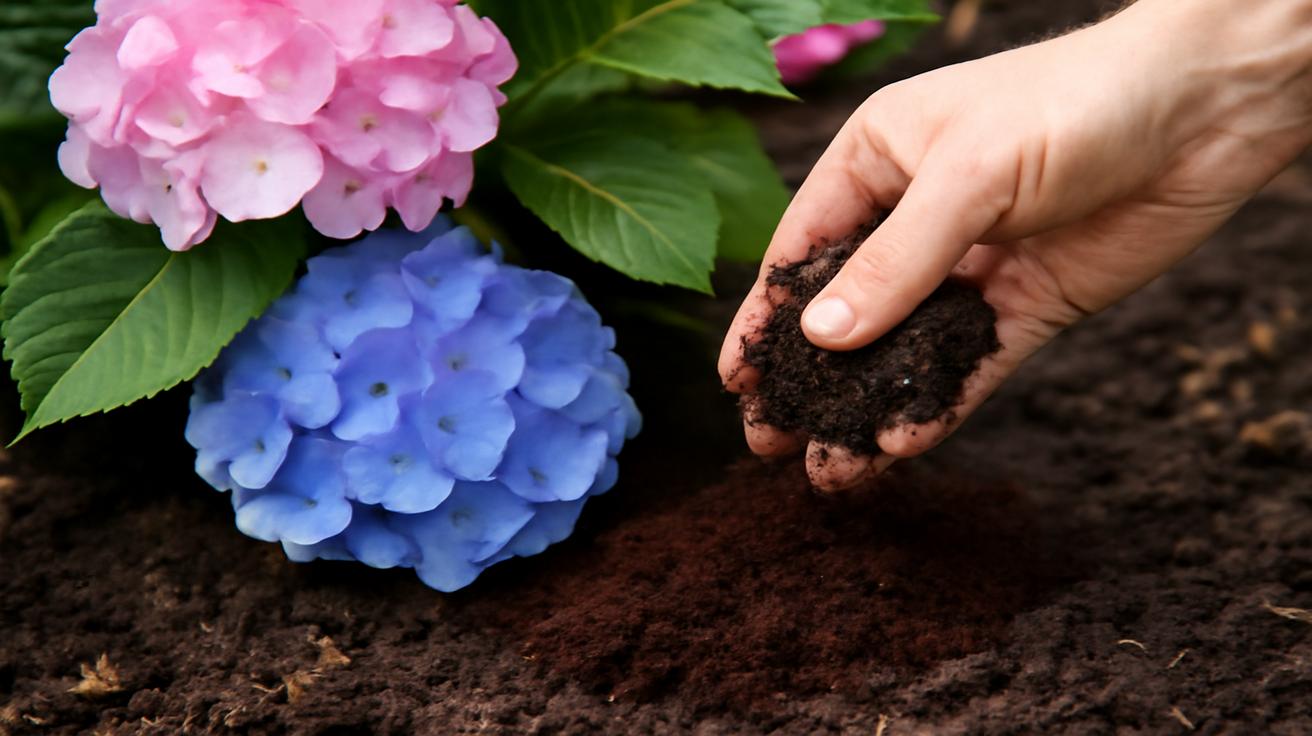
The first time I watched hydrangea flowers change color, it felt like a magic trick I wasn’t supposed to see. One week they were a soft, hesitant pink. A month later, the same bush along my neighbor’s fence glowed a deep, cloudless blue, like someone had quietly repainted the garden overnight. There was no new plant, no dye, no wizard with a watering can—just a woman in worn gardening gloves, walking out each morning with a mug in one hand and a small tin in the other.
That tin, she told me, was full of used coffee grounds.
The morning ritual that colored the garden
The ritual began, as many good rituals do, in the kitchen. The kettle hissed, the grinder growled, and the smell of fresh coffee drifted through the house like a promise. By the time the first cup had cooled enough to sip, the coffee maker held what most of us consider trash: a dense, fragrant puck of damp, spent grounds.
Most people knock that puck into the bin, tie up the bag, and send it off to the landfill without a second thought. But if you pause—if you hold that warm filter in your hands and really look at it—you might notice something: it still smells alive. Earthy. Dark. It looks less like “waste” and more like something that wants to go back to the soil.
Out in the yard, the air was different from the kitchen—cooler, sharper, tinged with the green scent of wet leaves and the faint sweetness of old blossoms. Hydrangeas, with their mophead blooms and lush, crinkled foliage, anchored the beds like grandmothers at a family gathering: solid, generous, impossible to ignore.
My neighbor would walk the narrow path, coffee in one hand, a container of yesterday’s grounds in the other, and stop at the hydrangeas. She didn’t bury the grounds deeply or scatter them wildly. She just sprinkled a thin ring around the base of each shrub, like seasoning a favorite recipe. A little here, a little there, always about a hand’s width from the stems, never piled up against them.
“They like their coffee,” she laughed when I asked what she was doing. “Turns them blue.”
The quiet chemistry behind blue hydrangeas
Hydrangeas, unlike most flowers, don’t always come with a fixed color destiny. For many varieties, especially the popular bigleaf hydrangeas (Hydrangea macrophylla), their blossom shades respond to the soil beneath them. While genetics set the stage—some varieties are naturally white or more reliably pink or blue—the final color often comes down to one main puppeteer: soil pH.
In human terms, think of soil pH as the garden’s mood: acidic soils are on the sour side (lower pH), and alkaline soils are more mellow and sweet (higher pH). Hydrangeas read that mood in a very specific way. In acidic soils, roughly below pH 6.0, aluminum in the soil becomes more available to the plant. The hydrangea absorbs it, and the flowers shift toward blue. In more alkaline or neutral soil, that aluminum gets locked up and unavailable, and blooms tend toward pink or even red tones.
Coffee grounds enter the story here as a kind of subtle mood shifter. Many gardeners have heard “coffee grounds are acidic” and imagine them as a quick, powerful way to alter soil pH. The truth is quieter and more nuanced. Fresh, unused coffee grounds are moderately acidic, but once brewed, much of that acidity goes into your mug. Used coffee grounds often sit close to neutral or just slightly acidic. They won’t transform your soil overnight. But add them slowly, steadily, over time, and they can help nudge the needle—especially when combined with other organic matter and an already slightly acidic environment.
What makes them special is not just their faint acidity, but their texture, nutrients, and the way they invite life into the soil. Earthworms love them. Soil microbes break them down. Over months, they contribute organic material that improves structure, water retention, and gentle nutrient release. In that richer, livelier soil, the chemistry that turns hydrangea flowers blue can happen more readily.
The subtle art of not overdoing it
It’s tempting to hear “coffee grounds turn hydrangeas blue” and rush over with a bucket the size of a small bathtub. But soil, like people, responds better to gentle, consistent care than wild swings and grand gestures. Too many grounds dumped in one place can form a dense, crusty layer that repels water instead of absorbing it, or encourage fungal growth where you don’t want it.
The trick is thin layers and patience. Imagine dusting cocoa on top of a tiramisu rather than frosting a cake: light, even, and breathable. That’s the kind of coverage hydrangeas appreciate. Just enough to work into the topsoil or blend with mulch, never enough to smother.
How to use coffee grounds around hydrangeas (without making a mess of it)
If you’re standing in your kitchen right now, filter in hand, wondering whether your morning habit can become your hydrangea’s new favorite thing, the answer is: yes, with a little care. Here’s a simple, down-to-earth way to get started.
Step 1: Save and dry your coffee grounds
Used coffee grounds are damp, and if you toss them straight into a closed container and forget about them, they can develop mold. A little fuzz isn’t the end of the world in the compost pile, but it’s not something you want in a neat garden bed.
Spread your grounds out on a shallow tray, plate, or old baking sheet and let them air-dry for a day or two. In warm kitchens, they dry quickly and crumble easily between your fingers. Once dry, you can store them in a lidded container or jar and add to your stash through the week.
Step 2: Apply in moderation
Head out to your hydrangeas and gently loosen the top inch or so of soil or mulch around the base with your fingers or a small hand fork. Then sprinkle a thin layer of dried grounds in a rough ring around the plant, staying a few inches away from the main stems. Think of it as seasoning the soil, not burying it.
For a mature hydrangea shrub, a small handful every week or two during the growing season is plenty. You don’t need to see a dark, obvious circle—just a faint dusting is enough. After sprinkling, lightly work the grounds into the top layer or cover them with a bit of mulch so they don’t clump on the surface.
Step 3: Pair with other organic matter
Coffee grounds work best as part of a broader soil-care approach, not as a solo act. Mix them into compost or combine them with leaf mold, pine needles, or shredded bark mulch. These companions can also support a slightly more acidic environment over time.
Over the course of a season, this slow layering builds a soft, living blanket over the roots. The soil becomes springy underfoot, rich with unseen threads of fungi and the quiet movements of earthworms. That living soil doesn’t just influence flower color—it supports overall plant health, from leaf vigor to drought resilience.
What to expect (and when): the patience of blue
Hydrangeas are not impulsive artists. They won’t repaint their petals at the first hint of coffee in the soil. Color change usually takes time—and often a full growing season or more—depending on your starting soil conditions, plant variety, and how consistently you adjust your soil.
If your soil is already moderately acidic and contains some available aluminum, your hydrangea may start showing tinges of lavender, periwinkle, or light blue by the next flowering flush. In more alkaline soils, it can take longer—and you may see flowers shift through a spectrum: pink edges with a blue heart, purplish tones, or mottled shades that look like watercolor experiments.
It helps to think of this as a relationship rather than a switch. You’re not flipping your hydrangea from pink to blue like a lightbulb. You’re nudging the environment, feeding the soil, watching the plant respond, and adjusting gently season by season. That’s part of the charm: you get to participate in the slow alchemy of color.
And if you’re wondering whether your efforts are working, a simple soil test can tell you a lot. Many garden centers sell basic pH test kits, and they can show whether your soil is leaning more acidic over time. Aim, generally, for a pH somewhere in the mid-5s to low-6s if blue blooms are your goal.
| Soil pH Range | Likely Hydrangea Color | What Coffee Grounds Help Do |
|---|---|---|
| 7.0 and above (alkaline) | Pink to deep pink | Minimal direct effect; may slightly lower pH over long periods with other amendments |
| 6.0–7.0 (neutral-ish) | Pink, sometimes lavender | Can gently nudge soil toward mild acidity and improve structure |
| 5.0–6.0 (slightly acidic) | Lavender to blue | Supports ongoing acidity, feeds soil life, and complements other acidifying practices |
| Below 5.0 (strongly acidic) | Deep, intense blue | Less impact on pH; primarily adds organic matter and nutrients |
Beyond color: the other gifts of coffee grounds
While the drama of shifting blooms from pink to blue is what catches our imagination, coffee grounds bring quieter gifts, too. When you sprinkle them around hydrangeas, you’re not just participating in a color experiment—you’re helping to build a more self-sustaining little ecosystem in your soil.
Used coffee grounds contain small amounts of nitrogen, plus traces of phosphorus, potassium, and micronutrients. They’re not a complete fertilizer, and they won’t replace a thoughtful feeding routine, but they do contribute a gentle, slow-release boost. Think of them as a side dish, not the main course, on your hydrangea’s menu.
They also improve soil texture. In heavy clay, worked-in grounds can gradually create more pockets for air and water to flow. In sandy soils, they help hold moisture a bit longer, giving roots a better chance to drink between rains or waterings. Over time, as they break down, they become part of the humus layer—the soft, dark, crumbly material that gardeners dream of.
Then there’s the life they invite. Earthworms are famously drawn to coffee grounds, and their tunneling can quietly transform a stubborn patch of soil into something more friable and rich. Microorganisms also thrive on organic additions, and their invisible work—from breaking down organic material to cycling nutrients—creates a healthier environment for plant roots.
There’s a kind of satisfaction in knowing that the same grounds that energized your morning are now fueling a tiny underground community that, in turn, supports your hydrangeas. It’s a closed loop with a touch of poetry: from bean to brew to bloom.
A few gentle cautions
Even good things have limits. Keep these points in mind as you build your coffee-and-hydrangea ritual:
- Don’t smother the soil. Always apply coffee grounds in thin layers or mix them with mulch or compost.
- Watch for water flow. If water seems to pool or run off instead of soaking in where you’ve applied grounds, you may be using too much in one spot.
- Be patient with pH. Coffee grounds alone are not a fast-acting acidifier. For significant pH shifts, they work best alongside other strategies like elemental sulfur (used carefully) and acid-forming fertilizers.
- Know your plant. White hydrangeas generally don’t change color with pH; they’ll stay white whether you add coffee or not. Coffee grounds still benefit the soil, but you won’t get blue blooms from a naturally white variety.
A new way to see your kitchen “waste”
Once you start using coffee grounds in the garden, you may notice something changing—not just in your hydrangeas, but in the way you see everyday habits. The act of walking from kitchen to flowerbed with your saved grounds becomes its own quiet ritual, a small daily offering to the patch of earth you care for.
You’ll start to feel the texture of the grounds as you crumble them between your fingers. You’ll notice how they darken the soil in soft patches, how the smell of coffee briefly mingles with damp earth and leaf litter. On some mornings, the hydrangeas may be dotted with dew, each drop catching the first light while last season’s grounds lie hidden beneath the mulch, still breaking down, still working.
Gardeners are, by nature, people who think in seasons instead of minutes. Coffee grounds fit that mindset perfectly. They ask you to believe that small, repeated acts—saving what you once threw away, sprinkling it thoughtfully, paying attention to the soil’s feel and the flowers’ colors—can add up to visible transformation.
Someday, someone might walk past your yard and pause, caught off guard by a hydrangea bloom the color of deep sky or sea glass. They might ask, as I once did, “How did you get them to turn so blue?” And you’ll smile, maybe holding your morning mug, and tell them about chemistry and soil and coffee and time. About not being so quick to throw things away. About how even the dregs at the bottom of the pot can become part of something beautiful.
FAQ
Do coffee grounds really turn hydrangeas blue?
Coffee grounds can help support the conditions that encourage blue hydrangea flowers, but they are not a magic switch. They contribute mild acidity and organic matter, which, over time and in already suitable soils, can help create an environment where aluminum is more available and blue tones are more likely. Significant color change usually requires a combination of slightly acidic soil, available aluminum, and consistent care.
How often should I put coffee grounds around my hydrangeas?
For most hydrangeas, a small handful every week or two during the growing season is enough. Always apply in thin layers and avoid dumping large amounts at once. You can also mix the grounds into your compost and use that compost around your hydrangeas a few times a year.
Can I put fresh (unused) coffee grounds on my hydrangeas?
It’s better to use brewed, used coffee grounds. Fresh grounds are more acidic and can potentially create too strong a localized effect or interfere with seed germination in some situations. Used grounds are milder, safer, and still beneficial for soil texture and life.
Will coffee grounds hurt my hydrangeas if I use too much?
In large quantities, coffee grounds can form a dense layer that repels water, encourages mold, or temporarily imbalances soil conditions. That’s why moderation is important. Thin layers, mixed with other organic materials, are safe. If you’ve over-applied, gently rake and mix the grounds into the topsoil or dilute the area with additional mulch or compost.
Do all hydrangeas change color with soil pH?
No. Primarily bigleaf hydrangeas (Hydrangea macrophylla) and some related types have flower colors influenced by soil pH and aluminum availability. White hydrangeas usually stay white regardless of pH, though they may take on slight tints as blooms age. If your hydrangea is a fixed-color or white variety, coffee grounds can still improve soil health, but they won’t turn the flowers blue.
Are coffee grounds enough to acidify my soil?
On their own, coffee grounds are usually not strong enough to make a dramatic change in soil pH, especially in already alkaline soils. They work best as part of a broader strategy: incorporating other acidic organic materials (like pine needles), using acid-forming fertilizers where appropriate, and, if needed, carefully applying soil amendments like sulfur based on a soil test.
Can I use coffee grounds on other garden plants?
Yes, many plants appreciate the organic matter from coffee grounds when used in moderation. Acid-loving plants like blueberries, azaleas, rhododendrons, and camellias often benefit. Just remember the same rules: small amounts, mixed in or mulched, not piled up thickly. Always observe how your plants and soil respond and adjust your habit accordingly.