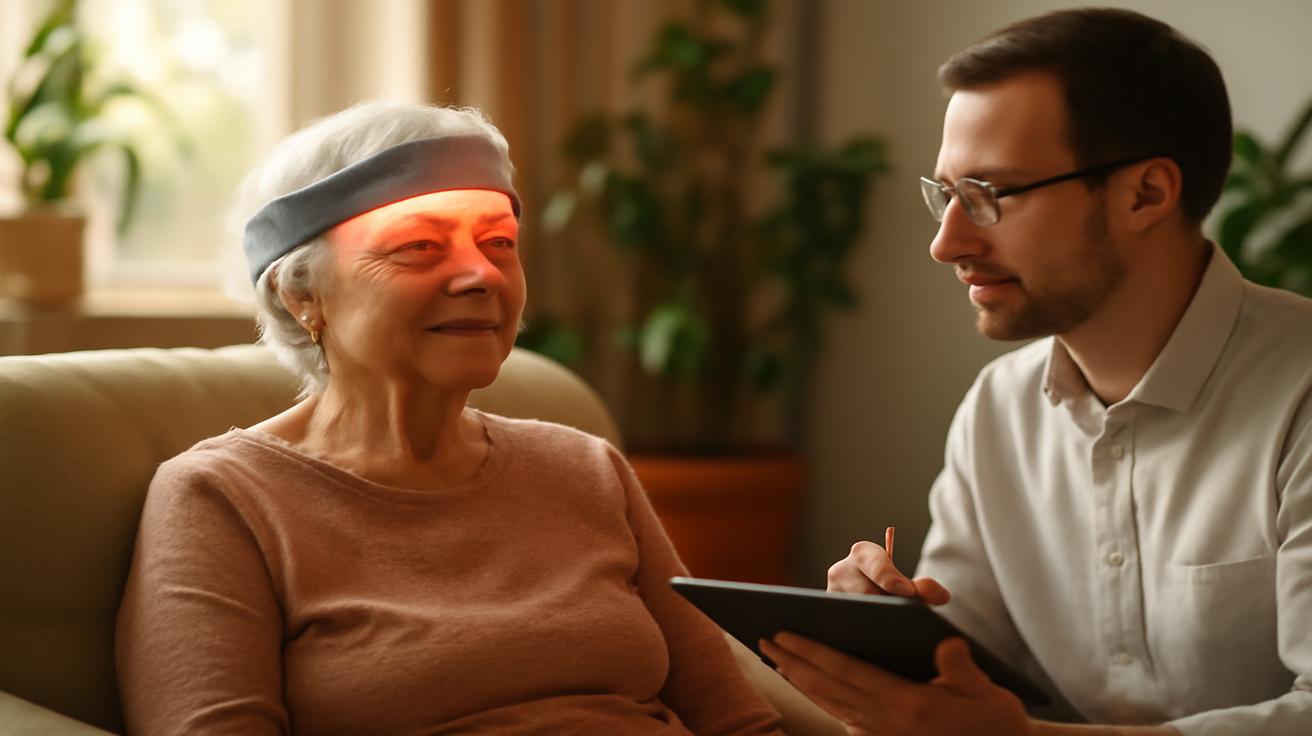
The first thing you notice in her lab is the quiet. Not the humming, beeping, screen‑filled chaos you might expect from a cutting‑edge neuroscience facility, but a kind of attentive stillness. Then, slowly, your eyes adjust. The room is dim, yet pulsing softly—barely perceptible flickers of light, like the final glow of embers beneath ash. A man sits in a comfortable chair wearing what looks like a futuristic visor. On a nearby table, a ring of LEDs glows gently at his feet. His eyes are closed. His hands are relaxed. And somewhere deep inside his brain, if the science is right, neurons are beginning to dance in time with the light.
The rhythm inside an aging brain
“We used to think of Alzheimer’s as a kind of unstoppable erosion,” the neuroscientist tells me. Her name is Dr. Elena Marquez, and she’s been studying memory and brain rhythms for almost two decades. “Plaques build up, neurons die, and you just… lose ground.” She pauses, searching for words that don’t sound like a medical textbook. “But we’re learning it’s not just about what’s dying. It’s about what’s falling out of sync.”
She moves to a whiteboard already crowded with rough sketches of neurons and wavy lines. “Your brain isn’t just a pile of cells; it’s an orchestra. Different regions keep time with each other using electrical rhythms. And one of the most important of these is called the gamma rhythm.” She draws a quick, tight oscillating wave. “About 40 times a second—40 hertz—your neurons pulse together. It’s fast, it’s precise, and it’s deeply tied to attention, learning, and memory.”
In a healthy brain, gamma waves surge when you’re focusing on a face, trying to remember a name, following the twists of a story. But in Alzheimer’s, studies have shown, those gamma rhythms weaken and fragment. The orchestra doesn’t stop playing, exactly; it just drifts out of time. Notes collide. Cues are missed. And gradually, memories become harder to lay down, harder to retrieve.
“That’s what drew me in,” Marquez says. “The idea that maybe, before neurons actually die, their timing slips. If we can restore that timing, could we buy the brain more time? Maybe even reverse some early symptoms?” She smiles, but her eyes are serious. “That’s where the light comes in.”
How flickering lights became a medical experiment
Light therapy sounds, at first, more like a wellness trend than a medical trial. You picture spa rooms and soft music, or sunrise alarm clocks promising better sleep. But the light in Marquez’s lab is different—narrow, precise, calculated to match the brain’s own language.
“We learned years ago that if you flash a light at 40 hertz, the visual cortex tends to follow along,” she explains. “Neurons fire in sync with the flicker. It’s like tapping a steady beat on a table—you can’t help but feel it.” In animal studies, something astonishing happened when researchers did this not just once, but day after day. Mice with early Alzheimer’s‑like changes in their brains were exposed to carefully pulsed 40‑hertz light and sound. Over time, their brain tissue showed fewer sticky amyloid plaques and lower levels of another toxic protein called tau. Immune cells in the brain—microglia—woke up and began cleaning house with new vigor.
“Those first experiments were almost unbelievable,” Marquez says. “You shine flickering light at the eyes and play a matching tone through the ears, and inside the brain, areas crucial for memory start shifting. The rhythms strengthen. The immune system seems to re‑engage. It was like finding a switch we didn’t know existed.”
Of course, mice are not people. Their brains are smaller, simpler, and disease can be induced in controlled ways that don’t mirror the slow, messy sprawl of human aging. “But the principle,” she says, tapping the board again, “the principle that you can nudge brain rhythms from the outside—that’s powerful.”
From lab mice to living rooms
Translating this idea into human therapy means stepping out of the sterile environment of the animal lab and into living rooms, clinics, and memory centers where early Alzheimer’s is a daily, intimate presence. It means working with people who can still tell you what they’re afraid of losing.
In the clinic wing adjacent to her lab, Marquez introduces me to Tom, a retired engineer in his early seventies. His diagnosis: mild cognitive impairment due to Alzheimer’s disease. Not full‑blown dementia yet, but the early drift has started. Names slip away. Directions blur. The moments of “what was I doing just now?” are no longer rare.
Tom sits in the same soft chair I noticed earlier, his visor adjusted over his eyes. Through its inner surface, a field of light pulses at 40 hertz—too fast to see as individual flashes, but enough to create a faint shimmer in your peripheral vision. A matching 40‑hertz tone hums softly through cushioned headphones. The device looks almost casual, like something you might use for a guided meditation session.
“First time I tried it, I thought, that’s it?” Tom says later, chuckling. “It’s just light and a faint sound. I expected something… bigger. More sci‑fi. But it kind of sneaks up on you. You sit there, you relax, the flicker fades into the background. It doesn’t feel like treatment.”
He’s been using the device at home for several months now, part of a clinical study. Each day, he settles into his favorite armchair, pulls the blinds just enough to soften daylight, and starts a 40‑minute session. On the coffee table: a notebook where his wife, Ellen, notes small changes—how easily he recalled a conversation, whether he misplaced his wallet again, whether he needed help finding the word “microwave” or it just came.
What the brain looks like under the light
Behind the scenes, Marquez and her team are less interested in Tom’s notebook (though they read every entry) than in what they can see directly through brain scans and EEG recordings. In one lab, a participant reclines inside an fMRI machine, the tunnel lit with a faint, synchronized flicker. In another room, a volunteer sits calmly while a cap full of electrodes reads the shifting currents along her scalp.
“This is where it gets really exciting,” Marquez says as she scrolls through colorful images on her computer. “When we expose people with early Alzheimer’s symptoms to 40‑hertz light and sound, parts of their brain that were showing weakened gamma rhythms start to come alive again. The oscillations sharpen. Areas involved in memory and attention, like the hippocampus and frontal cortex, start showing more coordinated activity.”
Some participants even show structural changes over time. “In a few small pilot trials, daily stimulation has been associated with slowed shrinkage in key brain regions,” she explains. “We’re talking millimeters and subtle trends, not magical regrowth. But slowing the atrophy—even a little—can mean months or years of preserved independence.”
The early data, from small groups of volunteers, suggest something else too: tiny but measurable improvements in memory tests, attention, and daily function. Not a full reversal, not a cure, but a nudge in the opposite direction of decline. Enough for people to notice in small ways: recognizing a neighbor faster, tracking a conversation more easily, following a recipe without losing their place.
“We have to be very cautious,” Marquez says. “These are still early‑stage human trials. Placebo effects are real. Not everyone responds. But for the first time, we’re seeing hints that a non‑invasive, drug‑free intervention might actually change the course of early Alzheimer’s, not just mask symptoms.”
The gentle discipline of daily light
Light therapy for Alzheimer’s, as it’s being tested now, doesn’t look dramatic. It looks like routine. A daily ritual of sitting quietly, headset on, room dimmed, light and sound doing their steady work in the background. The science, however, is anything but simple.
“We still don’t fully understand the chain of events,” Marquez admits. One leading idea is that the artificial 40‑hertz stimulation entrains the brain’s own gamma rhythms, helping scattered neurons fire together again. That synchronized firing might, in turn, wake up microglia—the brain’s cleanup crew—encouraging them to clear out amyloid plaques and other harmful debris more efficiently.
In animal models, this cascade has been observed directly: after consistent flicker exposure, microglia change shape, becoming more active; amyloid levels drop; blood vessels open slightly to ease nutrient and waste flow. “It’s like stirring a pond that’s beginning to stagnate,” Marquez says. “You get things moving again.”
In humans, the picture is fuzzier but tantalizing. Some participants show reduced levels of certain Alzheimer’s‑related proteins in spinal fluid. Others show changes in blood markers of inflammation. Brain scans hint at improved connectivity—wires talking to each other more clearly.
“No one thinks light alone will cure Alzheimer’s,” she says. “But as part of a broader toolkit—alongside medications, sleep support, cardiovascular health, cognitive training—it could become a way to keep the orchestra playing in time just a little longer.”
Living at the edge of hope and evidence
For families like Tom and Ellen’s, daily light sessions live in a delicate space between hope and uncertainty. Ellen tells me she’s wary of getting swept up in promises. “We’ve been through so many headlines,” she says. “Miracle drugs, miracle diets, miracle brain games. You learn to hold your heart back a little.”
And yet, there was that afternoon when Tom joined a group conversation at their granddaughter’s birthday party and stayed with it—threading comments, making jokes, remembering who had said what. “It felt like him,” Ellen says quietly. “The way he used to be in a room full of people. Maybe it was just a good day. But we notice every good day.”
Marquez’s team is careful not to oversell. Participants in trials hear a familiar refrain: early, experimental, not guaranteed. Some people don’t feel any difference. A few find the flicker irritating or tiring. People with a history of seizures are generally excluded, because intense visual flicker can, in some cases, trigger epileptic activity.
“We’re balancing safety, expectation, and scientific rigor,” Marquez says. Trials are randomized and controlled; some participants get flicker at active therapeutic frequencies, others get sham or non‑gamma patterns. No one knows which group they’re in until the study ends. “It’s the only way to be sure what we’re seeing isn’t just wishful thinking.”
Still, the feeling in the lab is one of cautious momentum. Grants are being renewed. Larger trials are launching in multiple centers. Engineers are refining devices to be less bulky, more comfortable, more adaptable to home life. “The goal,” Marquez says, “is something a person can slip on while they read a book or listen to the radio. Something that folds into life, not takes it over.”
A small technology with big questions
The technology itself is deceptively simple: LEDs, sound emitters, timing circuits, a comfortable form factor. But the questions it raises are vast. How early would you have to start gamma‑based light therapy to get the most benefit? Would people at genetic risk for Alzheimer’s, but still cognitively normal, use it as prevention? How long do benefits last after you stop? And perhaps most intriguingly: could this approach help other brain conditions marked by disrupted rhythms—like depression, schizophrenia, or Parkinson’s disease?
“The brain has so many different rhythms—delta, theta, alpha, beta, gamma,” Marquez says. “They’re like overlapping tides. If we can learn to selectively nudge them with light and sound, that opens an entirely new class of therapies. We’d be treating not just chemistry, but timing.”
There are ethical questions too. Who gets access first if the therapy proves effective—those who can pay out of pocket, or those at highest risk? Will regulators treat light‑based neuromodulation like a medical device or like a consumer gadget? How do you control quality if, sooner or later, cheap “Alzheimer’s light boxes” flood the market with no evidence behind them?
Marquez worries about that last part. “We’ve seen it with brain training apps and supplements,” she says. “A kernel of good science turns into an avalanche of products that promise far more than they can deliver. People with Alzheimer’s are vulnerable to that. Their families are desperate. We have a responsibility to make sure this doesn’t turn into another wave of false hope.”
What people are actually doing in trials
To understand what this therapy really looks like, it helps to see the daily reality laid out clearly. In Marquez’s current study, participants with early‑stage Alzheimer’s or mild cognitive impairment follow a structured routine that might look something like this:
| Element | Typical Setup in a Trial |
|---|---|
| Session length | About 30–60 minutes per day |
| Frequency of light/sound | 40 Hz (40 pulses per second), targeting gamma rhythms |
| Duration of study | Often 3–12 months of daily use, with follow‑up assessments |
| Environment | Quiet room, lights dimmed; participant seated comfortably at home or in clinic |
| Monitoring | Regular cognitive tests, brain scans or EEG, and symptom questionnaires |
From the outside, this might look like someone simply resting in a chair with a light visor and headphones, maybe holding a cup of tea, maybe listening to the faint murmur of life in the next room. Inside the skull, if the theory holds, billions of neurons are being gently coaxed into a more harmonious pulse.
“The most powerful interventions aren’t always the most dramatic,” Marquez says. “Sometimes they’re just the most consistent.”
Where curiosity meets care
Toward the end of my visit, the lab grows quiet again. The last scan of the day has finished. The visor is back in its cradle. For a moment, the faint LED rings sit dark and still, as if resting between heartbeats.
I ask Marquez what first drew her to Alzheimer’s research. She tells me about her grandmother, who slowly lost the thread of family stories she once told with theatrical flair. “The night she forgot my name,” Marquez says softly, “I remember thinking: this isn’t just memory. Something about the rhythm of who she was had changed.”
Years later, as a young scientist, she watched early recordings of disrupted gamma rhythms in Alzheimer’s patients and felt a flash of recognition. “It was the same feeling. Like listening to a song you love, but the beat has slipped just enough that you can’t dance to it anymore.”
Today, she stands in a room where light pulses at the same speed the brain uses to focus, learn, and remember. It’s an audacious idea—using simple flickers and tones to reach into the most intricate structure we know and ask it to find its rhythm again. The data aren’t conclusive yet. The path from pilot trials to everyday treatment is long, tangled with questions and caution.
But for people at the blurry edge of memory loss, the very existence of such experiments feels like a statement: the story is not over. The brain is not a static object succumbing helplessly to disease; it is a living, rhythmic system, responsive, adaptable, sometimes surprisingly willing to change if you find the right way to ask.
On my way out, I pass the waiting area where another participant sits, visor case on his lap, chatting with his daughter. He looks like anyone’s grandfather, laughing at a small joke, pausing once to search for a word and then finding it. There’s no visible sign that his brain is being gently retuned, no drama, no cinematic transformation. Just a quiet bet being placed, day after day, on the brain’s capacity to respond to rhythm and light.
“We’re not turning back time,” Marquez had said earlier. “We’re trying to give people more of it—more days when they recognize their loved ones, more conversations they can follow, more mornings when they wake up clear. If a simple pattern of light and sound can do even a part of that, it’s worth every year we spend testing it.”
Frequently Asked Questions
Is light therapy for Alzheimer’s available as a standard treatment yet?
No. Right now, gamma‑frequency light and sound therapy for Alzheimer’s is still experimental. It’s being tested in clinical trials at research centers. Some consumer devices claim similar benefits, but they typically haven’t gone through rigorous testing, and their effectiveness is unknown.
Can flickering lights be dangerous for people with Alzheimer’s?
In clinical trials, safety is monitored very carefully. People with a history of epilepsy or seizure disorders are usually excluded, because flickering light can sometimes trigger seizures. Mild eye strain or headaches can occur in some participants, but many tolerate the sessions well. Anyone considering this kind of approach should only do so under medical supervision.
Does light therapy cure Alzheimer’s disease?
No. There is currently no cure for Alzheimer’s disease. Early studies of 40‑hertz light and sound suggest it might slow progression or improve some symptoms in the early stages, but results are still preliminary. Researchers see it as a possible tool to delay decline, not a cure.
Who might benefit the most from gamma light therapy if it proves effective?
Based on current research, people in the very early stages—those with mild cognitive impairment or early Alzheimer’s—are the main focus. The idea is to support brain rhythms and function before large numbers of neurons are lost. It’s less clear how much benefit people with more advanced dementia would receive.
Can I try to recreate this therapy at home with regular lights?
It’s not recommended. The clinical devices use carefully controlled frequencies, intensities, and patterns that have been tested for safety and measured for brain effects. Improvised flickering lights could be ineffective or, in some cases, unsafe—especially for people with unknown seizure risk. If you’re interested, talk with a neurologist or memory specialist about ongoing, legitimate clinical trials instead.