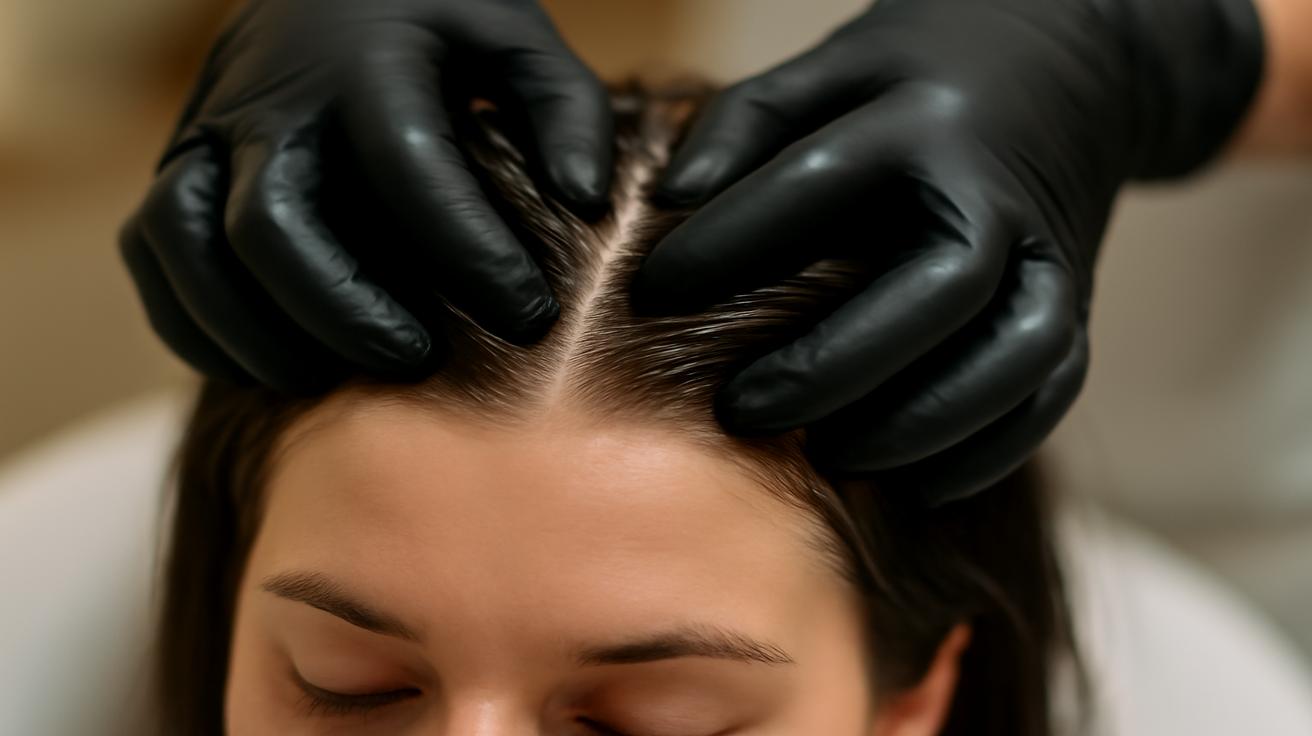
The first time someone really touches your scalp with intention, you realize how neglected that small, hidden landscape has been. Fingers glide through your hair, pausing thoughtfully in the tender valley at the base of your skull. The world shrinks to ten gentle points of contact. Your shoulders drop. Breath slows. Somewhere beneath the surface, tiny blood vessels wake up, like streams thawing after winter, and for a moment you wonder—could something this simple be the missing piece for your hair?
The Quiet Science Beneath Your Fingertips
Trichologists—the specialists who live and breathe hair and scalp health—will tell you that hair growth is rarely about a single miracle product. It’s about circulation, consistency, and the surprisingly emotional relationship you have with your scalp. They talk about follicles the way botanists talk about soil. You can’t just water the leaves, they’ll say; you have to tend to the ground.
Imagine your scalp as a hillside of tiny, partially dormant seeds. Some are sprouting bravely, some are resting, and some are on the brink of giving up. Now imagine sending a gentle, rhythmic wave of movement across that hillside every day—never harsh, never rushed—nudging those roots to pull in more nutrients, more oxygen. That’s the premise behind scalp massage for hair growth as trichologists describe it: not a quick rub, but a deliberate sequence of touch that coaxes a sluggish ecosystem back to life.
When you massage your scalp correctly, a few things begin happening beneath the skin:
- Blood vessels dilate, delivering more oxygen and nutrients to hair follicles.
- The thin network of fascia and muscles loosen, particularly the tight galea aponeurotica (the fibrous layer under your scalp) that can restrict circulation when chronically tense.
- Stress hormones begin to soften their grip; your nervous system drops a gear, dialing down the physiological chaos that often worsens shedding.
- Natural sebum redistributes, wrapping individual strands with a thin, protective sheen instead of building up in certain spots and suffocating roots.
To a trichologist, the scalp is living terrain. And their massage sequences are less like random kneading and more like a map—traced, refined, and repeated until your hands know the route by heart.
The Trichologist’s Golden Rule: Gentle, But Not Shy
“People either barely touch their scalp, or they attack it,” one trichologist likes to say. “We want neither.” The sweet spot is firm enough to move the skin over the skull, but never so hard that you feel pain, heat, or scratchiness. Think of nudging the scalp, not grinding it.
Before you begin, your fingers become your tools—rounded, warm, slightly oiled if you like. Some trichologists recommend just a drop or two of lightweight oil to reduce friction: jojoba, grapeseed, argan, or a formula your own hair expert suggests. But oil is optional; what matters most is intention, rhythm, and coverage.
To make this all feel less abstract, it helps to visualize how long you’ll spend and what you’re actually doing at each stage. Here’s a simple guide inspired by trichologist-approved routines, translated into an easy daily sequence:
| Step | Area | Technique | Duration |
|---|---|---|---|
| 1 | Nape & base of skull | Slow circular warm-up with fingertips | 2–3 minutes |
| 2 | Sides above ears (temporal area) | Press-and-release circles, moving upward | 3–4 minutes |
| 3 | Crown & top of head | Scalp lifting (gently sliding skin over skull) | 3–4 minutes |
| 4 | Frontal hairline & temples | Small circles + fingertip tapping | 3–4 minutes |
| 5 | Full scalp sweep | Slow “combing” with fingertips from front to back | 2–3 minutes |
Fifteen minutes total. The length of a podcast segment, a cup of tea, the space between getting into bed and actually trying to fall asleep. To a trichologist, what matters is that you do those minutes most days of the week—because hair doesn’t respond to grand gestures. It responds to habits.
The Step-by-Step Sequence Trichologists Swear By
Now let’s walk through the sequence itself, not like a dry set of instructions, but as something you can feel as you read—so that by the time you try it, your hands move more instinctively.
1. Grounding at the Nape
Start where the neck meets the skull. Interlace your fingers, place the pads—not the nails—of both hands across that ridge, and take a breath that reaches all the way down to your belly. Exhale slowly, letting your shoulders drop away from your ears. Your body is the landscape your scalp lives on; if the whole thing is tense, blood flow everywhere tightens.
Begin with slow circles, no more than the size of a coin. You’re not sliding over the hair so much as moving the skin beneath it, in tiny, deliberate motions. Trichologists love this area because so much tension accumulates here from screen time and poor posture. Warming it up first helps circulation flow upward more freely.
After a minute or two, use your thumbs to press gently along the base of the skull, from the center outward, like pressing doorbells in a row. Hold each point for a few seconds. If any spot feels slightly tender, that’s often where muscles and fascia are gripping too hard. Keep your pressure kind, but don’t abandon the spot—give it a few extra slow circles, like you’re convincing a clenched fist to open.
2. Waking the Sides: Above the Ears
Slide your hands upward so your fingertips rest in the soft fields above your ears. This is the temporal region, where blood supply is rich but often underused, and where some people notice early thinning. Here, trichologists favor a press-and-release rhythm.
Plant your fingertips, press just enough to feel the skin move, then draw small circles. After three or four circles, slightly shift your hands upward. Climb the sides of your head in slow increments, both hands moving in mirrored paths. Your scalp might tingle faintly as blood vessels respond; this is the quiet language of circulation returning.
As you move, you may notice how your jaw relaxes on its own. The muscles here speak to one another invisibly. When the temporal region softens, so does some of the pressure you unconsciously clench in your teeth. The body is never just parts; it’s an orchestra. Scalp massage, in its calm little way, is a conductor’s hand.
3. The Crown: Loosening the Invisible Helmet
Reach the crown of your head, that slightly domed center where many people complain of tightness, tension headaches, or a peculiar sense that the scalp is “stuck.” Underneath sits the galea aponeurotica, a fibrous layer that can behave like a tightened drum skin when you’re stressed for long periods. Some trichologists suspect that this persistent tightness may subtly restrict blood flow to follicles in the region.
Here, swap circular motions for something more like gentle lifting. Sink your fingertips into the scalp and, instead of sliding them, try to move the scalp itself in tiny forward and backward motions, then side to side. You’ll feel the skin shift on the skull. It may feel strange at first, as if you’re discovering the scalp as a separate, living layer for the first time.
Work in slow grids: front of the crown, middle, back, always lifting, nudging, and releasing. If you picture the tissue ungluing just a little with each movement, you’re not far from how a trichologist imagines it. They describe these motions as “decompressing” the scalp—creating a bit more give, a touch more space for blood and lymph to travel.
The Hairline: Guarding the Most Vulnerable Borders
Trichologists pay particular attention to the frontal hairline and temples. These areas are often the first to tell the story of hormonal shifts, genetic patterns, or chronic stress. They’re also where hands tend to be shy, as if afraid that touching will speed up loss. The opposite is true, as long as you’re gentle: nourishing touch speaks directly to the follicles gathered along this vulnerable border.
4. The Front Row Follicles
Place all ten fingertips just behind your hairline, from temple to temple. Start by drawing small circles again, but smaller than before, as if you’re tracing the size of a raindrop. Move slowly back an inch, then another, until you’ve worked through the first few “rows” of hair.
Next, try light fingertip tapping along the entire hairline: from one temple, across the forehead border, to the other temple. The motion is feather-light, like typing on soft moss. This percussion, trichologists explain, adds a different kind of stimulus—quick, rhythmic, and invigorating without friction. Veins and capillaries respond to patterns just as much as pressure.
If certain spots along your hairline make you nervous—where the hair looks finer, or the skin more visible—pause there. Give those areas an extra minute of the gentlest circles, paired with a deep breath. You’re telling your nervous system that this isn’t a battlefield; it’s a garden you’re willing to tend.
5. The Final Sweep: Teaching Your Scalp a New Rhythm
To close the sequence, bring your hands to your forehead, fingertips at the hairline again. This time, drag your fingers slowly backward through your hair as if your nails were very short comb teeth, making sure the finger pads keep contact with the scalp beneath. Don’t rush to the back in one stroke; pause halfway, give a few circles, then continue moving.
Repeat this sweeping motion several times, slightly shifting your starting point each time to cover the whole width of your scalp—from the midline to each side. This full-length movement helps unify everything you just did, like smoothing the surface of a freshly raked garden bed.
End at the nape again, where you began. Place your palms there and simply rest them for a few breaths, feeling the warmth gather. Trichologists often say that this stillness at the end is almost as important as the movement—the moment when your nervous system logs the entire ritual as “safe, soothing, repeatable.”
What Trichologists Notice When People Actually Commit
In quiet trichology clinics, where magnified cameras zoom in on scalps and follicles like telescopes on galaxies, patterns emerge. When patients commit to a proper scalp massage routine—5 to 7 times a week, consistently, for months—trichologists begin to see subtle shifts:
- Reduced shedding, especially that alarming handful in the shower drain.
- More uniform oil distribution and fewer patches of greasy build-up or dry, flaky skin.
- Miniaturized hairs (those baby-fine strands) sometimes thickening slightly, or at least holding their ground rather than dwindling.
- Patients reporting fewer tension headaches and less scalp sensitivity.
They’re also the first to tell you what scalp massage is not: it’s not a cure for genetic hair loss, not a replacement for medical treatments when needed, and not a guarantee of dramatic regrowth. But as an ally—an amplifier of everything else you’re doing—it matters.
Think of it as making sure the mail can get through. Medications, serums, nutrition, and hormones are all messages traveling through your bloodstream. If circulation is sluggish or tissue is chronically tight, those messages arrive late or not at all. Massage doesn’t write the letters, but it clears the roads.
Listening to the Landscape of Your Own Scalp
What transforms this from a mechanical routine into something truly potent is attention. A trichologist would quietly ask, “What did you notice?” after you massage your scalp regularly for a few weeks—not because they don’t know the science, but because each scalp is its own terrain.
As you get to know yours, you may find:
- Certain areas always feel tighter—the crown, maybe, or the spot above your right ear.
- Your scalp changes with your cycle, your stress levels, or your sleep.
- Some days your skin drinks in a drop of oil eagerly; other days it prefers none at all.
This kind of listening is rarely encouraged in our rushed routines. We shampoo, maybe condition, maybe blast with heat, and hope for the best. But the scalp, like any living landscape, responds to observation as much as intervention. When you know that the same spots always feel tender, you can bring them up with a trichologist or dermatologist. When you notice flakes increase after high-stress weeks, you can see that your hair is, quite literally, telling your story back to you.
Over time, the massage becomes less of a “treatment” and more of a ritual—an agreement between you and this patch of earth you carry on your head. Fifteen quiet minutes where your hands and your nervous system and your hair follicles share the same slow, steady tempo.
Some evenings, you might sit by a window, watching the sky go from blue to violet, fingers working methodically through your hair. On other days, it might be a rushed five minutes in the shower, circles sketched through lather. Both count. The scalp doesn’t need perfection; it needs repetition. A familiar, comforting sequence that says: I remember you. I’m coming back. I’m keeping the rivers moving.
Somewhere beneath those gentle motions, a tiny follicle that’s been surviving on the edge might get just a little more of what it needs. Not a miracle, not overnight, but enough. Enough to hold on. Enough to thicken. Enough to remind you that tending to what’s already yours is its own kind of growth.
FAQs
How often should I do this scalp massage sequence to support hair growth?
Trichologists generally suggest aiming for 5–7 sessions per week, about 10–15 minutes each time. Consistency over several months is more important than long, occasional sessions.
Can scalp massage alone reverse genetic hair loss?
No. Scalp massage can support circulation and scalp health, but it cannot override strong genetic or hormonal factors. It works best alongside medical treatments, lifestyle changes, and professional guidance when needed.
Is it better to massage on dry hair or with oil?
Either is fine. Oil can reduce friction and add conditioning benefits, but it’s optional. Use only a few drops of a lightweight oil and avoid anything that irritates your skin. If you’re prone to buildup, limit oil use to 1–2 times a week.
Can I damage my hair or scalp by massaging too hard?
Yes. Overly aggressive rubbing, scratching with nails, or tugging at the hair can cause breakage and irritation. You should feel pressure and movement of the skin, but no pain, burning, or soreness afterward.
When should I expect to see any changes?
Most trichologists encourage giving any routine at least 3–6 months, because hair grows slowly and in cycles. You may notice reduced tension or improved scalp comfort sooner, but visible hair changes typically take longer.
Can I use a scalp massager tool instead of my fingers?
You can, as long as the tool is gentle and designed for the scalp. Many specialists still prefer fingers because they let you feel tightness, tenderness, and texture changes more accurately, but tools can be a helpful supplement.
Should I massage if I have dandruff, psoriasis, or scalp infections?
If you have an active scalp condition—especially with redness, open skin, pain, or heavy flaking—check with a dermatologist or trichologist before massaging. In some cases, vigorous massage can worsen irritation and should be modified or paused.