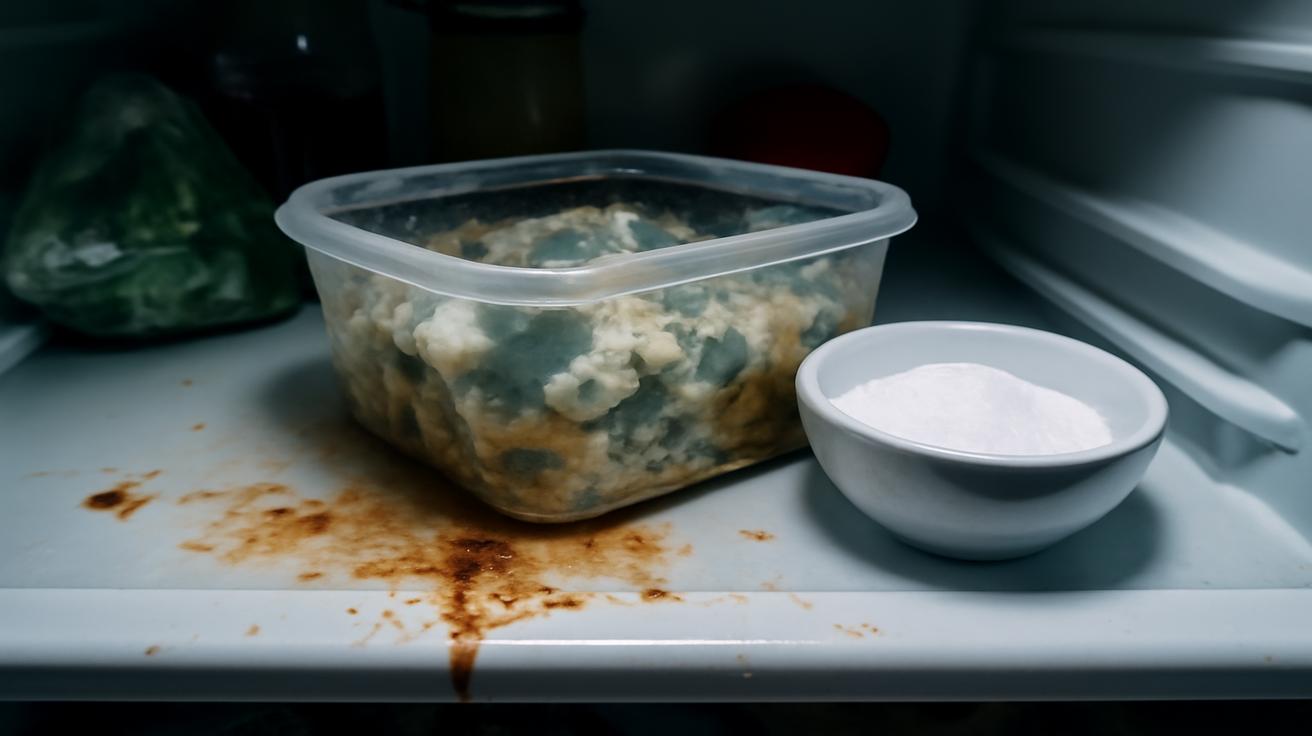
The smell hit you first—before your eyes even registered the open door, before the cold air slipped out in a tired sigh. It wasn’t quite rotten, not exactly sour, but a vaguely sweet, stale funk that wrapped around you like a damp towel. You stare into the white glow of your fridge, the humming machine that is supposed to keep life fresh, and you think, again: Why does it still smell like this?
The Fridge That Wouldn’t Forget
You’ve scrubbed. You’ve wiped every shelf twice with soapy water that smelled like citrus and optimism. You’ve filled bowls with baking soda, tucked them in the corners like tiny guardians. Once, in a moment of desperation, you even tried the internet’s strangest advice: a dish of coffee grounds, a plate of sliced lemons, a saucer of white vinegar that made your whole kitchen smell like a salad.
And yet, here it is. That familiar, ghostly odor that clings to the cold air. Not a sharp assault, but a memory—of takeout from a month ago, of forgotten leftovers, of something that dripped where it shouldn’t have. It’s faint, but it’s there. The kind of smell that makes you close the door faster than you need to, as if you could trap it inside and deny it breathing space.
There’s a phrase you might say to yourself in these moments: “My fridge just always smells.” Another, quieter thought follows: “Maybe that’s just how fridges are.” But they aren’t. A healthy refrigerator smells like almost nothing at all—just a soft hint of whatever you’ve put inside. If it has a personality, it should be mild, background, easily overwritten by tonight’s dinner.
So why doesn’t yours forget? Why does it remember every mistake, every spill, every abandoned container—even after you’ve cleaned until your knuckles wrinkle?
The One Mistake Everyone Makes (Without Knowing)
It’s tempting to blame the food alone. The smelly cheese. The fish from last week. The half an onion whose sharp scent seems to infiltrate everything, until your strawberries smell like they’re ready to be sautéed in olive oil. Food does play its role, of course. But food, on its own, is not the real villain in this story.
The mistake that makes fridge odors nearly impossible to eliminate is this:
We try to fix the smell, but not the system that creates it.
We treat the odor like a bad dream: wake up, shake it off, open a box of baking soda, wipe a shelf, promise to be better. Then life happens. A busy week. Groceries shoved in wherever there’s space. A container of soup pushed to the back. A bag of herbs that slowly melts into a dark green slump. Something leaks. Something drips. Something quietly explodes in the crisper, far from sight.
And underneath all of that, hidden in plain sight, there’s a layer you rarely think about: the invisible film of moisture, oil, and microscopic food particles that slowly coats the inner surfaces of your fridge. It nests in the seams where plastic meets metal. It lines the tiny channels of the drain hole. It slides under the glass shelf you never lift. It creeps into the gasket—the rubber seal lining your door—where crumbs and condensation make a perfect little home for bacteria.
This is the system. Not just a single spill or smelly cheese, but the quiet cycle of residue plus moisture plus time. You can remove the obvious source, toss the old leftovers, even give it a quick wipe—but if the system stays, the smell always finds a way back.
The Invisible Film You Never Fully Clean
Think about what a refrigerator really is: a cold, small, often crowded ecosystem. Air circulates slowly, looping around shelves and containers. Every time you open the door, warm air enters, bringing humidity and microscopic life. Every time something spills—even just a few drops—they don’t always evaporate. They seep and stay. Cold doesn’t kill smells. Cold just slows things down.
That almost-sour odor you can never quite name? It’s usually not one thing. It’s an accumulation: a faint bouquet of old milk molecules, onion oils, meat juices, citrus peels, yeast from old bread, and the humid breath of your open door. Over time, those traces soak—very lightly—into plastic, into seals, even into the tiniest scratches on shelves and drawers.
So when you try to “fix the smell” by wiping the obvious surfaces, you’re mostly polishing the stage, not dealing with the backstage where the real memory lives. You’re deodorizing, not disrupting.
A Fridge Is a Habitat, Not Just a Box
Walk up to your fridge and listen for a second. The motor hums. A faint whoosh of air circulates inside. Cold condenses on the back panel, beads gather, drip down toward a tiny drain. There is a flow here, slow but constant, a kind of minimalist weather system in miniature.
Odor lives within that weather system. It moves with the air, settles with the moisture, migrates to the warmest places: the door shelves, the corners, the little gaps behind the drawers. When you use strong-smelling foods and loosely wrapped containers, you’re adding invisible clouds of scent into that circulation. When things spill and aren’t cleaned thoroughly, you’re offering a long-term home for them to stay.
But there’s another, quieter factor: time. The longer something questionable stays in your fridge, the more chance it has to leak both physically and chemically into the air and surfaces. It doesn’t take a full-blown science experiment in Tupperware to start this process. Even a small smear of sauce or the drip from a meat package is enough to seed the system.
This is why some fridges, no matter how often you open a new box of baking soda, seem to default to a kind of persistent “fridge smell.” That smell is the patina of habit.
The Drain, the Gasket, and the Places You Don’t Look
There are places inside your fridge that are almost designed to be forgotten:
- The narrow channel along the back wall where condensation runs downward.
- The tiny drain hole where that water disappears.
- The rubber gasket—those folds around the door, lined with dust, crumbs, and a thin film of moisture.
- The underside of shelves and the gaps where glass and plastic meet.
In these places, odors don’t just pass through; they linger. Bacteria and mold don’t need warmth to exist—only moisture, time, and organic material. Low temperature slows them, but does not erase them. Over months or years, these spots can become memory banks of every spill you’ve ever cleaned “well enough.”
This is the mistake beneath the mistake: assuming that if the visible parts of the fridge look clean, the job is done. But the fridge remembers in layers, and those quiet, damp corners are your most stubborn storytellers.
Resetting the Story: A Deep Clean That Actually Works
To break the cycle, you don’t need magic. You need a reset.
Not a quick tidy. Not a new box of baking soda. A true, almost ceremonial reset that clears out both the smell and the system that feeds it.
Step 1: Empty the Habitat
First, everything comes out. Not just the questionable leftovers—all of it. Jars, condiments, the open carton of milk you swear is fine, the half-jar of olives, that mysterious sauce you bought for one recipe and never used again. Place everything on the counter or table, where light and air and your judgment can get to it.
As your fridge empties, its true scent becomes clearer. The cold air feels different, less muffled by food. You might catch a note of something sharper, more distinct, once the usual mix of smells steps aside.
Step 2: Go Beyond the Surface
Now, you dismantle—gently. Shelves out. Drawers out. Door bins off if they can be removed. This is the part most people skip, and it’s the exact reason their odors never fully leave.
Use warm water and a mild soap, or a simple solution of water and vinegar, to wash every removable piece. Not a quick wipe; a wash. Run a soft sponge along the underside of each shelf, where spilled liquids cling, invisible until you tilt them to the light.
Inside the fridge walls, work slowly. Pay attention to seams, grooves, and the area around the drain hole. A cotton swab or soft brush can coax out the residue that has tucked itself away in those hard-to-reach places.
Step 3: The Gasket—Where Smells Go to Hide
The door gasket deserves its own quiet moment. Those folds, soft and springy beneath your fingers, catch crumbs at the bottom and condense droplets along the sides. Dip a cloth in your cleaning solution, then run it deliberately through each fold, working your way around the entire frame of the door.
If a single place could be blamed for “permanent” fridge smell, it’s often here, in the rubber where air meets air, where inside and outside constantly pass each other. Clean it well, and you remove one of the main memory banks of your fridge’s past life.
Step 4: Only Then—The Deodorizer
Once everything is washed, dried, and reassembled, then you bring in your deodorizer. Baking soda is gentle and steady, a quiet absorber of lingering odors. Activated charcoal, if you have it, works even harder, like a magnet for stray smells in the air. But these are not bandages. They are, finally, guardians—effective only after the battlefield has been cleared.
Now, when you place that small open box of baking soda on a shelf, you’re not asking it to wrestle with years of residue. You’re giving it a simpler task: maintaining a system that’s clean at its core.
The Daily Choices That Decide the Future Smell
Once you’ve reset your fridge, the next question is: How long will it stay this way?
Odor isn’t a one-time enemy. It’s like dust in a sunbeam—always drifting back, drawn in by regular life. But you can slow its return dramatically with a few quiet, almost ritual habits. This isn’t about being perfectly tidy. It’s about designing your fridge like a landscape that’s hard for odors to take root in.
Containment Is Kindness
A bowl loosely covered with foil, a takeout box flapping slightly open, a cut avocado breathing its green perfume into the air—these are small acts, but they feed the system, releasing aroma into every corner.
Tight-lidded containers, reusable wraps, jars with sealed tops: they don’t just keep your food fresher; they keep your air cleaner. Strong-smelling foods like onions, garlic, seafood, and pungent cheeses deserve double protection. When their scent is contained, their story stays their own, instead of becoming the fridge’s entire personality.
First In, First Out (and Out Before It’s Too Late)
There’s a simple rule used in professional kitchens that works just as well at home: what went in first should be used first. Rotate your food so that nothing lives in the shadows until it quietly transforms into a science experiment.
Designate a “use soon” zone—a visible spot at eye level where leftovers and delicate items go. If something reaches the point where you don’t really trust it, don’t let it die in the cold. Compost it, discard it, but don’t let it dissolve into a future smell.
The Tiny Spills You Think Don’t Matter
A teaspoon of soup that dripped from a ladle. A smear of yogurt. A dot of jam. They feel like nothing in the moment, too small to trouble a sponge for. But each one is a seed of tomorrow’s aroma, especially when they hide along the edge of a shelf or under a jar.
A three-second ritual changes that: when you see a spill, you wipe it right away. A quick pass with a damp cloth prevents it from seeping, drying, and changing into something your fridge will remember for months.
A Simple Reference for Fridge-Friendly Habits
Sometimes, it helps to see all of this at a glance—what feeds the smell system, and what interrupts it.
| Habit | What It Does to Odors | Better Alternative |
|---|---|---|
| Leaving food loosely covered or open | Lets strong smells travel through the whole fridge | Use airtight containers or tightly sealed wraps |
| Ignoring tiny spills and drips | Creates sticky, hidden odor hotspots | Wipe spills immediately with a damp cloth |
| Cleaning shelves but not gaskets or drain | Leaves behind the “memory banks” of old smells | Include gaskets, seams, and drain area in deep cleans |
| Relying only on baking soda | Covers symptoms without removing the source | Deep clean first, then use baking soda to maintain |
| Letting leftovers linger “just in case” | Increases the chance of decay and leaks | Label with dates, use quickly, discard when in doubt |
The Day the Smell Finally Leaves
There is a subtle moment, days after a true reset, when you open the fridge and notice—nothing. Not because the air is empty, but because it’s quiet. Your nose doesn’t tense. You don’t brace yourself. There is only crisp cold, the faintest hint of whatever’s nearest the door—maybe cut fruit, maybe fresh herbs—but nothing that feels like a ghost of last month.
That moment is what we think of as “clean.” But it isn’t the result of a heroic scrub alone. It comes from a different way of seeing your fridge: not as a box that occasionally misbehaves, but as a small ecosystem shaped daily by your choices, your containers, your attention—or your neglect.
The mistake that keeps fridge odors around is believing they’re just about bad smells and not about long-term patterns. It’s mistaking deodorizing for deep resetting. Once you stop trying to mask the scent and instead break the system that feeds it, your fridge stops being that slightly embarrassing secret, the one you hope guests don’t open too wide.
You begin to trust it again. You know what’s in there. You know how long it’s been there. The air inside starts to feel like a promise: what you place in this chilled, humming habitat will be protected, not quietly transformed into another layer of something you can’t quite name.
The next time you open the door and breathe in that clean, almost-neutral cold, you might feel a small, unexpected calm. The machine is no longer arguing with you, no longer holding onto every past mistake. It’s ready to start over—as long as you are, too.
FAQ
Why does my fridge still smell after I clean it?
Often, the smell remains because only the visible surfaces were cleaned. Odors linger in gaskets, seams, under shelves, and around the drain area where tiny amounts of residue stay behind. Unless those hidden spots are washed, the smell returns quickly.
How often should I deep clean my refrigerator?
A full deep clean every 3–4 months works well for most households, with quick wipe-downs for spills as they happen and a weekly check for aging leftovers.
Is baking soda enough to remove fridge odors?
Baking soda helps absorb mild, lingering smells but cannot remove odors caused by built-up residue or spoiled food. It works best after a thorough cleaning, as a maintenance tool—not a cure-all.
What’s the smelliest food I should always keep sealed?
Onions, garlic, fish and seafood, strong cheeses, and fermented foods are among the most potent. Always store them in airtight containers or well-sealed wraps to keep their scent from spreading.
How can I tell if the gasket is causing the odor?
If your fridge looks clean but still smells, gently pull back the gasket folds and inspect for crumbs, discoloration, or moldy patches. A musty or sour smell close to the door edges is a strong sign the gasket needs a thorough cleaning.
What should I do if the smell comes from the drain area?
Check the small drain hole at the back inside wall. If it’s clogged, use a cotton swab or a small, flexible brush dipped in warm soapy water to clear it. Then wipe the surrounding area and let it dry before closing the door.
Can plastic inside the fridge permanently absorb odors?
Over time, plastic can hold onto smells, especially if it’s been exposed to strong odors and residue. A deep clean with a mild vinegar solution often helps. If certain drawers or bins always smell even after cleaning, they may be old enough to consider replacing.
What’s the simplest daily habit to prevent future odors?
Wipe tiny spills immediately and keep strong-smelling foods tightly sealed. Those two small habits, done consistently, make it far harder for odors to build a foothold in the first place.