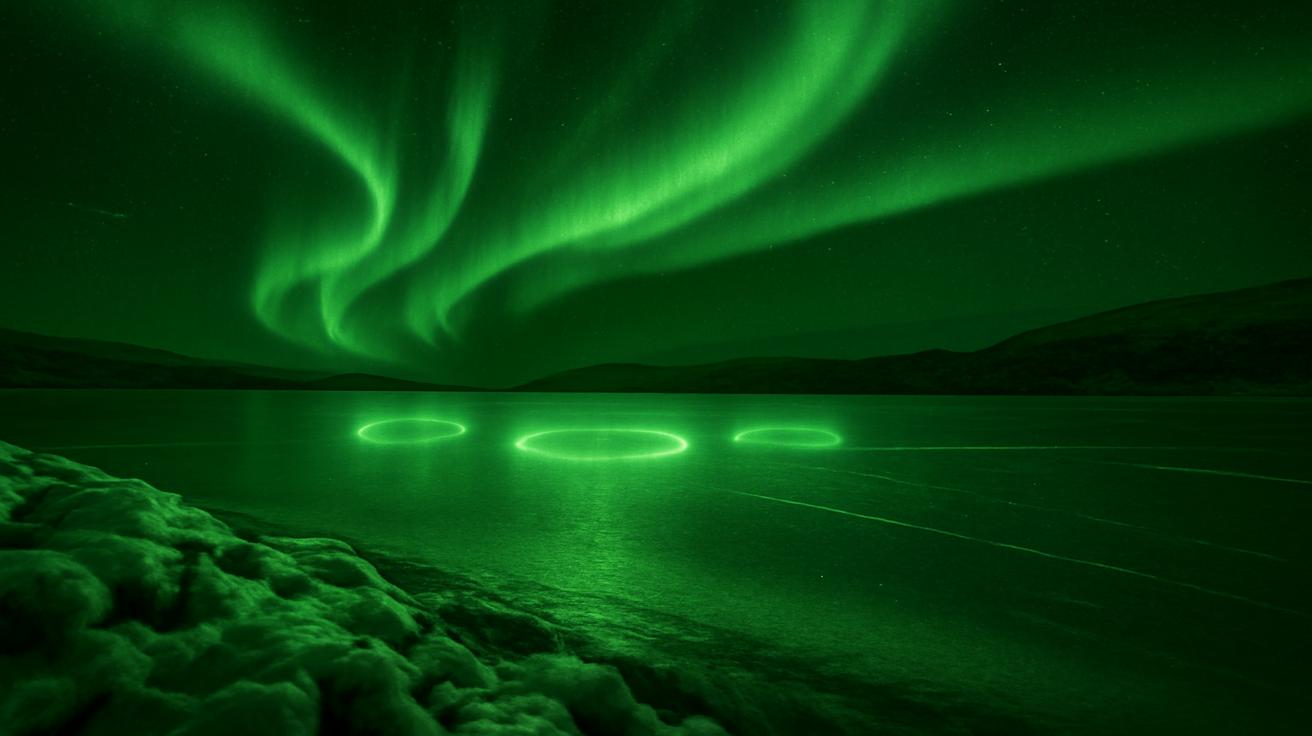
The frozen lake looked dead at first—just a flat, black sheet of ice under a sky that wouldn’t stop moving. The wind had dropped into that deep, Arctic stillness where sound seems to fall straight to the ground. Above, the aurora writhed like something alive, spilling curtains of green and violet over the horizon. It was the kind of cold that made your eyelashes crackle. The kind of night when even breath sounded loud. But the cameras, the ones wired to see in the dark beyond what human eyes can manage, were already picking up something else—something we wouldn’t notice until much later. On their screens, rings of light were beginning to bloom over the ice. Halos. Silent, hovering halos.
A Night That Wasn’t Really Dark
In the high Arctic, darkness is never just darkness. It’s layered—moonlight floating on snow, starlight pooling in drifts, and in winter, the aurora drawing ghostly maps across the sky. For weeks, a small research team had been camped beside a series of frozen lakes, their tents half-buried in snow berms, cables snaking away into sled-packed trenches, batteries humming faintly beneath insulated covers.
They weren’t there for the aurora, not exactly. They were testing night vision cameras—sensitive, high-speed instruments built to capture faint glows, thermal gradients, and elusive atmospheric phenomena. The kind of technology usually meant for border surveillance, search-and-rescue flights, or wildlife studies was now being turned upward and outward, repurposed to watch the night itself.
On this particular night, the auroral forecast had been strong. The kind of “storm level” alerts that draw photographers out of their cabins and convince pilots to rethink flight paths. The team had set the cameras to record automatically, wide-angle lenses aimed both at the sky and the frozen lakes that stretched away like black mirrors under the wavering light.
When the first arcs of the aurora crawled up from the northern horizon, no one was surprised. A chorus of low exclamations rippled around camp as the familiar bands brightened, folding and refolding in slow, liquid motions. But as the color intensified and the sky seemed to fill with rippling gauze, the cameras were already working in a different register, exposing a world far stranger than anything the naked eye could see.
The First Glowing Ring
Hours later, when the wind returned and the cold pushed everyone into the heated cabin, someone scrolled back through the recordings. The screen showed the lake—flat, grainy, and dark in infrared. The aurora shimmered above, greenish-white streaks in slow motion. And then, there it was: a delicate halo, slowly forming like breath on glass, hovering above the ice.
It wasn’t just a reflection of the aurora. It couldn’t be, not from the angle of the camera and not with that distinct shape—a soft-edged ring, maybe ten or twenty meters across, glowing just faintly brighter than the surrounding darkness. It flared, dimmed, then sharpened into something with definition, like a luminous crown hanging a few meters over the frozen surface. Then, as quickly as it had gathered, it seemed to unravel back into the night.
The room went quiet. Somebody replayed the sequence. Then again, slower. Pause. Frame by frame.
“That’s above the ice,” someone finally said. “Not in it. Above.”
Over the next few days, as memory cards were copied and cataloged, more halos emerged from the data—some small and faint, others broad and nearly complete, like circular ghosts drawn in pale light. They appeared almost exclusively during periods of intense auroral activity, when the sky outside seemed to boil with charged particles. Sometimes a halo would drift sideways; other times it simply grew brighter, then faded as though a dimmer switch had been turned down.
Seeing the Invisible
Night vision cameras don’t just “brighten the dark.” They extend vision into wavelengths our eyes barely register. Depending on the type—intensified low-light, thermal, near-infrared—they translate invisible photons into visible images. They exaggerate the whispers of light that stars, snow, water, and even air constantly give off.
On these Arctic lakes, that sensitivity turned the cameras into cartographers of the unseen. They could watch the thin exhalations of water vapor slipping from cracks in the ice. They could see where the snow was just a fraction warmer, where the lake released tiny plumes of heat into the static air. Under a sky stormed with auroral electrons, the boundary between ice, water, and atmosphere became a live interface, humming with interactions invisible to human observers standing only a few meters away.
In the recordings, the halos didn’t look like tidy rings drawn by some obedient geometric hand. They trembled gently, their edges feathery and unstable. Sometimes the halos seemed anchored to barely visible fissures in the ice. In other sequences, they hovered in blank space above featureless surfaces, almost like reflections with no source—a luminous echo searching for the original sound.
The Lake as a Silent Antenna
One way to imagine a frozen Arctic lake under an aurora is to see it as a kind of gigantic sensor—a flat, sprawling antenna lying quietly beneath the sky’s charged storm.
Above, solar particles hammer into Earth’s magnetic field, spiraling along invisible lines that thread down toward the poles. When they collide with atoms high in the atmosphere—oxygen, nitrogen—they knock electrons loose and kick photons free. That’s the glow we see as aurora, dancing across altitudes that can range from about 80 to more than 500 kilometers above the surface.
But the aurora doesn’t only light the sky. It also subtly rearranges the electric environment of everything beneath it: the ground, the ice, the air. Tiny electrical fields pulse and shift. Charged particles seep downward. Static builds, dissipates, rebuilds. The entire landscape, from the snow-laden spruce to the black lake ice, participates in this rearrangement, quietly and mostly unnoticed.
Now put a smooth, frozen lake into that scenario—a broad, flat surface with trapped bubbles, brine channels, hairline fractures, and patches of clear ice exposing the dark water below. Under the right conditions, those features might respond differently to the invisible electric and electromagnetic disturbances washing over them. Some may become slightly more conductive. Others may concentrate charges along their edges. Thin films of moisture above the ice could form, break, and reform in patterns we hardly understand.
Viewed through a camera sensitive enough to detect the faintest differences in emitted or scattered light, the lake reveals itself less as a static object and more as a responsive skin. The halos in the recordings may be the visible signatures of that response—regions where electrons, aerosols, or microscopic ice crystals are doing something just a little different than the space around them.
When Cold Air Starts to Glow
There is another, simpler possibility, too, and it lives right where air meets ice.
Under very cold, clear conditions, the air above Arctic lakes is rarely empty. It is filled with suspended ice crystals—tiny hexagonal plates and columns drifting in slow, imperceptible currents. When light passes through them at just the right angle, we see halos around the Sun or Moon, pillars rising up from bright lights on the horizon. These are well-known optical phenomena, mapped and modeled over centuries.
But add strong auroral activity, invisible infrared emissions from the ice, and an oversensitive camera pointed low across the surface—and suddenly, the familiar becomes less certain. Could those faint halos be a cousin to the classical ice crystal rings of the daytime sky, just operating on subtler wavelengths and stranger geometries?
Some sequences in the recordings show halos that shift in sync with slight changes in the aurora above, brightening as the overhead storm intensifies, then fading when the sky relaxes. Others seem to detach from that pattern, forming quietly even when the aurora is only a faint smear. In a few cases, faint vertical streaks—light pillars—rise out of the rings, like ghostly columns reaching for the sky.
The cameras may be catching a complex conversation between ice crystals, light sources, and shifting electrical fields. Human eyes, tuned for visible wavelengths and limited dynamic range, flatten that complexity into darkness. To us, it was just a very cold, very beautiful night. To the cameras, it was busy.
Stories Hidden in Numbers
Back in the lab—far from the lake, where winter had already loosened its grip—the halos turned into data. Coordinates, pixel brightness values, time stamps. Researchers reconstructed the geometry of the recordings, plotted the brightness of the rings against auroral indices, and overlaid everything against models of atmospheric conditions and magnetic field variations.
A table on one computer screen summarized the most striking halo events recorded during that season:
| Event ID | Auroral Activity (Kp) | Estimated Halo Diameter | Altitude Above Ice | Duration |
|---|---|---|---|---|
| H-01 | 6 | ~12 m | 2–3 m | 38 s |
| H-03 | 7 | ~25 m | 5–7 m | 2 min 11 s |
| H-07 | 5 | ~9 m | 1–2 m | 54 s |
| H-12 | 8 | ~30 m | 6–8 m | 3 min 05 s |
Even reduced to rows and columns, the halos retained something of their mystery. The correlation with stronger auroral activity was suggestive, but not absolute. Some of the brightest rings formed during medium-strength storms, while a few of the faintest emerged on nights when the sky was exploding in color.
Some halos aligned neatly with known ice cracks mapped earlier in the day. Others floated above patches of apparently solid ice, with no obvious features lurking beneath. A few events seemed to cluster in time, as if the lake and atmosphere had briefly shifted into a particularly sensitive configuration, lighting up several halos within just a couple of hours.
Between Explanation and Wonder
Science thrives on patterns. Give it enough data, and it will start assembling explanations from the ground up: electric field gradients, charge separation in blowing snow, micro-scale temperature inversions just above ice, subtle lensing effects in the optics. Each possibility nudges the halos a little closer to the familiar land of mechanisms and models.
And yet, there remains something quietly disarming about the thought itself: glowing circles, forming above silent, frozen lakes, revealed only by cameras designed to see past the edge of human vision. The Arctic is already a place where ordinary categories blur—day behaves like night, ice behaves like stone, clouds behave like curtains of living fire. The halos are another nudge, another reminder that what we casually call “night” is, in fact, thick with invisible activity.
For the people who kept night watch beside those lakes, the discovery didn’t diminish the aurora’s magic. If anything, it added another layer. Now, when the sky storms green and the ice cracks like distant thunder, it’s hard not to imagine those unseen rings forming and fading at the edge of perception—like quiet signatures of a planet constantly negotiating with the energy that rains down from space.
Listening Harder to a Quiet World
Technology often changes our relationship with wild places by making them louder: engines, drones, machinery, traffic. But tools like night vision cameras turn that equation inside out. They don’t add sound or light; they amplify what’s already there. They make the quiet even more articulate.
The halos above the frozen lakes are not headlines in themselves. They won’t alter weather forecasts or reshape navigation routes. They are, in some ways, small phenomena: delicate, transient patterns stitched into a tiny layer of space just above the ice. But the way we found them—by staring gently, patiently, with instruments tuned to subtlety—may point to where future discoveries in the polar regions will come from.
There is a growing sense among Arctic researchers that the most important signals might be small and easily overlooked: almost-silent seismic rumbles, faint chemical signatures in snow, infinitesimal shifts in glacier glow, eerie radio whispers during geomagnetic storms. To detect these, we need tools that expand our senses without drowning out the world in their own noise.
Night vision cameras, originally built for practical, often militarized tasks, have wandered north into a landscape that doesn’t care about human intentions. And in doing so, they have shown us something unexpected and oddly beautiful: that under strong auroral activity, frozen lakes can sprout halos of light—momentary crowns formed in the invisible bandwidths between ice and air.
Picture it again: a lake you might snowmobile across without a second thought, a place you’d call empty if you stood on its surface and turned slowly in a circle. Above you, the unforgettable theatre of the aurora. Beneath your boots, thick black ice. And in the narrow space between, rings of faint, shimmering light, bright enough to be certain on a camera’s sensor but too soft and subtle to touch your eyes.
The Arctic has always been good at hiding its stories in plain sight. We are only just learning how to listen hard enough—and gently enough—to hear them.
FAQ
Are these halos visible to the naked eye?
No. The halos recorded above the frozen lakes were only visible in the night vision camera footage. They appeared too faint, and in wavelengths our eyes are not sensitive enough to detect directly. To observers on the lake, the night looked like a normal—if spectacular—auroral display.
Are the halos caused directly by the aurora?
The halos are closely associated with strong auroral activity, but not necessarily caused by the visible aurora itself. It’s more likely that changes in local electric fields, charged particles, and subtle optical or thermal effects near the ice surface—all enhanced during auroral storms—contribute together to create the glowing rings.
Could these be camera artifacts or reflections?
Researchers carefully checked for optical artifacts such as lens flares or internal reflections. The halos changed position, size, and brightness in ways inconsistent with typical camera glitches. Multiple cameras, at different angles, recorded similar structures, suggesting the halos were real features in the environment, not equipment errors.
Do similar halos form over lakes outside the Arctic?
It’s possible, but not yet well documented. The unique combination of extreme cold, ice-covered water bodies, abundant ice crystals, and intense auroral and geomagnetic activity makes the Arctic particularly suitable for such phenomena. In lower latitudes, similar effects might be rarer or simply too faint to have been noticed.
Why are scientists interested in these halos?
Beyond their visual intrigue, the halos hint at complex interactions between Earth’s surface, atmosphere, and space weather. Understanding them better could improve our knowledge of near-surface electric fields, ice–atmosphere coupling, and how geomagnetic storms subtly influence conditions at ground level—information that can feed into broader studies of polar environments and space weather impacts.