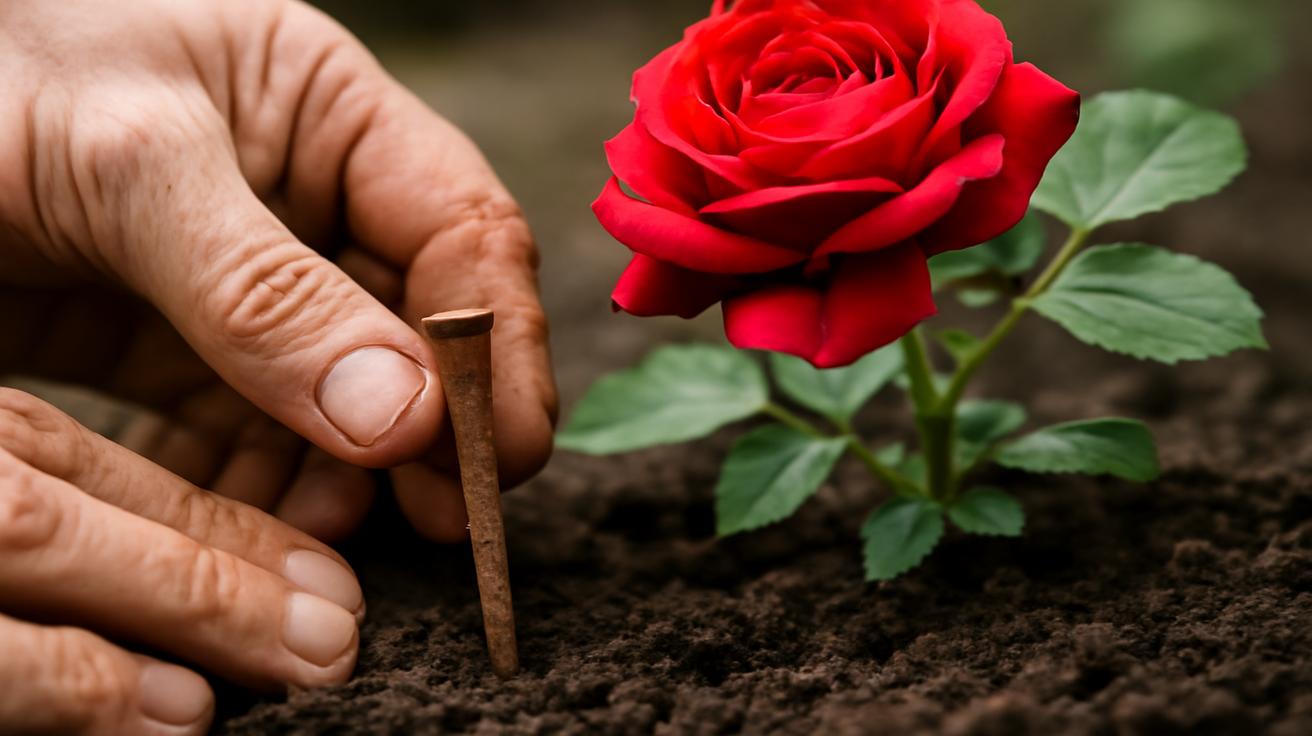
The story usually starts with a grandparent’s garden. Maybe it was your grandmother in a faded sunhat, or an elderly neighbor with soil permanently etched into the lines of his hands. Somewhere in that memory—between the smell of damp earth and the slow creak of the back gate—there’s a rose bush. And at the base of that rose bush, as you may have been told in a conspiratorial whisper, lies a rusty nail.
The Quiet Magic Beneath the Soil
Picture an early summer morning: the kind where the light is still soft and the air is cool enough that the dew hasn’t yet let go of the grass blades. You walk between garden beds, coffee in hand, and the roses are waking up—petals unfolding in slow motion, fragrance just beginning to lift into the air.
You kneel beside a bush whose flowers are a little paler than they should be. The leaves look a touch tired, maybe a bit yellowed between the veins. In old gardening tales, this is the moment someone would straighten up, wipe their hands on their trousers, and say, “You know, you might just need a rusty nail or two down there.”
It sounds like superstition, a piece of quaint country folklore left over from a time of hand-pumped water and wood stoves. But like many old garden stories, it has one foot in myth and the other in science. And the truth lies quietly in the dark, exactly where those nails were buried.
The Rusty Nail Legend: Part Myth, Part Science
For generations, gardeners believed rusty nails helped roses bloom richer and redder. They didn’t talk about “micronutrients” or “soil chemistry”—they talked about what they could see: color, vigor, the way a plant “looked happy.”
Rust, as we know now, is simply iron oxide. Roses, like all plants, need iron in small but crucial amounts. Iron helps them make chlorophyll—the green pigment that turns sunlight into living energy. When a rose doesn’t get enough iron, the leaves can turn a sickly yellow while the veins stay dark green: a condition called chlorosis. To an old-time gardener, that yellowing wasn’t a deficiency; it was a problem to be solved with whatever was on hand—often, a nail from a cracked board or a bent horseshoe nail saved “just in case.”
Driven less by chemistry and more by observation, gardeners started making the connection: rusty metal plus struggling roses sometimes equaled greener leaves and deeper blooms. Over time the idea spread: if your roses looked weary, give them a nail.
Of course, the scientific reality is a bit more complicated. Iron in rusted nails doesn’t dissolve quickly in many soil types. The effect, if any, was often slow and modest. Yet in some gardens—especially where the soil was acidic and eager to release iron—the nails really did help.
The Sensory Logic of an Old Trick
There’s a kind of sensory logic to the whole practice when you think like a traditional gardener. The nail feels solid and real in the hand, heavy with potential. You push it into the earth and walk away knowing you’ve “fed” the plant with something tangible. No labels, no charts, just a physical offering to the soil.
Later in the season, when the roses did better—whether because of the nail, the rain patterns, or a lucky cool spell—people remembered the ritual. The act of burying a nail became a quiet promise that the roses wouldn’t be left to struggle alone.
What Actually Happens When You Bury a Rusty Nail
Let’s walk beneath the surface for a moment. Down there, among the web of fine roots and wandering earthworms, that nail is undergoing its own slow drama.
In moist soil, iron on the nail’s surface reacts with oxygen and water. Over time, it forms more rust. If the soil is acidic and microorganisms are busy, tiny amounts of iron can gradually become available in forms that plant roots might absorb. Not in a dramatic, overnight flush—but in a quiet trickle, like a leaky faucet turned just enough to keep things going.
Old-time gardeners didn’t know the words iron availability or chelation, but they knew patterns. They saw that certain roses in certain soils perked up after they’d buried bits of iron nearby. In some older clay or slightly acidic soils, that observation actually holds up: the nail, through rust, becomes a slow-motion iron supplement.
But in very alkaline soil—common in many modern yards—the iron from a rusty nail can stay locked up and largely inaccessible to plants. The ritual might still be soothing, but the chemistry quietly shrugs and declines to cooperate.
Why Roses and Iron Have a Special Relationship
Roses are sensitive storytellers of soil health. They will complain visibly and early if the balance is off. When iron is low, new leaves grow in pale, almost lemony shades, while the veins stand out in a darker green map. It’s a look gardeners eventually learn to recognize like a familiar face.
Iron isn’t just about leaf color. When the plant can’t make enough chlorophyll, it can’t capture enough sunlight. Less energy means fewer or smaller blooms, weaker stems, and an overall lack of that lush, indulgent presence that makes a rose garden feel like a small theatre of abundance.
So when a gardener saw yellowing leaves and lackluster flowers, the nail was a kind of offering to this delicate relationship between soil and plant—an old-world way of acknowledging, “Something’s missing here. Let me see if I can give it back.”
The Culture of Ingenuity: Gardening Before Garden Centers
Part of the charm of the rusty nail story lies in the era it comes from. Imagine gardening before shelves of neatly bottled fertilizers, before soil tests in tidy paper envelopes and color-coded results. You had what your land gave you, what your animals contributed, and what you could scavenge.
If a plant struggled, you looked around at the world in front of you. Ash from the stove for potassium, manure for nitrogen, crushed bones or shells for calcium and phosphorus. Metal scraps—nails, old tools, bits of iron hardware—were just another potential resource, transformed from trash into hope by a gardener’s imagination.
In those times, gardening was less about purchasing solutions and more about improvising them. The garden was an ongoing experiment powered by stories: “Old Mrs. Harding swears by her rusty nails,” or “My uncle always tossed his bent nails beneath the roses, and they were the biggest blooms in the village.”
These stories stitched communities together. Advice passed over fences, through kitchen doors, and across generations. Whether strictly accurate or not, they gave people confidence and a sense of shared wisdom. Every nail pressed into the ground carried both a bit of iron and a lot of human belief.
The Emotional Weight of Little Rituals
There’s also something more tender here. The act of burying a nail is strangely ceremonial. You bend down, touch the soil, and tuck something into the earth like a secret. It’s almost like confiding in the garden: Here, I’m giving you what I can. Please respond with beauty.
Small acts like this are how many people fall in love with gardening. It’s not just pruning schedules and recommended NPK ratios; it’s the feeling that what you do with your hands has a direct, living consequence. The nail is a kind of physical faith—a symbol that you believe this plant can recover, can thrive, can fill the air with fragrance again.
Old Wisdom Meets Modern Understanding
We know more now. We can measure pH levels, test iron availability, and choose highly efficient iron supplements specifically designed for plant uptake. Ask any modern horticulturist if burying a random rusty nail is the most effective way to correct iron deficiency and they’ll likely smile and gently say, “Not really.”
Today, if a rose is yellowing from iron deficiency, a gardener might reach for a chelated iron product, adjust the soil pH, or amend the soil with organic matter that improves nutrient availability. These solutions are faster, more predictable, and far more targeted than a lone nail at the root zone.
But that doesn’t mean the old trick was entirely foolish. In some conditions—especially in slightly acidic, organically rich soils—those nails did slowly contribute iron. And sometimes, the nail was just one of many care steps: better watering, a bit of compost, some shade during heat waves. The rose recovered, and the nail got the credit.
| Approach | What It Provides | How Fast It Works | Best Used When |
|---|---|---|---|
| Rusty nails or iron scraps | Very slow, uncertain iron release | Very slow (months to years) | You’re honoring tradition, and soil is mildly acidic |
| Chelated iron products | Highly available iron for plants | Fast (days to weeks) | Leaves show iron chlorosis; you want predictable results |
| Compost and organic matter | Improved soil structure, gradual nutrient release | Moderate (weeks to seasons) | You’re building long-term soil health |
| Adjusting soil pH | Makes existing nutrients more available | Gradual (weeks to months) | Soil is too alkaline; multiple nutrients seem locked up |
In many ways, what we’ve done over time is translate old observations into newer language. Where an earlier gardener said, “The roses like iron,” we might now say, “This variety is sensitive to high pH and low iron availability; let’s amend accordingly.”
But the goal hasn’t changed. Then and now, people are still chasing the same thing: that giddy feeling of rounding a corner and seeing a rose bush absolutely covered in blooms, as though someone turned the saturation knob all the way up on the world.
Keeping the Story Without Losing the Science
So what do we do with the rusty nail tradition in a world of reliable soil tests and well-researched fertilizers? Perhaps the most generous answer is: we keep the story, even if we update the practice.
You might not rely on nails for your roses’ health anymore, but you could still tuck one into the soil as a nod to whoever first taught you to love plants. You could share the tale with a child or a beginning gardener, explaining both the myth and the science—how people once used what they had, and how we continue to learn from their experiments.
Gardening is, after all, as much about meaning as it is about method. The roses don’t care why you care about them. They respond to light, water, nutrients, and the chemistry of the soil. But you—standing there in the damp earth, watching for the first bud to unfurl—carry the stories that turn a patch of dirt into an inheritance.
Bringing Old Practices Into Modern Gardens
If you’re tempted to try the rusty nail tradition yourself, it might help to think of it as a conversation piece with the past rather than a primary treatment plan. There are gentler, more effective ways to ensure your roses get the iron and other nutrients they need.
Start with observation, just as those old gardeners did. Are the leaves turning yellow while the veins stay green? Do new leaves look weaker than old ones? Is your soil known to be alkaline or chalky? These are clues, and they matter more than any one trick.
From there, you might choose to add compost, mulch with well-rotted organic matter, or use a product designed specifically for iron deficiency in ornamentals. You can still slip a nail into the soil if the ritual appeals to you—and many people do, half-smiling at the thought of their grandparents as they do it.
The important thing is not whether the nail itself performs miracles, but that you remain curious, attentive, and willing to learn from both the old tales and the latest insights. Every healthy rose bush is, in a way, the result of that merged wisdom: the folklore that made us look closely, and the science that helps us understand what we’re seeing.
The Rose Bush as a Living Memory
In the end, a rose bush is rarely just a plant. It’s often planted for an occasion: a memorial, an anniversary, a new home, a birth. It holds dates and names and unsaid things in its thicket of thorns and petals. And because of that, people are willing to try almost anything to help it thrive—even pressing an old, bent nail into the root zone and hoping for the best.
Old-time gardeners buried rusty nails at the base of rose bushes not only because they believed in iron, but because they believed in effort. They believed that care, expressed in any humble way, might be enough to coax life toward beauty. That belief still lives each time someone leans down, fingers in the soil, and whispers, “Come on now, you can do it,” to a struggling plant.
So the next time you pass a rose in full bloom—heavy-headed, fragrant, and humming quietly with bees—pause for a moment. Somewhere under the soil, real or imagined, there might be a small, forgotten nail, rusting slowly into the dark. It may not be the secret to the rose’s beauty anymore, but it’s part of the long, human story that brought those petals to your eye level. And in a garden, that story is as nourishing as any nutrient.
FAQ
Did rusty nails really help rose bushes grow better?
Sometimes, but not always. In certain slightly acidic soils, the rust on old nails could slowly release small amounts of iron that roses could use. However, in many modern gardens—especially those with alkaline soil—the effect would be minimal or negligible. The practice had some basis in observation, but it’s not a reliable solution today.
Is it safe to bury rusty nails near plants?
In small quantities, burying a few rusty iron nails is generally not harmful to plants or soil. However, it’s not considered best practice, especially if you have pets or children who might dig in the area. Modern approaches focus on organic matter, proper pH, and targeted nutrients instead of burying metal.
What is a better way to fix yellowing leaves on roses?
First, identify the cause. Yellowing can result from iron deficiency, poor drainage, overwatering, lack of nutrients, or disease. For iron-related yellowing, gardeners often use chelated iron products or adjust soil pH. Adding compost and improving watering practices can also make a big difference over time.
Why did old-time gardeners rely on home remedies like rusty nails?
They had limited access to commercial fertilizers and soil tests, so they used what they had on hand: ashes, manure, bones, and metal scraps. Over time, they observed patterns and passed down tips that seemed to work. Many of these remedies carried a mix of practical value and folklore.
Should I continue the tradition of burying a nail under my roses?
You can, if it feels meaningful to you—but treat it as a symbolic gesture rather than a main source of nutrients. For the actual health of the plant, rely on good soil preparation, organic matter, proper watering, and, when needed, scientifically proven amendments. You can honor the story and embrace modern knowledge at the same time.