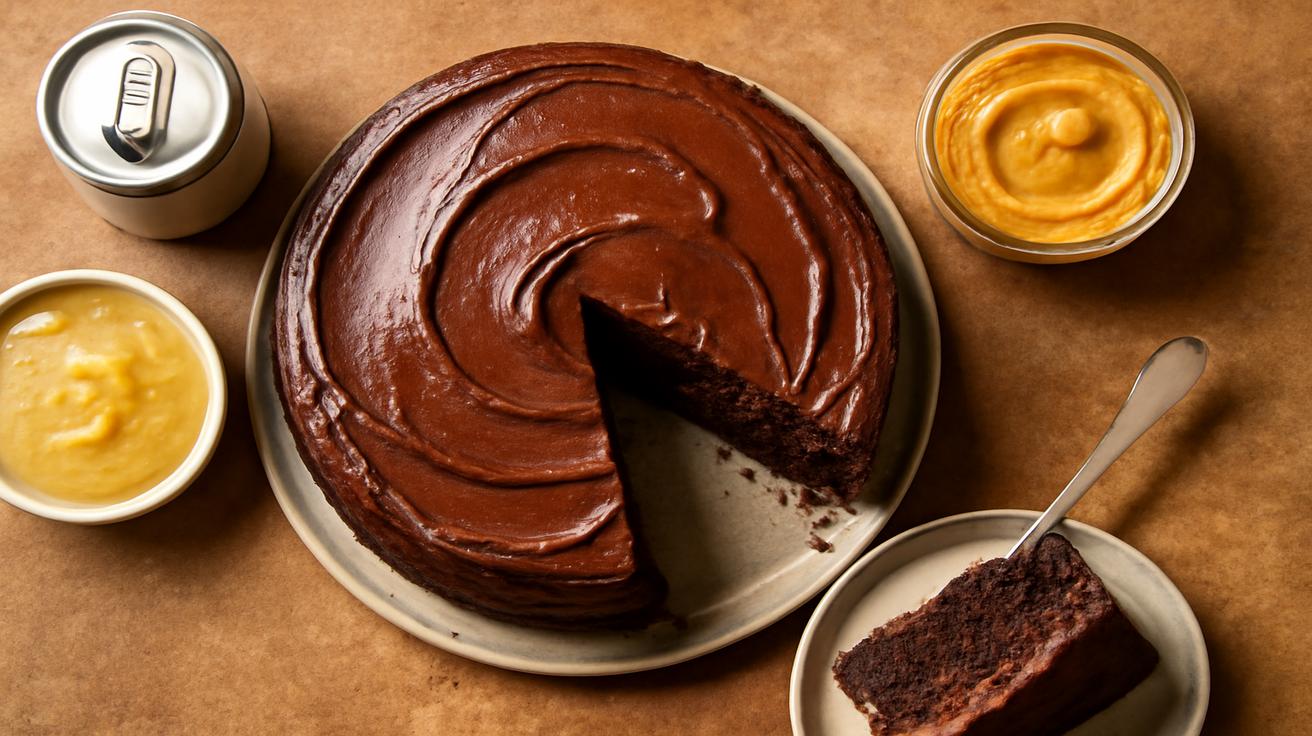
The first time I cracked an egg over my favorite chocolate cake batter and watched the golden yolk slip into the bowl, I didn’t think anything of it. It was just what you did—eggs, flour, sugar, cocoa, butter. Ritual. Muscle memory. The wooden spoon circling through glossy swirls of chocolate was as familiar as my own handwriting. But the night everything changed started with an empty carton, a late craving, and a stubborn refusal to change out of my pajamas and go to the store.
The Empty Carton That Started It All
It was past 9 p.m., the sort of quiet hour when the house softens and your thoughts get louder. Rain tapped against the windows, and the kitchen light cast a warm circle on the counter. I stood there, barefoot on cool tiles, measuring cocoa powder that puffed up in a fine chocolate mist. Sugar hissed against the sides of the mixing bowl, butter softened perfectly on the stove’s edge—everything ready.
Then I opened the fridge.
Inside: a half lemon, one lonely carrot, forgotten leftovers in fogged-up containers—and a single, unmistakably empty egg carton. I pulled it out anyway, as if weight might magically appear. The cardboard was featherlight, the plastic pockets hollow. No eggs. None tucked behind the milk. None in the back corner by the jar of pickles. Just absence.
I stood there, one hand gripping the fridge door, and felt something between irritation and challenge rise up. I wanted chocolate cake, the kind that fills the whole house with that rich, deep smell that pulls people out of their rooms. And I wanted it now. No shoes, no grocery run, no compromise.
So I did what any desperate, cake-obsessed, slightly stubborn night baker would do: I started rummaging through the pantry for a way to make a chocolate cake… without eggs.
First Swap: The Silky Surprise in the Back of the Pantry
The can was small, unassuming, and slightly dusty at the rim. Unsweetened applesauce. I’d bought it months ago for a granola recipe I never actually made. Now it sat in my hand like a dare.
I’d heard whispers about applesauce doing the job of eggs—binding, moistening, softening. But chocolate cake? It felt like asking a bicycle to tow a piano. Still, the idea of walking to the store felt worse, so I pried off the lid, and a gentle, fruity scent drifted up—mellow, mildly sweet, almost shy.
The batter came together easily. Cocoa turned it near-black, and when I spooned the applesauce in, the mixture loosened into something luxuriously smooth. The wooden spoon dragged through it with a low, satisfying resistance. It wasn’t as thick as my usual egg-filled batter, but it looked promising—shiny, velvety, almost silky.
While it baked, the kitchen grew warm and smelled like a bakery just before closing time: all chocolate and nostalgia, with a hint of caramel from the sugar hitting the heat. I hovered near the oven window like it was a tiny television screen, watching the cake rise, its surface puffing and settling, forming a soft dome.
When I finally cut into it, the knife slid through as if the cake were made of memory foam. The slice held together, dark and handsome, crumbs clinging lightly to the blade. I took one bite—and stopped.
It was different. Not bad-different. Just… softer. Almost tender in a way my old recipe never quite achieved. The crumb was fine and moist, like a chocolate cloud with just the faintest whisper of fruit. Not “apple-flavored cake,” just cake that happened to be better behaved, calmer, more evenly moist. I didn’t miss the eggs. Not for a second.
But this was only the beginning.
Applesauce vs. Egg – How It Stacked Up
For the first time, I started paying attention not just to taste, but to texture, structure, and what each ingredient actually did. Here’s how that first swap looked when I broke it down in my notebook later, because of course I took notes like a restless baking scientist.
| Egg Role | Applesauce Replacement | Result in Cake |
|---|---|---|
| Moisture | 3–4 tbsp per egg | Incredibly moist, almost no dryness at edges |
| Binding | Pureed fruit pulp | Cake holds, but slightly denser crumb |
| Leavening support | Needs baking powder/soda help | Softer rise, gentle, not towering |
That night, fork in hand, I realized something quietly thrilling: eggs weren’t the magic, non-negotiable center of my chocolate cake universe. They were one way. A good way, sure. But not the only one.
The Velvet Experiment: When Flaxseed Became an Egg
Word got out—by which I mean, I couldn’t shut up about how I’d made a chocolate cake with applesauce instead of eggs, and it actually worked. A friend, the kind who keeps jars of curious seeds in her cupboard, raised an eyebrow at me over coffee and said, “You know flax can do that too, right?”
Flax seed. The stuff I’d only ever tossed into smoothies and then promptly forgotten about. She told me to try it: ground flaxseed plus water, left to sit until it became “goopy.” Not the most appetizing word, but accurate.
Back in my kitchen, I measured: one tablespoon of ground flax, three tablespoons of water. In a small glass, it looked innocent at first—just cloudy water with reddish flecks. But a few minutes later, it transformed. The mixture thickened into a gel, threads forming when I stirred it, mimicking the slightly elastic quality of beaten egg.
I folded two “flax eggs” into my chocolate batter, along with a generous splash of vanilla and a pinch of instant coffee to deepen the cocoa. This batter felt a little more robust than the applesauce version, thicker, with a satisfying weight as the spoon moved through it. I smoothed it into the pan, the surface glossy and rich, almost like melted fudge.
As it baked, the smell was deeper this time—chocolate, yes, but also something warm and toasty, like a hint of roasted nuts hiding in the air. When the timer chimed and I pressed a fingertip gently into the center of the cake, it sprang back with a delicate resilience, like a well-made mattress. Promising.
The first slice was all about texture. The crumb was bolder, slightly more structured than the applesauce cake. Still soft, still tender, but with more of that classic, springy chocolate cake feel. The flax added the tiniest whisper of earthiness, but in chocolate, it read as complexity, not distraction. And the softness? It was the kind that made the cake feel almost plush, like velvet on the tongue.
If the applesauce cake whispered comfort, the flax cake quietly cleared its throat and said: “I can sit on the dessert table at a dinner party and no one will suspect a thing.”
Flax vs. Apple: A Softness Showdown
At this point, curiosity had fully replaced my old baking habits. I sliced slivers of applesauce cake and flax cake, lining them up on a plate, then went full detective mode.
| Replacement | Texture | Flavor | Best For |
|---|---|---|---|
| Applesauce | Ultra-moist, slightly denser | Very mild, faintly fruity | Homey cakes, snacking slices |
| Flax “Egg” | Soft yet springy, classic crumb | Subtle nuttiness, barely noticeable in chocolate | Celebration cakes, layering and frosting |
Did either make me miss real eggs? Not even a little. In fact, the more I baked without them, the more I noticed something else: my cakes were staying softer for longer. The next day, slices left on the counter were still tender, still pleasant. No sad, dry edges.
The Creamy Wildcard: Yogurt Steps Into the Spotlight
The next experiment wasn’t born out of desperation, but of sheer curiosity. I’d already swapped in applesauce and flax, so one lazy afternoon, I opened the fridge and stared at a tub of plain yogurt. Thick. Tangy. Cool. Could it do what eggs did?
I scooped some into a small bowl, smooth and white, with that gentle sour aroma that promises richness. Yogurt, unlike applesauce or flax, brings not only moisture and binding but also acidity—which, when paired with baking soda, gives your batter an extra lift. I could almost hear the chemistry happening in my head as I measured: about a quarter cup of yogurt per egg, adjusting the liquid just slightly elsewhere in the recipe.
The batter this time felt luxurious, like stirring melted chocolate into heavy cream. It clung to the spoon in slow ribbons, glossy and thick. I tucked the pan into the oven and, as the minutes passed, the kitchen filled with a smell that was not just chocolate, but chocolate with a backbone—deep, confident, and somehow creamier even before I tasted it.
When I cut into the yogurt cake, I noticed it immediately: the crumb was incredibly fine, almost silky. Each slice stood tall but not stiff, soft but not collapsing. On the tongue, the cake practically dissolved, leaving behind a lingering richness and a tiny, pleasant tang that made the chocolate flavor feel brighter, sharper around the edges, as if someone had turned up the contrast.
This was the cake that made me say, out loud and to no one in particular, “Oh. Oh wow.” It wasn’t just soft. It was decadent-soft. Bakery-soft. The kind of softness that makes you eat slower so you can stretch the moment out.
My Go-To Eggless Chocolate Cake Blueprint
By now, I wasn’t just messing around. I had a small arsenal of egg replacements and a growing sense of which one to reach for, depending on the mood of the day and what was in the fridge. I began sketching out a kind of mental blueprint for chocolate cake that didn’t rely on eggs at all, but on balance.
Often, I’d pick one of these bases:
- Applesauce for homey, everyday cakes.
- Flax for structure and subtle earthiness.
- Yogurt for a plush, velvety crumb.
Sometimes, I even combined them—half applesauce, half yogurt—to chase a particular kind of softness I was craving that day. No two batches were exactly the same, but they all shared one thing: they made the old, eggy version feel strangely unnecessary.
The Moment I Stopped Buying Eggs for Cake
The realization didn’t hit all at once. It arrived in tiny moments: scraping out a bowl without cracking a single shell; noticing that my grocery list no longer had “2 dozen eggs” scribbled in the margins before birthdays; watching a friend with an egg allergy take a bite of my chocolate cake without hesitation—and then watching their face change as the softness registered.
One evening, I baked my now-favorite yogurt-and-applesauce hybrid cake for a small gathering. The house was alive with that familiar chocolate-scented warmth, the lights dim, music humming low in the background. People drifted into the kitchen, drawn by the smell, asking the usual questions: “What kind of cake is it?” “Did you use dark cocoa?” “Is there coffee in here?”
But no one asked, “Did you put eggs in this?” Because why would they? In their minds, a cake meant eggs. It was just assumed.
I didn’t say anything at first. I watched them take bites, close their eyes briefly, nod to themselves. Someone said, with their mouth half-full, “This is insanely soft.” Another person went back for a second slice before finishing the first.
Only then did I tell them: “There aren’t any eggs in this cake.”
There was a beat of silence, then disbelief, then a flurry of questions. I saw the same mental shift I’d gone through: the quiet realization that maybe the rules of baking weren’t quite as rigid as we’d been taught. Maybe they’d always been a little more flexible, waiting for us to experiment.
Why Eggless Can Be Even Softer
I used to think eggs were what made cakes tender. And often, they do help. But once I turned away from habit and started looking at texture, moisture, and longevity, I noticed something surprising: eggless cakes, especially chocolate ones, can actually stay softer, longer.
- Fruit purees like applesauce hold moisture in the crumb, so the cake doesn’t dry out as quickly.
- Flax gel provides structure without toughness, keeping the crumb gentle instead of rubbery.
- Yogurt adds fat and acidity, partnering with baking soda to create tiny bubbles and that plush, velvet-soft crumb.
It’s not that eggs are the enemy—they’re just no longer the center of my baking universe. They’re an option, not a requirement. And there’s a particular kind of creative joy that comes from looking at a chocolate cake and knowing it got there by a different, unexpected path.
The Quiet Magic of Breaking the “Rules”
What began as a late-night inconvenience—no eggs, persistent craving, unwillingness to put on shoes—became one of the most quietly transformative kitchen adventures I’ve ever had. I didn’t set out to write a manifesto on eggless baking. I just wanted chocolate cake.
But somewhere between the applesauce can, the flax jar, and the tub of yogurt, I found a new way of thinking about recipes. They stopped being strict commandments and started feeling more like stories—ones I could rewrite, twist, or translate depending on what my pantry offered and what my curiosity demanded.
Now, when I pull a chocolate cake from the oven and the heat rushes out in a wave that smells like melted cocoa and toasted sugar, I don’t automatically reach for the memory of cracking eggs. I remember instead the first surprising softness of that applesauce cake, the quiet strength of the flax version, the velvet luxury of the yogurt crumb.
I remember standing in front of an empty egg carton and thinking, for a brief, stubborn moment, that maybe I could get away with breaking the rules. And I did.
Now, I don’t just get chocolate cake. I get chocolate cake that makes people pause mid-bite and say, “How is it this soft?”
And every time, I smile a little to myself, thinking of those unexpected ingredients, sitting patiently in the back of pantries and fridges everywhere—waiting, silently, to surprise someone else.
FAQ
Can I replace eggs with applesauce in any chocolate cake recipe?
In most simple chocolate cake recipes, yes. Use about 3–4 tablespoons of unsweetened applesauce for each egg. You may want to slightly reduce other liquids by a tablespoon or two if the batter seems very thin.
Will my cake taste like apples if I use applesauce?
In a chocolate cake, the cocoa usually overpowers the apple flavor. You’ll get moisture and softness, but only a faint, almost unnoticeable fruit note—nothing like an apple cake.
How do I make a flax “egg” for baking?
Mix 1 tablespoon of ground flaxseed with 3 tablespoons of water for each egg you want to replace. Let it sit for about 5–10 minutes until it thickens and turns slightly gel-like, then stir it into your batter.
What type of yogurt works best as an egg substitute?
Plain, unsweetened yogurt—either regular or Greek—works best. Use about 1/4 cup of yogurt per egg. If using thick Greek yogurt, you may need a teaspoon or two of extra liquid to keep the batter from getting too stiff.
Can I mix different egg replacements in the same cake?
Yes. Combining them can give you the best of each world. For example, using half applesauce and half yogurt can create a cake that is both extra moist and incredibly soft, with a fine, delicate crumb.
Do eggless cakes bake for the same amount of time?
Usually, the baking time is similar, but eggless batters can sometimes take a few extra minutes. Always start checking near the original recipe time, and use a toothpick test—if it comes out with just a few moist crumbs, it’s ready.
Will the cake rise properly without eggs?
Yes, as long as you rely on other leavening agents like baking powder and baking soda. Pairing yogurt (for acidity) with baking soda, or carefully balancing your baking powder, helps eggless cakes rise beautifully and stay soft.