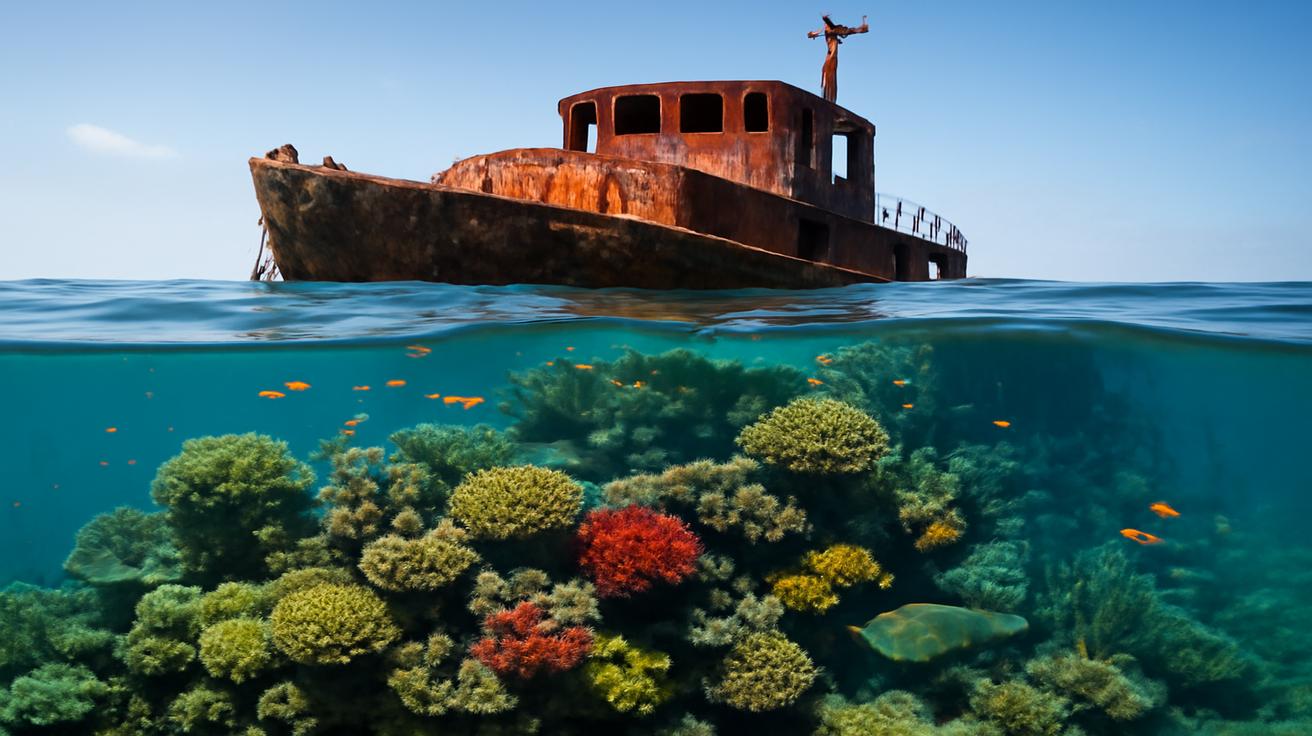
The first thing you notice is the sound. Not the crash of waves or the shriek of gulls, but a soft, constant crackle—like frying oil in a distant kitchen. You’re twenty meters below the surface of a calm, turquoise sea, hovering beside the ghostly silhouette of a ship that hasn’t moved in years. Its hull is furred with corals, its railings thick with sponges, its shadowy windows turning into doorways for fish. A silver cloud of jacks flickers past, changing direction as though wired to a single mind. Out of a rusted hatchway, a curious grouper glides, regards you for a heartbeat, and drifts back into the dim interior. Everything here, from the swaying fan corals to the sharp-eyed moray eel tucked into a pipe, is alive—and none of it was meant to be.
The Decision to Sink a Fleet
There was a time, not long ago, when this stretch of coast offered little more than sand and silt beneath its bright surface. Fishing boats went farther and farther out, chasing dwindling catches. Coral reefs, once radiant, succumbed to warming seas, pollution, and careless anchors. Local divers spoke of “what used to be here” in the same hushed way people talk about childhood homes that have vanished beneath highways.
Faced with dying fisheries and fading reefs, one small nation—call it a sliver of land arcing through warm ocean—made a decision that sounded, at first, a little mad: if nature’s reefs were failing, they would build new ones from scratch. Not with polished, expensive technology, but with what they already had too much of—retired naval ships, rusting cargo vessels, and unremarkable concrete blocks stacked in forgotten yards.
The ocean, after all, loves structure. Sunken logs, rock piles, broken piers—any hard surface in the right place becomes an invitation for life. So why not turn junk into invitations? Why not transform the graveyard of old ships and surplus concrete into the blueprint for an entirely new ecosystem?
The proposal drew skepticism. Environmental groups worried about pollution; fishermen doubted anything could bring the fish back fast enough; coastal residents imagined ugly metal hulks littering the seafloor. But in community halls and ministry offices, marine biologists showed grainy underwater photos from other parts of the world—tanks and trams and subway cars carpeted with corals and shimmering with fish. The ocean, they argued, is astonishingly forgiving, if you give it the right skeleton to grow on.
A Careful Art: How to Build a Reef from Scrap
Building a reef from discarded ships is less like dumping trash into the sea and more like performing delicate surgery. Onshore, in dry docks that smell of salt and old oil, teams in overalls and respirators strip each vessel bare. Out go the fuel tanks, the wiring, the paint laced with toxins. Every bolt and bracket that might leach heavy metals is cataloged, removed, replaced. By the time they are done, the proud warship or workhorse freighter is hollowed into a metal skeleton—clean, inert, ready for a second life.
Marine planners study charts and currents. They choose places where the seafloor is barren, far from fragile natural reefs, but close enough to benefit fishing communities and dive operators. Depth matters: too shallow, and storms can tear a wreck apart; too deep, and the light fades, corals struggle, and divers can’t visit safely. They model how currents will sweep food particles through open hatches and along decks, how fish might use the superstructure as shelter from predators.
On the morning of a scuttling, the harbor hums with an unusual, respectful excitement. Tugs nudge the stripped ship to its final coordinates. A skeletal crew moves through echoing corridors for the last time, checking valves, setting charges, running through a ritual that feels part engineering, part farewell. From shore, a small crowd watches this strange funeral of steel.
When the explosives finally thump in a muffled sequence, the ship begins to list, hesitating like a creature uncertain whether to trust gravity. Water pours through pre-cut holes; air roars from vents and doorways; gulls wheel and cry overhead. Then the ship tips decisively, bows under, and begins the long, slow glide to the bottom, vanishing in a boil of foam that smooths to calm within minutes. A GPS marker blinks on a screen: the birth certificate of a brand-new artificial reef.
Concrete Cities on the Seafloor
Not every reef begins life as a ship. Out on a barge under a pale sky, workers lower clusters of concrete blocks—some plain, some molded into domes and arches—into the water. To the casual eye, they look like chunks of abandoned construction projects. But to a juvenile fish, each hollow and crevice is an apartment in a safe new neighborhood.
Concrete, it turns out, is a brutally efficient stand-in for rock if you get it right. The mix must be correct—low in chemicals that might harm corals, rough enough for tiny larvae to grip. Engineers have learned to add texture: grooves, pits, and channels that interrupt currents and create tiny pockets of still water where plankton can settle. The blocks are spaced with care, forming corridors that funnel water and create a patchwork of light and shadow. From above, the layout resembles a slow-motion city expansion: a modular skyline growing on the empty plain of the seafloor.
At first, the blocks look stark, ghostly pale in the blue water. But even in those early days, life is already making its claim. Films of bacteria and algae bloom over the concrete. These slimy pioneers are food for microscopic grazers, who in turn attract small fish. Within weeks, the first corals arrive, not as visible bouquets but as specks—larval dots drifting on currents that happen to bump into something solid at just the right time.
The Slow Explosion of Life
Six months after sinking one of the nation’s first artificial-reef ships, a team of divers descends with cameras and clipboards. They remember the wreck as a clean, almost sterile outline of steel. Now, they have to blink to be sure they’re in the same place.
The hull is freckled with orange and pink sponges, like paint splatters. Soft corals sway in the faint current, their tentacles filtering tiny bits of food from the water. A school of juvenile snappers hovers in tight formation above the deck, ready to dissolve into the safety of the ship’s innards at the first hint of danger. Along the rail, small damselfish fuss over tufts of algae as though tending miniature gardens.
By the end of the first year, the numbers begin to tell their own story—fish counts doubling and tripling, crustaceans colonizing pipes and nooks, octopuses claiming hidden corners. Over time, scientists compile rough snapshots like the one below.
| Time Since Reef Created | Average Fish Species Observed | Notable Changes |
|---|---|---|
| 3 months | 5–10 | Algae, small invertebrates, first juvenile fish |
| 1 year | 15–25 | Coral recruits, larger schools, resident predators |
| 3 years | 30+ | Complex food webs, spawning aggregations observed |
The artificial reefs begin to host entire life cycles, not just transient visitors. Tiny fish shelter in the lacework of corals and steel beams. As they grow, they move into the open water column above the wreck, where predators like barracuda and mackerel patrol. On moonlit nights, clouds of eggs and milky sperm billow into the water—a sign that creatures feel secure enough to raise the next generation here.
Swim along one of these reefs now and you can feel the system breathing. Cleaners—shrimp and small wrasses—set up shop where bigger fish come to have parasites picked from their scales. Crabs scuttle amid broken fittings, leaving zigzag tracks in the thin layer of sediment. A turtle, serene and unhurried, surfaces from beneath an overhang to take a slow arc toward the light. Everything is connected by invisible threads of energy: sunlight to algae, algae to grazers, grazers to hunters, hunters to scavengers, and back into the cycle again.
From Empty Sea to Fishing Ground
For the coastal communities that line this nation’s shores, the transformation is not just visible under water; it’s audible at the docks. Before the reefs, fishers complained of long, fuel-hungry trips offshore with meager catches. Boats returned late, diesel fumes hanging heavy, holds half empty. Younger generations wondered if the sea still had a future for them.
Now, as artificial reefs mature, the sea has begun to answer back. Fishers steer to reef coordinates logged into their GPS units, anchoring within sight of shore. They cast lines near the edges, careful not to snag on the structures below. Over time, regulations emerge: no nets that could tangle in the wrecks, no destructive gear, seasonal closures when spawning is at its peak. The reefs become not just fishing spots but managed nurseries, sources of spillover that replenish broader waters.
On good days, a few hours near a reef is enough for a respectable haul: snapper, grouper, the occasional surprise of a pelagic wanderer passing through. Families notice the difference in kitchen conversations—more fish, better quality, fewer stories about “the one that got away” because there were too few to begin with.
Tourism, too, finds a new anchor. Dive boats, once limited to a handful of natural reefs showing their age, now offer circuits of shipwrecks and concrete gardens. Underwater photographers relish the drama of corroded steel draped in living color. Local guides learn to point out how this once-bare patch of ocean became a maze of life through a mix of design, patience, and luck.
The Ethics of Playing Ocean Architect
Interfering with the sea at this scale raises uncomfortable questions. Who are we to remake marine landscapes, to decide where reefs should grow and which species will benefit most? Not all artificial reefs are created equal, and not all intentions are pure. Dumping junk into the ocean and calling it conservation is easy; building a functioning ecosystem is not.
This nation’s experiment works as well as it does because of what happens before anything touches the water. Environmental agencies insist on rigorous cleaning standards for ships. Independent scientists review every proposal. Sites are surveyed before and after, monitored for changes in species composition and water quality. If a reef seems to be drawing too much fishing pressure, new rules are drafted, sometimes to the grumbling of those who’ve come to rely on it.
There are still trade-offs. Artificial reefs can concentrate fish and divers in ways that stress certain species if regulations lag. They can overshadow small natural reefs nearby, drawing fish away. Certain invasive species may find footholds on new structures just as eagerly as natives do. Playing ocean architect means accepting that the blueprint will never be perfect, and that course corrections are part of the work.
Yet, as one biologist on the project put it, standing on a pier at dusk, looking out where a retired frigate now rests: “We broke so much of the sea without thinking. This is us thinking very hard about how to help it heal.” Artificial reefs are not a substitute for protecting natural ones. They are a bridge—a way to buy time, restore abundance, and remind people what a living sea feels like while we tackle the deeper causes of ocean decline.
When Metal and Concrete Disappear
There is a curious paradox at the heart of these reefs: the better they work, the less you see of what they used to be. Give a shipwreck twenty or thirty years, and its metal bones soften under coral, sponge, and encrusting life, until only the rough outline of its former shape remains: the gentle rise of a bow, the faint geometry of railings, a hint of a funnel swallowed by branching corals.
Divers sometimes surface surprised after visiting one of the oldest artificial reefs. “I thought it would feel like a wreck,” they say, “but it just felt like a reef.” The navigation instruments and gun mounts, the cargo holds and stairwells—all of it becomes background to the choreography of marine life. Fish do not care what their shelter used to be; they care that it is there now, in the right place, with the right cracks and corners.
Concrete blocks vanish even faster. Within a decade, their edges blur, their gray hidden beneath a living skin. A young diver, kneeling to examine a coral head the size of a basketball, might not realize her hand rests on a human-made dome. If you scraped away the living crust—a grim thought—you would find the original dull geometry. But that is precisely the point: the goal is not to showcase our engineering, but to erase it beneath something wilder and older than cities or ships.
The Nation That Chose to Rebuild the Sea
Stories about this nation’s artificial reefs now travel faster than currents. Other coastal countries send delegations to study the approach—how ships are prepped, how communities are included, how monitoring and regulation keep ambition tethered to reality. Some visitors arrive skeptical, imagining bright propaganda that glosses over messy truths. What they find instead is something more modest and, in its own way, more radical: a society learning that restoration is not a one-time act but an ongoing relationship.
In classrooms overlooking the harbor, children trace the outlines of famous sunken ships on paper, then color them with improbable corals and fish. In small-town cafés, older fishers argue about which artificial reef is best on which tide, telling stories about the first time they saw a particular wreck on sonar as a ghostly new shape on the screen. In ministry offices, maps of the nation’s coastline are now speckled with dots marking reefs made of concrete and steel, each dot a promise to keep tending what has been started.
What began as a desperate attempt to salvage a collapsing marine economy has become something else: a national experiment in humility and imagination. By admitting that the sea as it was cannot simply be willed back into existence, this nation chose a more difficult path—one that involves design, risk, and the unsettling role of becoming a partner in rebuilding ecosystems.
If you dive one of these reefs today, you might not think about policy or economics at all. You’ll be too busy watching sunlight splinter through a ship’s companionway or following a sea turtle as it threads effortlessly between concrete domes. But you will feel something that once seemed close to disappearing along this coast: the sense that the water around you is not empty space, but a living, layered world with room—finally—for abundance again.
Metal and concrete, in the end, are just the scaffolding. What matters is what grows over them: the soft limbs of corals, the quick flash of scales, the invisible tides of larvae drifting in from far away, ready to settle into a future that did not exist a few years ago. One nation chose to build that future out of its own discarded past—and the ocean, remarkably, chose to meet it halfway.
Frequently Asked Questions
Do artificial reefs really help marine life, or just attract fish from other areas?
Artificial reefs do attract fish from surrounding waters at first, but long-term monitoring shows that many also increase overall biomass. By adding hard surfaces where there were none, they create new habitat for corals, invertebrates, and algae, which then support more fish and more complex food webs. The key is careful design, site selection, and regulation, so the reef becomes genuine new habitat rather than just a fish aggregation device.
Are sunken ships and concrete structures safe for the ocean?
When properly prepared, they can be. Ships must be stripped of fuels, oils, wiring, and toxic paints before sinking. Concrete needs to be formulated to avoid harmful chemical leaching. In well-run projects, environmental standards are strict, and every structure is inspected and cleaned before deployment. Poorly managed projects, however, can cause pollution, which is why oversight and transparent standards are essential.
How long does it take for an artificial reef to resemble a natural one?
Within months, you’ll see algae, invertebrates, and small fish. After one to three years, corals and more complex communities establish. It can take a decade or more for a structure to visually blend into its surroundings and start to resemble a mature natural reef, and several decades to reach full complexity. The timeline varies with water temperature, currents, water quality, and the availability of larvae.
Do artificial reefs replace the need to protect natural reefs?
No. Artificial reefs are a supplement, not a replacement. They can relieve pressure on natural reefs, create new fishing and diving sites, and help rebuild fish stocks. But they cannot replicate the full biodiversity and cultural value of ancient natural reef systems. Protecting existing reefs from overfishing, pollution, and climate impacts remains critical.
Can any coastal nation start building artificial reefs from old ships and concrete?
In principle, yes—but success depends on more than just sinking structures. Countries need strong environmental regulations, proper cleaning and preparation of materials, good site selection, and long-term monitoring. Local communities and fishers must be involved, and clear rules for fishing and tourism around the reefs are essential. Done well, artificial reefs can be powerful tools for restoration; done carelessly, they risk becoming underwater junkyards.