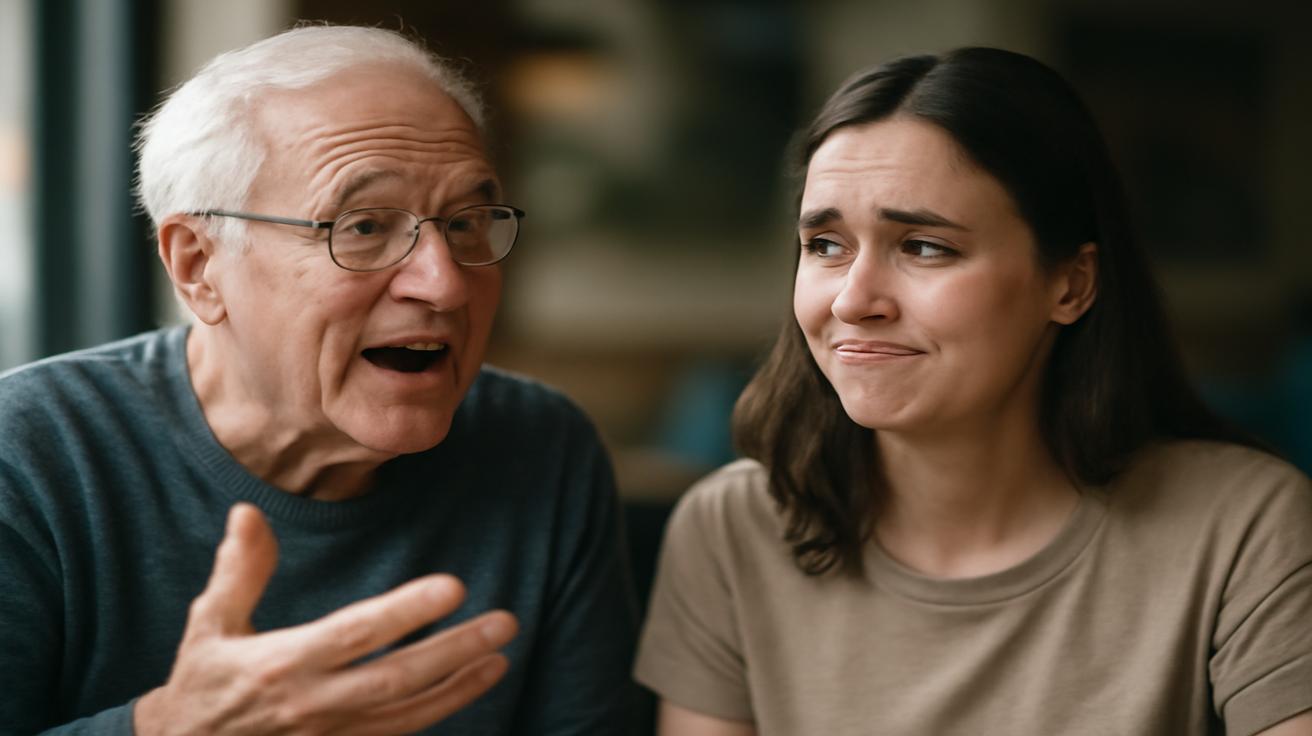
The coffee shop was loud with the usual Thursday night chaos—steam hissing from espresso machines, phones buzzing, someone laughing too loudly in the corner. At the table beside me, a girl in a denim jacket was explaining TikTok trends to her friend when her grandpa shuffled in, cardigan buttoned slightly wrong, eyes lighting up at the sight of her. He leaned over the table, patted her shoulder, and said, “Well, don’t you look sharp as a tack. How’s tricks?”
Her smile froze. You could see her trying to decode the phrase in real time, eyebrows knitting together like a buffering video. “Uh… good?” she answered, drawing out the word as if it might buy her a little more context.
He meant: How are you doing? How’s life treating you? It was pure warmth. But to her, it sounded like a transmission from another century.
That’s the strange magic of language across generations. The words themselves are simple, but the world wrapped around them—the smells, the streets, the technologies they grew up with—has shifted so dramatically that some phrases now land like alien messages. If you listen closely to people over 65, you’ll hear a hidden archive of another era, still alive in their vocabulary. To young people, these expressions can sound not just old-fashioned, but almost surreal.
Let’s slip into that space between ages—the soft crackling zone where phrases collide, and meaning goes slightly out of tune.
“Don’t Touch That Dial” – Spoken Into a World Without Dials
Once, there was a living-room altar made of wood and glass, humming softly, anchored to the corner like a quiet planet. The television. Before remotes, before endless streaming menus, you had to walk across the room and twist a knob to change the channel. Radios had chunky dials you turned slowly, chasing voices through static.
So when someone says, “Don’t touch that dial,” what they really mean is: Stay here. Don’t change the channel. Don’t go anywhere. The phrase is ghosted into older people’s speech, like a watermark from a black-and-white era.
Now imagine saying that to a 17-year-old on a couch, thumb hovering over their phone screen as they scroll through videos at the speed of thought. There is no dial. There hasn’t been a dial in their entire lifetime. The idea of physically walking across a room to alter your entertainment feels completely absurd.
Yet the phrase still appears: a grandparent calling from the kitchen when a commercial break hits, or an older boss joking as they hand over the remote during a team retreat. To them it’s playful, nostalgic. To younger ears, it’s like referencing a horse and buggy in the middle of a conversation about electric cars.
“Back in My Day” – When Time Becomes a Weapon
The phrase almost always arrives with a sigh or a shake of the head. A weathered hand waves through the air like it’s brushing dust off an invisible shelf.
“Back in my day, we respected our elders.”
“Back in my day, we didn’t need smartphones to have fun.”
It’s an opener that can feel like a lecture sneaking in through the side door. To the person over 65, it’s less about scolding and more about calling up a whole lived reality. “Back in my day” is a portal—back to when milk came in glass bottles, when a Sunday drive was entertainment, when you had to call the house phone and risk talking to someone’s father first.
To younger people, though, it often lands as an accusation dressed as nostalgia. Hidden inside the phrase is an unspoken “and your day is worse” or “you’re softer than we were.” It can shut down conversation in an instant, building a wall between past and present rather than a bridge.
What older adults often intend is something softer: a desire to share what life used to feel like, at a slower, simpler speed. They might be reaching not for authority, but for connection. Yet to ears raised on constant change and relentless crises, “back in my day” can sound like clinging to an era that never truly existed the way it’s remembered.
How “Back in My Day” Gets Heard
Context changes everything. Consider how the same phrase can be felt in totally different ways:
| Speaker’s Intention | Exact Words | How It Feels to Young People |
|---|---|---|
| Nostalgic sharing | “Back in my day, renting a movie meant a whole trip to the store. It was an event.” | Curious, like a story from another planet. |
| Judgment | “Back in my day, we just worked harder instead of complaining.” | Dismissive, like their struggles don’t count. |
| Attempt at humor | “Back in my day, we thought cassette tapes were high tech!” | Lighthearted—but still a reminder of the age gap. |
The phrase isn’t doomed, but it walks a thin line. Delivered gently, as an invitation into a story, it can be beautiful. Fired like a dart, it stings.
“You Look Like a Million Bucks” – Compliments in a Different Currency
There’s a particular gleam in the eye of someone over 65 when they say, “You look like a million bucks.” You can feel the admiration behind it, the sense of special occasion. Once upon a time, a million dollars was an unthinkable fortune—a number reserved for movie stars, oil tycoons, and game show fantasies.
Now, in an age where billionaires casually orbit the planet and the cost of a city apartment can hit seven figures, a million doesn’t sound like the mythic summit it used to. Young people, used to headlines stacked with astronomical numbers, might hear the phrase and think, “A million isn’t even that much anymore,” even as they laugh and say thank you.
Underneath the surface mismatch of economic realities, though, is a tender truth: older people often use money metaphors to describe worth because that was the language they were taught. Value was tallied in dollars, promotions, and property.
Younger generations are renegotiating that, talking more about emotional well-being, authenticity, mental health. So when a grandparent beams and says, “You look like a million bucks,” what they really might mean is: You look radiant. You look like your life is going well. I’m proud of you.
The phrase may be outdated in its math, but not in its intention.
“Kids These Days” – A Phrase Older Than Almost Everyone
Picture a park bench late in the afternoon. The light is fading, kids are running in nervous, jittery circles around a play structure, some bent over glowing phones, some practicing skateboard tricks on the path. On the bench, two older men sit with coffee cups cooling in their hands, watching.
One of them sighs. “Kids these days…”
Maybe he’s half amused, half bewildered by the way they film everything. Maybe he’s annoyed by the swearing. Maybe he’s quietly impressed by their courage, their hair dyed every color of hard candy. The trouble is, you rarely get the rest of the sentence.
“Kids these days” is one of those phrases that can carry anything: awe, worry, disdain, nostalgia. But to young people, it almost always sounds like a prelude to criticism, because that’s how it’s most often used in public—pundits on television complaining about “kids these days and their work ethic,” or strangers online blaming “kids these days” for the death of some industry or tradition.
What gets lost is the simple fact that this phrase isn’t new at all. People have been complaining—or marveling—about “kids these days” since long before smartphones, electricity, or indoor plumbing. There are writings from ancient Greece where older adults lament how the youth are lazy, rude, and ungrateful. Every generation inherits some version of it.
To someone over 65, the phrase can feel like sliding into a familiar groove, a way to talk about rapid cultural change that feels dizzying. To someone who is one of those “kids,” it’s like being reduced to a stereotype before you’ve even opened your mouth.
Why “Kids These Days” Feels So Off-Base
Young people today are growing up in a world of climate anxiety, unstable economies, and infinite digital comparison. They’re navigating realities older generations never had to face at the same age. So when they hear “kids these days” used as shorthand for laziness or fragility, it hits a nerve.
What many of them wish older people would say instead is something like, “I don’t understand everything about what young people are dealing with. Can you tell me what it’s like?” That’s a much longer sentence—but also a far braver one.
“Put Some Elbow Grease Into It” – When Effort Isn’t the Only Answer
The phrase comes with a mental image: sleeves rolled up, arms straining over a bucket or a workbench. “Elbow grease” is a kind of invisible substance you’re supposed to generate by sheer willpower—a combination of sweat, grit, and determination.
“Just put some elbow grease into it” could mean scrub harder, try again, study more, don’t give up so easily. For many older adults, who grew up being told that hard work was the one sure path to a better life, the phrase feels almost sacred.
To younger generations, it can sound like a refusal to see the systems stacked against them. No amount of elbow grease pays off student loans that ballooned beyond anything the speaker ever had to imagine. No amount of sheer effort alone solves housing crises, medical costs, or a job market where full-time work doesn’t always mean stability.
So when a 20-something shares that they’re burned out, working multiple jobs, and still struggling, hearing “put some elbow grease into it” can feel not just dated but a little cruel, as if their exhaustion is being mistaken for laziness.
Of course, effort does still matter. Perseverance, discipline, showing up when things are hard—those are timeless truths. But the phrase doesn’t leave room for nuance. It turns every problem into a matter of individual will, ignoring the terrain each person is climbing.
The Hidden Story Behind “Elbow Grease”
For many over 65, this was survival logic. They grew up in families that had to stretch every dollar, where quitting wasn’t an option. “Elbow grease” wasn’t a cute metaphor—it was how you made it through a week. That’s part of why they hang onto the phrase so tightly: it worked for them. It was how they earned pride in a world that didn’t hand it out easily.
The disconnect isn’t about whether effort matters. It’s about whether effort alone is enough. That’s where the generational friction lives.
“Don’t Air Your Dirty Laundry in Public” – Privacy in the Age of Oversharing
The phrase smells faintly of laundry starch and sun-dried sheets. You can almost see the backyard clothesline, shirts flapping in the wind, neighbors glancing over the fence. “Dirty laundry” was once literal—visible stains, torn fabric, the private mess of a household hung out for all to see.
So when someone over 65 says, “Don’t air your dirty laundry in public,” they’re often talking about family arguments on social media, emotional posts, public call-outs, or anything that feels too personal for the world’s gaze. To them, certain things should stay behind closed doors, handled quietly and calmly.
Young people, on the other hand, have grown up in a digital landscape where sharing struggles online can be a lifeline. They look for community through hashtags, DM groups, anonymous forums. Talking publicly about mental health, trauma, or relationship problems is not about drama to them; it’s about survival, solidarity, and refusing to suffer in silence.
So when an older relative tuts, “You shouldn’t post that; don’t air your dirty laundry,” it can sound like, “Hide your pain. Don’t make anyone uncomfortable. Keep it to yourself.” That hits especially hard in generations that are actively trying to break cycles of silence.
The older phrase carries a belief: that privacy equals dignity. The younger counter-belief is that openness equals healing. Both have truth in them. Both can go wrong. Somewhere between the laundry line and the livestream, there’s a balance still being negotiated.
“We Made Do With What We Had” – The Quiet Edge of Resentment
There’s another phrase that slips easily off the tongues of people over 65, sometimes with pride, sometimes with a subtle edge: “We made do with what we had.”
It might surface when a grandchild complains about their phone being “too slow,” or about not being able to afford the latest gadget, or even about the state of the world. “We made do with what we had” conjures images of patched clothes, re-used jars, hand-me-down furniture, wartime ration lines, depression-era frugality. It’s a reminder that previous generations also weathered storms.
But in a conversation with a young person, it can slide quickly into comparison: We struggled, too—so why are you having such a hard time? Underneath, there can be unspoken hurt: If we survived all that without therapy and social media and “self-care,” why can’t you?
Young people hear the phrase and feel a flicker of defensiveness. They’re not asking for life to be easy. Many are grinding through their own versions of “making do”—with crushing rent, gig work, climate dread, political instability. The specifics are different, but the weight is real.
When “we made do with what we had” is shared as a story of resourcefulness, it can be inspiring. When it’s used as a ruler to measure someone else’s pain, it hurts. The line between those uses is thin, and often invisible in the moment.
Bridging the Gap, One Phrase at a Time
Here’s the quiet secret tucked underneath all these out-of-touch sayings: they’re usually powered by emotion more than arrogance. Fear that the world is changing too fast. Pride in having survived a different kind of hard. Desire to feel that their own youth still matters in a culture obsessed with the new.
To younger ears, the phrases can sound creaky and condescending, like a door that won’t quite close. But if you listen past the words themselves—past “kids these days” and “back in my day” and “put some elbow grease into it”—you’ll sometimes hear a simpler message trying to get through: I want to feel connected to you. I want what I learned to still be worth something.
Language is one of the last places the past holds on. That’s why it can feel both charming and frustrating, both tender and wildly out of touch. The trick isn’t to ban these phrases or mock them, but to translate them—and maybe gently update them in the process.
When a grandparent says, “Don’t touch that dial,” you might smile and reply, “Deal. I won’t scroll past this moment.” When someone says, “You look like a million bucks,” you can hear the subtext: You matter to me. When “kids these days” escapes someone’s lips, you can answer, “Yeah, kids these days are dealing with a lot. Want to hear what it’s like?”
Somewhere between the rotary phone and the For You page, between the clothesline and the cloud, there’s a conversation still happening. It’s imperfect, full of old metaphors and new anxieties, but it’s ours. And if we listen a little closer—to the words, and to what’s hiding beneath them—we might find that the generations aren’t as far apart as they sound.
FAQ
Why do people over 65 still use these old phrases?
Because language is tied to memory. These phrases were formed during their most vivid years—childhood, teens, early adulthood—so they feel natural and comforting, even if the world around them has changed.
Are these phrases always offensive to young people?
No. The impact depends on tone and context. Used playfully or as part of storytelling, they can be charming. Used to dismiss or criticize, they feel out of touch or hurtful.
Should older people stop using these expressions?
Not necessarily. It’s more helpful to be aware of how they can land and be open to explaining, adapting, or listening when someone reacts badly.
How can young people respond without sounding disrespectful?
They can ask questions (“What does that mean?”), share how it sounds to them, or gently offer modern alternatives, turning the moment into a conversation rather than an argument.
Can language differences actually bring generations closer?
Yes. When both sides treat confusing or outdated phrases as chances to trade stories—about radios, streaming, dials, and DMs—they become bridges, not barriers.