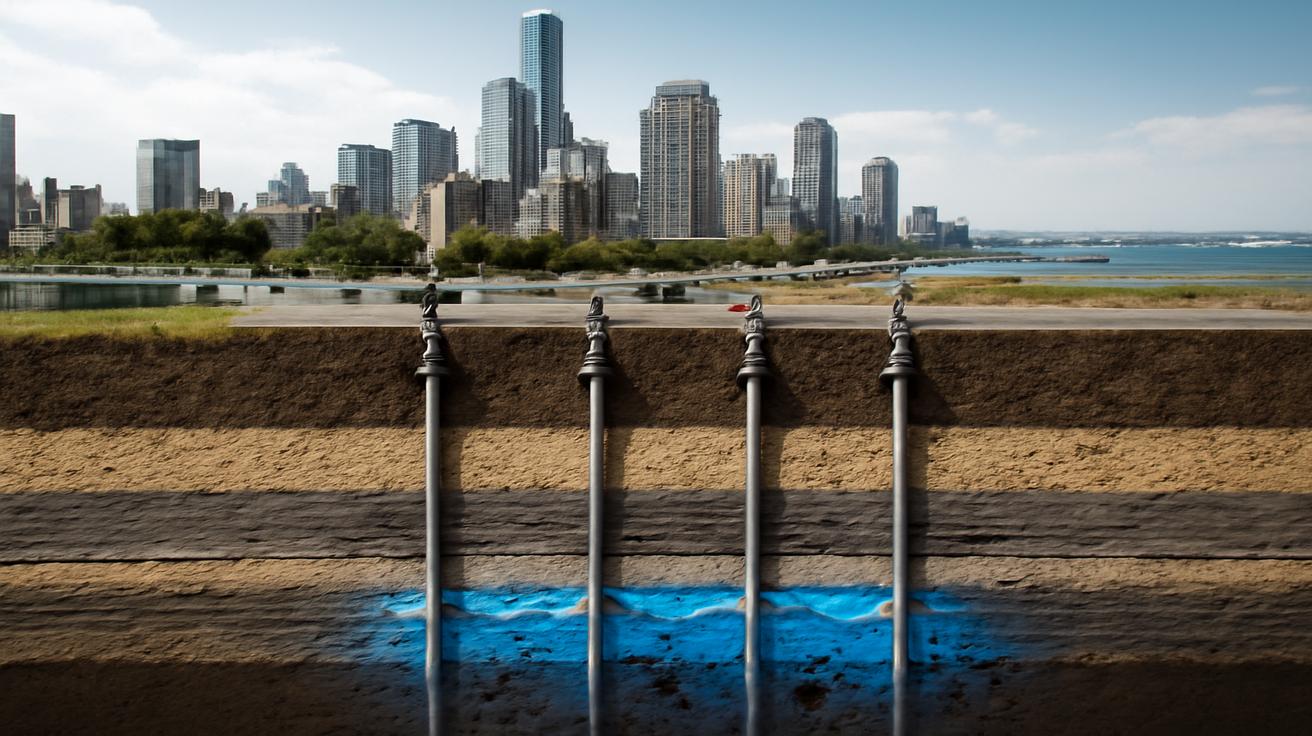
The first time you see a city sinking, you don’t notice it. Not really. You see a crack running along a building wall and think: bad plasterwork. You notice how your favorite coffee shop floods a little deeper each monsoon season and blame it on clogged drains. You feel a slight tilt in an old sidewalk and chalk it up to time. But the ground is moving, slow as breath, and entire skylines are quietly, steadily, slipping down.
When the Ground Begins to Breathe
Engineers have a dry name for it: land subsidence. It sounds almost polite, like the earth is gently sitting down after a long day. In reality, it’s a slow-motion catastrophe. In some of the world’s largest cities, the land has been dropping by centimeters every year—enough to warp train tracks, twist building foundations, and invite the sea in a little closer.
The villains are invisible and utterly ordinary: water, oil, and gas. Or, more precisely, the sudden absence of them.
Underground, the earth’s crust is not a solid block. It’s a layered library of rock, sand, clay, and porous stone, its tiny gaps filled with fluids. For a century or more, we’ve been tapping those hidden reserves—pumping out oil to fuel cars and planes, and sucking up groundwater to feed megacities and irrigate crops. Remove enough of that subterranean support, and the overlying land begins to sag, like a mattress with the stuffing pulled out.
Yet in the same way humans created this problem, they’ve also discovered an unlikely, almost poetic counter-move: put something back. In some of the world’s largest and most vulnerable cities, engineers are now pumping water into empty oil fields, coaxing underground rocks to swell and brace themselves, slowing the city’s descent. It’s like teaching the ground to breathe again.
The City That Refused to Sink
Picture a sprawling coastal metropolis at dawn. Tower cranes stitch the sky. Freeways coil around glass towers. Tankers queue offshore like patient steel whales. Beneath the traffic hum and the early-morning heat, another, quieter industry is at work—far below street level.
Decades ago, this city struck black gold. Oil fields beneath its outskirts and offshore platforms turned it from a modest port into a global powerhouse. For years, the oil flowed upward in steady, profitable rivers. But as the barrels mounted, something else began to change: the land itself.
Neighborhoods closest to the old oil fields started showing worrying signs. Tide lines crept higher along seawalls. Engineers measured subtle drops in elevation. In some districts, the land was sinking by more than a centimeter a year—an almost imperceptible drop, until you stretched it over a decade or a human lifetime.
Geologists traced the cause: as oil was pumped out of the underground reservoirs, the rock formations that once held that oil—porous, sponge-like layers—lost their internal pressure. Grains of sand and rock shifted closer together under the immense weight of the overlying earth. The result: compaction. The land surface slowly inched downward.
To many, this seemed like the inevitable cost of progress. Fields age. Wells run dry. The city grows richer even as its foundations quietly soften. But a small group of engineers and geoscientists refused to accept that equation. If taking fluid out made the land sink, they reasoned, might putting fluid back help hold it up?
Turning the Flow Backward
The idea wasn’t entirely new. Oil companies had long experimented with “waterflooding” to push out stubborn pockets of crude. By injecting water into certain wells, they could maintain pressure in the reservoir and squeeze a bit more oil from the rock. But what if this technical trick could be repurposed—not to harvest more oil, but to protect the city itself?
Teams began designing injection programs focused less on economics and more on geomechanics. They studied which layers of rock were most sensitive to pressure changes, mapped historic rates of sinking, and installed networks of precise GPS stations and satellites to monitor every millimeter of ground movement.
Soon, pumps that once roared oil upward began to hum in reverse. Treated water—sometimes seawater, sometimes freshwater, sometimes recycled urban wastewater—was pushed back down into depleted formations. Instead of draining the underground sponge, they were re-wetting it, carefully, methodically.
And the city, astonishingly, began to respond.
In districts that had been subsiding fastest, the sinking slowed dramatically. In a few areas, instruments even recorded a slight uplift—a barely measurable rebound, like a mattress rising when a sleeper rolls away. The ground would never return to its original height, but its downward spiral had been interrupted.
| City / Region | Main Cause of Subsidence | Mitigation Approach | Observed Effect |
|---|---|---|---|
| Coastal oil metropolis | Oil extraction from deep reservoirs | Water injection into depleted fields | Slowed or halted subsidence; minor uplift in zones |
| Delta megacity | Excessive groundwater pumping | Reduced pumping, aquifer recharge projects | Lowered sinking rates but still vulnerable to seas |
| Industrial basin city | Oil, gas, and groundwater withdrawal | Combined water injection, regulation, monitoring | Stabilized ground in key industrial zones |
The Strange Physics Under Our Feet
It’s tempting to picture oil fields as giant underground lakes, with companies simply dipping straws into them. In reality, they’re closer to soaked rocks: imagine a dense sandstone soaked with oil and water, every pore space filled. When oil is pumped out and nothing replaces it, the pressure inside those tiny spaces drops. The enormous weight of the overlying rocks—kilometers of earth—begins to crush the reservoir layer more tightly.
This compaction is what tugs the land surface downward. It happens slowly and unevenly. One neighborhood may sit atop a stiff, resilient formation and barely move; another might rest above a soft, compressible layer and slump like wet clay.
When engineers inject water into depleted oil fields, they’re not inflating some hollow balloon. They’re restoring pressure in those microscopic pores. Done carefully, this re-pressurizing can brace the reservoir rock, slowing its tendency to compact. The overlying land responds like an old house whose sagging beams have been propped up—not perfectly level, but no longer collapsing.
Of course, it’s a delicate game. Push too hard, raise pressure too fast, and new risks emerge: fractures opening in rock layers, leaks into unintended zones, even induced earthquakes in some geological settings. So the work becomes part science, part listening exercise—tuning injection rates, monitoring tiny tremors, watching satellite imagery for the faintest hint of uplift or renewed sinking.
The main ingredient is patience. Land subsidence unfolds over decades; reversing or even slowing it demands the same long horizon. There is no overnight fix, only the steady discipline of respecting physics and letting the ground adjust at its own glacial pace.
Balancing Water, Oil, and People
Beneath the technical diagrams and pressure charts lies a tangle of human questions. Where does the injected water come from? Can a city already thirsty for drinking water spare millions of cubic meters to pump underground? How do you weigh the need for energy against the risk of sinking neighborhoods?
In some cities, the solution has been to use seawater. Offshore platforms already draw from the ocean, treat the water to remove suspended solids and corrosive elements, and push it down into undersea reservoirs. Onshore, however, the calculation is murkier. Coastal aquifers may be brackish; river water may be seasonal or polluted; desalination is expensive and energy-hungry.
Some engineers have turned to what cities have in abundance: wastewater. Modern treatment plants can purify sewage and industrial runoff to a degree where it becomes acceptable for industrial reuse, including injection into deep formations. It’s not drinking-water quality, but it is a new kind of urban resource—a loop where the city’s own effluent becomes a tool to stabilize its foundations.
This looping of flows—oil out, water in; water used, water treated, water reinjected—begins to blur older lines between energy systems and water systems. In many large cities, the departments that once barely spoke to each other—oil ministries, water authorities, environmental regulators—now find themselves sitting at the same tables, assessing the same subsidence maps.
They talk not just about technical feasibility but about trade-offs. Is it better to curb groundwater pumping and rely more on water injection into oil fields? Which neighborhoods should be prioritized for ground stabilization efforts? Where should the city retreat from rising seas, and where is the land still worth defending with every available tool?
The Ethical Depths Beneath the Engineering
There’s an uncomfortable irony in having to “repair” the ground because of activities that made the city rich in the first place. Oil and gas built roads, hospitals, and schools, yet their extraction undermined the long-term habitability of the land itself. Injecting water into empty reservoirs, then, is both remedy and reckoning.
Engineers often describe their work in neutral terms: managing reservoir pressure, minimizing surface deformation. But behind these phrases lies a quieter moral challenge: how do you act responsibly in a system whose full consequences you’re only now beginning to grasp?
In some cities, the decision to invest in water injection schemes came only after damage was undeniable—buildings tilting, pipelines stretching, coastal wetlands drowning more each year. In others, early research and pressure from scientists persuaded governments to change course before the worst occurred. That difference—between reacting and anticipating—can define the fate of entire districts.
The people who live above these emptying and refilling reservoirs rarely see the pipes and pumps beneath their feet. What they see are more tangible markers: new cracks in kitchen tiles, doors that no longer close properly, roads patched again and again. For them, subsidence is not a geological concept but an everyday nuisance, a creeping anxiety.
Convincing these communities that underground water injection can help is partly a technical challenge and partly a storytelling one. You have to explain why the ground is moving, what you plan to do about it, and how you’ll know if it’s working—without drowning anyone in jargon. You have to make the invisible visible, honestly, without promising miracles.
Sinking Cities, Rising Seas
Land subsidence would be worrying enough on its own, but it’s happening in a century of rising seas and intensifying storms. When the ground sinks even a few centimeters, the relative sea level rises that much more. A city doesn’t care whether the water comes up or the land goes down; it simply gets wetter.
In some of the world’s low-lying megacities, this double squeeze is already turning daily life into a negotiation with water. High tides flirt with the bottoms of bridges. Storm surges overtop defenses that were designed for calmer conditions and steadier shorelines. Saltwater slips into coastal aquifers, souring wells that once tasted sweet.
Here, injecting water into empty oil fields is not a grand, heroic fix. It’s a defensive maneuver, one piece of a larger adaptation puzzle. You still need sea walls and restored wetlands and wiser disaster planning. You still need to stop over-pumping groundwater and better manage stormwater. You still need to reckon with climate change at its source.
But slowing subsidence buys time. It gives a city precious years to redesign its waterfronts, elevate critical infrastructure, and decide—sometimes painfully—which areas to save and which to surrender. It postpones the day when king tides become everyday floods and when “once-in-a-century” storms arrive every decade.
In that sense, water injection into depleted fields becomes more than an engineering curiosity. It’s part of a fragile social contract between a city and its future: we will try to hold the ground steady beneath you, for as long as physics allows, while we work on the deeper transformations we can no longer avoid.
Listening to the Earth in Millimeters
What makes this contract possible is our new ability to “listen” to the earth with extraordinary precision. Once, measuring land movement meant driving stakes into the ground and returning with a tape measure years later. Now, engineers use satellites that can detect elevation changes as small as a few millimeters.
These space-borne eyes send radar pulses toward the city and read the echoes, building detailed maps of uplift and subsidence. Over months and years, those maps turn into time-lapse portraits of a living landscape: the soft sag of a groundwater basin, the gentle rise over an injection field, the ominous deepening of a coastal bowl.
Combined with sensors on the ground and data from wells, the picture becomes even richer. Engineers know when a particular injection program is working, where to adjust, where to ease off. In a sense, they are learning to co-manage the earth’s crust the way we’ve long tried to manage rivers or forests—imperfectly, but more consciously than before.
It’s a humbling endeavor. For every success story of halted subsidence, there are other places where the sinking continues unabated, driven more by groundwater extraction or the heavy weight of new urban development than by oil fields. Water injection into depleted reservoirs is powerful, but it is not universal magic. Each city must read its own geology, its own history of extraction, and its own appetite for risk.
What We Owe the Future Ground
Stand again in that waking city. The sun has climbed higher now; the glass towers glow. Somewhere offshore, a platform hums as seawater is pushed down into a reservoir that once coughed up oil. Somewhere inland, a treatment plant sends a stream of cleaned wastewater into a network of pipes that dive deep below industrial parks and apartment blocks.
Up here, life goes on. Children walk to school along sidewalks that are, for now, level. Trains cross bridges whose footings, for now, sit steady. The tide rolls against seawalls whose designers have, for now, won a few extra centimeters of breathing space thanks to the pressure being restored below.
None of this is permanent. Land will continue to move, as it always has. Seas will keep rising. Some mistakes made underground cannot be fully undone. But in learning to pump water into the very voids our thirst for oil created, we have stumbled into a new kind of relationship with the planet’s crust: less extractive, more conversational.
We are no longer just taking and taking, then walking away when the wells run dry. In some places, at least, we are staying to tend the emptiness we left behind—to refill, to shore up, to slow the sinking. It is not redemption. It is responsibility.
And if you pay attention—if you look closely at that hairline crack in the wall, at the angle of the street, at the tide mark on the pier—you may start to sense it: the ground beneath you is not fixed. It never was. But somewhere, in the quiet thrum of pumps miles below, there is an answer to that movement—a human-made heartbeat under the city, pulsing water into darkness, buying time for whatever comes next.
Frequently Asked Questions
How does pumping water into empty oil fields help reduce land subsidence?
When oil is pumped out of underground reservoirs, the pressure that once supported the surrounding rock drops, and the rock layers can compact, causing the land above to sink. Pumping water back in restores some of that pressure, helping to brace the rock and slow or partially halt the compaction. It doesn’t rebuild what’s already collapsed, but it can significantly reduce future sinking.
Can water injection completely stop a city from sinking?
In most cases, no. Water injection can slow or stabilize subsidence where it’s directly caused by oil extraction and pressure loss in reservoirs. But cities usually face multiple drivers of sinking—such as groundwater overuse, heavy construction, and natural soil compaction. Injection can be very effective locally, but it works best as part of a broader strategy that also addresses groundwater use, building practices, and coastal protection.
Where does the injected water usually come from?
Sources vary by location. Offshore fields commonly use seawater that’s filtered and treated before injection. Onshore, engineers may use brackish water, treated wastewater, or in some cases river or desalinated water. The key is that the water must be treated enough to avoid clogging the rock pores or corroding infrastructure, but it doesn’t have to be drinking-quality.
Is injecting water into the ground safe?
When carefully designed and monitored, injection into deep, well-characterized formations can be done safely. However, there are risks if pressure is raised too quickly or in the wrong layers—such as triggering small earthquakes or causing fluids to migrate into unintended zones. That’s why projects rely on detailed geological studies, strict pressure limits, and continuous monitoring of both ground movement and seismic activity.
Why don’t all sinking cities use this method?
Water injection into depleted oil fields only works where subsidence is closely tied to pressure loss in those specific reservoirs—and where such reservoirs actually exist beneath or near the city. Many sinking cities rest on soft sediments and rely heavily on groundwater, not oil. In those places, solutions focus more on reducing groundwater pumping, improving water supply, and redesigning infrastructure rather than injecting water into oil fields.