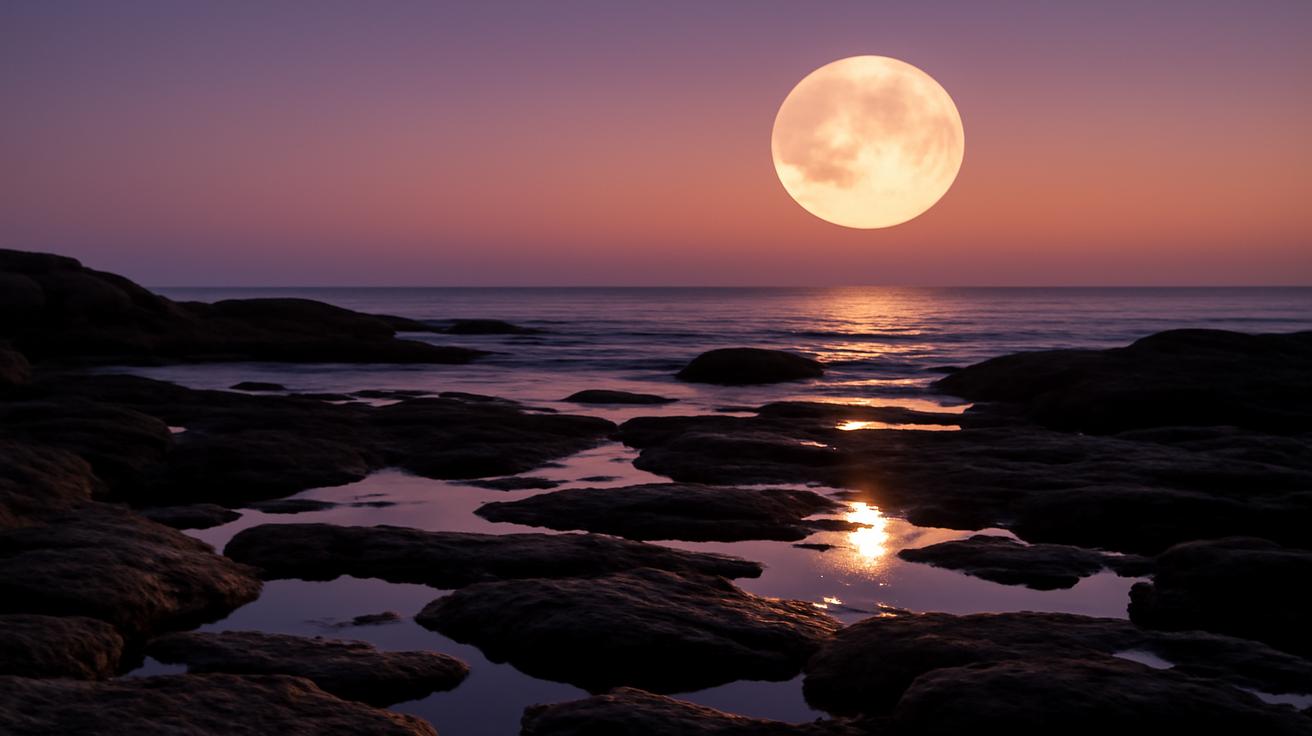
The first time you notice the Moon is moving away from us, it might be because you learn the number: 3.8 centimeters per year. It sounds laughably small, like the width of a fingernail. You picture the Moon hanging in the black, silver-pale and perfectly still, yet the truth is stranger: it is leaving. Very slowly, very quietly, the Moon is slipping from Earth’s grasp. And as it drifts, almost imperceptibly, the length of our days and the rhythm of our tides are being rewritten.
The Silent Departure Above Our Heads
Step outside on a clear night. The air sharpens. Somewhere in the branches above you, a night bird stirs. The world feels paused, like it’s holding its breath. You tip your head back and there it is: the Moon, bright enough to cast a weak, grainy shadow at your feet. It looks constant, more permanent than any city or mountain or river.
But if you could watch the Moon not over hours, but over millions of years, you would see something different. You’d see a slow, stately retreat. Frame by frame, the Moon would slide outward, its orbit expanding like a widening halo. In a sped-up cosmic time-lapse, it would look as if the Moon is slowly letting go of us.
Right now, the Moon is about 384,400 kilometers away. That’s a number we’ve stamped into textbooks and trivia. Yet ancient lava flows on the Moon, dusted with eons of micrometeorites, whisper a different distance. Laser beams fired from Earth and bounced off reflective panels left by Apollo astronauts give us exact measurements: the Moon is receding about 3.8 centimeters every year.
It’s not falling away into darkness or breaking some cosmic tether. Instead, it’s following the quiet rules of physics and energy, nudged by the very tides that cradle our coasts. The Moon sculpts Earth’s oceans, and in return, the oceans are slowly pushing the Moon away.
The Tug-of-War Between Earth, Moon, and Sea
Tides feel like breathing. The ocean gathers itself in slow, deliberate inhales, then exhales, withdrawing across sand and rock. To a person on the shore, it’s gentle, familiar. But beneath that rolling surface is a colossal exchange of energy.
The Moon’s gravity pulls on Earth. It tugs especially at the oceans, which are free to move. Water bulges toward the Moon on the side facing it, and another bulge forms on the opposite side of Earth – a delicate balancing act of inertia and gravity. As Earth spins, these tidal bulges don’t perfectly align with the Moon. They’re dragged slightly ahead, pulled forward by Earth’s faster rotation.
That small misalignment matters. Those bulges of water act like a giant hand, pulling on the Moon, giving it a tiny forward push in its orbit. A forward push in orbit means more energy, and more orbital energy means the Moon can climb higher, slipping farther away.
But energy isn’t free. To gift the Moon a little more orbital energy, Earth has to pay with its spin. So the planet slows down. Just a whisper. A thousandth of a second here, a thousandth there. Over millions of years, those whispers add up to hours.
We live inside this exchange without ever noticing it. The rhythm of waves on a rocky shore, the glint of moonlight on tidal flats, the soft sucking sounds of water sliding back through pebbles – these everyday, sensory details are all part of a grand celestial tug-of-war that is literally changing the length of our day.
What a Slowing Planet Feels Like
You will not wake tomorrow to find that your day is suddenly longer. Our modern clocks are far too precise for such crude surprises. Instead, scientists detect Earth’s slowing rotation through exquisitely sensitive measurements: radio telescopes linking distant observatories; atomic clocks ticking with relentless regularity.
Right now, our day lengthens by about 1.7 milliseconds per century – a blink, inside a blink. Over a human lifetime, it’s nothing you’d feel in your bones or your sleep. But Earth is old. When you stretch that change across billions of years, it becomes enormous.
We can actually read that history, written into ancient rocks. In some places, bands of sediment – layers of mud and silt laid down rhythmically by tides – record the beat of long-ago days. Like the rings of a tree, they preserve patterns: thick, thin, thick, thin, in repeating cycles tied to the Moon’s pull. By studying these “tidal rhythmites,” scientists have reconstructed the length of a day in deep time.
About 620 million years ago, a day on Earth was roughly 21.9 hours long, and a year held more days – maybe around 400 of them. Life was just beginning to experiment with complex bodies, strange frond-like creatures waving under shallow seas. The sky looked the same, but time itself moved differently.
Farther back, in the young, restless Earth more than a billion years ago, a single rotation might have been even shorter – perhaps 18 hours or so. The planet spun like a faster top, while the Moon loomed larger in the sky, its gravity yanking bigger tides across the newborn continents.
How the Moon Changes Our Tides – And Our Coasts
Stand by the sea at high tide and feel how close the ocean comes. Waves slap at stone walls, licking at the edges of roads and piers. A few hours later, everything is transformed. Fishing boats rest on mud. Seaweed hangs limp from barnacled pylons. The ocean feels miles away, even though you’ve barely moved.
This rise and fall is dominated by the Moon. The Sun plays a role too, but it’s the nearness of the Moon that makes its pull so powerful. As the Moon drifts away, its grip weakens. That means that in the unimaginably distant future, Earth’s tides will be gentler.
Not next year. Not in your grandchildren’s time, or their grandchildren’s. Over the next few million years, the change will be slight, overshadowed by regional geography, warming oceans, and shifting coastlines. But on a timescale of hundreds of millions or billions of years, the overall tone of the oceans will soften. The extreme highs and lows will fade, just a little.
Yet the story of tides is more than simple height. It’s about timing. Tides control coastal ecosystems: when tidepools are covered or uncovered, when estuaries fill and empty, when salt marshes breathe in seawater and breathe it out again. Many species have tied their lives to this rhythm – crabs, shellfish, shorebirds, even some corals.
If we could skip through future ages like pages in a book, we might see subtle changes in where these ecosystems can thrive, how they feed, how they breed. The Moon moves away, Earth’s spin slows, tides shift – and somewhere, a species of mollusk either adapts, migrates, or disappears, all because a satellite in the sky is very slightly farther out.
The Long Memory of Water and Rock
Our planet keeps a diary of its changes. Not in words, but in patterns. Tidal rhythmites in cliffs. Reefs stacked like pages. Ancient coral and shell growth rings that whisper of how many sunrises fit into a single year. Taken together, they tell us: the Moon used to be closer. The tides used to hit harder. Days used to be shorter.
Imagine a coastline a billion years from now. Continents may be unrecognizable, rearranged by plate tectonics. But wherever land meets ocean, water will still respond to the Moon. The “whoosh” and retreat of the sea will still exist, just tuned to a slightly different beat – longer days, a more distant Moon, gentler tides.
Our descendants, if they are still here and still watching, might measure the distance to the Moon with whatever tools they invent and calmly confirm what we already know today: the separation continues. Earth’s diary is still being written, one slow rotation at a time.
Earth, Moon, and the Music of Stability
There’s another quiet effect of the Moon’s presence – something you don’t feel when you look up, but which shapes your life more than you realize: stability. Our planet doesn’t just spin; it also tilts. That tilt, about 23.5 degrees, gives us seasons. Without the Moon, that tilt might wander wildly over time, swinging between gentle and extreme, throwing climate patterns into chaos.
The Moon acts like a steadying hand, helping to keep Earth’s tilt within a relatively narrow range. This, in turn, helps keep our climate from lurching into dramatic mood swings too often. It doesn’t prevent ice ages, deserts, or storms – but it smooths the larger, long-term dance.
As the Moon moves away, its stabilizing influence does change, though not overnight. In theory, a much more distant Moon could mean a slightly less anchored spin, allowing Earth’s tilt to wander more. Over vast timescales, this could lead to slower, larger-amplitude shifts in seasons and climate, like changing the tempo and intensity of a familiar song.
There’s a kind of fragile grace in this arrangement. The same tidal friction that slows Earth and pushes the Moon outward also helps maintain this overall pattern. Energy moves around, but not chaotically – more like a carefully choreographed routine that just happens to take billions of years to perform.
A Future with Extra-Long Days
If you could leap forward billions of years, the numbers turn surreal. The Moon might be hundreds of thousands of kilometers farther out. A single Earth day might last more than 40 current hours, or even longer, depending on how other forces – like the Sun’s evolution – reshape the system.
In that far-off era, the concept of “day” and “night” as we know them would feel different. Long, drawn-out daylight basking one side of the planet; long, lingering nights on the other. Tides creeping in and out under a smaller, more distant Moon. The sky’s bright lantern reduced to a paler coin, hanging farther from Earth’s grasp.
Interestingly, this process can’t just go on forever unchallenged. The Sun will eventually swell into a red giant, and the entire dynamics of the Earth–Moon–Sun system will shift. But long before that, the quiet exchange of momentum between ocean and satellite will continue, playing out like a patient, inevitable story written in millimeters and milliseconds.
Seeing the Cosmic in the Everyday
In the meantime, you live in a sweet, particular moment of this long narrative. The Moon fits neatly in the sky, just the right size that it can perfectly eclipse the Sun from our point of view. The tides are strong enough to shape coasts and ecosystems, but not so overwhelming as to flood the world. Our days are 24 hours – a balance that works well enough for circadian rhythms and human schedules.
Pick a night soon and go find the Moon again. Maybe the air is smoky with summer heat, or crisp with the edge of autumn. Maybe waves thud on a nearby beach, or a city hum masks the quiet. Wherever you stand, the Moon is there, serene and indifferent, already a little farther away than it was when your grandparents were born. A tiny fraction of a centimeter, but still – farther.
Try to imagine the invisible threads that link the Moon to the ocean, and the ocean to the spinning Earth, and the spinning Earth to your own sense of time. Think of the seconds added to our days over ages; of ancient coral, once living, counting shorter days long before humans came along to ask questions.
This is one of the richest gifts of science: it lets you stand in the ordinary – a night sky, a lapping tide – and glimpse the extraordinary architecture beneath it. The fact that the Moon is slowly leaving doesn’t make it feel more distant. In a way, it makes every moonrise more intimate, more finite, more worth noticing.
The retreat is slow, but relentless. With every passing year, our companion in the sky steps back a little, and Earth’s spin loosens just a touch. Time lengthens. Tides shift. And in the background, the universe continues its calm, patient work, rearranging the details while we live our brief, luminous lives under the drifting Moon.
Numbers Behind the Drift (A Tiny Table of Big Changes)
Here’s a compact look at how the Moon’s slow retreat and Earth’s slowing spin stack up across different timescales:
| Timescale | Moon’s Distance Change* | Change in Length of Day* |
|---|---|---|
| 1 year | +3.8 cm | Too small to detect in daily life |
| 100 years | ~3.8 meters | ~+1.7 milliseconds |
| 1 million years | ~38 km | ~+17 seconds |
| 600 million years ago (past) | Moon closer by tens of thousands of km | Day ~22 hours long |
| Billions of years from now (future) | Moon much farther; details uncertain | Day could exceed 40 hours |
| *Approximate values; real changes are influenced by complex Earth–Moon–Sun interactions. | ||
Frequently Asked Questions
Is the Moon really moving away from Earth?
Yes. Precise laser-ranging experiments show that the Moon is receding from Earth at about 3.8 centimeters per year. This is due to tidal interactions between Earth’s oceans and the Moon’s gravity, which transfer rotational energy from Earth’s spin into the Moon’s orbit.
Will the Moon ever completely leave Earth’s orbit?
Not in any timeframe that matters to human civilization. The Moon will continue to drift outward for billions of years, but long before it could meaningfully “escape,” the Sun will evolve into a red giant and radically alter the Earth–Moon system. Practically speaking, the Moon remains our companion for the lifespan of the planet as we know it.
How does the Moon moving away affect the length of our day?
As the Moon gains orbital energy and moves outward, Earth loses rotational energy and spins more slowly. This makes days longer by roughly 1.7 milliseconds per century. Over hundreds of millions of years, that adds up from hours shorter days in the past to potentially much longer days in the distant future.
Are tides already changing because of this drift?
The Moon’s gradual retreat does weaken its gravitational pull over very long timescales, which will slowly reduce the strength of tides. However, over human, historical, or even near-geological timescales, local factors like coastline shape, ocean depth, and climate-driven sea-level changes have a much larger impact on the tides we experience.
Does the Moon help stabilize Earth’s climate?
Yes. The Moon helps stabilize Earth’s axial tilt, which influences the severity and regularity of seasons. Without the Moon, Earth’s tilt might wobble more dramatically over time, potentially causing larger, more erratic climate shifts. As the Moon slowly moves away, its stabilizing effect changes, but this happens over such long timescales that it doesn’t pose a near-term concern.