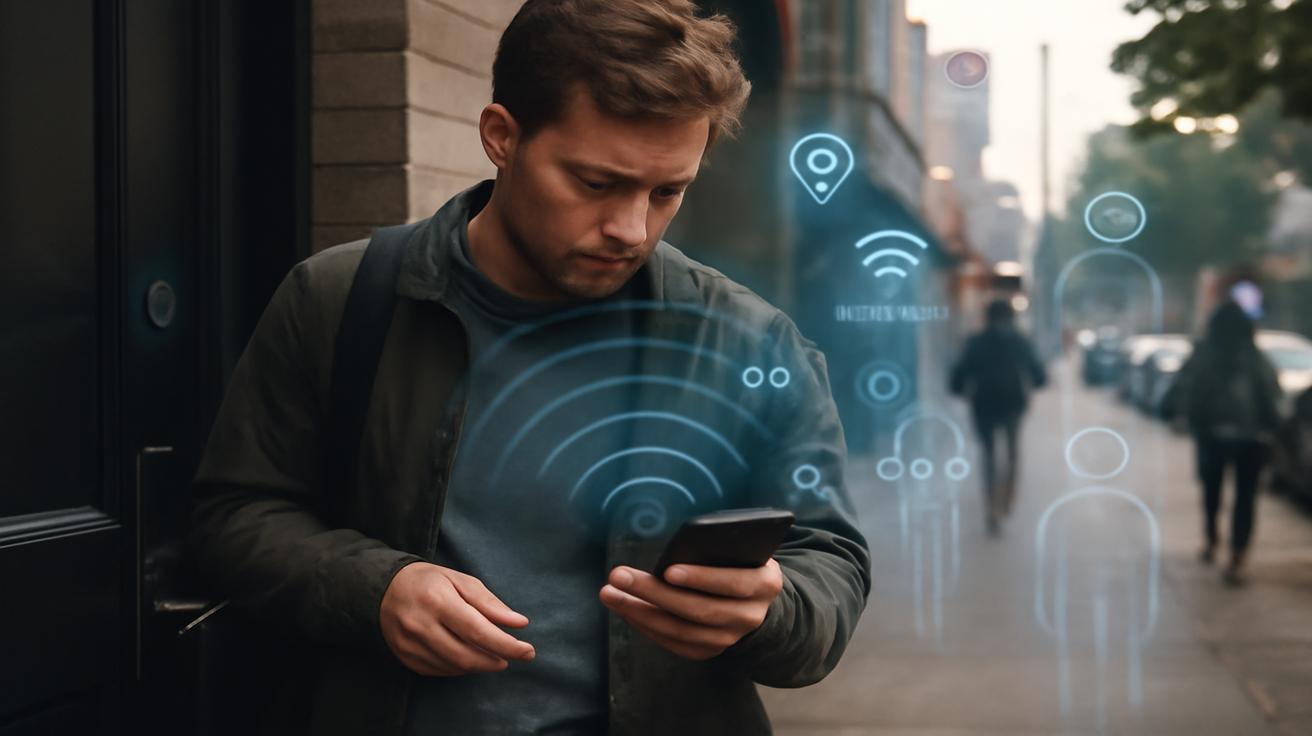
The moment the door clicks shut behind you, the world sounds different. The hum of your fridge fades, the muffled city noise sharpens, the sky stretches wide above the street like it suddenly remembered it’s supposed to be endless. Your phone buzzes in your pocket—again. A tiny tug on your attention, a small, invisible thread pulling you away from the taste of the air, the pattern of light on the pavement, the quiet language of trees lining the sidewalk.
You thumb the screen awake out of habit. A notification. An update. A “connect to Wi‑Fi?” prompt from a café across the road you’ve never even stepped inside. Your phone is reaching, searching, whispering digital introductions to every signal around you. You’re officially out of your home—and your Wi‑Fi should officially be off.
The Invisible Net You’re Carrying Around
Imagine walking through your neighborhood carrying a big, colorful fishing net over your head. As you move, it snags on every little thing—branches, signposts, door handles, strangers. It slows you down, distracts you, gets caught in places you never meant to go.
That’s your phone with Wi‑Fi on when you leave home.
Your device is constantly scanning, pinging, announcing itself: “Any networks out there for me? Any open doors?” You don’t hear it, but it happens every few seconds, wherever you are: in the park, on the bus, in the elevator, on a remote trail where you thought you’d finally escaped all of it.
This quiet, continuous chatter does more than drain your battery. It leaves little breadcrumbs of your movement, creates a map of the spaces you inhabit, and gently, insistently tugs you away from the textures of the real world. The story of your day stops being written by your senses and starts being shaped by whatever network your phone can find next.
The Battery You Keep Wasting Without Realizing
If your phone had a voice, it would probably sound a little out of breath by noon. It’s not just your bright screen or endless scrolling that wears it down—it’s the silent background work. One of the hungriest culprits? That innocent little Wi‑Fi icon glowing away in your status bar.
When you step outside your front door with Wi‑Fi still on, your phone launches into a restless search mode. It sends out probe requests—tiny, constant digital calls—asking, “Is my home network here? How about this one? Or this one?” even when you’re nowhere near your router. It’s like walking down the street yelling the names of people you know, in case any of them happen to be nearby.
Now multiply that by every café, store, office building, subway, and stranger’s phone that could, in theory, respond. Your battery is bleeding out in microscopic drips. Ten percent here, fifteen percent there—just from looking for networks you never asked it to join.
There’s a quiet kind of power in shutting that door. Flip off Wi‑Fi as you walk away from your front steps, and suddenly your phone isn’t wandering the neighborhood trying to introduce itself to every router in town. You gain hours of battery life over a week—time you could trade for photos, offline maps, music, or simply knowing your phone will still be alive when you need to call someone on your way home in the dark.
| Setting | Wi‑Fi Left On | Wi‑Fi Turned Off |
|---|---|---|
| Battery over a busy day out | Noticeable drain from constant scanning | Battery saved for what you actually use |
| Background network checks | Continuous, even when you don’t need Wi‑Fi | Minimal; phone does only what you ask |
| Chance of random auto‑connections | High, especially in busy areas | Low; you choose when and where to connect |
| Attention and presence | More prompts, pop‑ups, and distractions | Fewer interruptions; more time in the moment |
The Places You Visit Without Moving an Inch
Stand at a crosswalk and look around. You see a grocery store, a bus shelter, a tree that has somehow survived roadworks, cables, and decades of exhaust. Your phone sees something else: “StoreFreeWiFi”, “Guest‑Network‑12”, “OpenMetroWiFi”, “Home‑5578”, “Printer‑Office2”, “WiFi‑Cafe‑PasswordOnReceipt”. A whole city of invisible doors, flickering open and shut in the air around you.
Every time your phone’s Wi‑Fi is on, it’s participating in that hidden city whether you want it to or not. It remembers networks you’ve connected to before—work, your friend’s place, that hotel last summer—and says, “Hey, are you here? Are you here? Are you here?” It doesn’t just quietly listen; it speaks.
In digital terms, that chatter is data. Data that can, in some situations and by some systems, be used to sketch a rough outline of your day: the café you walked past, the station you waited at, the mall you crossed through without buying a thing. You may not have opened a single app, but your presence echoes.
The Quiet Privacy Leak You Don’t Notice
You don’t mean to tell the world where you go. You lock your front door. You close the curtains at night. You protect your passwords, your banking app, your messages. But your phone’s Wi‑Fi, left on as you wander, can whisper little hints about your routines without you noticing.
Some public spaces use Wi‑Fi tracking to understand foot traffic: how long people linger, which paths they take, which corners are busiest. Sometimes it’s anonymous, sometimes less so. Your phone, constantly checking “any networks here I know?”, can be part of this invisible counting game.
Then there’s the threat that feels like it belongs in a spy movie but exists in the real world: fake Wi‑Fi networks designed to lure your phone into connecting. Your device, friendly and trusting, might say, “Oh, I know that network name; we met at a hotel!” without realizing this new signal isn’t the same place at all. In rare but real cases, that can open the door to snooping on your traffic or nudging you toward malicious pages.
Turning off Wi‑Fi when you walk out your door is like choosing when to enter a crowded market instead of being dragged through every stall with a bell around your neck. You decide when your phone participates in the wireless noise and when it simply hangs back, quiet and self-contained.
Micro‑Moments: What You Miss When Your Phone Is Listening
There’s a very particular sound to a park in the late afternoon. The low rush of traffic a street away. The layered birdsong, some sharp and metallic, some soft and questioning. A dog’s collar jingling. Leaves rubbing against each other like a thousand small hands.
If you sit on a bench with your phone in your hand and Wi‑Fi on, that quiet song has competition. A notification slides down your screen: “New open network available.” Another app hints that it could download faster if you’d only connect. Your email refreshes in the background because the phone thinks, “Ah, I’ve found something—time to work.”
It doesn’t seem like much. One glance here, one tap there. But those tiny fractures in your attention add up. They steal micro‑moments: the shimmer of wind on a river, the shape of a stranger’s smile, the way the light moves across a wall and makes it look like it’s breathing. The small, strange, delicate things that stitch together your sense of place.
Presence Feels Different When the Air Is Quiet
There is a specific feeling that comes over you when you deliberately shut something off. The soft satisfaction of turning a key in a lock. The hush after you unplug a humming appliance. The gentle surrender that comes with closing a laptop at the end of the day.
Switching off Wi‑Fi as you leave home can have that same weight, tiny but real. It’s a ritual: a signal to yourself that you are stepping into a different kind of experience. That your phone, for now, is a tool on standby, not an antenna pulling in every possible update the world can shove at you.
In that quieter space, your senses have room to stretch. You might notice that the air smells different on one side of the street than the other. You might hear someone playing piano in a nearby apartment with just enough clumsiness that you can tell they’re learning. You might watch a crow drop a nut onto the road, wait for a car to crack it, then hop in triumph to collect the pieces.
None of these moments depend on Wi‑Fi. Many of them are lost because of it.
The Ancient Brain vs. the Always‑On Signal
Your brain is old. Not in a tired way, but in a deep-time kind of way. It evolved in forests and grasslands, tuned to the rustle of animals in the bushes, the smell of rain long before clouds darkened, the shifting colors of sky that whispered, “storm” or “safe.”
Now, that same brain is being asked to live inside a civilization of glowing rectangles. Your attention, which once snapped to movement in the undergrowth, now snaps to movement on your lock screen. Every time your phone finds a new network or regains Wi‑Fi in a new place, it can trigger a tiny reward loop: more messages, more updates, more things you “could” be checking.
Leaving Wi‑Fi on while you’re out feeds that loop in quiet, constant ways. More auto-syncing. More background downloads. More things happening without your explicit permission, all of them little beacons for your attention to chase.
What Happens When You Gently Close the Door
Turn the Wi‑Fi off, and the environment changes—for your phone and for your nervous system. Your device stops leaping towards every signal; the digital tide inside it calms. Fewer notifications toss themselves at you mid‑stride. Fewer reasons to pull your gaze down from the sky, the horizon, or the person walking beside you.
You may notice, after a few days of this practice, that your mental world expands a bit when you leave your front door. The walk to the bus stop feels longer in a good way. Waiting in line becomes a chance to people‑watch, to daydream, to let your thoughts untangle instead of be constantly rewoven by things flashing onto your phone.
It’s not about rejecting technology or pretending we can go back to some imagined wild past. It’s about giving your mind small islands of quiet in a sea of constant connection. About letting your ancient brain do what it’s still brilliantly good at: noticing, sensing, ranging out into the world around you instead of only the one inside your screen.
Turning It Off Becomes a Tiny Act of Intentional Living
There’s a moment, right as you reach for your keys, where you decide what kind of walk, commute, or errand run you’re about to have. Most days, we rush past that choice. We shove the phone in our pocket, Wi‑Fi humming, notifications primed, habits on autopilot.
But picture this instead:
You slip your phone from the counter. Before you step out, your thumb slides the Wi‑Fi toggle off. The little icon disappears. There’s no big ceremony, no speech. Just a quiet, deliberate decision: Right now, I don’t need to be connected to everything.
In that second, you reclaim a part of your day. You choose when and where you’ll reconnect—maybe at a café you trust, maybe at the library, maybe back home. You are no longer a walking node in a web of signals; you are simply a human moving through air, light, weather, sound.
It doesn’t mean you can’t use your phone. Your cellular data is still there, ready if you truly need directions, a call, or a message. The difference is that nothing else is quietly tapping your shoulder without your consent. Every connection from this point on is a choice, not default background noise.
The more often you make that choice, the more it starts to shape you. You notice which parts of your routine used to vanish into scrolling. You feel how much calmer it is to arrive somewhere before you plug back into the online world. And you realize that this tiny habit—toggling off a small icon—has rewired the texture of your days.
FAQs: Your Questions About Turning Off Wi‑Fi, Answered
Do I really save that much battery by turning off Wi‑Fi when I leave home?
Over a single day, the savings might feel modest, but over a week or month it adds up. Constantly searching for networks and maintaining background connections uses energy. If you’re out and about a lot, switching off Wi‑Fi can noticeably extend how long your phone lasts between charges.
Isn’t mobile data more power‑hungry than Wi‑Fi?
When you’re actively using your phone for streaming or big downloads, Wi‑Fi can be more efficient. But when you’re just walking, commuting, or not using data heavily, a constantly scanning Wi‑Fi chip can waste power for no real benefit. Turning it off when you don’t need it strikes a better balance.
What about security—does turning off Wi‑Fi really help?
Yes, in a quiet, behind-the-scenes way. With Wi‑Fi off, your phone won’t try to auto‑connect to suspicious or fake networks, and it sends fewer signals that can be used for tracking your movements. It’s not a magic shield, but it reduces certain risks.
Will I miss important messages or emails if Wi‑Fi is off?
If you have mobile data on, you’ll still receive calls, texts, and app notifications. Turning off Wi‑Fi doesn’t disconnect you from the network entirely—it just stops your phone from constantly chatting with every nearby router. You stay reachable, just less entangled.
Is there a simple way to remember to turn off Wi‑Fi when I leave?
You can build it into a small ritual: keys, wallet, lights, Wi‑Fi. Some people set a reminder or use a home automation routine to nudge them. After a week or two, it tends to become automatic—a quiet, intentional step between “inside” and “out in the world.”