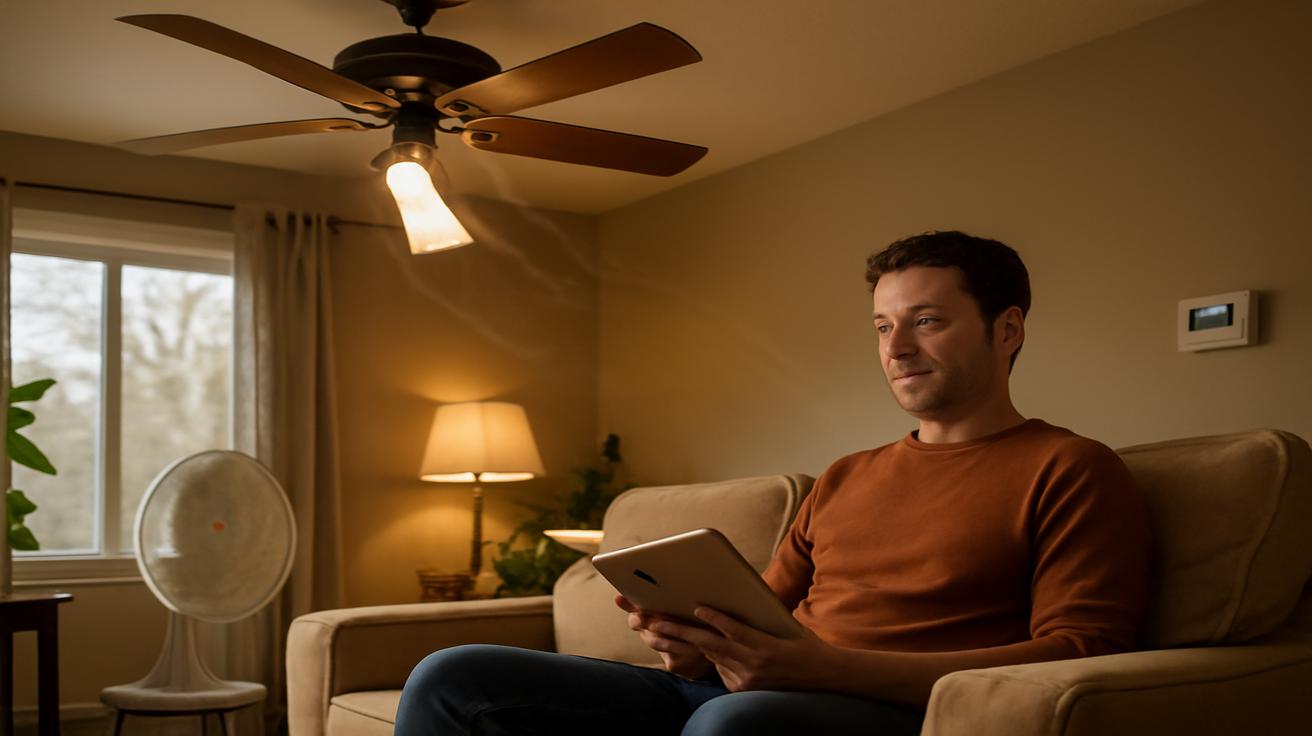
The first thing you notice isn’t the heat, or the stuffiness. It’s the silence. A heavy, muffled kind of quiet that presses against your ears when you step into the room. The air just… sits there. No movement, no drift, no sense of life. In summer it feels like walking into a forgotten attic; in winter, like a room that can’t quite wake up. You nudge the thermostat, again, hoping one more degree will fix it. But it never really does, does it?
The Day I Stopped Blaming the Thermostat
For years, I treated my thermostat like a magic wand. Too hot? Tap it down. Too cold? Nudge it up. Every discomfort had the same solution: more heating, more cooling, more energy, more money.
Then one late afternoon, in that hazy hour when the sunlight slants low and golden through the windows, I watched something that changed how I thought about comfort completely.
A curtain moved.
That was it. A soft, lazy sway where the fabric met a narrow beam of sunlight. There was no fan running, no window open. The HVAC was humming quietly, but barely. Yet the curtain trembled like it had just heard a secret.
I stood there and watched as that single movement told the whole story of my home: air was moving in one corner, and not moving at all in others. I realized my discomfort wasn’t about temperature. It was about stillness. About stale pockets of air where heat and cool pooled and stubbornly stayed.
Comfort, it turns out, isn’t just what the thermostat says. It’s what the air is actually doing—how it touches your skin, how it drifts, how it escapes.
The Trick: Move the Air, Not the Number
There’s a quiet little secret hidden in almost every comfortable home: someone, somewhere, has figured out how to make the air move without constantly adjusting the thermostat.
The trick is simple enough to write on a sticky note and slap on your fridge:
Direct the airflow you already have.
That’s it. No smart device, no complicated installation. Just moving, redirecting, and tuning the currents of air that already live in your rooms. Done right, it often feels like you’ve upgraded your entire HVAC system—without touching the temperature setting once.
Imagine stepping into a living room where the air glides gently past your arms instead of hanging like a wet blanket. Or a bedroom where winter warmth actually reaches your feet instead of pooling unseen at the ceiling. That’s the difference between a room that’s technically at 72°F and a room that feels like 72°F.
This is body-level science. A faint breeze across your skin makes you feel cooler at the same temperature. Even, gentle warmth around your ankles makes you feel cozier without turning the furnace into a dragon. The thermostat doesn’t decide that. Flow does.
The Easy Home Airflow Trick You Can Try Today
Here’s the core move, the one small habit that can quietly transform how your home feels:
Use fans and vents to create a deliberate loop of air through each room, instead of letting air stagnate in pockets.
In practice, that means three simple steps you can play with like knobs on a soundboard:
- Position one fan to pull air in from a cooler, fresher spot (like near a shaded window, a hallway, or an open interior door).
- Position another fan or open pathway to push air out toward a warmer or more stagnant zone (like an inner room, stairwell, or stuffy corner).
- Adjust supply and return vents to encourage that loop instead of fighting it—open where you want more flow, partially close where you get too much blast.
This creates a gentle, continuous circuit of air. Not a wind tunnel, not a hurricane. Just a steady conversation between the different temperatures in your home.
Why It Works Even When You Don’t Change the Temperature
Think of your home like a forest on a still day versus one with a soft breeze. The same sunlight, the same temperature, but the breeze changes everything. Leaves talk to each other. Shadows ripple. You feel the world on your skin.
In your home:
- A slow-moving current of air across your face, hands, and neck increases evaporative cooling—you feel cooler even if the room is technically the same temperature.
- Redirecting warm air from places where it gathers (like ceilings and upstairs corners) down to where you live and breathe evenly spreads comfort.
- Circulating fresh air into stale pockets reduces that stuffy, heavy feeling that has nothing to do with the thermostat reading and everything to do with trapped CO₂ and humidity.
The thermostat is a scoreboard; airflow is the game. Change the game, and the numbers matter less.
How to “Tune” the Air in Different Rooms
Every room in your home has its own microclimate, like little ecosystems with their own personalities. Instead of fighting them, you can learn to work with them.
Living Room: The Evening Heat Trap
Sunset light pours through the windows. The couch is warm. The thermostat claims everything is normal, but your back sticks to the cushions. Here’s where the airflow trick shines.
- Place a fan near a cooler zone—for example, in the hallway outside the living room or near a shaded window—and angle it into the room.
- Crack a window or open a door on the far side of the room, or simply open the path to a different area of the house.
- Use a second small fan (if you have one) on the opposite side of the room to push air out toward that exit path.
You’re not blasting cold air at your face; instead, you’re giving the room a direction to breathe. Warm air has somewhere to go. Cooler air has a reason to arrive.
Bedroom: The Nighttime Balancer
Beds are curious islands. Your body radiates heat into the same pocket of air all night long. Without movement, that pocket becomes a warm bubble.
- Place a quiet fan across the room from your bed, not right beside your head, and aim it so air drifts above your body, then down.
- Crack the door slightly to connect your room’s air to the hallway’s, turning your space from a closed jar into part of a gentle loop.
- In winter, reverse it: aim air from a warmer hallway or neighboring room gently into the bedroom, so you’re pulling in warmth instead of pushing it out.
Instead of waking up sweaty or chilled, you wake up in an environment that felt quietly alive all night—soft air passing, never lingering too long in one spot.
Kitchen: The Hidden Heat Engine
The kitchen is where air comfort goes to challenge you. Ovens, stovetops, dishwashers, simmering pots—it’s a laboratory of shifting temperatures.
- Run your range hood fan when cooking, not just for smells, but to give hot air an exit route.
- Use a small fan at floor level at the edge of the kitchen to pull in cooler air from the nearest hallway or adjoining room.
- Let that air move straight through—toward the range hood, an open window, or even an interior door that leads away from your main hangout spots.
Suddenly the kitchen doesn’t flood the rest of the house with that heavy, post-dinner warmth. Air has direction. Heat has a path to leave.
Your Home, Seen as a River of Air
Once you start paying attention, you begin to see your home less like a collection of rooms and more like a landscape—valleys of cool, ridges of heat, sunlit slopes, shaded hollows.
Warm air rises along stairwells like mist climbing a mountainside. Cold air pools near floors and behind closed doors, like shaded ponds beneath trees. Doors, vents, and fans become gates and streams.
The real trick isn’t more equipment. It’s more awareness.
Stand in the doorway between two rooms sometime in the late afternoon. Close your eyes. Feel how the temperature changes from one side of the frame to the other. Notice the way air caresses your cheek in the hallway and then disappears when you step toward the center of the room. That’s a boundary. That’s a story. And you can rewrite it.
All it takes is treating airflow like water: giving it a place to start, a route to follow, and a way out.
A Simple Table to Guide Your Adjustments
Here’s an easy reference you can use as you experiment. Think of it as a tiny field guide for your home’s microclimates:
| Home Situation | What You Feel | Airflow Adjustment Trick |
|---|---|---|
| Sunny living room in late afternoon | Room reads “normal” but feels hot and heavy | Fan pulling cooler air in from hallway + window or door slightly open opposite to let warm air escape |
| Bedroom at night | Waking up sweaty, even with reasonable thermostat setting | Fan across the room aimed to skim air over the bed; door cracked to connect to cooler hall air |
| Upstairs vs. downstairs | Upstairs too hot, downstairs too cool | Use a fan at the base of stairs to push cool air up, open upper vents and slightly close a few downstairs vents |
| Kitchen during cooking | Heat spilling into nearby rooms, lingering after meals | Range hood on; small fan at floor level bringing in cooler air from hallway toward the hood or window |
| Drafty winter room | Feet cold, head warm; room feels “leaky” | Low fan on the warmest side of the room pushing air gently along floor; seal obvious drafts, keep vents fully open |
The Subtle Comfort of Getting It “Just Right”
There’s a peculiar pleasure in walking through a home that feels quietly balanced. Not chilly, not muggy. Not stale, not gusty. Just… right. It’s the domestic equivalent of a forest trail at 70°F with a faint breeze and dappled light: you don’t think about the weather at all. You just live.
Directing airflow instead of bullying the thermostat creates this kind of comfort more often. It’s subtle. You might notice it when:
- You stop carrying a sweater from room to room.
- You realize you haven’t touched the thermostat all week.
- Your electric bill dips a little, then a little more.
- You breathe deeper in spaces that used to feel “off” somehow.
And it’s not just physical. Humans are good at noticing movement in our environment, even when we don’t consciously register it. A still house can feel emotionally stagnant; a gently breathing house feels alive.
You experience it in the smallest ways—the whisper of air moving past a bookshelf, the soft flutter of a plant leaf in the corner, the way cooking smells don’t cling quite as fiercely. Your home becomes less of a sealed box and more of a living, breathing habitat.
A Tiny Ritual to Start With
If you do nothing else, try this one simple ritual tomorrow:
- Pick the one room that annoys you the most—too hot, too cold, too heavy.
- Stand in the doorway and feel the difference between hallway and room.
- Place a fan so it draws air from the more comfortable side into the less comfortable room.
- Find an exit—an open door, a cracked window, a stairwell—for that room’s air to drift toward.
- Let it run for an hour while you go about your day.
Then walk back in and notice the shift. You’ll still be in the same home, with the same thermostat setting, but the air will tell you a different story.
Let the Air Teach You
Somewhere in your house right now, a draft is slipping beneath a door, or warm air is pooling near a sunny window, or cool air is nesting quietly in a shaded corner. If you listen—really listen—you can start to feel the language of airflow.
Crack a window on the shaded side of the house and another in a room that bakes in the afternoon. Watch how curtains respond. Sit at your kitchen table and notice where your skin feels cool or warm. Trace the path of that feeling back to its source.
This is the real heart of the “easy airflow trick”: not the fan, not the vent, not the window. It’s the attention you bring to your space. The realization that comfort doesn’t always require more energy, more machinery, more control.
Sometimes it just requires guiding what’s already there.
So the next time you reach for the thermostat, pause. Rest your hand on the wall instead. Feel the stillness, or the drift. Ask yourself a small, potent question:
What if the air just needs a better way to move?
And then, with one fan, one open doorway, one gentle adjustment, give it that way. Let your home breathe—and notice how, in return, it helps you breathe a little easier too.
FAQs
Do I really need more than one fan for this to work?
No. One fan can make a big difference if you think in terms of “in” and “out.” Place the fan so it pulls more comfortable air into a problem room, and give that room an exit path via an open door, window, or hallway. A second fan simply makes the loop stronger and more predictable.
Will this trick work if I live in a small apartment?
Yes. Smaller spaces often respond even faster because the air volume is lower. Use one fan near the coolest part of your apartment to push air toward the warmest, or vice versa. Even shifting a fan by a few feet can noticeably change how the space feels.
Doesn’t running fans use a lot of electricity?
Fans use far less energy than heating or cooling equipment. A typical small fan draws only a fraction of what your air conditioner or electric heater uses. By improving comfort through airflow, you can often avoid constant thermostat changes, which saves energy overall.
What about ceiling fans—are they enough?
Ceiling fans are very helpful, especially when you set them correctly: in summer, they should spin counterclockwise to push air down; in winter, clockwise on low to gently pull warm air from the ceiling. But they work best as part of a broader airflow pattern, not as the only source of movement.
Is it okay to partially close vents in some rooms?
Light, thoughtful adjustments are usually fine—slightly closing a few vents in over-conditioned rooms can encourage more flow elsewhere. Just avoid shutting many vents completely, as this can increase pressure in your ducts and stress your HVAC system. Small changes, watched over time, are safer and more effective.
How quickly should I expect to feel a difference?
Often within 15–30 minutes, especially in smaller rooms. In larger or multi-story homes, it might take an hour or more for the new air loop to settle. The key is to experiment: adjust fan direction, speed, and position until the room feels less stagnant and more evenly comfortable.