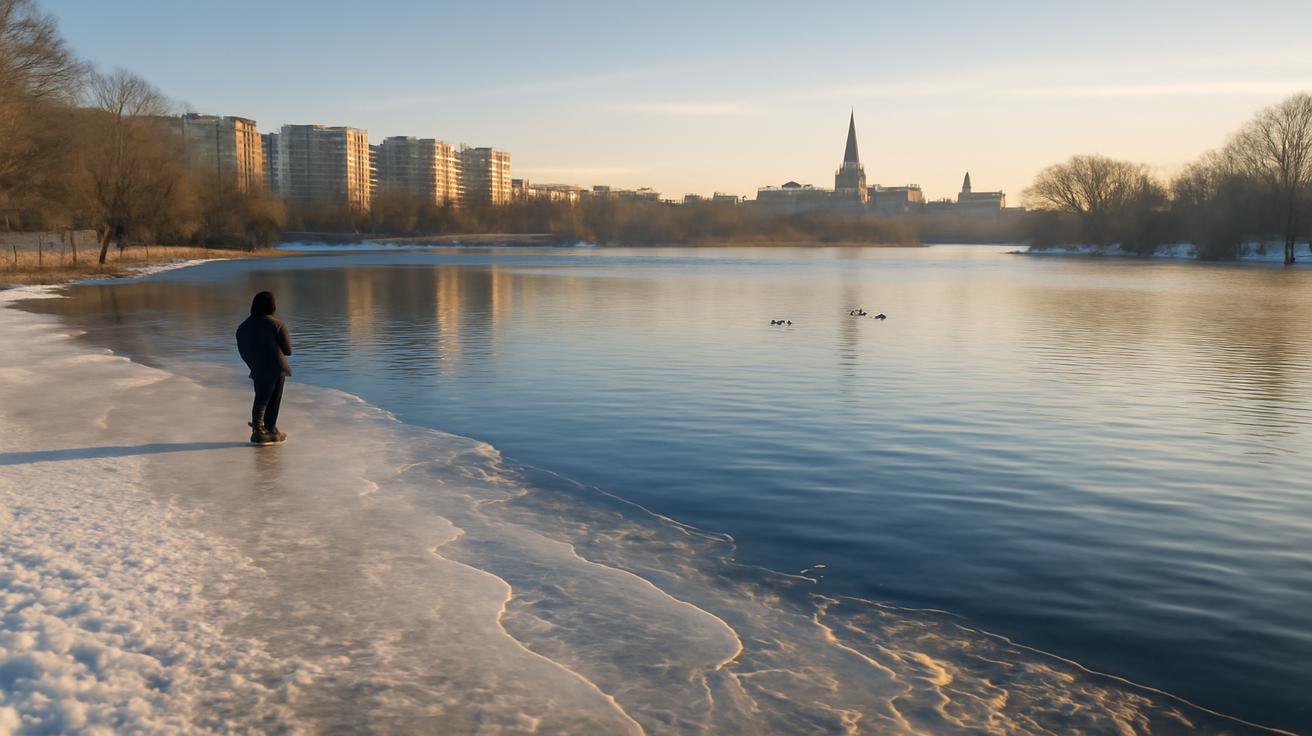
The first thing you noticed was the sound. Not the crisp, storybook crunch of ice under boots, but a softer, more hesitant crackle—like cellophane being folded in slow motion. You had walked down to Lake Créteil in the clear, bright cold of the afternoon, expecting the water to be either fully frozen or not frozen at all. Simple. Obvious. But standing on the shore you saw something that didn’t fit that neat picture at all: a stubborn white collar of ice hugging the edges of the lake, while the middle shimmered with dark, rippling water, free and moving under the winter sun.
The Strange Half-Frozen Lake
You stood there, hands buried in your pockets, breath blooming in small white ghosts, trying to make sense of it. The shore looked like winter, solid and still. The center of Lake Créteil looked like early spring, restless and alive. Wind brushed over the open water, ruffling it into tiny silver scales, while the ice at your feet lay perfectly still, faintly cracking in delicate spiderwebs near the rocks.
A couple walked carefully along the path beside you, pausing to stare at the same thing. Someone a few benches down muttered to a friend in French, something about it being “bizarre” that the center had thawed so quickly. A child tossed a pebble at the frozen edge, eyes lighting up as it bounced with a hollow, glassy sound instead of sinking. The lake seemed to be in the middle of a quiet argument with itself: freeze or flow, hold or release, winter or not yet.
And in the middle of that small crowd of quiet onlookers, you found yourself asking the simplest question: Why is the ice only along the shore? How could one part of the same body of water be locked into a thin winter armor while the rest of it moved freely under the pale light of a January sun?
The Lake Is Not One Single Thing
At first glance, a lake seems like a single, uniform thing—a big bowl of water, all behaving the same. But standing at Lake Créteil that afternoon, you were really looking at different worlds stitched together. The shore and the center might be separated by only a few meters, yet they experience winter in completely different ways.
Imagine the lake as a living mosaic, each tile feeling the weather a little differently. Along the shore, the water is shallow. You can see the bottom where stones rest under a cloudy green-brown layer, and the reeds stand frozen in place like brittle paintbrushes. In shallow water, the cold doesn’t have far to travel. It can reach the bottom quickly, chilling every layer of water from top to bottom. That means the surface freezes faster and stays frozen longer.
Now imagine stepping back and looking toward the center. Out there, the water is deeper, darker, and slower to respond to the whims of a cold snap or a sunny afternoon. Cold air starts working on the top, but the bulk of that deeper water holds on to its stored warmth from previous days and weeks. The surface chills, but beneath it, layers of water swirl and resist, shuffling warmth up and cold down. The result? The middle often takes much longer to freeze—and, just as important, thaws more easily when a bit of sunshine or wind returns.
So when you saw Lake Créteil frozen along the shore but open in the middle, you were really seeing a contest between depth and air, between how quickly cold can bite into water and how stubbornly water clings to the memory of warmth.
The Quiet Work of Sun, Wind, and Depth
Earlier in the day, the sun had likely been brighter, even if weak by summer standards. A low winter sun is still powerful enough to warm dark surfaces, and water—especially deep, dark water—absorbs that light like a sponge. The middle of the lake, away from the shade of buildings, trees, and the sloping banks, is exposed directly to this subtle, steady light. Bit by bit, the surface warms just enough to disrupt forming ice.
Wind joins the story too. Over the open water in the middle, the breeze can move freely, brushing the surface into small waves and ripples. Those ripples are the enemies of ice. For water to freeze, its surface needs to linger at or below 0°C long enough and still enough for ice crystals to lock hands. Stir the surface constantly, and you break up those fragile beginnings. The wind keeps bringing slightly warmer water from below, folding it into the cold at the top, blurring the edge where ice would like to appear.
Along the shore, the story changes. The land shelters the edge from the wind. Trees, buildings, small slopes, and even the curve of the embankment dull the breeze’s force. The water here is less disturbed, more protected, calmer. Calm water freezes more easily. Without much mixing, the cold can settle in like a blanket and get on with the quiet work of turning liquid into thin glass.
So now you have a picture: a sheltered, shallow fringe of water, cooled to the bone and barely stirred, freezing into place. And a restless, wind-brushed center, deeper and darker, constantly moving just enough to keep its surface from stiffening into ice—at least, not for long.
How Cold, How Deep, How Still?
It helps to imagine three invisible sliders controlling what you saw at Lake Créteil that afternoon: temperature, depth, and motion. Move any of them, and the lake behaves differently.
| Factor | Near the Shore | Middle of the Lake |
|---|---|---|
| Depth | Shallow – cools and warms quickly | Deeper – slow to change temperature |
| Wind Exposure | Often sheltered by land, trees, structures | More exposed, more waves and ripples |
| Water Movement | Relatively still, minimal mixing | More mixing between warm and cold layers |
| Freezing Tendency | Freezes earlier and thaws later | Freezes later and thaws earlier |
On that afternoon, all three sliders along the shore were set to favor ice: shallow, quiet, and fully surrendered to the lingering cold. In the middle, the sliders were turned the other way: deeper, wind-stirred, and resistant.
The Hidden Physics Beneath Your Feet
The air was cold enough for your fingertips to sting, yet not so brutal that you could see your breath hanging in the air for long. This kind of “just below freezing” weather is a perfect setup for the difference you observed. Water is a surprisingly stubborn substance. It doesn’t rush into freezing just because the air dips below 0°C for a few hours. It has a kind of memory, a reluctance to change state quickly, thanks to its high specific heat capacity—the amount of energy needed to raise or lower its temperature.
Over the last days, perhaps nights had fallen below freezing, letting ice creep out from the edges. During the day, weak sunlight and slightly warmer air would begin thawing what they could. The edges, in constant contact with the cold earth and sheltered from most of the wind, were able to hold on to their ice. The middle, constantly churned and slightly warmed by depth and sunlight, gave up its ice more readily.
There’s another quiet twist in the physics: water is densest at about 4°C. As winter cools a lake, surface water drops in temperature and sinks—until it hits that point. Below 4°C, as it gets colder still and approaches freezing, it becomes less dense and stays near the surface. So the very coldest water lives in a thin layer at the top. In shallow areas, there’s not much below to mix with, so that cold layer dominates and freezes. In the deeper middle, there’s a thicker column of slightly warmer water below, constantly nudging upward, making the surface a moving compromise between cold and not-quite-so-cold.
All of this is happening in silence while you watch a child test the strength of the shore ice with a cautious, delighted foot. Beneath that thin, milky surface, the coldest water has settled into place, content for now. A few meters farther out, the water refuses to stand still long enough to take that final step into solidity.
The Shore’s Secret Allies: Stones, Soil, and Concrete
Take a closer look at the border between land and water. Stones, soil, concrete edges, and vegetation each play a quiet role in shaping where ice holds and where it surrenders. The materials along the shore tend to lose their heat quickly on cold nights. They radiate that lost warmth into the air and into the thin film of water just beside them, speeding up cooling in the shallows. At night, when the sky is clear, this effect is amplified. The ground “sees” the open sky, radiates heat away, and chills the air and water hugging the margin.
In the middle of the lake, there is no nearby wall or bank bleeding away heat in this way; the water’s temperature is governed more by its own slow conversation between surface cooling, sunlight, and deeper warmth. The edges are like cold fingers, reaching into the lake and encouraging ice to form earlier, then helping it linger longer, even when the day grows a touch milder.
If parts of the shore are concreted or lined with stones, these surfaces, with their hard angles and rough textures, catch sheets of ice like shelves. Even as the sun returns and the air softens, thin slabs can break and refreeze at night along the boundary, creating a jigsaw of plates that take longer to disappear completely than a former sheet over open water.
A Moment in a Moving Season
What you saw that afternoon at Lake Créteil was more than a frozen shoreline. It was a snapshot, a single frame in the long, fluid film of the season. If you come back in two days of clear, sharp frost with colder nights, you might find the center beginning to skin over with a pale crystal sheen. Wait a week of milder weather, and the last stubborn rim of ice along the shore might finally surrender back to liquid, breaking up in the wind and vanishing as if it had never been there.
We often imagine winter as a block of time—“the cold months”—but nature works in gradients and edges. Ice rarely appears everywhere at once in an instant. It creeps and retreats, thickens and thins, arrives first in shadows and shallows. A lake doesn’t freeze in one gesture; it negotiates with temperature, sunlight, wind, depth, and shoreline, day by day, hour by hour.
Lake Créteil, like many urban lakes and reservoirs, may also feel the subtle effects of human presence. Warmer water can enter from drains or inflows, small currents can form near outlets, even birds gathering and paddling in groups can keep parts of the surface more open. These influences are often strongest away from the quiet, protected reaches of shoreline where nothing moves except the air and the occasional pebble tossed by curious hands.
Seeing the Lake Like a Story, Not a Still Image
Think of the lake as a story being told slowly, not a single photograph. The frozen shore is an early chapter: the part where winter’s grip is strongest on the delicate edge where land and water meet. The open middle is a later chapter waiting to be written, a stretch of water still resisting the plot twist that would turn it to ice.
When you look at the contrast—solid here, fluid there—you’re really catching the lake mid-sentence. The shoreline is already speaking winter’s language fluently, in white and gray; the center is still muttering the last words of autumn in low, dark ripples.
Watching With New Eyes
The next time you walk around Lake Créteil on a cold afternoon, you might pause a little longer at the place where ice fades into open water. That border is alive with invisible forces. You might notice how the ice is thicker where the shore curves inward, more sheltered, and thinner where the winds slide down the length of the lake. You might see how the color of the water changes—from an opaque, milky white near your feet to a deep, metallic blue as your gaze moves outward.
You could listen, too. Sometimes the ice along the shore will pop softly as it adjusts to tiny shifts in temperature or water level. The open water beyond will answer with a gentle slap of small waves against the underside of the ice edge. That line is both boundary and bridge, the place where two states of matter meet and negotiate.
If you arrive just as the sun is setting, you might catch a pink or orange glow caught in the tiny fractures and bubbles trapped inside the ice. The middle of the lake, free of that rigid skin, will hold a different kind of light—darker, more fluid, broken only by the wake of a passing bird. This contrast isn’t just scientifically interesting; it’s quietly beautiful, a reminder that even seemingly simple winter scenes are layered with detail and meaning.
What the Lake Teaches About Change
In a way, the half-frozen lake is a lesson in how change really happens—not as an instant switch, but as a patchwork. Some parts of a system shift early; others lag behind. The sheltered, shallow edges transform first. The deeper, central parts hold on until the last possible moment.
We like clean categories: frozen or not frozen, winter or not winter. But the lake offers you a softer, truer version of reality. Along its edge, the world has already decided. In the middle, it’s still undecided, caught in between. The ice along the shore is a promise of what might come—or a leftover remnant of what has just been, depending on where the days ahead decide to lead.
So when you ask why Lake Créteil was frozen along the shore but not in the middle, you are really asking to see the lake not as a single object but as a landscape of small differences: depth, shelter, wind, sunlight, movement. These differences assemble themselves into the quiet drama you watched that afternoon: rigid at your feet, rippling in the distance.
And if you linger there a bit longer, watching the slow, subtle shift of light on ice and water, you may begin to feel that the answer is not just in the physics of freezing, but in the way you learn to notice the world: not in black and white, but in edges, gradients, and the beautiful, complicated in-between.
FAQs
Why does ice form first along the edges of a lake?
Ice often forms first along the edges because the water there is shallower, cools faster, and is usually more sheltered from wind. Without much mixing or wave action, the surface can stay still and cold long enough for ice crystals to form and join together.
Can the middle of a lake freeze later in the season?
Yes. If temperatures stay cold enough for long periods and the wind is not too strong, even the deeper, more exposed middle can eventually freeze. Large lakes may only partially freeze, but smaller ones sometimes develop a solid ice cover from shore to shore in prolonged cold.
Does the color of the water or ice tell me anything?
It can. Thin, new ice often looks clear or slightly gray, while thicker ice can appear more opaque and white. Dark, rippling water in the middle usually means it is still liquid and relatively deeper. Subtle differences in color can hint at depth, clarity, and thickness.
Is it safe to walk on ice that forms along the shore?
Not necessarily. Shore ice can be very thin, even if it looks solid. It may not extend far, and the depth of water beneath can change quickly. Without careful measurement and local guidance, walking on lake ice is risky and often unsafe, especially in cities.
Why does the ice sometimes stay even when the air feels warmer?
Ice takes time to melt, just as water takes time to freeze. The air might feel milder during the day, but if nights are still cold and the water beneath remains near freezing, the ice—especially along sheltered, shallow edges—can linger for days after temperatures seem to improve.