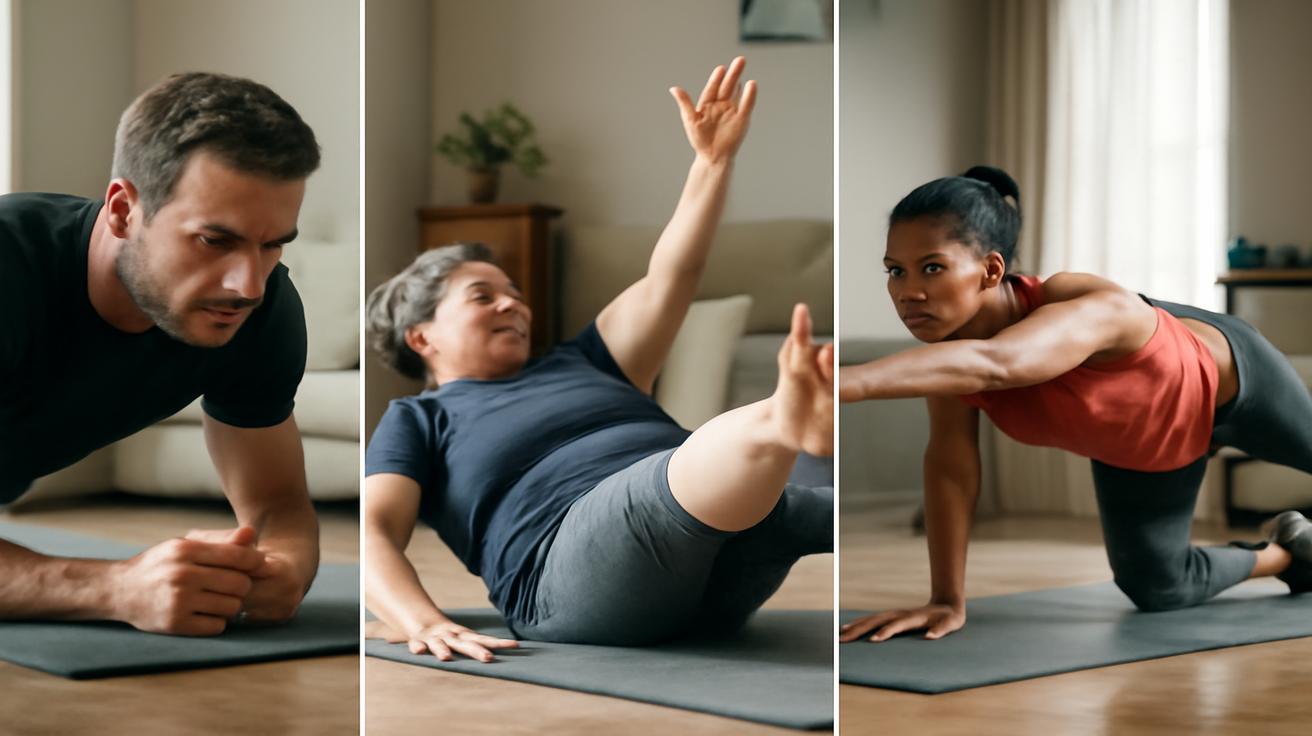
The first time you notice it, you’re washing your hands in a public bathroom. Harsh overhead lights. A mirror that is entirely too honest. You stand up a little straighter, pull your shoulders back, and there it is: the soft, bloated curve of your belly, pushing a bit farther than you remember. It’s not dramatic, not some sudden overnight transformation—more like a quiet, gradual drift. A button that feels tighter. A waistband that digs in by mid-afternoon. The way you now subtly adjust your shirt when you sit down.
You sigh. You don’t necessarily want a chiseled six-pack. But you do want to feel strong again—solid in your middle, supported from the inside out. You want to walk through the day without that heavy, puffy feeling in your gut and without your lower back complaining by 3 p.m. You want a core that holds you up, not a belly that pulls you down.
This isn’t about punishment or shame or punishing workouts you secretly hate. It’s about learning that your core is less about how your stomach looks and more about how your whole body lives in the world—how you breathe, stand, bend, carry, twist, and rest. And sometimes, all it takes to begin changing that story is three simple exercises and the willingness to meet your body where it is today.
The Quiet Truth About Your Belly
Most of us talk about our belly like it’s a stubborn enemy. We poke it, pinch it, suck it in when we walk past reflective windows. We blame age, hormones, late-night snacks, or that one holiday that somehow lasted three weeks. But beneath the surface, something bigger is happening—and it starts with the core.
Your core isn’t just your abs. It’s a layered system that wraps around you like a natural corset: deep stabilizing muscles, obliques that help you twist, the diaphragm that helps you breathe, muscles along your spine that hold you upright, even the pelvic floor beneath you. When that system is weak or out of sync, your belly often tells the story first.
It might show up as a bloated, protruding belly that seems to push out no matter how much you suck it in. Or a lower back that constantly aches. Or hips that feel tight and heavy. Or a sense of fatigue that begins right in your middle. Your core is supposed to be your center of power—when it’s offline, everyday life gets harder in ways that feel subtle, but relentless.
Here’s the good news: your body isn’t broken. It’s just trying to cope with modern life—long hours of sitting, shallow breathing, stress hormones churning in the background, rushed meals, and too much time hunched over screens. A softer, puffier midsection is often less about “bad discipline” and more about a system that needs rebalancing.
You don’t need a gym full of machines or an hour-long ab torture session. You need a few carefully chosen movements that wake up the deeper muscles, reconnect your breath, and invite your posture back into alignment. Three exercises, practiced with intention, can start to rewrite how your body holds itself from the inside.
Why “More Crunches” Isn’t the Answer
Crunches have been sold as the shortcut to flat abs for decades. You’ve seen them in magazine spreads, late-night infomercials, and “30-day challenge” posts. But if crunches were truly the answer, we’d all be walking around with strong, stable cores by now.
Here’s what crunches often miss: they mostly hammer the surface layer of your abs—the rectus abdominis, the famous “six-pack” muscle. That can make your belly feel tight on the outside while the deeper, stabilizing muscles stay weak and disengaged underneath. It’s a bit like repainting a wall without fixing the cracked foundation.
And then there’s the posture problem. Too many crunches can reinforce the very hunched, rounded position that tightens your hips, strains your neck, and encourages your belly to push forward when you stand. You may feel a burn, but not the kind that truly transforms how your core works in your everyday life.
A stronger core starts from the inside out—with movements that recruit deeper muscles like the transverse abdominis, engage your diaphragm through the breath, and connect your ribs, spine, and pelvis into a single, coordinated system. When that system turns on, your belly often begins to flatten and firm up naturally, not because you’re yanking it in, but because your support structure is finally doing its job.
That’s where three deceptively simple exercises come in. No fancy props, no noise, no drama—just you, a bit of space, and a willingness to slow down and feel.
Exercise 1: The Hard Reset – Dead Bug
Think of Dead Bug as a reboot for your core. If your posture, breath, and spine have wandered off in different directions over the years, this exercise quietly invites them back into a shared conversation.
Lie on your back. Feel the floor beneath you, cool and steady. Bend your knees to a tabletop position so they float above your hips, shins parallel to the ceiling. Lift your arms straight up so your hands hover over your shoulders, like you’re reaching to the sky.
Your lower back is gently pressed toward the floor—not jammed down with force, not arching up like a bridge, just a subtle, grounded contact. This is the anchor for everything.
Now inhale slowly through your nose. As you exhale, imagine you’re fogging up a mirror, letting the breath gently force its way out. Without losing that light contact between your lower back and the floor, slowly lower your right arm and left leg toward the ground. Move as if you’re underwater—steady, controlled, aware. Only go as far as you can without letting your low back arch or your belly puff upward like a balloon.
Pause at your lowest point for a heartbeat. Then, on your next exhale, bring the arm and leg back to the starting point. Switch sides. One right arm/left leg, one left arm/right leg—that’s one full cycle.
You’re not chasing speed. You’re chasing connection: spine grounded, ribs soft, belly gently drawing inward as you move. That subtle, hugging sensation? That’s your deep core waking up.
Start with 6–8 slow cycles, resting if your neck or hip flexors try to take over. Done consistently, this exercise teaches your body how to stabilize from the center in a way that carries over into every step, lift, and twist of your day.
How Dead Bug Helps Your “Bloated” Belly
When your deep core isn’t firing, your belly often pooches forward to compensate, especially when you lift your legs or move your arms. Dead Bug retrains that pattern. Instead of your stomach bulging outward under effort, it gently tightens inward, sharing the load with your spine and pelvis.
Over time, this can reduce that constantly “pushed out” look, especially when combined with better breathing and a bit of patience.
Exercise 2: The Quiet Challenge – Forearm Plank (Done Right)
You’ve seen plank everywhere, but the power of this exercise lies not in how long you can tremble and sweat on the floor, but in how well you can hold a clean, aligned position that asks your whole core to show up.
Start on your hands and knees. Lower your forearms to the ground so your elbows sit directly under your shoulders. Spread your fingers. Feel your palms press lightly into the floor, as if you’re rooting down through your bones.
Step one foot back, then the other, until you’re in a straight line from head to heels. Your legs are long, your heels reaching gently back, your crown of the head reaching forward. Now soften the space between your shoulder blades instead of letting your upper back sag or hump. Let the back of your neck be long, gaze just slightly ahead on the floor.
Here’s the crucial part: lightly tighten your glutes and imagine zipping up a long zipper from your pubic bone to your ribs. Your belly shouldn’t be dangling toward the floor or pushing downward; it should feel like it’s gently lifted in toward your spine, as if a string is drawing it up.
Hold for 15–20 seconds. Feel the mild shake in your midsection, the warmth spreading from your abdomen into your back and shoulders. Then lower your knees, rest, and breathe. Try 2–3 rounds, focusing on quality, not endurance.
Making Plank Work for Your Body
If a full plank feels like too much right now, drop your knees to the floor and walk them slightly back, keeping that same long line from knees to head. All the alignment rules stay the same: zipped-up belly, steady breath, no sagging in the lower back.
Your body responds better to regular, doable effort than to heroic struggles once a week. A few honest seconds of solid plank, repeated most days, beats a shaky 90-second hold that leaves your back aching every time.
Exercise 3: The Everyday Hero – Farmer’s Carry
Life doesn’t happen lying on the floor. It happens when you’re walking, reaching, carrying, dragging, and balancing your way through the world. That’s why the third exercise is dynamic, grounded, and quietly powerful: the Farmer’s Carry.
Stand tall. Grab a weight in each hand—dumbbells, kettlebells, or even two heavy grocery bags or water jugs if that’s what you have. Let your arms hang by your sides, palms facing your thighs.
Before you take a single step, set your posture. Imagine a string lifting you gently from the crown of your head. Let your shoulders soften down and slightly back, chest open but not puffed. Now imagine that same subtle zipper from pubic bone to ribs, your belly hugging inward in a way that feels supportive, not strained.
Begin to walk slowly, one deliberate step at a time. Feel the floor under your feet. Notice how the weights gently pull your arms down, inviting your core to stabilize your spine so you don’t lean or sway. Resist the urge to rush. This is not a race; it’s a walking meditation with benefits.
Walk 20–30 seconds, rest, repeat 3–4 times. If you’re at home, pace a hallway. If you’re at the gym, take a lane. If you’re outside, let the breeze brush your face as you move. Your core is working every second you carry those weights and keep your body tall and centered.
Why Farmer’s Carry Belongs in a “Belly” Plan
This movement teaches your core to function where it matters most: in real life. Your deep abdominals, obliques, and spinal stabilizers must all cooperate to keep you upright as gravity tugs the load downward. Over time, this translates to better posture, less lower-back strain, and a midsection that looks and feels more solid—less like a loose, bloated balloon and more like a grounded center of gravity.
Putting It All Together: Your 10–15 Minute Core Ritual
You don’t need a complicated spreadsheet of sets and reps. You need a small, sustainable ritual—something you can weave into mornings before work, evenings after the kids are asleep, or the quiet pocket of time between errands.
| Exercise | What to Do | Beginner Target |
|---|---|---|
| Dead Bug | Slow alternating arm/leg reach, keeping lower back gently grounded. | 6–8 cycles (each side) × 1–2 sets |
| Forearm Plank | Hold a straight line, belly gently “zipped up,” breathing steadily. | 15–20 seconds × 2–3 sets |
| Farmer’s Carry | Walk tall with weights at your sides, resisting sway or lean. | 20–30 seconds × 3–4 walks |
Move through these three exercises most days of the week. Some days your body will feel powerful, other days a little sluggish or stiff. Do them anyway, adjusting as needed. Your body doesn’t require perfection; it responds to consistency.
And as you move, pay attention to the quieter changes: standing up from a chair feels lighter. Putting on shoes without your lower back barking at you. Carrying bags in from the car with a surprising sense of ease. The bloated belly that used to feel like a stubborn mystery slowly begins to feel less tight, less heavy, less in the way.
Beyond Exercises: Small Shifts That Support Your Core
Strength is only part of the story. The way you breathe, sit, and move when you’re not “working out” deeply affects how your belly feels and behaves.
Start with breath. Several times a day, pause and take a slow inhale through your nose, letting your ribs expand gently out to the sides instead of just pushing your belly forward. On the exhale, feel your lower ribs glide back in and your deep belly lightly draw inward. This kind of 360-degree breathing soothes your nervous system and invites your core to share the load instead of leaving it all to your lower back.
Then look at how you sit. Notice how often you slump forward, ribs caving inward, pelvis tucked under. This posture compresses your organs, shortens your hip flexors, and pushes your belly outward. You don’t need perfect posture at every moment, but a few times each day, gently adjust: sit a little taller, feet grounded, ribs stacked over your hips, chin slightly tucked. It’s a micro workout your core can quietly perform all day long.
And finally, check in with how you talk to your belly. It might sound sentimental, but your body hears the words you repeat. Instead of “I hate this stomach,” try “I’m working on making you stronger,” or “We’re figuring this out.” That shift can be the difference between abandoning the process after a week and allowing yourself the time you actually need to change.
Let Your Core Become Your Ally Again
Your belly doesn’t have to be a constant source of frustration, something you hide under loose sweaters or glare at in fitting-room mirrors. It can become something else entirely: a signal, a compass, a center.
When your core grows stronger, it quietly reshapes the way you move through the world. Your spine stacks more easily. Your breath deepens. Your steps sound more confident on the floor. The protruding, bloated feeling begins to fade, replaced not by some unrealistic magazine-cover ideal, but by a grounded sense of support you can feel from the inside.
Three exercises. Ten to fifteen minutes. A handful of small daily shifts. This is not a crash program; it’s a reintroduction—to your own center, to the deep muscles that have been there all along, waiting to help.
Next time you catch your reflection under those harsh bathroom lights, you may still notice your belly. But maybe you’ll also notice something else: a little more lift in your posture, a quieter strength in the way you stand. The beginning of a new story, written from the core out.
FAQ
How often should I do these three core exercises?
Aim for 3–5 times per week. You can even do them daily if you keep the volume modest and listen to your body. Consistency matters more than intensity.
When will I start to see changes in my belly?
Many people feel more stability and less “spilling out” within 2–3 weeks of regular practice. Visible changes often follow over 6–8 weeks, especially when paired with decent sleep, hydration, and mindful eating.
Can these exercises help with lower-back pain?
They often do, because they strengthen the muscles that support your spine. However, if you have existing back issues or pain that worsens with these movements, stop and consult a healthcare or movement professional.
Do I need equipment for the Farmer’s Carry?
No. You can start with what you have: filled water bottles, grocery bags, or any two objects of similar weight with handles or easy grip. As you get stronger, you can increase the weight gradually.
Are these exercises safe if I’m returning to movement after a long break?
Generally yes, as they’re low-impact and focus on control rather than strain. Start with fewer reps and shorter holds, and give yourself permission to rest. If you have medical conditions, recent surgery, or are pregnant/postpartum, check with a professional before beginning.