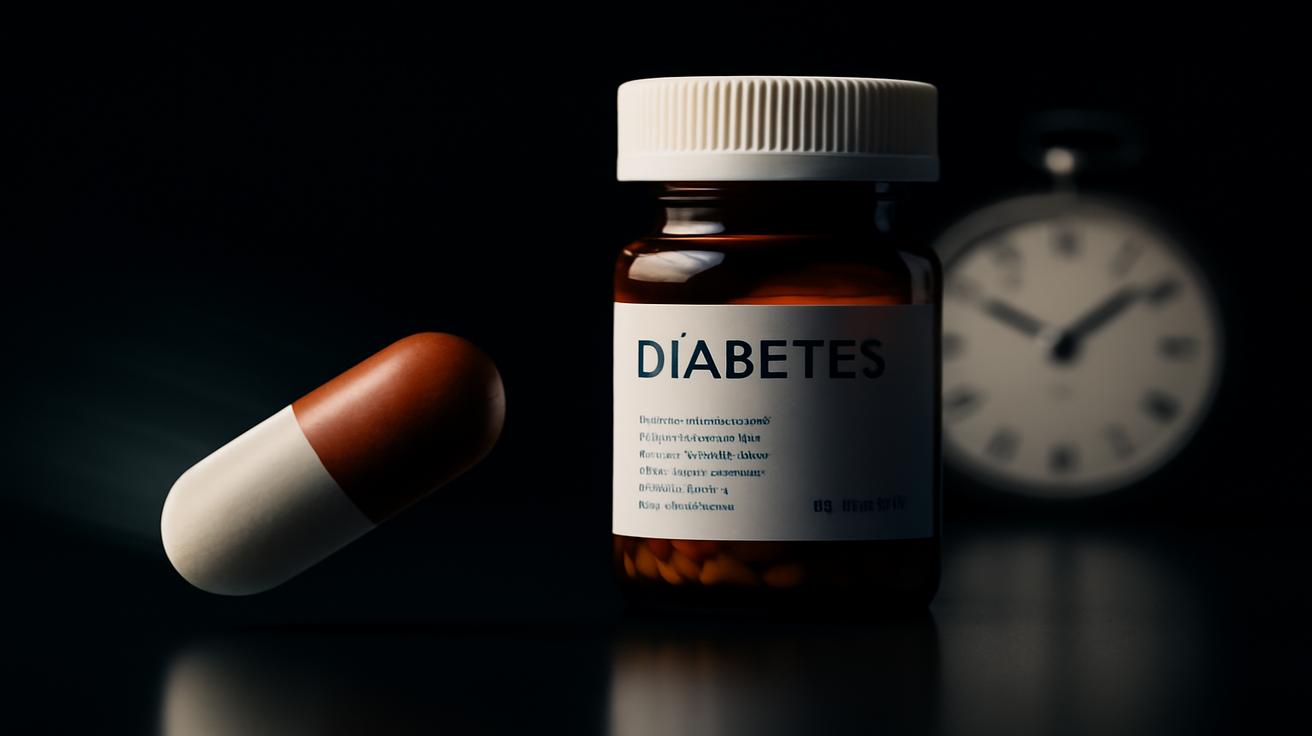
The lab freezer door sighed open, exhaling a breath of air so cold it smelled metallic, like snow on a city sidewalk just before dawn. On the middle shelf, between boxes of labeled vials and the frost-fringed walls, sat a row of tiny glass bottles filled with a perfectly ordinary-looking clear liquid. You’d never guess that, in clinics and pharmacies across the world, this same kind of liquid is quietly rewriting how we think about time, aging, and what it means to grow old.
On paper, it’s a diabetes drug. A workhorse, not a celebrity. It doesn’t shimmer blue or glow under black light. It doesn’t quite sound like science fiction—metformin, semaglutide, tirzepatide, the names snap and stutter like mechanical syllables. Yet some scientists are beginning to wonder if one of these molecules does something far stranger than just lowering blood sugar. Maybe—just maybe—it slows down time itself, not by stopping the clock on the wall, but by coaxing the body’s cells into a slower, calmer dance with decay.
The Whisper in the Data
The first clues that something unusual was happening didn’t come with trumpets. They arrived like whispers in hospital corridors and footnotes in clinical trials. Doctors treating people with type 2 diabetes noticed something odd: those taking certain drugs weren’t just getting their blood sugar under control. They seemed to be dodging other bullets too—heart attacks, strokes, sometimes even early death.
Imagine two people, both in their late fifties, both with similar diets, jobs, and family histories. One develops type 2 diabetes and begins treatment with a modern diabetes medication. The other doesn’t have diabetes and never touches the drug. Years later, researchers look back at thousands of such lives, lined up in meticulous spreadsheets and medical records. Something doesn’t quite add up. In some of these comparisons, the person who got sick—the one who needed treatment—is living as long as, or occasionally longer than, the person who never needed the drug at all.
That’s not how the story of chronic illness usually goes. Diabetes is supposed to shorten the path, to ease the body faster toward frailty and disease. But the data kept hinting at a different narrative: people on certain diabetes drugs were experiencing fewer age-related complications—fewer cardiovascular events, fewer kidney issues, in some studies even fewer cancers—than researchers expected. Not magical immunity, not immortality, but a subtle reshaping of the risk curve. Time, it seemed, was leaning away from them a little more gently.
In hushed conference rooms and crowded poster sessions at medical meetings, those whispers grew louder. Biostatisticians triple-checked their models. Clinicians checked their instincts. Was this real? Or just a trick of numbers, a mirage on the statistical horizon?
The Day “Anti-Aging” Walked Into a Diabetes Clinic
Walk into an ordinary diabetes clinic and it doesn’t feel like a portal to the future. The air smells faintly of disinfectant and coffee. Posters on the walls show cartoon pancreases and cross-sections of arteries. People sit in the waiting room scrolling on their phones, the quiet murmur of human worry rising and falling like a soft tide.
You might see an older woman, hands wrapped around a water bottle, waiting for her checkup. She’s been on a diabetes drug for five years now. Her blood sugar is better, sure, but something else has changed. She tells her doctor her energy is steadier. Her weight has crept downward—not dramatically, but enough that she’s started walking the three blocks to the grocery store again, instead of driving. Her blood pressure looks better. Her cholesterol has eased into safer numbers. She’s sleeping more deeply, waking up with less of that familiar, friction-heavy fatigue.
None of these things, taken alone, would scream “We are defeating time.” But put together, they begin to sound like a quiet rearrangement of her body’s relationship with aging. Less inflammation, fewer metabolic storms, a more stable internal climate. And as more patients file in—men and women, older and younger, each carrying the intricate map of their own biology—the pattern is echoed again and again.
Doctors notice. Researchers notice. So do the companies making these drugs, and the governments paying for them. Could it be that medications designed to manage a single disease are also nudging the broader arc of aging? Could a drug that steadies blood sugar also be smoothing some of the wrinkles in time itself?
What Does It Mean to Slow Time in a Body?
When scientists talk about “slowing aging,” they don’t mean freezing someone at thirty-two forever. There’s no secret lab where gray hairs vanish and crow’s feet retreat. What they mean is something both more subtle and more profound: bending the slope of decline.
Picture your life as a line on a graph. On the left: childhood—fast growth, rapid change, a body flaring upward like a rocket. In the middle: adulthood—plateau, strength, fertility, the steady hum of maintenance. On the right: aging—cells repairing themselves more slowly, systems gradually fraying, risks stacking up like kindling waiting for a spark.
Now imagine if that right-hand side of the curve could be stretched just a little. Not erased, not flattened, but softened. What if the descent was slower, the risks arrived later, the years of healthy, independent living extended by five, ten, maybe more? This is what people mean by slowing biological time: not stopping the calendar, but persuading the body to move through it more gracefully.
Certain diabetes drugs, particularly some of the newer ones, appear to nudge multiple systems at once: appetite regulation, inflammation, vascular health, possibly even subtle signals in the brain that regulate stress and resilience. They weren’t designed as “longevity drugs,” yet they keep brushing up against the hallmarks of aging like a hand skimming along the surface of a river—metabolism, cellular stress, hormonal balance, cardiovascular strain.
It’s as if a medication invented to solve one problem accidentally reached into a deeper, older conversation—the one happening inside our cells about when, and how quickly, to grow old.
The Strange Poetry of Side Effects
Every drug has side effects. Most are annoying. Some are dangerous. But in the story of diabetes medications and aging, the side effects are where things get intriguingly poetic.
Take weight loss, for example. Many of the newer diabetes drugs influence hormones that tell your brain when you’ve had enough to eat. People taking them often find their cravings quieting; portion sizes shrink without conscious effort. For someone living in a body worn down by decades of overeating, insulin resistance, and metabolic chaos, this is more than cosmetic. Fat around the organs begins to shrink. The liver unloads some of its burden. Blood vessels feel less constant pressure. The heart doesn’t have to beat so frantically to move blood through a crowded system.
At the same time, some of these drugs seem to dampen chronic inflammation—that persistent, low-grade alarm that smolders inside us when we’re stressed, sedentary, or metabolically unbalanced. Chronic inflammation is like background static in the body, eroding tissues, whispering to plaque in the arteries, stirring up mischief in cells that may one day turn cancerous.
Reduce that static—even modestly—and you begin to change the background conditions of aging. You’re not reversing time, but you might be thickening the walls of the hourglass, slowing how quickly the sand slips through.
Still, these drugs are no fairy tale. Some people feel nauseated, especially at the start. Others battle constipation, digestive distress, or a strange, hard-to-describe sense of internal dissonance as the body adjusts. Very rarely, more serious complications appear. This is not a soft-focus commercial where everyone skips down a beach at sunset. It’s real biology, with real trade-offs, measured in discomfort and risk and long-term uncertainty.
From Lab Mice to Human Time
If you zoom out even further—to petri dishes glowing under fluorescence microscopes, to mice scurrying beneath infrared cameras in darkened labs—you’ll find another layer to this story. Long before some of these diabetes drugs exploded into public consciousness, scientists were already trying to tweak aging in animals, probing the levers and pulleys that make time run faster or slower in small bodies.
They discovered that certain biological pathways govern not just blood sugar but also cell survival, repair, and stress tolerance. Tweak these pathways in tiny worms, and their lives double. Adjust them in mice, and you get more resilient hearts, cleaner arteries, brains that hold onto memory a little longer. Some diabetes medications seem to nudge those same ancient switches, the ones that tell cells when to hoard resources, when to repair damage, when to surrender to decay.
In the dim, humming quiet of those labs, with the faint scent of bedding and sterilized plastic lingering in the air, the question sharpens: Are we watching a metabolism drug accidentally lean against the gears of aging? Or are we so eager to outwit time that we’re seeing patterns where none truly exist?
To make sense of it, scientists sift through mountains of data, their screens flickering with rows of tiny numbers and curves. Survival rates. Hospitalizations. Organ function over time. Slowly, the outline of something new becomes visible—not a miracle, but a shift. Lives a little longer. Hearts a little sturdier. Brains perhaps slightly more protected. A constellation of small, cumulative motions in the direction of more time lived in better health.
A Tiny Molecule and a Giant Question
Somewhere between the sterile precision of the lab and the messy reality of daily life lies the real heart of the story. A person sits at their kitchen table in the early morning light, coffee steaming in one hand, a small pill or injection pen in the other. Outside, a sparrow rattles in the gutter. The refrigerator hums. The sun slowly climbs, dust motes spinning like galaxies in the air.
They take the drug because their doctor says it will help with diabetes—or maybe prevent diabetes from fully arriving. They swallow or inject it, feel that tiny chemical signature enter their bloodstream, and then they get on with their day. They go to work. They text their kids. They worry about rent or retirement. They cook dinner, or grab something from a drive-thru, or reheat yesterday’s leftovers. They live.
They are not thinking about senescent cells or mitochondrial efficiency or inflammatory cytokines. They are thinking about making it through another week.
And yet, inside them, quietly, thousands of molecular conversations shift. The pancreas negotiates differently with the bloodstream. The liver recalibrates its accounting. The brain alters its appetite forecasts. The immune system adjusts its baseline alert level. A tapestry of tiny tweaks, some we understand, some we don’t, begins to reweave tomorrow’s probabilities.
This is where the idea of “slowing time” stops being an abstract headline and becomes something intimate: an ordinary person, in an ordinary kitchen, possibly trading side effects and co-pays for a slightly different trajectory through the years ahead.
Dreams, Hype, and the Ethics of Borrowed Time
Of course, once a whisper of “age-slowing” escapes into the world, it doesn’t stay a whisper for long. It catches in headlines, ripples through social media, gets repeated in gyms and co-working spaces and dinner parties: “Did you hear? There’s a diabetes drug that might slow aging.”
Soon, people without diabetes—people still young or healthy by most measures—start to eye these medications with hungry curiosity. If a drug helps someone with metabolic illness live longer, could it help a healthy person stack even more years on top? Could it be a cheat code for time, a pharmaceutical shortcut to the kind of slow-aging biology some people win at the genetic lottery?
This is where the story gets messier, and more human. Doctors sit in their offices, wrestling with questions that have no simple answers. Is it ethical to prescribe a powerful drug to someone who doesn’t strictly need it yet, in the hope of slowing aging? What about the people who desperately need it for diabetes management but can’t access it because of shortages or cost, while others seek it for cosmetic weight loss or speculative longevity?
There’s an unease that creeps in, a sense that we’re peering into a future where time itself could become another form of privilege: those who can pay for the latest molecule get a slightly longer runway before disease and decline. Those who cannot keep aging at the old, unforgiving speed.
And in the middle of that moral fog stands the molecule itself, indifferent—a tiny, dumb arrangement of atoms, doing what chemistry compels it to do, whether in the body of a wealthy executive, a retired bus driver, or a single parent juggling three jobs.
Listening Carefully to the Clock
For all the excitement, there’s something humbling that researchers repeat, sometimes wearily, sometimes fiercely: we don’t fully know yet. The long-term story of using diabetes drugs for longevity is still being written, day by day, across millions of quiet lives. Controlled trials are underway, but they take years. Biology rarely speaks in absolutes; it speaks in trade-offs, in probabilities, in context.
One person may respond beautifully—better metabolic health, fewer complications, minimal side effects. Another might struggle with nausea, or see no meaningful improvement beyond what lifestyle changes alone could provide. A third might not be a suitable candidate at all, because of other medical conditions or medications, because of pregnancy, or because their doctor reads the emerging data and decides: not yet, not for you, not in this way.
What we know, so far, is tantalizing and incomplete. Some diabetes drugs appear to reduce overall mortality and cardiovascular risk in people with diabetes. Some may reduce the incidence of certain age-related diseases. Some help people lose weight and keep it off, easing pressure on joints, hearts, and organs. All of that looks a lot like slowing the biological wear and tear that accumulates across decades.
But “slowing aging” is a grand, sweeping phrase, and time is a harsh editor. The coming years will trim our early optimism with hard data, sharpen the outlines of who benefits and who doesn’t, reveal which risks were underestimated, which hopes were overblown.
A Quiet Revolution in How We Imagine the Future
Step outside for a moment—away from the clinics, the labs, the graphs—and just listen. Cars hiss along wet streets. A dog barks two blocks over. Somewhere, a train horn wails like a distant memory. The sky is doing what it always does: brightening or darkening by imperceptible degrees, a rhythm so steady we rarely notice it. Time, in the large-scale sense, is still immutable. Seasons still turn. Bodies—and the stories they hold—still begin, crest, and finally bow out.
And yet, tucked discreetly into bathroom cabinets and bedside drawers, in purses and glove compartments and pharmacy bags, are tiny tools that may be tilting the lived experience of that arc. Not reversing death, not conquering decay, but quietly giving some people a few more years of clear thought, of steady steps, of afternoons in the sun where the body feels like an ally instead of an adversary.
It is both deeply ordinary and profoundly radical that a drug first developed to tame wayward blood sugar might also be a chisel held gently against the stone of aging. It forces us to rethink what medicine is for. Is it only for treating disease once it arrives? Or can it also be for sculpting a healthier trajectory long before the first big crisis hits? Where is the line between therapy and enhancement, between care and optimization?
There’s a kind of fragile beauty in the idea that slowing time might not look like a glowing serum or an ultra-exclusive treatment in a futuristic spa. It might look like a generic box on a pharmacy shelf, handed across a counter under fluorescent lights, taken with a sip of tap water while the dishwasher hums in the background.
We are used to imagining time as an enemy: a thief, a predator, a ticking bomb. But what if, in the coming years, we learn to think of it instead as a negotiator? Not fully under our control, not something we can own—but something we can bargain with, gently, through habits, community, environment, and yes, sometimes, carefully chosen drugs.
That diabetes medication in the frost-rimmed lab freezer will never truly stop time. But for some of the people who take it, it may loosen time’s grip just enough to allow for a few more sunsets watched from the porch, a few more stories told at family tables, a few more mornings when climbing the stairs does not feel like scaling a mountain.
In the end, slowing time might not be about chasing immortality at all. It might be about deepening the years we’re given—making them clearer, kinder, more spacious. A quieter revolution, hidden in plain sight, humming inside the bloodstream of millions.
A Glimpse at What We Know—and Don’t
While the science is still evolving, here’s a simplified snapshot of how diabetes drugs intersect with aging-related themes. This is not medical advice, just a big-picture look at current thinking.
| Aspect | What Some Diabetes Drugs Tend to Do | Possible Aging-Related Impact |
|---|---|---|
| Blood sugar & insulin | Improve insulin sensitivity, stabilize glucose swings | Less metabolic stress on organs over time |
| Weight & appetite | Reduce appetite, support weight loss in many people | Lower strain on heart, joints, and liver |
| Cardiovascular system | Lower risk of heart attack and stroke in some groups | Potentially more years with healthier circulation |
| Inflammation & stress | May reduce chronic inflammation and oxidative stress | Could slow certain damage linked to aging |
| Longevity potential | Associated with improved survival in some studies | Hints at slower biological aging—but not proven for everyone |
Frequently Asked Questions
Does this mean a diabetes drug can make me live forever?
No. Nothing in current medicine can stop aging or guarantee a dramatically longer life. Some diabetes drugs are linked to better health and lower risk of certain age-related diseases, especially in people with diabetes, but they do not confer immortality or anything close to it.
Should I take a diabetes drug if I don’t have diabetes, just to slow aging?
This is not something to decide on your own. Using powerful medications “off label” for longevity is still experimental territory. The potential benefits and long-term risks are not fully known. Any decision would need a careful, individualized conversation with a qualified healthcare professional who knows your medical history.
Is the effect on aging the same for all diabetes drugs?
No. Different drugs work through different pathways and have different risk–benefit profiles. Some have stronger evidence for cardiovascular protection or weight loss; others do not. The “time-slowing” conversation is not about every diabetes drug equally, but about specific ones with particular patterns in the data.
If these drugs might slow aging, why aren’t they prescribed to everyone?
Because medicine is always a balancing act between benefit and risk. These drugs can have side effects, interact with other medications, and may not be appropriate for people with certain conditions. Cost, access, and ongoing scientific uncertainty also play big roles. Widespread use for aging alone would be premature based on what we currently know.
What can I do right now to support healthy aging without drugs?
The unglamorous basics are still powerful: moving your body regularly; eating mostly whole, minimally processed foods; getting enough sleep; avoiding tobacco; moderating alcohol; nurturing relationships; and managing stress. These choices won’t stop time, but they can shift how kindly it treats you—often more reliably than any single pill we currently have.