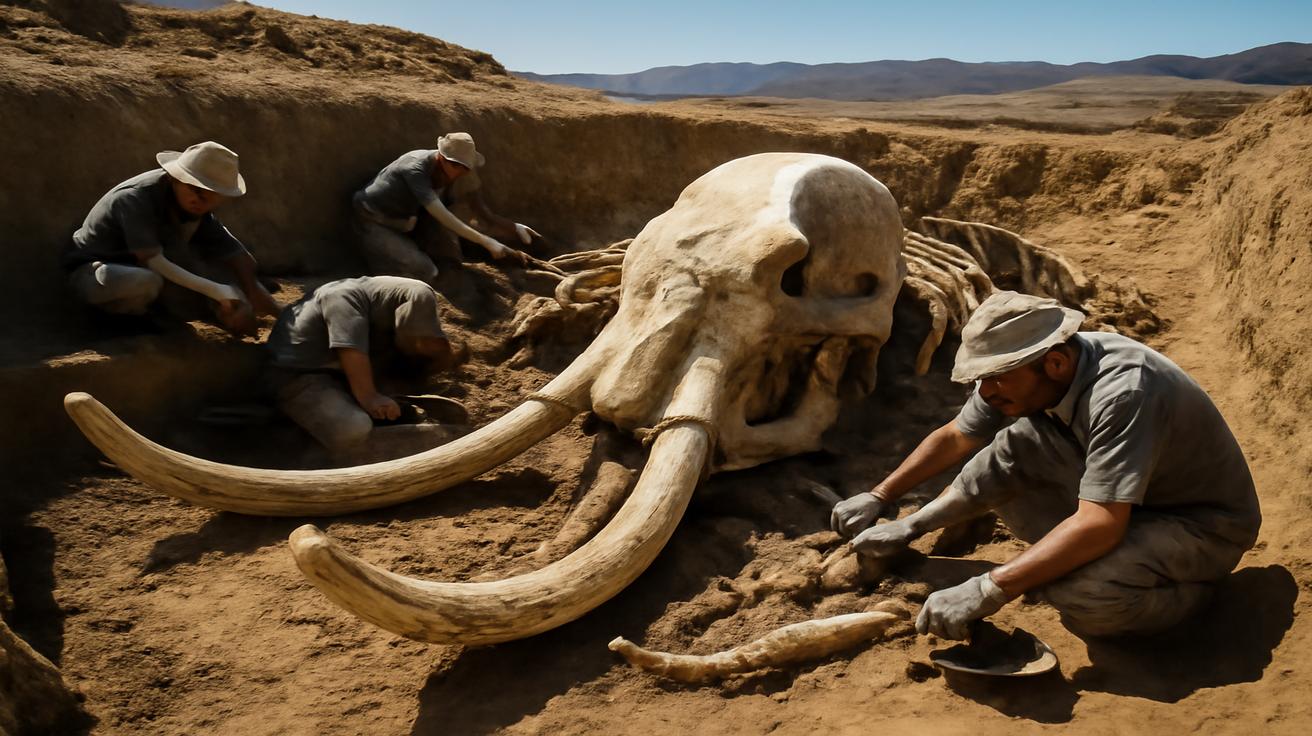
The first thing you notice is the silence. Not the pristine silence of wilderness, but a hushed, reverent quiet that seems to gather itself among the low Spanish hills, between scrubby pines and dusty stone. Somewhere beyond the horizon, a highway murmurs and a town goes about its business. But here, near a nondescript patch of earth in eastern Spain, the present feels thin, as if you could almost hear, beneath the cicadas and soft wind, the low, impossible rumble of elephants marching to war.
The Bone in the Dust
On a dry, bright morning, a team of archaeologists stand in a shallow trench, their knees dusty, their fingers careful. The soil here is pale and compacted, speckled with tiny stones and the faint shadows of long-gone roots. This part of Spain has been dug and redrawn for centuries, from Roman walls to medieval farmsteads, each generation leaving a story in the ground. But this trench is different. The scientists have a hunch that this place may hold something rarer—a whisper from perhaps the most audacious military maneuver in ancient history: Hannibal crossing the Alps with elephants to attack Rome.
The trowel moves slowly, shaving down thin curls of earth. A brush follows, whispering against the soil. And then—something that is not earth. Hard. Curved. Pale, but not like stone. Someone leans closer. The air thickens around the trench. A fragment of bone, heavy and wide, begins to emerge. It is too large for a cow, too robust for a horse. The team exchanges looks that say more than words. Could this be…?
For centuries, Hannibal’s elephants have wavered between history and legend, their great silhouettes trudging across the snow-covered passes of the Alps in the imagination of generations. But in Spain, hundreds of miles from those famous ridgelines, a new discovery is quietly reshaping the debate over what actually happened, and how real those war elephants truly were.
The Ghost Herd of History
To understand why a single bone in Spanish soil matters, you have to picture the world two thousand years ago. Carthage, a powerful maritime city in North Africa, was locked in a bitter struggle with Rome. Hannibal Barca, Carthage’s brilliant and relentless general, dreamed of breaking Roman power by attacking from the land—through Spain, over the formidable Alps, and into Italy itself.
Ancient historians like Polybius and Livy painted unforgettable scenes: elephants splashing through rivers, trumpeting on narrow mountain paths, pressing forward through blizzards and rockfalls. These were not just exotic creatures; they were living battering rams and psychological weapons. To the Romans, many of whom had never seen such animals, the sight of armored elephants charging across a battlefield must have been the stuff of nightmares.
But over time, as modern scholars revisited the tale, doubt settled in. How many elephants did Hannibal really have? Could they survive the brutal conditions of mountain crossing? Did some classical writers exaggerate for drama, turning a small caravan into a thundering army of giants? The Alps are not kind to large, heat-loving animals. Without solid physical evidence, Hannibal’s elephants began to feel like the ghost herd of history: real, perhaps, but embellished, blurred by the mists of storytelling.
And then, in Spain, the ground began to speak.
Spain: The First Stage of a Dangerous Journey
Long before snow and high passes, Hannibal’s march began on warmer soil. In the late 3rd century BCE, the Carthaginians held significant territories on the Iberian Peninsula. Coastal cities and inland routes formed the first lines of his campaign, feeding men, horses—and if the texts were right—elephants into the great move toward Rome.
Recent excavations at several Iron Age and early Roman-period sites in eastern and southern Spain have turned up an intriguing pattern: large animal remains that don’t fit neatly with the usual livestock bones. Among them, at one particular site—its exact coordinates guarded to protect it—archaeologists have now identified what appears to be the partial remains of an elephant from roughly the right time period. Not a circus elephant, not a medieval curiosity, but an animal from the age when Carthaginian armies roamed this land.
Under the microscope, the bone tells a story in fine details: density, thickness, the subtle architecture of weight-bearing structures. It hints at an adult animal of substantial size, but not as large as a full African savanna elephant. That clue matters, because Carthaginian war elephants are believed to have been mostly North African forest elephants—smaller, stockier, and now extinct—or in some cases Indian elephants obtained through trade. The bone also shows microscopic wear and stress, consistent with heavy loads or unusual movement patterns—exactly what you might expect from an animal used in warfare, traveling long distances under strain.
The context matters as much as the bone itself. Nearby layers hold fragments of pottery typical of Carthaginian influence in Iberia: burnished surfaces, specific decorative styles, and residues of olive oil and wine. Mixed in are traces of weapons—metal fragments of spearheads, bits of harness, corroded buckles. When radiocarbon dating and stratigraphy align the layers, they converge on a tantalizing window around the late 3rd century BCE. A time when, according to Roman historians, Hannibal’s army was on the move through this very landscape.
The Revival of an Old Theory
For much of the 20th century, historians viewed Hannibal’s elephants with a blend of admiration and skepticism. Yes, there had likely been elephants, they agreed, but how many? Twenty? Forty? More? And did they all truly cross the Alps, or were some left behind earlier, their presence overstated by writers eager for drama?
Now, as more Iberian sites yield both environmental data and faunal remains, a quieter, data-driven chorus has begun to back an older, once-doubted theory: that Hannibal not only used elephants in North Africa and Spain, but that he systematically moved them along the campaign route, relying on established networks of supply, training, and animal handling. The elephants weren’t a one-time stunt but an integrated part of Carthaginian military strategy.
In Spain, isotopic analysis of tooth enamel from the discovered elephant remains suggests an animal that didn’t grow up locally. The chemical signatures hint at a diet and water source different from Iberian ecosystems, likely brought in from elsewhere in the Mediterranean. To science, this is like a faint passport stamp: this was a traveler, not a native. When lined up with ancient descriptions, it adds weight to the idea that Carthage imported specialized war elephants and moved them deliberately along the routes of conquest.
Below is a simplified snapshot of how this emerging picture compares Hannibal’s era to modern evidence from Spain:
| Aspect | Ancient Accounts | Evidence from Spain |
|---|---|---|
| Elephant Numbers | Up to 37–40 elephants at campaign start | Single confirmed remains; suggests at least some elephants present |
| Elephant Origin | North Africa and possibly Indian elephants via trade | Isotopes indicate non-local origin, consistent with imported animals |
| Military Role | Shock troops, psychological weapons, mobile platforms | Bone wear suggests heavy use and long-distance movement |
| Campaign Route | From North Africa through Iberia, over Alps into Italy | Finds cluster along known Carthaginian corridors in Spain |
None of this proves, in a courtroom sense, that every detail from Polybius was accurate. But it does something perhaps more powerful: it reconnects the story of Hannibal’s elephants to the physical earth, to real animals that ate, walked, suffered, and died along the way.
Following the Footsteps – and Footprints
Close your eyes and imagine that Spanish site not as a quiet dig, but as it might have been more than two thousand years ago. The air thick with the raw, animal smell of elephants: a musky, grassy scent, layered with sweat and dust. Goatherds on distant hills would have heard the clanking of gear, the harsh calls of foreign tongues, the barked commands of handlers guiding their enormous charges.
Hannibal’s army was not a neat, straight line of soldiers marching to a drum. It was a living, shifting organism of people and animals: infantry, cavalry, pack mules, supply wagons, and at the center of every onlooker’s attention, those towering grey bodies moving with slow, relentless certainty. Each elephant needed staggering amounts of food and water. Rivers became critical choke points. Forests and shrublands were stripped for forage. Villages along the route may have watched their fields vanish into the mouths of Hannibal’s living war machines.
Modern environmental studies of pollen and sediment cores in regions associated with Hannibal’s Iberian movements reveal spikes of disturbance—periods when vegetation patterns shifted abruptly, as if a heavy pressure rolled through the land. These data can’t label themselves “Hannibal” in so many words, but the timing and location match a period of unusual human impact. It’s as if the land itself still carries the bruises of that passage.
Spanish archaeologists talk about this with a certain quiet wonder. You hear it in their voices during late-afternoon fieldwork, when shadows grow long across the trench. The idea that their homeland—today known more for vineyards, olive groves, and sun-soaked coasts—once hosted one of the most daring military feats in ancient history feels almost surreal. Yet under their fingertips, the bones and sediments insist that yes, for a brief, violent moment, this terrain echoed with the heavy tread of elephants moving toward a distant war.
Myth, Memory, and the Shape of an Elephant
Elephants have always lived in the borderland between reality and symbol. In many cultures they represent memory itself, or the weight of history, or the power of empires. Hannibal’s elephants are no exception. They have become shorthand for ambition, audacity, and the wild edge of what is possible.
For years, some scholars wondered whether those elephants had been enlarged in the telling, their numbers inflated, their struggles dramatized. The Alps are cruel, after all. Even modern mountaineers with high-tech gear struggle there. Could elephants truly have crossed those passes in significant numbers? Maybe, the skeptics suggested, only a handful survived the journey, and the rest entered legend rather than Italy.
The new discoveries in Spain do not answer every question about the Alpine passage, but they subtly shift the center of gravity. If Carthage had the logistical capability to move elephants through Iberia, feed them, maintain them, and incorporate them into a large marching army, then the idea of at least some of those animals making it over the mountains begins to feel less like myth and more like a brutally difficult, yet not impossible, reality.
In that sense, the Spanish bone is more than just a fossil; it’s a piece of evidence in a broader philosophical trial about how we treat ancient stories. Do we discard them as exaggerated campfire tales, or do we treat them like old maps—distorted, yes, but ultimately pointing toward real landscapes? Every time the spade finds something that aligns with the texts, our sense of the past grows less abstract and more embodied. The elephants step a little closer to us, their presence less ghostly, more solid.
The Science Behind the Story
Peeling back the layers of Hannibal’s campaign now demands a curious mix of disciplines. There are the classical historians, fluent in Latin and Greek, who parse every line of ancient accounts for hints and contradictions. There are the archaeologists, who read the soil like a script, interpreting broken pottery and scattered bones. And then there are the specialists whose work seems almost like forensic magic: isotope geochemists, paleoecologists, zooarchaeologists.
From a single elephant tooth—when one is found intact—scientists can extract clues about what that animal ate in different phases of its life. Seasonal shifts in diet leave chemical patterns. If an elephant grew up browsing acacia in North Africa and later ate a diet of Iberian grasses, that transition can appear in the enamel as distinct zones. Strontium isotopes, drawn from the local bedrock into plants and then into the animal’s body, act like tiny geological signatures.
Meanwhile, the layout of a site—where bones are clustered, where metal fragments lie, how fire pits are distributed—helps reconstruct how an army camped. Were elephants kept at the periphery, away from the men at night? Did the handlers have separate quarters? Did their presence change how far the army could move in a day? Environmental data from the soil—traces of trampled vegetation, eroded banks, compacted layers—add another dimension: this is not just a story of men, but of land and animals reshaped by a single great decision to march on Rome.
Spain’s role in this science is crucial. Unlike the harsh, eroding landscapes of high Alpine passes, Iberian sites often preserve remains better, offering thicker, more legible chapters in the book of the past. When those chapters mention elephants, even faintly, they anchor the more fragile, scattered Alpine hints and Italian battlefield traces.
A Living Past, and Questions That Remain
As the sun begins to dip over that Spanish dig site, the day’s last light slides across the exposed bone—a curve of ancient ivory-colored surface set into the earth like a question mark. Around it lie fragments of ordinary life: broken jars, animal droppings long turned to dust, charcoal from fires that once warmed hands now long gone. The team will catalog, sample, send pieces off to laboratories in quiet envelopes. Months or years from now, graphs and charts will appear in scientific papers, each line a step closer to understanding what happened here.
Yet even as science advances, some mysteries may never be entirely solved. We may never know the exact number of elephants that set out with Hannibal from Spain, or how many survived each mile of the journey. We may never hear the precise sounds of their passage, or know what the soldiers felt when they camped beside these great animals on cold, uncertain nights.
But thanks to discoveries like the one in Spain, the theory that Hannibal’s elephants were not just a literary flourish but a robust, organized part of his war machine has new life. The debate is no longer restricted to musty libraries and speculative maps. It is being tested in the dust, in the chemistry of ancient teeth, in the patterns of disturbed soil beneath our feet.
And if you stand there long enough, on that quiet patch of Iberian ground, you might feel something unexpected: a connection to those long-ago handlers whispering to restless animals under unfamiliar stars. The elephants are gone; the Carthaginian empire is long reduced to ruins and footnotes. But in the end, the earth remembers. Sometimes, when the trowel catches just the right edge of bone, it remembers loudly enough that we can hear it.
Frequently Asked Questions
Did Hannibal really use elephants in his war against Rome?
Yes. Ancient sources like Polybius and Livy consistently describe Hannibal using elephants during his campaigns. While details such as exact numbers and survival rates are debated, the overall use of war elephants by Carthage is widely accepted by historians.
What exactly was discovered in Spain?
Archaeologists uncovered large animal bones, likely from an elephant, in a context dating to the late 3rd century BCE, along with artifacts linked to Carthaginian activity. Isotopic and anatomical analyses support the idea that the animal was non-local and may have been part of a military force moving through the region.
How does this Spanish discovery support the theory of Hannibal’s war elephants?
The find shows that elephants were present in Iberia during Hannibal’s era and likely moved along established Carthaginian routes. This supports the notion that Hannibal’s use of elephants was systematic, not merely symbolic, strengthening the case that some of these animals could have continued with him toward the Alps and Italy.
Were Hannibal’s elephants African or Indian?
Most researchers believe they were primarily North African forest elephants, a smaller, now-extinct species, with the possibility that some Indian elephants were acquired through trade. The new Spanish evidence suggests a non-local origin for the animal, consistent with imports rather than native Iberian fauna.
Will we ever know how many elephants crossed the Alps?
Probably not with certainty. Estimates range from a few survivors to a couple of dozen. However, as more archaeological and environmental data emerge—from Spain, the Alps, and Italy—we may refine those estimates and better understand how crucial the elephants were to Hannibal’s strategy and legend.