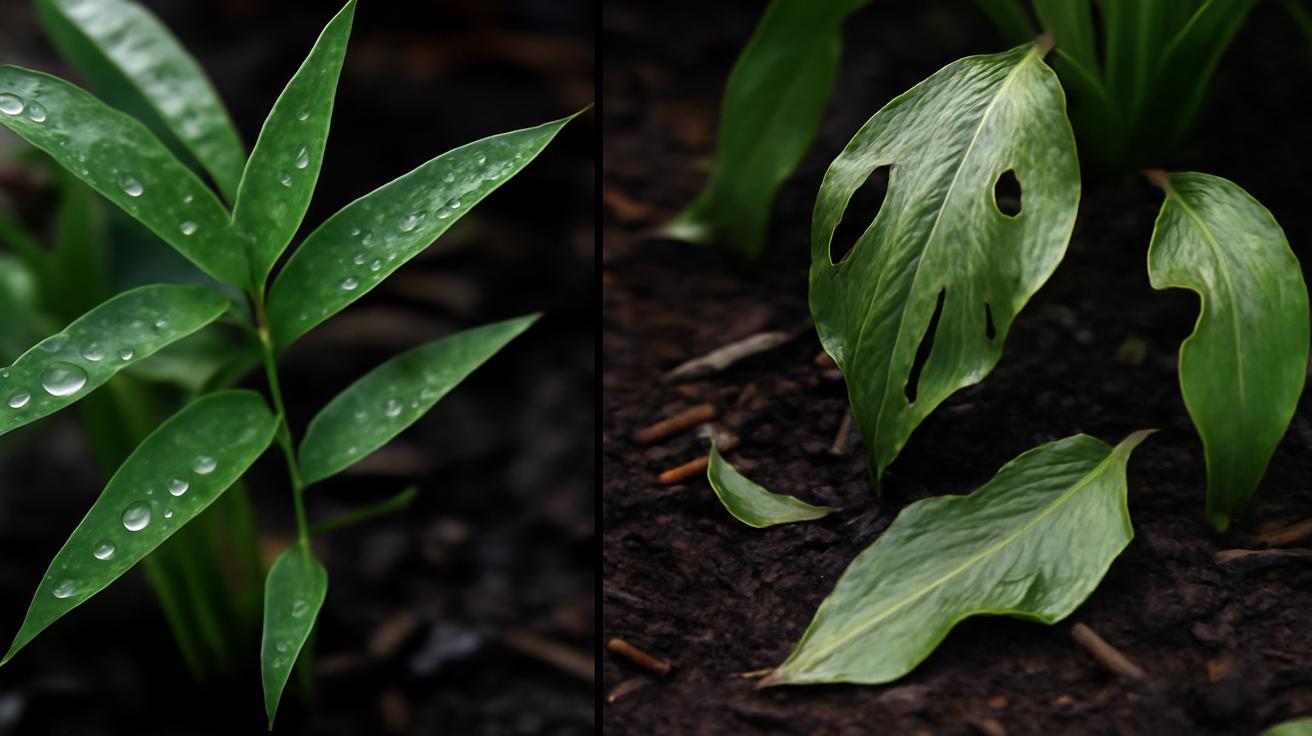
The morning after the storm, the garden looked like a crime scene. Soil was gouged open, pots overturned, leaves plastered to the path like wet confetti. A broken trellis leaned drunkenly against the fence. Yet, in the middle of the wreckage, one thing stood upright and almost serene: the old rosemary shrub, fragrant and defiant, as if the night’s roaring tantrum had been nothing more than a stiff breeze. Beside it, a once-stately sunflower lay folded in half, its heavy head pressed into the mud. Same storm. Same wind. Completely different endings.
If you’ve ever walked through a forest or your own backyard after a major storm, you’ve probably noticed this quiet mystery. Some plants snap, some shred, some simply disappear—and some seem to shrug, rearrange a few leaves, and carry on as if nothing happened. How is it that one tree can lose half its branches while the sapling right next to it is barely scratched? Why does your neighbor’s ornamental maple bounce back after being bent nearly sideways, while your prized hydrangea sulks and never really recovers?
The answers live in the bodies of the plants themselves: in the quiet architecture of wood and stem, in root systems you never see, in timing, in history, and in the ways life has learned to bend without breaking. To understand why some plants recover quickly after storms while others never do, we have to slow down and look more closely—not just at what’s broken, but at what was built to survive.
The Secret Architecture of Survival
Long before the storm clouds gathered, every plant in your yard was quietly making design decisions. Not conscious ones, of course, but evolutionary choices baked into its DNA. These choices show up in what you can see: the thickness of a stem, the way branches are arranged, how close or far the leaves are spaced. They also show up in what you can’t see: the density of the wood, the depth of the roots, even the microscopic structure of plant cells.
Some plants are built like old stone cathedrals—rigid, towering, magnificent, but not especially forgiving when the earth shakes. Others are more like tents at a windy beach: low, flexible, and unbothered by being shoved around. When the storm hits, that invisible philosophy of structure becomes suddenly, dramatically visible.
Take two shrubs in the same yard: a loosely branched, whippy willow and a dense, rigid boxwood. The willow’s branches sway wildly with the wind, bending into improbable arcs, then springing back when the gust passes. Its wood fibers are full of flexible tissues that allow movement. The boxwood, on the other hand, holds its shape sternly—until it doesn’t. Beyond a certain point, its stems don’t bend; they break. After the storm, the willow looks disheveled but intact, while the boxwood may be missing whole sections.
Inside, the difference is structural. Plants that recover quickly often have:
- More flexible stems and branches with a higher proportion of living, elastic tissues.
- Branching patterns that allow wind to pass through rather than catch it like a sail.
- Wood that can bend and form subtle “hinges” without snapping completely.
Meanwhile, more brittle species tend to have denser wood with less give, tight branching angles that trap wind and ice, and heavier crowns that act like levers. Storms simply reveal the consequences of those designs.
Roots: The Invisible Half of the Story
It’s easy to blame wind for every fallen tree, but much of what you see on the surface is really a root story. Deep underground, long before the first rumble of thunder, plants are either setting themselves up for resilience—or for a dramatic toppling.
Imagine two trees side by side in a storm-soaked park. One wrenches out of the ground, roots clawing the air like a blown-out umbrella, while the other leans but holds. From above, they seemed similar. Underground, they were not.
Some plants anchor themselves with deep taproots that stab straight into the soil, supplemented by spreading lateral roots. Others lay out a wide, shallow net that clings close to the surface. In normal conditions, both can work. But in saturated soil, that shallow web can loosen, turning the tree into a 30-foot-tall lever waiting for a nudge. When that nudge comes as a 60-mile-per-hour gust, you know what happens next.
Survivors often share several hidden traits:
- Depth and breadth: Roots that reach down for stability and also outward for balance.
- Strong soil relationships: Fine root hairs intertwined with fungal networks that help knit the plant into the ground.
- Healthy structure: No major rot, girdling roots, or damage from past construction or compaction.
Plants that fail to recover often had silent problems long before the storm: roots shaved during sidewalk installation, years of overwatering or compaction, or containers that never allowed proper root spread. The storm isn’t the cause; it’s the final stress that reveals the weakness.
| Feature | Plants That Bounce Back | Plants That Struggle |
|---|---|---|
| Root System | Deep and wide, well-branched, healthy soil connections | Shallow, restricted, damaged, or circling roots |
| Stem & Wood | Flexible tissues, moderate density, can bend | Brittle, very dense or weak wood, prone to snapping |
| Crown Shape | Open, allows wind to pass through | Dense, top-heavy, acts like a sail or lever |
| History | Minimal past stress, proper pruning and care | Old wounds, decay, poor planting or pruning practices |
| Recovery Ability | Strong resprouting, good wound sealing | Limited buds left, slow healing, infection risk |
Flexibility, Memory, and the Art of Bending
Walk through a coastal dune on a windy day, and you’ll see grasses bowing over as if in prayer, their blades almost horizontal, then springing back when the gusts pass. These plants don’t resist the wind; they collaborate with it. Their stems are thin but strong, full of fibers that allow an enormous amount of movement without damage. This is not weakness; this is strategy.
Plants that recover quickly from storms often win by being just flexible enough. They bend instead of break, sway instead of snap. But there’s more going on here than simple give in the stems. Many plants also carry a kind of physical memory—subtle changes in growth that record past storms.
If a young tree is regularly exposed to wind, it will often grow thicker, stronger trunks and shorter, more compact crowns. Botanists call this “thigmomorphogenesis,” a mouthful that simply means growth shaped by touch and mechanical stress. You can see it in trees at the edge of a forest, leaning permanently away from prevailing winds, their branches shorter and more muscular on the windward side.
These plants are essentially training with the weather. Each smaller storm is a rehearsal, strengthening fibers before the main performance. When a major event finally arrives, they’re ready. A tree that grew up in a sheltered greenhouse and was then plopped into a wind-prone hillside, by contrast, may never develop that same muscular architecture. The first big storm is a shock it’s not built to handle.
Recovery happens most readily when:
- The plant’s tissues have some elasticity and can rebound after bending.
- Previous wind exposure led to compact, reinforced growth.
- The plant has enough stored energy to repair what was damaged.
When you see a tree that snapped clean in half, you’re seeing the opposite: tissues that resisted movement until they failed suddenly and catastrophically. Often these trees looked strong. They were simply inflexible in the wrong places.
Wounds, Energy, and the Slow Work of Healing
Storm damage is not just dramatic—it’s expensive. Not in money, but in energy. To a plant, every broken branch and torn leaf is a bill that must be paid with stored sugars and nutrients. Whether a plant recovers quickly or not at all often comes down to what it can afford.
Imagine a tree that has just lost a major limb. In human terms, that limb might have been a long-term investment: years of energy poured into wood, leaves, and fine twigs. Now, in a single night, it’s gone. The tree has to do three things at once:
- Seal the wound to prevent disease and decay from marching into the heartwood.
- Rebalance its crown and root system, now mismatched in size.
- Replace lost foliage to keep photosynthesis—and thus energy production—going.
Plants that bounce back have reserves. They’ve been well-fed by good soil and adequate light. They weren’t already struggling with drought, pests, or repeated pruning. They have dormant buds tucked along stems, ready to wake up and resprout after damage. Their internal plumbing—xylem and phloem—can reroute water and sugars around damaged areas.
Plants that never really recover often enter the storm already in debt. Maybe they’ve endured years of subtle stress: chronic dryness, compacted roots, nutrient-poor soil. Maybe they’re old, with slower internal traffic and fewer reserves. When a storm suddenly demands major repairs, they simply don’t have the energy to make them.
You’ll see it in a slow decline rather than an immediate death: leaves that get smaller year by year, branches that never fully leaf out again, dieback creeping from the tips inward. The storm didn’t just break the plant; it pushed it past a recovery threshold. On the outside, it looks like “it never recovered.” Inside, it was more like a bank account that finally went negative.
Native Wisdom: Plants That Know Their Storms
In landscapes shaped by regular storms—coastal plains, river valleys, hurricane-prone regions—there’s a quiet pattern if you know how to look for it. The plants that dominate over centuries are not the ones that look most impressive in calm weather, but the ones that can lose parts of themselves and regrow, over and over again.
Along shorelines, you’ll often find low, tough shrubs rather than towering, delicate trees. Many of these species evolved with salt-laden winds and violent gusts. Their leaves may be small and thick, their growth habits compact and tangled. Some can resprout aggressively if broken, sending up new shoots from roots or basal stems. Knock them down, and they come back denser.
In storm-prone forests, certain trees have adapted to damage as a regular part of life. Some species compartmentalize decay incredibly well, walling off rot behind chemically fortified barriers. Others are masters at sprouting new trunks from stumps or roots when the main stem is destroyed. They’ve essentially woven disturbance into their life cycle.
This native wisdom is one big reason why some plants in your yard seem almost blasé about bad weather: they come from places where storms are normal, not exceptional. Ornamental species bred in calm, gentle climates may never have needed such traits. When we import those species into harsher regions because we like their flowers or fall colors, we’re sometimes setting them up for a reunion with forces they were never designed to meet.
Choosing storm-savvy plants isn’t about giving up beauty in favor of toughness. It’s about finding the species whose beauty includes toughness—plants whose glamour hides an evolutionary résumé full of wind, rain, and recovery.
The Human Factor: How Our Choices Shape Plant Fate
The story of which plants survive storms is not written by nature alone. Our decisions—often well-intentioned, sometimes rushed—explain a surprising amount of the damage we see. A tree planted too deep. A shrub pruned incorrectly. A hedgerow forced into a shape it never wanted. All of these leave fingerprints on what happens when the sky turns dark.
Planting depth, for instance, seems like a boring detail until you walk through a neighborhood after a storm and see a pattern. Trees whose root flares—where the trunk widens at the base—were buried below soil often rock or topple more easily. Their roots never spread correctly, or they suffocated in slow motion. A simple decision at planting time set a limit on future resilience.
Pruning plays its role too. Regular, thoughtful pruning can open up a tree’s crown, reduce weight on long limbs, and guide strong branch structure. But aggressive topping or one-sided trimming can create weak points and dense, unstable regrowth. In the next big wind, those weakly attached shoots and overloaded limbs are exactly where breaks occur.
Then there’s placement. A tall, brittle tree positioned at the corner of a building, funneled by wind between structures, faces a very different fate than the same species growing in an open field. A shallow-rooted ornamental in a spot where water pools during every rainstorm will endure more root stress than its cousins on higher ground.
When we say some plants “never recover” after storms, we’re often seeing the ending of a story we unknowingly helped write. The good news is that we can also help write better futures. Planting the right species in the right place, at the right depth, with enough space to grow; pruning thoughtfully; nurturing healthy soil—these are acts of quiet preparation for a future storm whose date we don’t yet know.
How to Read the Aftermath
The next time you step outside after a storm, pause before you reach for the pruning shears or start pulling things up. Walk slowly. Look closely. The damage is not just a mess to clean up; it’s a kind of map. It tells you how your plants are built, how they’ve been living, and what they might need to face the next storm differently.
Notice which plants bent and sprang back. Note which snapped at the base versus midway along a branch. Look for patterns: Are all the broken limbs on one side, where wind was funneled between houses? Are the toppled trees the ones closest to recent construction, where roots might have been cut?
You may see that your most devastated plants were already struggling—thin canopies, small leaves, signs of disease. The storm didn’t choose victims at random; it amplified existing vulnerabilities. You may also find quiet heroes: a battered but upright shrub, a young tree that lost a few twigs but kept its core structure, a patch of groundcover that looks as composed as it did the day before.
Those resilient survivors are clues, too. They’re showing you what works in your particular patch of earth: which root styles, growth habits, and species are best matched to your winds, your soil, your way of tending the land. Listening to them may change what you plant next year.
Because in the end, the reason some plants recover quickly after storms while others never do is not a single reason, but a layered story: of hidden roots and flexible stems, of past stresses and stored energy, of native wisdom and human choices. Storms are the loud, dramatic chapters. Recovery—or its absence—is the quiet epilogue that reveals everything that came before.
Frequently Asked Questions
Why did my young plants recover better than older trees?
Young plants often have more flexible stems, faster growth rates, and greater energy reserves relative to their size. Older trees may be dealing with internal decay, past pruning wounds, or root damage that limit their ability to adapt and heal after a storm.
Can I help a damaged plant recover after a storm?
Yes, to a point. Remove broken or hanging branches with clean cuts, avoid over-pruning, and focus on reducing further stress: water during dry spells, protect roots, and avoid heavy fertilization immediately after damage. Give the plant one or two growing seasons before deciding its fate.
Are some plant species naturally more storm-resistant?
Absolutely. Species native to windy, storm-prone regions often have traits like flexible wood, strong root systems, and the ability to resprout after damage. Researching local native plants is one of the best ways to build a resilient landscape.
How can I choose trees that are less likely to fail in storms?
Look for species with good structural reputations in your region: strong branch attachments, moderate mature height for your space, and non-brittle wood. Plant them at proper depth, give them enough room, and maintain them with careful, regular pruning guided by an arborist if possible.
Why did a plant look fine right after the storm but decline later?
Storms can cause internal or root damage that isn’t immediately obvious. The plant may also have lost more leaf area than it can afford, depleting its energy reserves over time. Months later, you’ll see smaller leaves, dieback, or increased susceptibility to pests and disease as the hidden damage plays out.