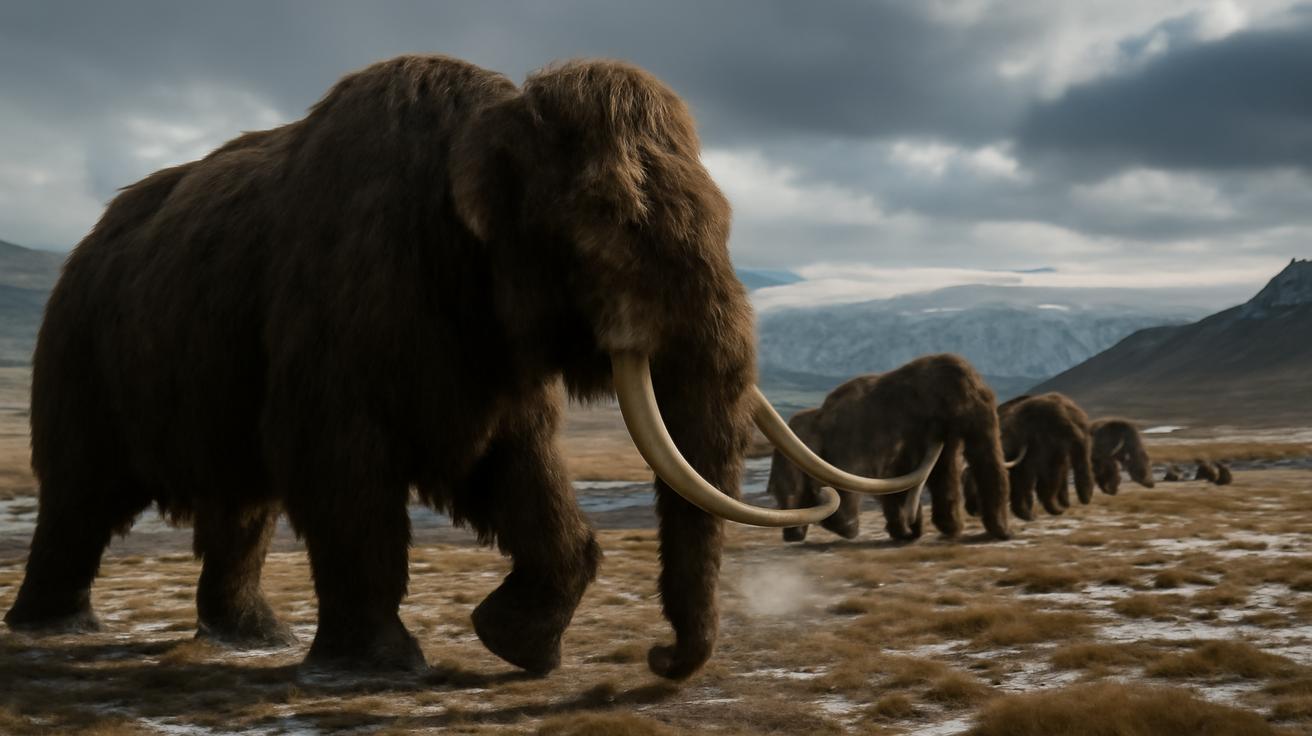
The first time you imagine a mammoth running, you probably hear thunder. Great shaggy beasts pounding across frozen steppe, trunks swinging, tusks like ivory scythes cutting the air. Dinosaurs? They come with their own sound effects: cinematic booms, ground-shaking footfalls, herds surging over primeval plains in a blur of muscle and speed. For decades, our minds have been tuned to that channel—prehistoric life as a nonstop, high-speed epic.
But in a sunlit lab in Spain, surrounded by casts of fossilized footprints and nervous stacks of data sheets, a team of researchers has quietly turned down the volume on that soundtrack. Using new methods to study the tracks left behind by mammoths, dinosaurs, and other giants, they’ve revealed something far more surprising than another record-breaking top speed.
These creatures, it seems, were… slow. Not lazy, not clumsy—just moving through their world at a pace that feels startlingly familiar. Measured. Steady. Almost, you might say, human.
The Step That Changed the Story
The story begins not with teeth or bones, but with something far more humble: footprints. Across parts of Spain—dusty plateaus, river valleys, and cliffs that were once ancient shorelines—prehistoric tracks are preserved like frozen echoes. Mammoth trails cross what used to be tundra; dinosaur prints stitch their way along dried-out sediments that once bordered lakes and sea shallows.
For years, these tracks were admired, cataloged, photographed. They were solid proof that such animals had walked here. But only recently have they become a kind of living dataset—a way to measure the speed, stride, and daily habits of animals that vanished tens of thousands, even millions, of years ago.
Spanish researchers began meticulously scanning, mapping, and comparing these footprints, using drones, 3D modeling, and computer simulations. What they uncovered pushed back against long‑held assumptions. When they calculated speeds based on footprint spacing and estimated hip height, the numbers came back lower than expected—again and again.
Those stampeding herds we loved in movies? The data suggested something calmer: mammoths traveling at a walking pace, dinosaurs ambling instead of dashing, movement not of panic and chase, but of quiet intent.
Slow Giants: What the Numbers Reveal
To get a sense of just how different this new picture is from the old one, imagine standing beside a path marked with mammoth tracks, each print like a basin in the earth. The distance between one footprint and the next—the stride length—tells you how far each leg swung forward. Combine that with the size of the animal, and you can estimate speed.
The researchers built on classic biomechanical formulas, originally developed for living animals, and applied them to the fossil record. When they ran the numbers on several remarkable trackways in Spain, a pattern emerged: both mammoths and many large dinosaurs were moving at surprisingly modest speeds during the moments those tracks were made.
| Prehistoric Animal | Context of Trackway | Estimated Speed | Modern Comparison |
|---|---|---|---|
| Woolly mammoth (Iberian track sites) | Group moving across open steppe | ~3–6 km/h | Brisk human walk |
| Large sauropod dinosaur | Multiple individuals on soft sediment | ~2–5 km/h | Relaxed stroll |
| Theropod dinosaur (predatory type) | Single trackway weaving slightly | ~4–8 km/h | Human jog to fast walk |
The numbers fluctuate by site, species, and terrain, but the trend is clear: these giants spent huge portions of their lives moving at speeds that wouldn’t leave most humans breathless. Even predatory dinosaurs, in many of the Spanish trackways, appear less like sprinting monsters and more like patient walkers, covering ground in a rhythm that feels almost meditative.
Listening to the Ground
Speed is only one part of the story. When you stand in front of a trackway, the sheer size of the prints is mesmerizing, but it’s the small irregularities—the scuffs, slips, and deepened impressions—that bring it alive.
In one Iberian valley, the tracks of multiple mammoths seem to wander as if the animals were sniffing out patches of exposed vegetation. Some prints are more deeply pressed, hinting at a heavier step down a gentle slope. Others are shallower and closer together, suggesting a cautious descent across muddy ground. The pattern reads like a diary of their hesitation and decision-making.
Similarly, dinosaur trackways in Spain show subtle variations: a slight swerve here, a shortening of stride there, the faint suggestion that an animal paused or adjusted its path. When these are paired with speed estimates, a rich behavioral landscape emerges. The dinosaurs and mammoths aren’t just moving slowly; they’re moving thoughtfully, constrained by terrain, energy costs, and the demands of group living.
The Physics of Being Enormous
Once you factor in basic physics, the idea of slow-moving giants stops being surprising and starts feeling inevitable. Big bodies are expensive to move. Every step of a sauropod dinosaur—those long-necked, long-tailed colossi—meant shearing forces running through bones and tendons, shock waves traveling up columns of vertebrae, and a massive center of gravity shifting from one foot to another.
Spanish researchers point out that scaling up an animal doesn’t just make it bigger; it changes the rules that govern how it moves. A mouse can dart and leap with wild agility, but it pays little penalty if it slips. A thirty-ton dinosaur has no such luxury. A fall could mean shattered limbs or internal injuries, the end of a life invested in growing and surviving for decades.
From that perspective, slow movement isn’t a limitation but a strategy. A slow, steady pace spreads out energy use, reduces injuries, and allows large animals to cover long distances without burning out. Mammoths likely had to travel to new feeding grounds regularly, their trunks sweeping through sedges, shrubs, and grasses. Dinosaurs, too, may have needed to migrate with the seasons, following water and vegetation. Speed bursts would have been short, precious, and rare—like a sprint to escape danger, not the default setting of their lives.
Rewriting the Movie in Your Mind
This quieter reality doesn’t mean prehistoric life was dull. In some ways, it makes it more compelling. Picture a dawn 15,000 years ago on the Iberian Peninsula. Cold air lies low over the ground, each exhale a white cloud. A line of mammoths, adults and juveniles, drifts across the plain, their steps deliberate, their world held together not by speed but by memory—where the river is, where the winds cut most sharply, where last year’s storms flattened stands of shrubs that are now springing back to life.
Now roll the clock back even further, more than 100 million years. A group of sauropods, necks bobbing with each slow step, move toward a shrinking waterhole. Their shadows stretch across mud that, in time, will harden into stone, capturing their patient march. Not a stampede, just a procession. Nearby, a solitary theropod—perhaps a mid‑sized predator—walks along a slightly different course. Not running, not lunging, simply covering ground, alert but unhurried.
Our culture has trained us to think of dinosaurs and mammoths as creatures of spectacle: fights, chases, roaring confrontations. What the Spanish trackways and speed analyses offer instead is a window into all the in-between moments—the 95 percent of their lives when nothing cinematic was happening. And that, oddly enough, brings them closer to us.
Think of how you spend your days. Most of your time isn’t dramatic. It’s walking from one room to another, pacing on a phone call, heading to the bus stop, meandering through a park. The prehistoric giants, it turns out, lived at that scale of experience too. They were endurance walkers, routine keepers, creatures of habit and route.
What Slow Movement Tells Us About Their Minds
Speed isn’t just about muscles; it’s about decisions. To move slowly is often to be careful, to pay attention to surroundings, to save energy for when it truly matters. This new understanding of prehistoric movement hints at something deeper about how these animals lived.
For mammoths, moving slowly in groups suggests social coherence. You can’t maintain a tight-knit herd if half of you are sprinting and the others are lagging. A gentle walking pace allows for communication—rumbling calls, touches of trunk against shoulder, a young mammoth trotting ahead and then circling back. The tracks in Spain sometimes show animals of different sizes walking side by side, their footprints overlapping in ways that feel almost intimate.
For dinosaurs, especially large herbivores, slow travel likely meant a constant negotiation between hunger and safety. Moving too fast for too long would strip food from an area too quickly, leaving them in an energy debt. Moving too slowly could leave them exposed, unable to reach better forage or water. The moderate speeds revealed by trackway analysis suggest a balance: not frantic, not sluggish, just tuned to the physics of their bodies and the limits of their world.
Science in the Fine Print of Footsteps
What makes the Spanish research so transformative isn’t a single, spectacular discovery, but a slow build of evidence. By combining precise measurements of tracks with advanced models of body mass, limb proportions, and gait mechanics, the researchers are turning what once felt like guesswork into testable, repeatable science.
Still, there’s a kind of humility woven into the process. Fossilized footprints are only snapshots—moments when an animal happened to cross soft ground that then, by geologic luck, was preserved. We are not watching continuous movies, only scattered frames. Within those limits, speed estimates are careful approximations, bracketed by assumptions about posture and anatomy.
What’s remarkable is how consistently those approximations align. Across multiple track sites, multiple species, and multiple time periods, the numbers keep singing the same quiet song: slow, deliberate, efficient movement. The outliers—rare trackways suggesting bursts of speed—only highlight how exceptional fast movement probably was.
Slow, in this context, doesn’t mean simple or unsophisticated. It means tuned. Every step a conversation between mass and gravity, every trail a compromise between the need to move and the cost of doing so. The Spanish research pulls our gaze away from teeth and claws and places it firmly on the ground beneath them, on the unglamorous, deeply revealing art of putting one foot in front of the other.
Why This Changes How We See Prehistoric Life
When you adjust the speed of an animal in your imagination, everything else in the scene rearranges itself. A slower mammoth is not just a different kind of walker; it’s a different kind of forager, a different kind of parent, a different kind of survivor in an Ice Age landscape. A slower dinosaur is not just less terrifying; it’s more constrained by food and distance, more shaped by the rhythms of plants, climate, and geology.
This subtle shift in tempo raises fresh questions. How did slow movement affect migration routes and seasonal patterns? Did it change how predators stalked and ambushed their prey? Were the landscapes of the distant past carved not by endless animal chases, but by deliberate, long-term trails—paths worn over generations by herds that never needed to hurry?
Looking at the Spanish data, it’s tempting to see the prehistoric world not as a constant theater of violence, but as a slow choreography of needs: food, water, warmth, safety, companionship. The drama is still there, but it’s stretched across vast spans of time. The predators still killed. The herds still fled when they had to. But day to day, life moved at the pace of a walk.
Walking With Them, Now
There’s another reason this new vision feels so arresting: it invites us in. It’s hard to truly imagine what it’s like to run at 60 kilometers an hour on two legs with a tail for balance or to thunder along at 40 tons of fury. But it’s not hard to imagine walking.
Next time you’re on a quiet trail, listen to your own footsteps. Feel the subtle shift of weight from heel to toe, the roll of your hips, the way your arms swing to keep you balanced. Your body, like theirs, is working with gravity, adjusting for uneven ground, keeping your center of mass under control. Multiply that by thousands of kilograms, by limbs thicker than tree trunks, and you’re sharing, in some small way, the same conversation with the earth that mammoths and dinosaurs once had.
Knowing they were slower doesn’t diminish them. It makes their survival more impressive. To be enormous, to carry that much weight through a world of ice, floodplains, and shifting climates, and to do it mainly at walking speed, is a feat of endurance that puts our weekend hikes to shame.
Somewhere in Spain, under a crust of dust and wild grasses, there are still trackways waiting to be found—silent lines of prints that will tweak the numbers a little more, refine the models, deepen the story. They’ll speak not in roars, but in the memory of each step.
It’s a new way of seeing prehistoric life: less like an action film and more like a long, patient documentary, where the camera lingers on movement as it really is—work, habit, survival. The giants of the past didn’t rush through their world. They walked it, slowly, thoroughly, step by step. And now, with the help of Spanish researchers and the stubborn persistence of ancient mud turned to stone, we can finally walk alongside them.
FAQ
Did this research prove that dinosaurs could never run fast?
No. The Spanish studies focus on specific trackways that mostly capture everyday movement, not rare bursts of maximum speed. They show that many large dinosaurs usually moved slowly, but they don’t rule out the ability to run when necessary.
How can scientists estimate speed from footprints?
Researchers measure the distance between consecutive footprints (stride length) and estimate the animal’s hip height from track size. Using biomechanical equations tested on modern animals, they calculate a likely range of walking or running speeds.
Why are the Spanish trackways especially important?
Spain preserves a rich variety of fossil footprints from both Ice Age mammals like mammoths and much older dinosaurs. This diversity allows scientists to compare movement patterns across different species, sizes, and time periods within a relatively small geographic area.
Does the slower movement mean these animals were weak or unhealthy?
Not at all. Slow, steady movement is often the most efficient strategy for very large animals. It reduces injury risk, saves energy, and supports long-distance travel. In this context, “slow” is a sign of adaptation, not weakness.
How does this change what we see in documentaries and films?
Many films emphasize speed and dramatic chases. The new research suggests that to be realistic, portrayals of mammoths and large dinosaurs should include much more slow, purposeful walking, group movement, and long-distance travel at modest speeds.
Could similar methods be used for other extinct animals?
Yes. Any well-preserved trackway—from ancient crocodiles to early mammals—can be analyzed using similar biomechanical approaches, as long as scientists have a reasonable idea of the track maker’s size and limb structure.
What’s the biggest takeaway from this new understanding?
The main insight is that prehistoric life, especially for large animals, was dominated by slow, efficient movement rather than constant high-speed drama. This reshapes our view of how these creatures lived, migrated, and interacted with their environments.