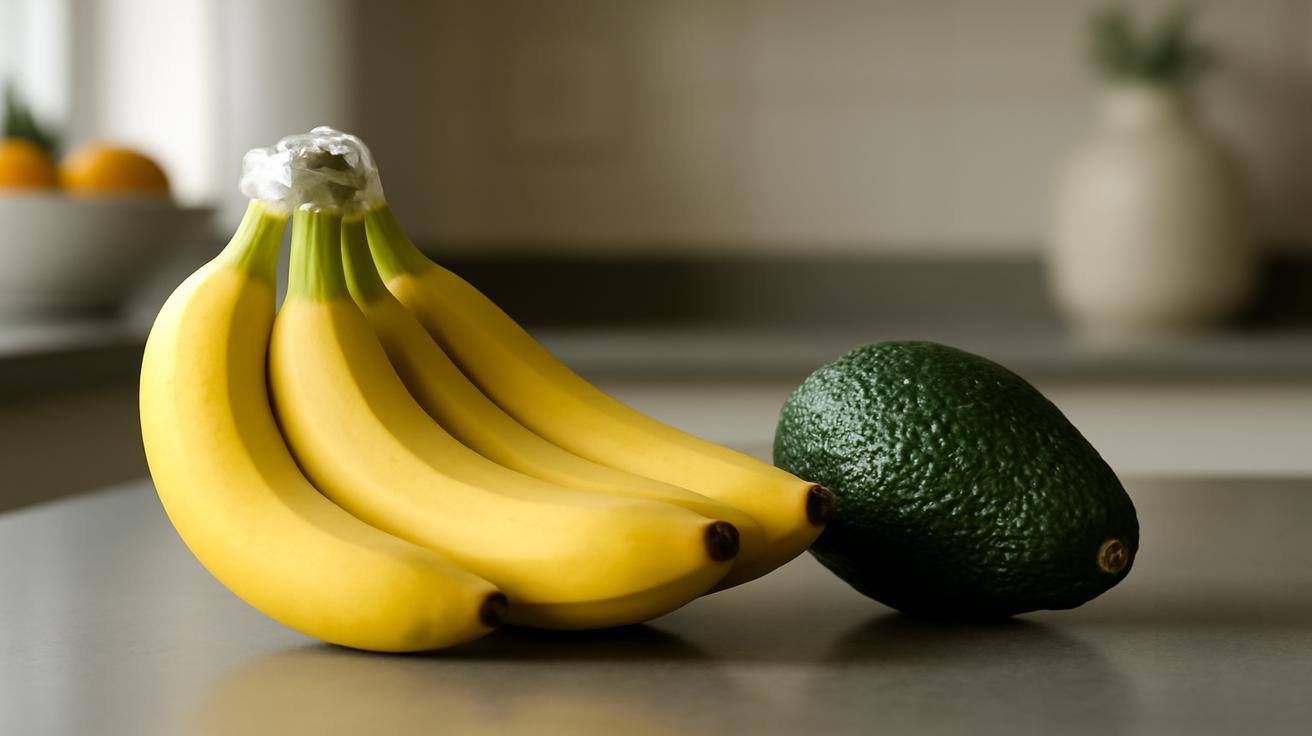
The bananas on your counter are having a quiet little drama you can’t see. One day they’re sunshine-yellow, smugly perfect, and the next they’ve turned freckled and slumped, as if they’ve lived through something unspeakable overnight. You buy them with the best intentions—smoothies, lunchbox snacks, maybe a banana bread if all else fails—and yet, week after week, they ripen too fast. You move them around the kitchen like chess pieces: on the table, in a bowl, away from apples, near the window, far from the window. Still, they streak from green to spotty brown like someone hit fast-forward.
The Mystery of the Vanishing Yellow
Before we get to the simple household item that can keep bananas fresh and yellow for up to two weeks, you need to meet the real star of this story: ethylene. It’s an invisible plant hormone, a kind of botanical whisper passed between fruits. Bananas produce it naturally as they ripen. Think of ethylene as a message that says, “Okay, everyone—it’s time to mature.” The problem is, once that message gets going, it doesn’t know when to stop.
If you’ve ever tossed bananas into a fruit bowl and watched everything ripen at lightning speed, ethylene is to blame. Apples, pears, avocados—they all join the conversation, pumping out their own little puffs of gas. It’s a feedback loop. Bananas accelerate their own aging, and the bowl becomes a tiny, fragrant, over-achieving ripening chamber.
You may have tried tricks already. Hanging bananas on a stand. Separating them from the bunch. Sticking them in the fridge (only to discover the skins turn an eerie black, even if the inside stays firm a bit longer). You’ve likely heard half a dozen contradictory hacks passed around in family kitchens and internet threads.
And yet, buried in everyday life, likely within a few meters of where you’re reading this, there’s one simple thing that can quietly slow that invisible ripening message. Not by magic. By chemistry.
The One Simple Household Item (You Already Own It)
The secret is surprisingly humble: plastic wrap or a small plastic bag used to tightly cover the banana stems.
Not the whole banana. Not the fruit bowl. Just the cluster of stems at the top, where the bananas join together like fingers on a hand. That knobbly, slightly sticky crown is where ethylene gas is released in the highest concentration. It’s the broadcasting station for the ripening signal.
When you cover the stems tightly—really snug, with as little air as possible—you slow that signal from spreading to the rest of the banana and to its neighbors. It’s like putting a muffler over a loudspeaker. The bananas still ripen, but they do it at a gentle, almost lazy pace instead of racing toward brown.
Here’s the almost suspiciously simple method:
- Keep the bananas in a bunch. Don’t separate them yet.
- Tear off a small piece of plastic wrap or use a small plastic bag.
- Wrap it firmly around the stems at the top of the bunch, covering all the exposed stem area.
- For best results, press it down to make good contact and twist or fold it tight.
That’s it. No special gadgets, no expensive freshness pods, no complicated recipes. Just a ready-made barrier that traps much of the ethylene gas before it can flood the fruit and the air around it.
Why the Stems Matter More Than You Think
Bananas aren’t just passively sitting there on your counter; they’re still breathing. Technically, they’re “respiring,” taking in oxygen and releasing carbon dioxide—along with that all-important ethylene gas. The stems at the top of the bunch, where the bananas were attached to the plant, are like vents. Much of the ethylene escapes from there.
By wrapping the stems, you’re not stopping ripening entirely—that would give you weird, flavorless fruit. You’re simply slowing the pace, letting the bananas take their time. Instead of surging from yellow to brown in three or four days, they can keep their bright, firm, sweet-but-not-mushy state for closer to ten, even fourteen days in a cool, stable environment.
It’s a small intervention, almost absurdly simple in practice, but the effect can feel a bit like cheating time. Each morning, you glance at the fruit bowl, almost expecting a collapse of brown spots—and find the same sunny yellow staring calmly back at you.
A Week in the Life of a Slowed-Down Banana
Imagine this: It’s Sunday afternoon. You come back from the grocery store with a hopeful bunch of slightly green bananas. You rinse your hands, tear a small square of plastic wrap from the roll, and gently gather the stems together. The wrap crinkles faintly as you twist it snug around the top of the bunch. You set the bananas in a shallow bowl, away from the sunny window and the ripening apples.
Day two, Monday morning. The bananas are a quiet yellow-green, shoulders still firm. You grab one for your commute. It peels with a gentle snap, flesh creamy but not too soft. You don’t think much about the wrap—you’re already halfway out the door.
By Wednesday, a normal bunch would be flirting with overripe. But yours are just hitting their stride. Yellow deepens, the faint green at the edges fading. They have the smell you remember from school lunchboxes: clean, sweet, with the delicate perfume that comes only just before overripe, not after.
Friday rolls in, and this is usually the danger zone: Use them now or surrender them to banana bread. Yet when your hand skims the bowl, the bananas feel solid, skins still smooth, just a sprinkling of tiny freckles starting at the tips. Inside, they’re softening in a slow, generous way—creamy enough for a smoothie, still firm enough to slice over yogurt without collapsing.
Saturday and Sunday pass in a blur of errands. A banana or two goes into a backpack for a hike, keeps its shape in transit, and emerges just as yellow and unbruised as when it left home. The stems are still cinched in their makeshift plastic collar, a tiny, unassuming tool holding back the rush of time.
By the middle of the second week, your bananas are finally easing into the fully spotted, banana-bread stage. But instead of arriving all at once in an overwhelming, speckled wave, they’ve taken turns, each fruit ripening on a more human, livable schedule. You ate them when you wanted to, not in a frantic scramble before they spoiled.
Small Table, Big Difference
Here’s a simple look at how wrapped stems compare with unwrapped stems over time, assuming normal room temperature and no other ethylene-heavy fruits nearby:
| Day | Without Stem Wrapped | With Stem Wrapped |
|---|---|---|
| Day 1–2 | Green-yellow, firm | Green-yellow, firm (similar) |
| Day 3–4 | Fully yellow, just starting to spot | Bright yellow, minimal or no spots |
| Day 5–7 | Heavily spotted, soft, best for baking | Yellow, lightly speckled, still firm enough for snacking |
| Day 8–10 | Often too soft; many people discard | More spots, softer but usable; good flavor |
| Day 11–14 | Usually inedible for most tastes | Approaching baking stage, but some still good for eating |
It’s not a laboratory chart, just a reflection of what many home kitchens experience: the gentle drag of time when you give your bananas that tiny bit of help at the stem.
Making the Trick Even More Powerful
If wrapping the stems is the main event, a few easy supporting acts can make this simple method even better. Bananas are surprisingly sensitive little things. A few small choices add up.
1. Choose Your Bananas Like You’re Casting a Story
At the store, look for bananas that are still a little green at the tips but mostly yellow along the body. Avoid those with split stems or dark bruises—damage can speed up ripening no matter what you do later. Your future success starts in the grocery aisle, under the hum of fluorescent lights and the rustle of produce bags.
If you plan to keep bananas for a full two weeks, starting with slightly firmer, greener fruit gives you a longer runway. You’re not fighting against the clock; you’re lengthening it from the very beginning.
2. Keep Them Away from Other Fruit “Gossips”
Apples, pears, peaches, avocados, even tomatoes—all of them release ethylene, each like a tiny radio tower broadcasting ripening signals. If you tuck your nicely wrapped bananas beside a pile of ripening apples, you’re creating a chorus of “Hurry up!” around them.
Instead, give your bananas a little personal space. A separate bowl. A corner of the counter that doesn’t get blasted by afternoon sun. Distance might not make the heart grow fonder, but it definitely helps the banana stay yellow.
3. Find a Calm, Cool Spot
Temperature matters. Bananas prefer a moderate, stable environment: not on top of the warm fridge, not in a sunlit window, not directly beside a heat source. Warmer temperatures speed up respiration and ethylene production; cooler room temperatures slow it down.
You don’t have to be obsessive—no thermometer required. Just notice the microclimates in your home. That darker corner of the kitchen, away from the oven and the afternoon light, might become your new banana sanctuary.
4. Hang, Don’t Heap (If You Can)
If you have a banana hanger, use it. When bananas rest in a bowl, their own weight can create pressure points, leading to bruising that accelerates browning and spoilage. Hanging minimizes contact, lets air circulate, and keeps them looking almost theatrically perfect.
But even in a bowl, the stem-wrapping trick still works; just be gentle. Place the bunch on top of softer fruits rather than beneath them, or better yet, in its own small dish. Treat the bananas a bit like delicate glassware, and they’ll reward you with longer life.
The Quiet Satisfaction of Wasting Less
There’s a subtle pleasure in opening your kitchen and seeing fruit that’s right where you left it—still inviting, still usable. The stem-wrapping trick is more than a convenience; it’s a tiny act of resistance against waste.
You know the cycle: buying a bunch, forgetting a few, feeling that twinge of guilt as you drop limp, brown bananas into the trash or compost. Each one represents a path—sun, soil, labor, water, shipping—ending on your counter. When you stretch a banana’s life by even a few days, you’re quietly honoring that path.
There’s also something satisfying about solving a daily-life annoyance with something you already own. No special container, no gadget promising miracles. Just a strip of plastic that, in most kitchens, was destined to wrap leftovers or half an onion. It’s simple, almost old-fashioned: a little observation, a little science, a pinch of patience.
And then there’s the sensory reward. Bananas that have been given time—not rushed, not left to collapse—have that sweet spot of texture and flavor: creamy but not soggy, fragrant but not overpowering, bright on the tongue. You taste not just fruit, but the absence of hurry.
From Kitchen Curiosity to Everyday Habit
The first time you try wrapping the stems, it might feel like a quirky experiment. You’ll hover a little, checking the bananas each morning, mentally comparing them to your usual timeline. By day five or six, if they’re still sitting there, characteristically yellow instead of tipping into freckled surrender, the trick starts to sink in.
Soon it becomes muscle memory. You get home from the store, unload the bags, tear off that small square of plastic almost without thinking. Wrap the stems. Twist. Press. Place. Done. A ten-second ritual that quietly ripples through your week: fewer frantic smoothies made “just to use them up,” fewer emergency baking sessions, fewer grudging trips to the compost bin.
The bananas themselves don’t know they’re part of a story. They just sit, wrapped and unbothered, catching the changing light of the day, slowly turning starch into sweetness at a manageable pace. But for you, they become a marker: of a kitchen that works a little more smoothly, of food that lasts a little longer, of the small power you hold over the details of everyday life.
And maybe, after a while, you start looking at other things differently—the bag of salad you always forget, the bread that stales on the counter, the herbs that wilt in the fridge drawer. If a square of plastic can give you almost two weeks of yellow bananas, what other small, quiet changes might be waiting for you to notice them?
Frequently Asked Questions
How exactly should I wrap the banana stems?
Keep the bananas in a bunch and gather the stems together. Tear off a small piece of plastic wrap or use a small plastic bag, then tightly cover the entire stem area at the top. Press it snugly around the stems, removing as much air as you reasonably can. You don’t need to wrap the whole banana—just the stem cluster.
Can I wrap each banana stem separately instead of the whole bunch?
Yes. Wrapping individual stems can help if you like to separate bananas for easier grabbing. Just know it’s a bit more fiddly and time-consuming. Many people find that wrapping the stems of the whole bunch together gives most of the benefit with less effort.
Will this work if I store bananas in the refrigerator?
Refrigeration slows ripening, but it also darkens the peel. If you refrigerate bananas, wrapping the stems can still help slow ethylene release; however, the skins will likely turn brown even if the inside remains firm. For a balance of appearance and longevity, most people prefer room temperature storage with wrapped stems in a cool part of the kitchen.
Does this trick work with organic bananas too?
Yes. Organic and non-organic bananas ripen using the same biological processes, including ethylene production. Wrapping the stems helps slow ripening in both cases.
Is there an alternative to plastic wrap?
You can experiment with small reusable silicone covers or tightly fitted reusable food wraps, as long as they form a fairly good seal around the stems. The key is limiting how much ethylene escapes from the stem area into the surrounding air.
Will this keep bananas from ever turning brown?
No. Bananas will always ripen and eventually brown; that’s their natural life cycle. Wrapping the stems simply slows the process so they stay fresh and yellow for much longer—often close to two weeks under good conditions—rather than racing from perfect to overripe in just a few days.
Do I need to re-wrap the stems after removing a banana?
Yes. If you remove one or two bananas, check the stem wrap. If it has loosened or no longer covers all the exposed stem areas, adjust it or add a bit more wrap. Keeping a snug seal after each removal helps maintain the effect throughout the bunch’s life.