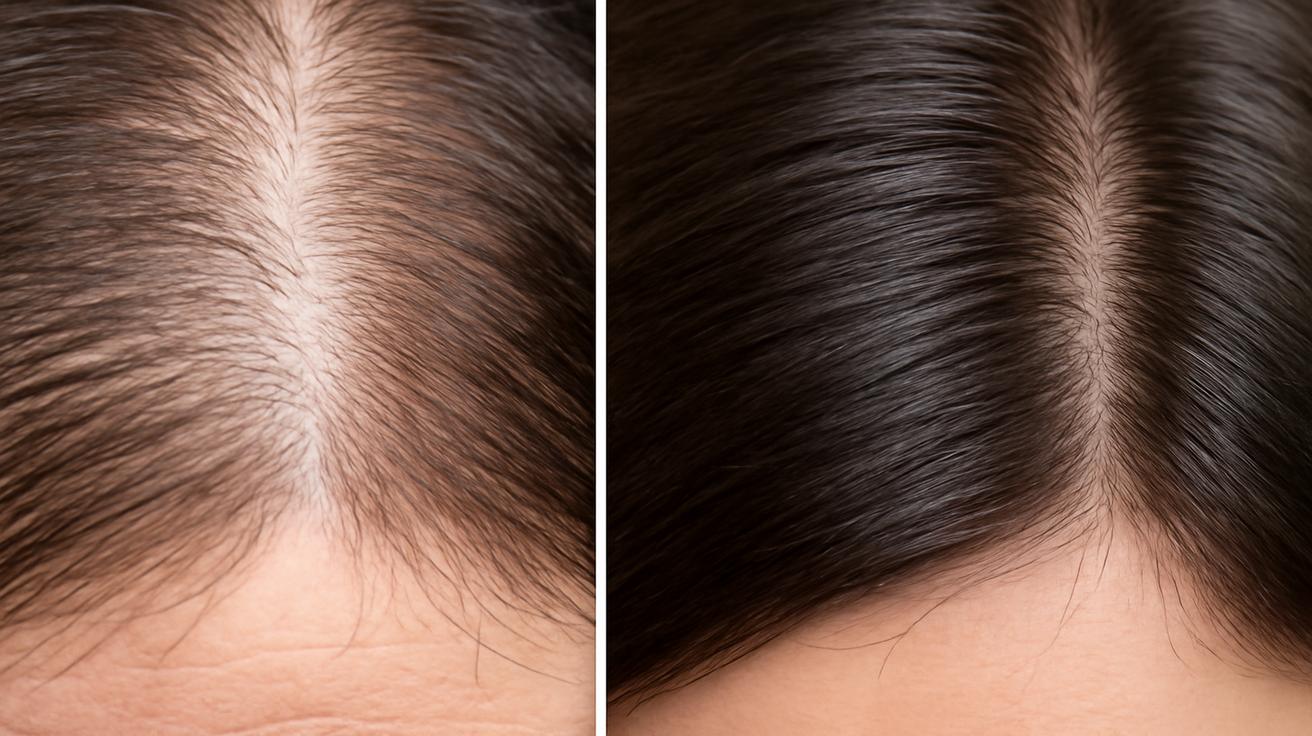
The first time you really notice it is never dramatic. It’s a quiet moment, almost intimate. Maybe it happens over the bathroom sink, when you lean forward into the mirror and see more scalp than you remember. Or in the shower, when your fingers glide through your hair and come away holding what feels like a small handful of autumn leaves. For a second, the world narrows: just you, your reflection, and a question that lands heavier than it should—“Is my hair… thinning?”
The Secret Life of a Strand
Before we talk treatments, it helps to picture what’s actually happening beneath your scalp—because hair isn’t just decoration, it’s a living little forest of its own.
Each strand of hair grows from a tiny pocket in your skin called a follicle. That follicle is like a miniature ecosystem: it has its own blood supply, its own growth rhythm, its own vulnerabilities. Hair grows in cycles—there’s a growth phase, a resting phase, and a shedding phase. On a normal day, you can lose 50 to 100 hairs without it meaning anything more than your follicles are ticking along on schedule.
Thinning begins when that private ecosystem gets disrupted. Genetic signals can shrink follicles over time so they produce finer, shorter hairs. Stress hormones can nudge follicles to abandon the growth phase early. Nutrient gaps, tight hairstyles, inflammation, hormones, even harsh styling habits—each one can quietly conspire to make your hair feel a little less like a wild meadow and a little more like a patchy field.
This is why there’s no single magic bullet that works for everyone. Hair loss isn’t one story; it’s a collection of overlapping tales. But there are, fortunately, some reliable characters that show up again and again in the stories of people who’ve managed to bring their thinning hair back to a fuller, thicker version of itself.
The Treatments That Actually Thicken Hair
If you’ve ever fallen down a late-night internet rabbit hole of “miracle” hair cures, you know how wild the promises can get. What truly helps, though, tends to fall into a few clear categories: medications that nudge follicles back into growth, therapies that improve blood flow and signaling, nutrients that support the building of new strands, and habits that protect what you already have.
Think of your scalp as soil. Some treatments are like fertilizer, some like irrigation, some like clearing out the weeds, and some like simply not trampling the garden every day with tight ponytails and sizzling straighteners.
| Treatment Type | How It Helps | Best For |
|---|---|---|
| Topical Minoxidil | Extends growth phase, increases blood flow to follicles | Genetic thinning, early-to-moderate hair loss |
| Oral & Hormonal Medications | Reduce hormone-related follicle shrinkage | Pattern hair loss in men & women (under medical care) |
| Low-Level Laser & PRP | Stimulate follicles, improve scalp circulation | Thinning areas, people who want non-surgical options |
| Nutrition & Supplements | Support new hair building and reduce deficiency-related loss | Diffuse thinning, stress or diet-related shedding |
| Lifestyle & Haircare Changes | Reduce breakage, stress, and scalp inflammation | Everyone with fragile or thinning hair |
The art is in combining them wisely, in a way that feels sustainable instead of like a second job you didn’t ask for. Let’s walk through the most effective options, the way you might walk a forest trail—curious, observant, and paying attention to how each step feels.
1. Topical Minoxidil: The Classic Regrowth Companion
On a quiet shelf in almost every pharmacy sits a little bottle that has earned its place in hair-loss history: minoxidil. It doesn’t shout; there’s no glamorous branding. But it is one of the few treatments with strong evidence behind it for both men and women.
Minoxidil is like opening extra windows in a stuffy room. Applied to the scalp as a foam or liquid, it increases blood flow to hair follicles and helps extend their growth phase. Over time, that can coax finer, shorter strands into becoming thicker and longer again.
The experience of using it is more like a ritual than a quick fix: a small amount massaged into the scalp once or twice a day, consistently, for months. One day, you might lean into the mirror and notice a gentle fuzz along your hairline, like tiny saplings. They’re often lighter at first, almost shy. With patience, those hairs can darken and thicken.
Minoxidil works best when you start early—when hair is thinning but the follicles are still alive. It’s less about regrowing hair from nothing and more about rescuing strands that are on the verge of giving up. And it’s a long-term relationship: if you stop, the benefits usually fade within several months.
There can be mild shedding at first as older hairs make way for new ones, and some people notice scalp dryness or irritation. But for many, it becomes as routine as brushing their teeth. A quiet, daily promise: I’m giving my hair a reason to stay.
2. Inside Out: Medications, Hormones, and Professional Guidance
Step a little deeper into the story, and you’ll find the invisible characters: hormones. For many people, especially those with a family history of thinning, hormones are the whisper behind the hairline slowly moving back or the part gradually widening.
In men, this often shows up as male pattern baldness—temples receding, crown thinning. In women, it may be more subtle: overall thinning, less density at the part, or a feeling that a ponytail that used to be thick now wraps with an extra loop of elastic.
Here, oral medications sometimes step in. There are drugs that work behind the scenes to reduce the effect of certain hormones on hair follicles, helping prevent further miniaturization—the slow shrinking that makes each new hair a little weaker than the last.
These medications aren’t casual purchases; they ask for a conversation with a doctor who understands hair loss. They’re powerful, often effective, and not suitable for everyone—especially women who are pregnant or could become pregnant, or people with specific health conditions. But for those who are good candidates, they can be a strong backbone for a hair-thickening plan, slowing down the storm so that other treatments have time to work.
For women, working with a clinician can also mean looking at thyroid levels, iron status, and other hormones like androgens and estrogen. Sometimes thickening your hair isn’t just about “hair treatments” at all—it’s about coaxing your whole inner ecosystem back into balance.
3. Light, Needles, and Your Own Platelets: Modern Scalp Therapies
Imagine lying back in a quiet clinic room, the hum of a device above you, soft red light bathing your scalp. Low-level laser therapy looks almost too gentle to matter, but under the surface, those wavelengths are thought to stimulate cellular activity within hair follicles, encouraging growth. Over months of regular sessions—or at home with specially designed caps or combs—many people notice a subtle but real increase in thickness and fullness.
Then there’s something that sounds a bit like science fiction but feels surprisingly intuitive once you picture it: platelet-rich plasma, or PRP. A small vial of your blood is drawn, spun in a centrifuge until the golden layer of plasma, rich with growth factors, separates out. That plasma is then injected back into thinning areas of your scalp.
The idea is simple but powerful: use your body’s own healing signals to wake up sleepy follicles. Many people describe PRP as a series of small pinches, then a wave of warmth, then nothing at all—until months later, when they notice baby hairs along their part, like soft brushstrokes where there was once blank canvas.
These therapies aren’t magic, and they’re not cheap. They require commitment—multiple sessions, ongoing maintenance. But for those who can access them, they often become an important support in a broader routine: a way of telling the scalp, “We’re investing in you. Grow.”
4. Food, Nutrients, and the Quiet Power of Enough
There’s a particular kind of hair loss that doesn’t arrive with a blazing family history or sharp pattern. Instead, it drifts in after a stretch of intense stress, illness, surgery, crash dieting, or a season of quietly skipping meals and living on coffee and willpower. The shedding seems to come from everywhere at once; the shower drain testifies daily.
In this kind of story, bloodwork often reveals the culprits: low iron stores, not quite enough vitamin D, a shortage of protein, maybe low B12 or zinc. Hair is built from protein, and it’s a luxury item as far as your body is concerned; if resources are tight, it is often the first to get cut from the budget.
Here, the best “treatment” may be as simple and as challenging as feeding yourself well. Building meals that include a palm-sized portion of protein—beans, lentils, fish, eggs, poultry, tofu, tempeh—gives your follicles the raw materials they need. Iron from leafy greens, lentils, and fortified foods; healthy fats from nuts, seeds, olive oil, and avocados; colorful vegetables rich in antioxidants all support the quiet, continual process of strand-building.
Supplements can be useful when there’s a proven deficiency, or when diet alone can’t close the gap—iron when ferritin is low, vitamin D in darker months, biotin and other B vitamins when intake is poor. But more isn’t always better; mega-dosing can sometimes backfire or stress the body in other ways. Testing, not guessing, is the friend of anyone serious about thickening their hair from the inside out.
As weeks pass and meals become warmer, richer, more nourishing, hair might still be the last thing to change. But somewhere deep in the follicles, new strands are lining up, stronger and better supplied than the ones before them.
5. Everyday Rituals: How You Touch, Wash, and Wear Your Hair
If treatments and nutrients are the grand gestures, daily care is the steady, quiet love. This is where you can make small changes that, multiplied over months, can mean the difference between fragile, snapping ends and hair that feels denser and more resilient.
Picture your hair as a living fabric. Every tight ponytail that pulls at your temples is a stretch. Every scorching pass of a flat iron is a scorch mark. Every harsh shampoo that leaves your scalp tight and squeaky-clean is a stripped field left bare in the wind.
To give thinning hair a chance to thicken, gentleness becomes a strategy:
- Looser styles that don’t pull—soft buns, low ponytails, braids that sit comfortably rather than tug.
- Microfiber towels or cotton T-shirts to squeeze, not rub, your hair dry, so the strands aren’t roughed up while they’re most fragile.
- Heat styling turned down a notch, with heat protectant as a non-negotiable layer of armor.
- Shampoos that clean without stripping—formulas aimed at sensitive or thinning scalps, sometimes with gentle volumizing ingredients or caffeine for a stimulating feel.
- Scalp massages in the shower or before bed: fingertips pressing in slow circles, waking up circulation, turning hair care into a sensory pause in your day.
There are also cosmetic allies that don’t change the follicle itself but can make hair look thicker while other treatments do their slow, deep work. Thickening sprays that coat each strand, powders that create instant fullness at the roots, tinted fibers that cling to hair and scalp to blur the contrast between hair and skin. These are not deceptions; they’re small acts of kindness to your reflection while the biology catches up.
Over time, with fewer breakages, calmer roots, and a scalp environment that feels cared for rather than punished, hair often begins to respond. Not overnight. Not in a week. But slowly, the ponytail feels a little heavier; the part looks a touch shadowed instead of bright.
Patience, Stories, and Taking Back the Mirror
Hair loss has a way of feeling personal, even when it’s not your fault at all. It’s woven into identity, gender, culture, memory. Maybe your grandfather had the same thinning crown, or your mother’s part widened in her forties. Maybe your hair used to be the thing people noticed first—“You have such thick hair!”—and losing that feels like losing a part of who you were.
But here is the quiet truth running beneath all the treatments and routines: hair is changeable. It always has been. It grows and sheds and regrows like seasons passing through a forest. Some seasons are lush, some sparse. No single season defines the whole landscape.
The best treatments to thicken your hair are rarely a single potion or pill. They’re a layered story: a bottle of minoxidil by the sink, a conversation with a doctor about hormones or thyroid, a revised grocery list full of color and protein, a decision to ease up on the tight buns and high heat, maybe a few futuristic sessions under soft red light or with your own platelets waking up sleeping follicles.
And woven through all of it is time. Months where it feels like nothing is happening, until, one morning, you catch sight of yourself sideways in soft daylight and realize something has shifted. The outline of your hair looks denser. The scalp doesn’t gleam through quite as much. You touch the back of your head and feel that familiar weight again, not yet what it once was, but no longer what it had become.
This is not about chasing perfection. It’s about reclaiming a sense of agency—being able to say, “My hair is changing, and I have choices.” It’s about standing in front of the mirror not in battle, but in quiet collaboration with your body, your biology, and your own patience.
Your hair may never look exactly like it did in an old photograph. But it can become something else: lived-in, cared for, strengthened from root to tip by a story in which you chose curiosity over panic, information over fear, and daily, gentle action over despair.
And maybe, one day, someone will look at you and say, “Your hair looks so healthy lately.” You’ll smile, knowing how many small, unseen decisions are braided into that simple word: thick.
Frequently Asked Questions
How long does it take to see results from hair-thickening treatments?
Most treatments need at least 3 months before you see early changes, and 6 to 12 months for fuller results. Hair grows slowly, so consistency over time matters more than intensity in the beginning.
Can hair loss be completely reversed?
It depends on the cause and how advanced it is. Early thinning and shedding from stress or nutrient deficiencies often improve significantly. Long-standing pattern baldness with shiny, bare areas is harder to fully reverse, but density can often be improved around those zones.
Is it normal to shed more hair when starting treatments like minoxidil?
Yes, a temporary increase in shedding can happen in the first few weeks. Older hairs are being pushed out to make room for new ones. This usually settles within a couple of months.
Do supplements alone make hair thicker?
Supplements help most when there’s a deficiency. If your nutrient levels are already adequate, extra pills won’t usually transform your hair on their own. They work best as part of a broader plan including scalp care and, when needed, medical treatments.
When should I see a doctor about hair loss?
If your hair is thinning quickly, if you see bald patches, if your scalp is painful or itchy, or if hair loss comes with other symptoms like fatigue or weight changes, it’s wise to see a dermatologist or healthcare professional. Early evaluation often means more options and better results.