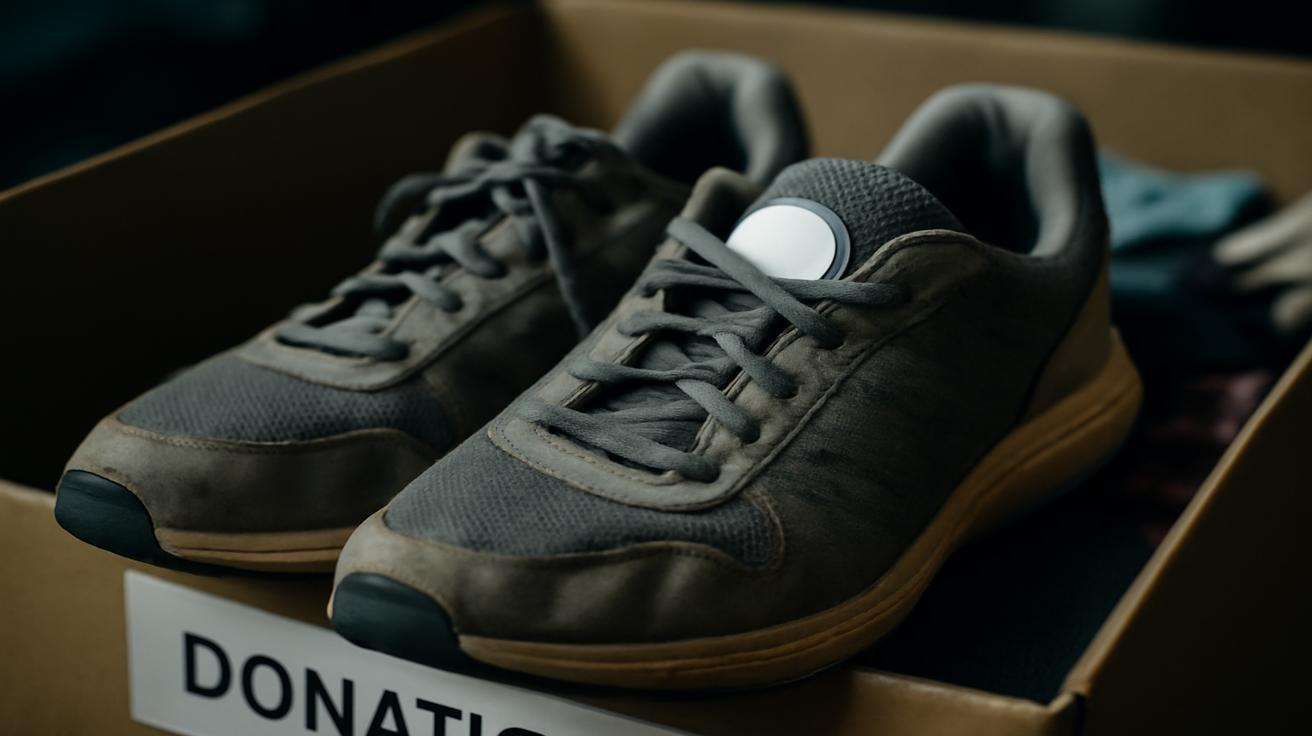
The box was small enough to swing by its twine handle, but it felt heavy in his hand—heavy with the strange mix of hope and doubt that comes with giving something away and trusting it will end up where it’s needed most. The sneakers inside were bright, almost obnoxiously so, the color of fresh limes and traffic vests. They were the sort of shoes you couldn’t ignore, which was exactly why he’d bought them. Now, standing in the fluorescent wash of a Red Cross drop-off center, he was about to let them go—and quietly, secretly, keep watching where they went.
A Pair of Sneakers and a Quiet Question
He hadn’t planned on becoming a detective. It started, as these things often do, with a small, nagging question that wouldn’t leave him alone: Where does my donation actually go?
Friends had told him stories—bags of clothes sent overseas, boxes of food for disaster zones, mountains of shoes for families who’d lost everything. But then there were the other stories, the ones you heard in line at the grocery store or scrolling late at night: donations sitting in warehouses, being resold in bulk, or never making it out of the country at all.
So one afternoon, he bought a pair of new sneakers, the kind he imagined a teenager might pull on and suddenly feel just a little bit faster, a little more themselves. Before he nestled them into the box, he slipped an Apple AirTag under the insole, pressing it flat like a secret. He named the tag “Green Kicks” in the app, watched the dot appear on the map, and sealed the box with a firm line of tape.
The Red Cross drop-off center smelled like cardboard and cold air. Volunteers moved in a quiet choreography, lifting, sorting, labeling. He waited his turn, heart tapping a little faster than the moment really called for.
“Shoes,” he said, placing the box on the table.
The volunteer smiled, slid the box closer, and added it to a growing stack. That was that. With a polite nod and the faintest wash of guilt—for tracking a gift meant to be given freely—he walked out into the daylight, phone in his pocket, map already ready.
The Dot That Wouldn’t Sit Still
The first day, nothing much happened. The dot—his green sneakers—stayed right where he’d left them, a quiet pixel nestled in the city grid. He checked once before bed, half expecting the magic of motion, but it hadn’t moved.
On the second day, the dot shifted across the block to what his map labeled as a “regional logistics center.” It made sense. Donations needed to be sorted, inspected, grouped. He pictured the sneakers perched on top of a pile of clothes and blankets, bright green among the more sensible browns and grays. That image soothed him.
But by day four, the dot was somewhere else entirely.
He stared at his phone, blinking. The sneakers had traveled across town, away from the cluster of warehouses and nonprofit offices, to a manicured district marked by polished storefronts and small, immaculate trees in square metal grates. It was, unmistakably, the shopping district.
Zooming in, he saw an address he recognized—not because he’d ever been inside, but because its window displays were famous in the city: a trendy consignment and outlet store. The kind with highly curated secondhand pieces and price tags that reminded you that even “used” could be a luxury.
A question, sharper now, rose under his ribs: What were his donation sneakers doing there?
| Day | Location of AirTag | What He Assumed |
|---|---|---|
| 1 | Local Red Cross drop-off | Shoes waiting to be sorted |
| 2–3 | Regional logistics center | Preparing for shipment to people in need |
| 4 | Upscale consignment outlet | Possible resale of “donated” shoes |
| 7+ | New warehouse on edge of city | Part of a larger distribution system |
The more he watched, the more tangled his feelings became. He’d always believed in giving—quietly, regularly, trying not to cling too hard to where things ended up. But this was different. This was a direct line between his hands and a map pin, and that pin was standing still outside a shop that, on principle, he would never have chosen as the destination for emergency aid.
Between Outrage and Curiosity
He considered walking away. After all, once you give something, doesn’t it stop being yours, in every sense that matters? But the little gray dot on his screen nagged at him with every coffee break, every idle train ride. It became a ritual: tap the app, see where the sneakers were, imagine the room they were sitting in, the hands that had lifted them last.
By day six, the location shifted again. This time, the dot moved from the consignment store to a warehouse address on the edge of the city—an anonymous building in a sea of flat roofs and loading docks. Nothing about it looked like a charity office. Yet it tugged at his curiosity even more.
He finally caved and called the local Red Cross chapter. The woman on the line sounded tired but patient, her voice the kind that had probably talked many anxious people through disasters much bigger than one pair of shoes.
“Hi,” he began, already feeling self-conscious. “I donated a pair of sneakers last week, and, um, I put an AirTag in them so I could see where they ended up.” He winced at his own words, hearing how strange it sounded out loud. “They went to a consignment shop first. Now they’re at some warehouse. I’m confused. Are donations being sold?”
There was a pause. Not long, but long enough.
“You’re not the first person to track a donation,” she said at last. “Let me explain how it works.”
Following the Money Trail of Good Intentions
Her explanation unfolded in patient, practiced sentences. The Red Cross, she said, sometimes partners with third-party organizations to process certain types of donations. Not everything that comes in can be directly handed to someone in crisis. Seasonal clothes. Items in surplus. Shoes in uncommon sizes. Some of these goods are channeled into resale networks.
The key, she insisted, was that the money from any resale still goes toward their humanitarian work. The sneakers, bright green and barely worn, were considered high-value in a retail context but not necessarily what was needed most on the ground after a flood or wildfire.
“So we sell some items to generate funds,” she said, “which then support operations, shelters, medical supplies, disaster response. It’s part of making the most of what we’re given.”
He listened, phone clamped between cheek and shoulder, watching the map as if the dot might behave differently now that he knew its rough fate. His outrage started to loosen, but didn’t completely disappear.
“But why not say that more clearly?” he asked. “At the drop-off center, it felt like I was giving it to someone who’d put it straight into a family’s hands. There weren’t signs about resale partners or logistics systems. It just said: Donate here. Help people.”
This time, her silence carried something like resignation.
“Transparency,” she admitted, “is something we’re still working on.”
The Invisible Infrastructure of Generosity
It’s easy to imagine donations as a direct line: your item, their hands. Reality is a maze of routes and decisions, where even the brightest green sneaker becomes a data point in a vast logistics puzzle.
Behind every donation bin is a chain of people and procedures. Items need to be sorted for quality, safety, and relevance. A winter coat in summer might languish unused if not rerouted. A surplus of T-shirts in one city might mean shipping them elsewhere or, yes, selling some off to keep the engine of aid running.
There are shipping costs, warehouse rents, staff wages, fuel, insurance. Charities are held to an impossible standard: be everywhere at once, spend nothing on overhead, and still move like a well-oiled machine. When physical goods pile up, organizations improvise. They tap into resale markets. They partner with wholesalers who buy in bulk and redistribute. They do math most donors never see.
And yet, from a donor’s perspective, that gap between intention and implementation can feel like betrayal. Standing at the drop-off point, watching volunteers heft bags and boxes, the heart spins a simple story: My shoes will meet someone who needs them. Introducing nuance—maybe they’ll be sold, maybe they’ll pay for gasoline or tarps or cots—interrupts that comforting narrative.
Technology, of course, cares nothing for comforting narratives. An AirTag is indifferent. It simply reports: here, here, now here. In doing so, it pulls the curtain back on systems we’re not used to seeing, forcing questions that used to stay safely abstract.
When Good Deeds Meet GPS
He hadn’t meant to expose anything. The AirTag, at first, was just curiosity mixed with a thin layer of cynicism, the sort that grows quietly in a world full of headlines about misused funds and mishandled aid. Now it felt like a small flashlight pointed into the shadows of a sprawling, imperfect ecosystem.
Later that week, the Red Cross followed up with him. This time, the call came from someone higher up—a communications officer who sounded both careful and candid.
“We’re reviewing how we explain our donation pipeline,” she said. “Your experience is a reminder that people care about the journey of their gifts.”
He asked if they thought what he’d done was invasive, a violation of trust.
Another thoughtful pause. “You donated the shoes,” she said, “but you also donated a question we needed to answer.”
It wasn’t a perfect answer. But it was, at least, an acknowledgment that his small act of amateur tracking had touched a nerve.
In the age of trackers and real-time maps, the secret lives of donated goods are becoming harder to keep entirely invisible. Stories like his—of suitcases, coats, bikes, and yes, sneakers, tagged and followed—are quietly surfacing in online forums and news segments. Sometimes they confirm suspicions of negligence. Sometimes they reveal surprisingly efficient global routes. More often, they highlight something more complicated: the mismatch between the story organizations tell and the one donors expect.
Trust, Tested in Transit
What does trust look like when you can follow it on a screen?
For generations, people have given based on faith—faith in institutions, in symbols, in red crosses stamped on white backgrounds. You put something into the system and assume the system knows how to wield it better than you do. When that assumption begins to waver, the whole architecture of philanthropy shakes with it.
Transparency is not just a moral nicety; it’s structural reinforcement. Knowing that some items may be resold to fund operations doesn’t inherently cheapen the act of giving. In some ways, it enriches it. Your sneakers might not cradle someone’s feet, but they might help keep the generator running in a crowded, storm-battered shelter.
The trouble begins when donors are left to discover this on their own, through tracking dots and half-heard stories, rather than being invited in with clear explanations at the outset. It’s the difference between being a participant and feeling like an unwitting customer in a system you never agreed to.
Sitting at his kitchen table, phone face up, he thought about this. About how easily his frustration could have been tempered by a single sign at the donation center:
Some items may be resold or repurposed to support disaster relief, logistics, and emergency response. Your donation helps in more ways than one.
Would he have still tagged the sneakers? Maybe. But he would have been watching a story he’d chosen to be part of, not one he felt tricked into discovering.
Changing the Story Without Changing the Heart
The sneakers, by then, had stopped moving. The AirTag rested at the same warehouse coordinates for days. Maybe they were shelved, waiting for a bulk pickup. Maybe they were already in a box with a printed label, destined for some unknown buyer who’d never know the shoes once carried an extra, invisible passenger.
He thought about retrieving the AirTag, about marching to the address and asking for his little white disc back, just to close the loop. But something about that felt like trying to reverse the act of giving itself—pulling on a string that ought to stay cut once it’s tied.
Instead, he opened the app and watched the softly pulsing circle one last time. Then he tapped the option to remove the AirTag from his account. The dot vanished. The shoes, at last, were free from his gaze.
Yet he carried something with him that he hadn’t had before: a more complicated respect for the messy, human machinery behind acts of kindness. The Red Cross had not been exposed as a villain, nor exonerated as flawless. It had been revealed as something more ordinary and perhaps more honest—an organization straining to do good at scale, making choices that didn’t always match the tidy stories on donation bins.
And maybe that, he thought, was what needed to change. Not just the systems, but the stories we wrap around them. If donors could be trusted with the full, unvarnished picture—with resale markets and warehouses and budget lines—they might not turn away in disgust. They might lean in, ask better questions, offer more targeted help.
In a world, and a century, where almost anything can be tracked, the real test is no longer whether charities can keep their processes invisible. It’s whether they can confidently stand by them once they’re seen.
Questions We’ll Keep Asking
After the sneakers, he didn’t stop donating. But he did start reading more, asking volunteers where items went, listening for specifics instead of slogans. He brought canned food when local shelters asked for it directly. He sent money during disasters instead of rummaging through his closet, trusting that cash, at least, didn’t need a logistics pipeline he couldn’t see.
The box at the edge of town, the consignment store, the Red Cross office—all of them stayed with him like waypoints on a larger, ongoing map. Not just of one pair of green shoes, but of how generosity moves through the world: bumping up against systems, institutions, and the practical realities of scale.
Maybe, someday soon, donation centers will have QR codes on their walls linking to simple breakdowns of where items might go and why. Maybe charities will invite people behind the scenes more intentionally: warehouse tours, explainer videos, honest flowcharts of resale channels and revenue streams. Maybe the narrative arc of giving will stretch from “I donated” to “I understand,” without losing its heart somewhere in the middle.
For now, one thing is certain. The age of blind trust is fading, and in its place, a more curious, data-literate kind of compassion is taking root. People still want to help. They just also want to know how that help travels—and whether it lands where they hoped.
He doesn’t know who wears the sneakers now, or if they ever even found a pair of feet. But he knows this: the next time he drops a box on a table under bright fluorescent lights, he’ll be walking into that room with his eyes wider open—and, perhaps, with a different kind of hope. One that isn’t afraid of complexity, or of the stories a tiny, blinking dot on a map might tell.
FAQ
Is it legal to track a donation with an AirTag or similar device?
Legality varies by region, but in general, tracking an object you own is not illegal. However, once you donate an item, you relinquish ownership, and continuing to track it can raise ethical and privacy concerns, especially if the item ends up in someone’s personal possession.
Do charities like the Red Cross really sell donated items?
Many large charities do resell some donated goods or work with partners who do. The revenue is typically used to fund programs, logistics, and disaster response. This practice can be legitimate, but it relies heavily on transparent communication so donors understand how their gifts are used.
Why don’t organizations clearly state that some donations may be resold?
Sometimes it’s oversight; sometimes it’s fear that donors will be put off by complexity. Simple messages—“Your shoes will help someone in need”—are easier to communicate than nuanced explanations of resale networks and funding models, even though the latter may be more accurate.
How can I make sure my donation has the impact I intend?
Ask specific questions before giving. Inquire whether items are given directly to people in need or may be resold. Consider donating money to reputable organizations, responding to targeted “most needed” lists, or giving directly to local shelters and mutual aid groups that can articulate exactly how your contribution will be used.
Should I stop donating physical goods because of stories like this?
Not necessarily. Physical goods can still be very helpful, especially when requested by organizations that know current needs. Rather than stopping, aim to donate more intentionally: check needs lists, ask about distribution, and support organizations that are open about their processes and constraints.