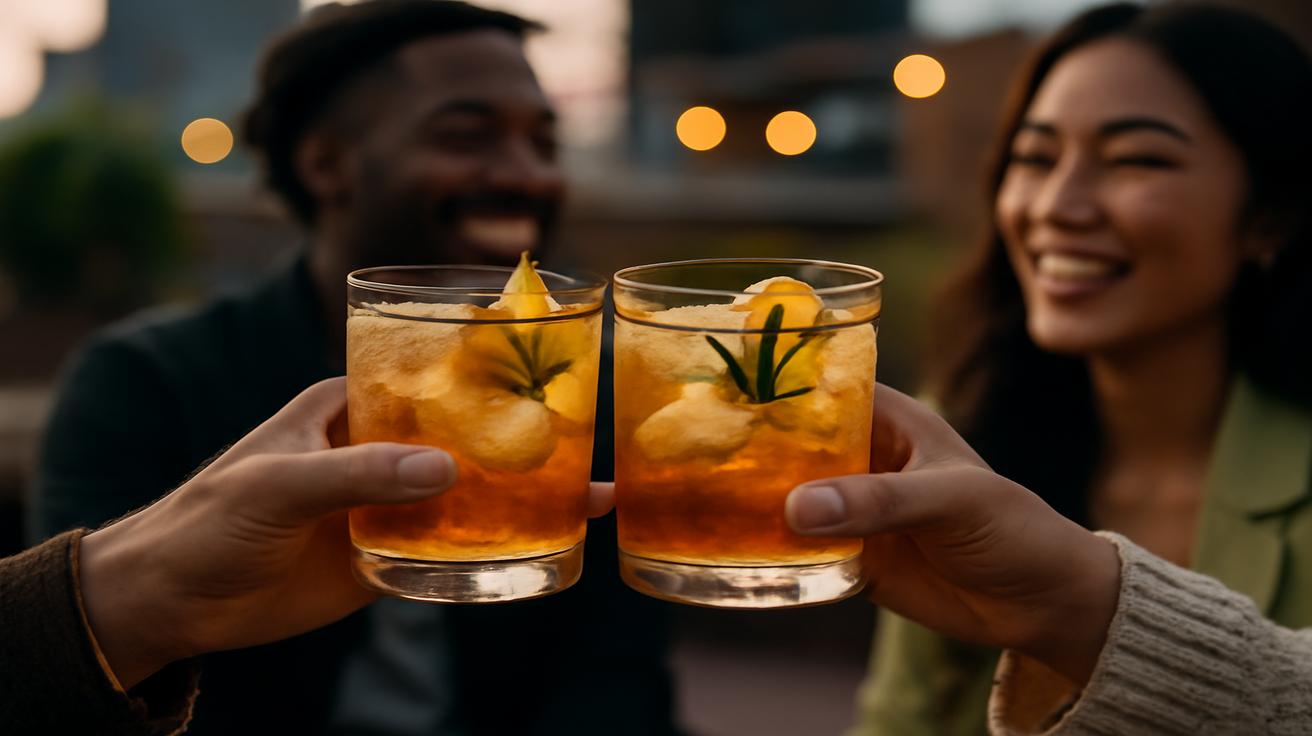
The first thing you notice is the sound. Not the clink of ice against glass or the soft hiss of a beer can cracking open, but a quieter, almost shy fizz. Tiny bubbles climb the sides of a pale green bottle, catching the low light of the room. A woman in a denim jacket lifts it to her nose, inhales, and smiles. Around her, in a bar that smells faintly of citrus and pine, nearly every hand holds something that looks like a cocktail yet carries no alcohol at all. The room is loose, talkative, bright-eyed—and astonishingly sober.
A New Kind of Buzz
The bartender moves with the familiar rhythm of a Friday night rush, but the back bar is different. Instead of rows of whiskey, gin, and vodka, there are slender cans, jewel-toned bottles, and neatly labeled droppers. A chalkboard lists “Spritzed Grapefruit THC Tonic,” “Herbal CBD Cooler,” and “Mango Myrcene Mule.” There’s still music, still flirting, still laughter that erupts in waves, but there’s a feeling you don’t usually encounter in late-night spaces: clarity.
This is one of the new “sober curious” lounges popping up in cities where cannabis is legal. The premise is almost disarmingly simple: take everything people love about drinking—the ritual, the social ease, the little shift in mood—and replace the alcohol with carefully measured cannabinoids. No shots. No hangovers. No one leaning too hard on a stranger’s shoulder, slurring apologies.
For decades, the idea that cannabis might someday share a shelf with beer and wine was a punchline, something you’d expect to see in a stoner comedy. Yet here we are, watching friends raise frosted glasses of cannabis spritzers the way people have toasted champagne for generations. Only now, the cultural question is more serious: what if this isn’t a quirky trend, but an unexpected path in the fight against alcohol’s grip on our lives?
The Quiet Weight of Alcohol
Alcohol is woven into the fabric of everyday life with a softness that almost hides its weight. It’s in the beer you drink after work to “take the edge off,” the wine you pour when cooking dinner, the cocktails you order to mark a birthday, a breakup, a promotion, a Tuesday that felt too long. For many, it is celebration, reward, numbing agent, and social lubricant in a single shimmering glass.
And yet, just beneath that glow, there’s an ache. Hospitals feel it. Families feel it. Quiet, private mornings feel it—when someone wakes up with a pounding head, vague regrets, and a promise to “cut back” that dissolves by Friday. Alcohol has become such a given that questioning it often feels like breaking an unspoken rule. Saying “I don’t drink” at a party can land with the same awkwardness as an unwanted confession.
The harm is not abstract. Liver disease, accidents, violence, dependency—these are not statistical ghosts but ordinary realities. Still, telling people to simply stop drinking rarely works. Humans are wired for ritual and pleasure, for shared experiences that soften the hard edges of the day. Take that away without offering an alternative, and the void feels larger than the problem ever did.
This is where cannabis drinks slip in softly, not as a lecture, but as an invitation. What if you didn’t need to give up the glass in your hand to step away from alcohol?
The First Sip of Something Different
Picture opening a cold cannabis-infused seltzer. The can gives a crisp sigh, and a mist of scent rises—grapefruit, basil, maybe a twist of lime. It smells like a summer afternoon, not like the heavy sweetness of a liqueur or the sharp burn of vodka. The first sip is light, floral, maybe a bit herbal. There is no familiar heat sliding down your throat, no quick flush in your cheeks from a jolting shot of ethanol. Instead, the experience sneaks up, gentler and more patient.
Ten, twenty, thirty minutes pass. The mood shifts—not in a drunken wobble, but in a soft loosening. Conversation feels easier. The music seems a little warmer around the edges. Your shoulders drop from your ears. Yet your thoughts remain clear, not scattered. You can track the thread of a story, remember what someone just said, and feel present in a way that alcohol often steals.
This difference in texture—the character of the “buzz”—is what surprises many first-time cannabis drinkers. They’re expecting a rapid, overwhelming high, like taking too many hits from a joint in college. Instead, in low to moderate doses, the effect feels more like gently dimming the room’s harsh lights. You’re still in the same space, but the sharpness of the day is softened.
How Cannabis Drinks Change the Ritual
For a long time, cannabis culture revolved around smoke and secrecy. You rolled a joint in a quiet corner, passed it quickly, watched the ember glow and fade. It was something done on the side or in the shadows—a private rebellion, not a public tradition. Drinks, on the other hand, are public by design. Glassware clinks. Bottles pour. Toasts rise. Entire rooms participate in the same shared ceremony.
Cannabis beverages bridge that gap. They bring the discreet plant into the bright center of the room.
On a wooden table in a backyard, you might see a lineup of cans and bottles: a blood orange THC soda, a CBD lavender spritzer, a pomegranate “social tonic” with just a whisper of psychoactivity. People hover, reading labels, asking questions:
- “How many milligrams are in this one?”
- “Is this more of a body relaxation or more in my head?”
- “Will I still be able to wake up early for my hike tomorrow?”
The language is more careful than at a traditional party. Instead of “strong” or “weak,” you hear “dose,” “effects,” “time to onset.” There’s a consciousness to it, a kind of respect for the experience that alcohol rarely gets until it’s too late.
The ritual returns—the opening, the pouring, the sipping—but it’s rewritten. No one is pounding shots in the kitchen. No one is pressuring the hesitant friend with “Come on, just one more.” The presence of measured doses makes excess less tempting and more obvious. You’re not refilling an infinite glass of wine; you are choosing, intentionally, another 2 or 5 milligrams.
| Aspect | Alcoholic Drink | Cannabis Drink |
|---|---|---|
| Primary effect | Sedation, disinhibition, impairment | Relaxation, mood shift, often clearer awareness at low doses |
| Onset time | Minutes | Typically 10–45 minutes, depending on formulation |
| Hangover | Common: headache, nausea, fatigue | Much less common; possible grogginess at high doses |
| Social pressure | “Drink more” culture is widespread | Emerging culture often emphasizes pacing and consent |
| Caloric load | Often high, especially in cocktails and beer | Can be very low; many infused seltzers are near-zero sugar |
On a small scale, these shifts might feel subtle. On a cultural level, they are seismic. They invite a world in which unwinding after work doesn’t have to mean slowly poisoning your liver, and celebrating doesn’t have to mean waking up to a headache and half-remembered conversations.
Stories from the Shift
In living rooms, back patios, and group texts, the stories behind this shift are starting to overlap.
There’s the man in his late thirties who used to end every workday with a double whiskey “to shut his brain off.” Night after night, his one drink became two, then three. Mornings arrived with grit behind his eyes and a feeling that life was a treadmill he couldn’t step off. When a friend handed him a can of low-dose cannabis tonic at a barbecue, he was skeptical. It felt like cheating the unwritten rules of adulthood. But he tried it. The next morning, he woke up with a clear head and an unfamiliar sensation: relief with no cost.
There’s the woman who loved wine for the way it softened the edges of social anxiety, but hated how it slowly eroded her sleep, her skin, and her sense of control. When she found cannabis beverages dosed at 2 milligrams—barely enough to feel “high” in the traditional sense, but enough to gently loosen a crowded room—she began bringing them to dinner parties in place of her old faithful bottle of red. At first, friends teased. Then they asked for a sip. Then they asked where to buy their own.
Not everyone’s story is simple, and cannabis is not a magic switch that works for all. Some people find it makes them uncomfortable, or prefer not to feel any psychoactive effects at all. Yet threaded through thousands of these experiments is a recurring theme: if people are given options that feel good, respectful of their bodies, and still socially meaningful, many will quietly step away from alcohol on their own.
Nature in a Glass
Part of the appeal of cannabis drinks lies in their connection to the wider natural world. Where alcohol can feel harsh and extractive—ferment, distill, burn—cannabis beverages often lean into botanicals, herbs, and flavors that echo a walk through a garden at dusk.
Imagine a drink infused not only with THC or CBD, but with terpenes, the aromatic compounds that give plants their scents. The same molecules that make pine forests smell sharp and clean, or citrus groves smell electric and bright, are now carefully folded into beverages. You hold a glass to your nose and catch a hint of a forest after rain, a peel of orange, a field of lavender. The experience becomes less like taking a drug and more like participating in a small ritual of the senses.
On a summer night, someone pours a cannabis spritz over ice, and the cubes crackle, catching glints of amber and green. A slice of blood orange rests on the rim. The drink feels alive, layered, not simply designed to knock you backwards. You taste bitterness, floral notes, a fleeting sweetness. As the cannabinoids enter your system, they meet the smells and tastes that came with them, and the whole moment feels anchored to the earth rather than abstracted from it.
This re-rooting of intoxication in the language of plants—and in respect for dosage—has quiet power. It reminds us that mood-altering experiences have always existed in relationship with nature: cacao, kava, coffee, tea, fermented fruits, sacred herbs used by cultures for thousands of years. What’s new is not the desire to feel different; it’s the willingness to step away from alcohol as the sole, default path.
Caution, Care, and the Middle Path
None of this makes cannabis a saint. It is not harmless, not for everyone, not in all quantities. Someone with a history of psychosis may need to avoid it entirely. Someone prone to anxiety may find certain strains or doses uncomfortable. Driving under the influence—of anything—is dangerous, whether the buzz comes from a bottle or a can with a cannabis leaf printed quietly on its side.
There is also the risk of swapping one dependency for another, of leaning on a substance—any substance—to smooth every rough edge rather than learning other tools: breath, boundaries, honest conversation, rest. Cannabis can be misused, commercialized, and overhyped just as easily as alcohol was. If this is a path out of one trap, it is not an invitation to sleepwalk into another.
Yet between those extremes lies a middle path, and that is where cannabis drinks may be doing their most radical work. They invite conversation: How much is enough? How do I want to feel? What do I want this night to be about? Instead of defaulting to “another round,” people are pausing to decide.
In that pause is opportunity. Opportunity for someone to say, “I’m good with just this one.” Opportunity for a party to stay warm and connected without tipping into chaos. Opportunity for a whole generation to reimagine what adult pleasure looks like without anchoring it to a substance that quietly steals far more than it gives.
A Future Where the Glass in Your Hand Is a Choice
In the years ahead, you might walk into a restaurant and be handed two menus: one for alcohol, one for cannabis beverages, each with tasting notes, suggested pairings, and clear guidance on effects. You might go to a wedding where half the toasts are raised with sparkling THC tonics instead of champagne, and no one has to be half-carried to a taxi at midnight. You might sit by a campfire, stars pricked sharp against a black sky, and sip a low-dose cannabis cider that lets the constellations feel a little closer without pulling you away from yourself.
For some, the choice will still be a glass of wine or a cold beer. For others, it will be a chilled cannabis spritz or a sleepy-time CBD drink after a long day. For many, it will be both, in different moments, in careful ratios. The important shift is this: alcohol will no longer be the unquestioned center of the social universe. It will be one planet among several, no longer allowed to eclipse everything else.
In that bar where we began, the night inches forward. Someone orders another round of grapefruit tonics. Someone else switches to sparkling water. The bartender rinses a glass, wipes the counter, and glances up at a room full of people who are laughing hard, eyes bright, bodies relaxed, but not stumbling. The music hums. The bottles on the back bar gleam softly under the lights, herbs and fruits and cannabinoids captured in glass.
It feels quiet, almost ordinary. That’s how you know something profound is happening. A culture is rewriting one of its oldest, deepest rituals—not with slogans or bans, but with small, repeated choices. A different fizz. A different kind of buzz. A path that winds, slowly and imperfectly, away from harm and toward a relationship with altered states that is more conscious, more rooted, and—finally—more kind.
Frequently Asked Questions
Are cannabis drinks safer than alcohol?
“Safer” depends on context, but cannabis beverages generally do not carry the same risks of liver damage, overdose by respiratory failure, or violent disinhibition seen with alcohol. However, they can still impair coordination and judgment, especially at higher doses, and are not risk-free.
Will I get a hangover from cannabis drinks?
Many people report little to no classic “hangover” from moderate cannabis drink use—no pounding headache or intense nausea. Some may feel groggy or mentally fuzzy after high doses or poor sleep, but this tends to be shorter-lived and milder than typical alcohol hangovers.
How much should I drink if I’m new to cannabis beverages?
Start low and go slow. For THC, many beginners find 2–5 milligrams a comfortable starting range. Drink one, wait at least 60–90 minutes to fully feel the effects, and only then decide whether to have more. Pay close attention to product labels.
Can I mix alcohol and cannabis drinks?
Mixing is generally not recommended, especially for beginners. The combination can intensify impairment, increase nausea or dizziness, and make it harder to read your own limits. If you choose to mix, do so cautiously and in very low amounts, and never drive.
Are cannabis beverages legal everywhere?
No. Legality varies by country, state, and region. Some places allow only CBD drinks, others permit THC beverages under regulated systems, and some ban both. Always check local laws before buying, carrying, or consuming cannabis products.
Can cannabis drinks help someone quit alcohol?
For some people, yes—they can serve as a lower-harm alternative that maintains social rituals while reducing alcohol intake. But they are not a universal solution or medical treatment. Anyone with a serious alcohol use disorder should seek professional support and discuss options with a healthcare provider.