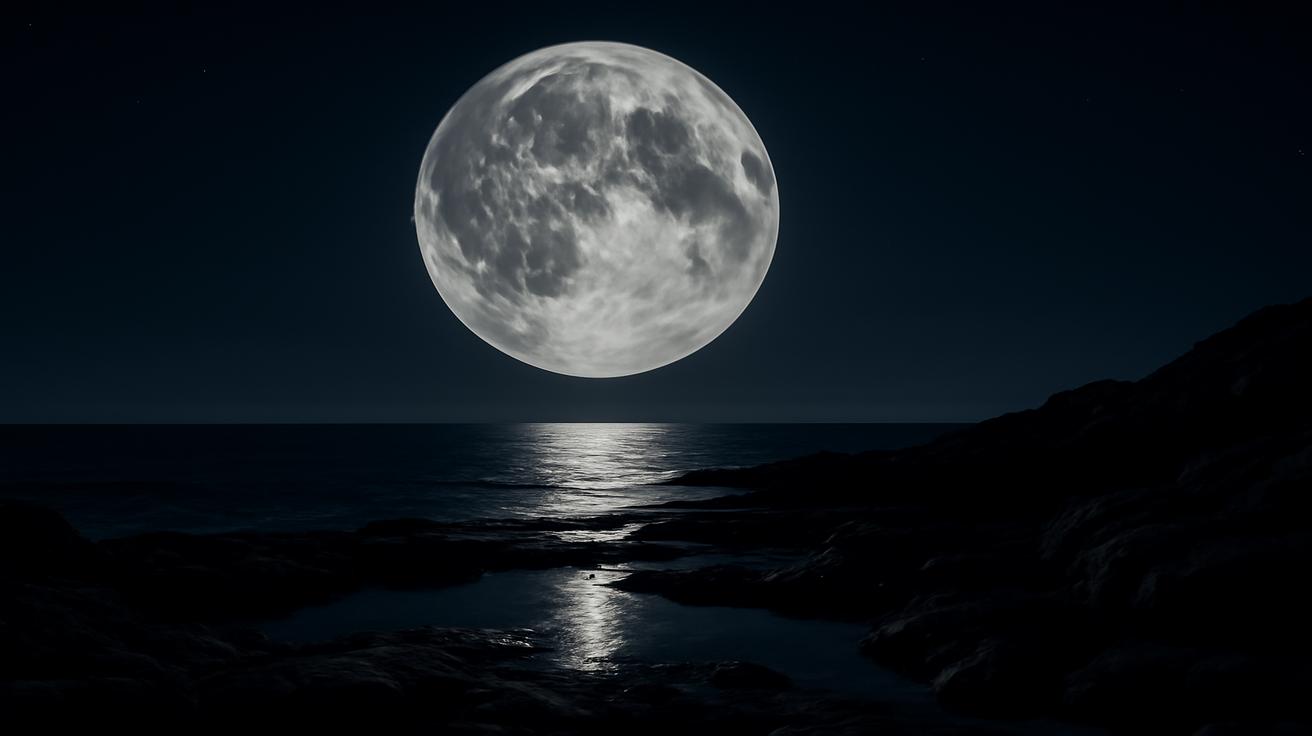
The night you notice it will be nothing special at all. A cool breeze, a sky rinsed clean by rain, the familiar pale coin of the Moon hanging above the dark ribs of the trees. You might be walking the dog, taking out the trash, stepping onto a balcony for one last look at the stars before sleep. The Moon looks the same as it always has: pocked, serene, slightly yellowed at the edges as it rises. You would swear it hasn’t changed in your lifetime, or your grandparents’ lifetimes, or anyone’s, really. And yet, invisibly and relentlessly, that silent companion is slipping away from us—about the width your fingernails grow in a week, every single year.
A Quiet Drift in the Dark
We like to think of the heavens as fixed. The Big Dipper always over that rooftop. Venus always the bright “star” near sunset. The Moon, round and bright, always tugging the tides. But the cosmos is more like a slow, grinding river than a static painting. Everything moves. Everything drifts. Everything is in the middle of some long, unfinished story.
The Moon’s story with Earth began with violence. Around 4.5 billion years ago, when Earth was still molten and wild, something the size of Mars is thought to have slammed into our young planet. That impact flung molten rock into orbit. Gravity, patient and persistent, gathered that spray of fire into a single molten orb. Over time, it cooled, scarred, and became the Moon we recognize.
Back then, the Moon would have loomed huge—many times larger in our sky than now. Days were short, maybe only five or six hours long, as Earth spun frantically. The newborn Moon whipped around us quickly, raising tides so immense they may have surged hundreds of meters high along early coastlines. It must have been a world of thunderous oceans and dizzying, restless days.
Fast-forward billions of years, and the drama has turned subtle. The Moon is still on the move, but now the pace is glacial: about 3.8 centimeters farther from Earth each year, roughly the speed that your toenails grow. You could live your entire life, and the Moon would only have crept away a couple of meters—a shift smaller than the length of your living room. No one looks up and thinks, “Ah yes, the Moon is definitely farther away this summer.” But over deep time, this tiny, continual nudge reshapes the length of our days and the moods of our seas.
The Tidal Dance Beneath Our Feet
To feel what the Moon is doing to us, you don’t have to look up at all. You can stand at the edge of an ocean, toes dug into the sand, and wait. Watch the line where water meets land creep forward, lick at your ankles, then slowly slink away. The rising and falling of tides is the most daily, tangible evidence that there is a celestial body tugging on our planet, stretching and squeezing the oceans like soft dough.
It’s a bit like an invisible hand grabbing Earth’s oceans and pulling them into a bulge on the side facing the Moon—and another on the far side, where water lags behind the spinning Earth. As our planet rotates, these bulges slide across the surface, giving us two high tides and two low tides most places each day. The solid Earth itself flexes a little, too, a barely perceptible breathing of rock.
Here’s the twist: because Earth is spinning faster than the Moon orbits us, these tidal bulges aren’t perfectly lined up beneath the Moon. They’re dragged a little ahead, like the wake in front of a boat. That offset matters. It’s where a quiet, cosmic transaction happens: Earth loses a sliver of its spin, and the Moon gains a sliver of energy, nudging it outward.
Every time the tides surge and ebb, friction between water, seabed, and continental shelves converts a little rotational energy into heat, and a little into the Moon’s motion. The result is a trade: our days slowly lengthen as Earth’s rotation slows, and the Moon slowly spirals away into a wider orbit. What looks like a steady, comforting rhythm—waves murmuring on the shore—is actually a brake pedal being pressed, gently but inexorably, on the spin of the world.
Days That Grow Slowly Longer
Step back, mentally, over geologic time and imagine watching a clock whose second hand is imperceptibly easing down. Hundreds of millions of years ago, the days ticked by faster. When dinosaurs roamed, a day lasted roughly 23 hours. Go farther back, and the difference becomes stunning. Ancient coral fossils carry growth rings—daily and yearly markers—that act like tree rings of the sea. Some of these fossils show about 400 daily rings inside what was, for them, a single year. That means there were around 400 sunrises and sunsets in one orbit around the Sun. A year was still a year, but a day was only about 21.8 hours long.
By comparison, we live in a world where a year contains about 365.24 days, each roughly 24 hours. The change is slow, but it’s measurable. Laser beams bounced off mirrors left on the Moon by Apollo astronauts show us, with millimeter precision, that our satellite is drifting away. Combine that with geological clues in ancient rocks and fossils, and we can read the long arc: the Moon retreats, Earth’s spin slackens; days stretch.
You won’t notice it during your lifetime. The day length increases by only about 1.7 milliseconds per century. Over a human generation, that’s nothing. But let the imagination slip forward hundreds of millions of years, and the difference adds up into hours. There’s something humbling in that—knowing that if some distant future beings stand on this same rotating sphere, they’ll have longer days not because of politics or planetary engineering, but because of the slow whisper of tides rubbing against the seafloor for eons.
Picture a future coastline, millions of years from now. The Sun still rises in the east, but it lingers a little longer overhead before dipping westward. The same Moon looks a fraction smaller, its track across the sky a touch slower. The daily rhythm, by then, will have shifted—daylight slightly more stretched, nights slightly more extended. The metronome of Earth will be ticking at a different pace, all thanks to that distant pale companion making its gradual escape.
Tides in a Changing Future
As the Moon inches outward, its grip on our oceans loosens. Tides are driven mainly by lunar gravity, with the Sun playing a supporting role. Greater distance means weaker pull, and weaker pull means lower tides. Over extremely long timescales, high tides won’t climb as high; low tides won’t drop as low. The beating heart of the ocean will still pulse, but with a slightly softer rhythm.
Right now, though, our changing tides have more to do with climate than with lunar drift. Melting ice sheets, warming oceans, storm surges—these forces are rewriting shorelines far more dramatically and quickly than the Moon’s slow retreat ever could. If your favorite beach is swallowed or reshaped in the coming centuries, it won’t be because the Moon slipped a few meters farther away. Human activity dwarfs the Moon’s subtle influence on that timescale.
Still, in the deep future, after our current crises have either been resolved or recorded in the stratified rocks, the Moon’s gentle retreat will continue sculpting coasts and marine ecosystems. Some coastal wetlands depend on being regularly flooded and drained. Intertidal zones—those bands of life that live between high and low tide lines—will gradually narrow as the difference between high and low tide diminishes. Creatures that cling to rocks, burrow in sandy flats, or hide in tide pools could find their habitat shifting, shrinking, or evolving into something new.
There’s another long-term twist in this story. Eventually, if nothing catastrophic intervenes first, Earth and the Moon will edge toward a kind of gravitational truce called tidal locking. We already see one side of the Moon forever; it’s tidally locked to us. Far in the future, Earth itself could spin so slowly that one side constantly faces the Moon. Just as a dancer can sync their spins, planet and satellite may one day fall into a shared rhythm: the same face of Earth turned toward the same face of the Moon, forever.
In that distant arrangement, the length of a day would match the length of a lunar month. Tides would freeze into more or less permanent bulges. The concept of “high tide” and “low tide” would be redefined, more about geography than time. It’s an eerie picture: an Earth where, in some regions, the Moon never leaves the sky, hanging like a lantern nailed to a single point, and the great oceans heave in slow, almost statuesque swells.
Living With a Moving Moon
For now, we live in an in-between era—one in which the Moon is close enough to raise strong tides, but far enough to move in a stately, stable orbit. It’s a good time to be an ocean, or a tide pool, or a human standing on a pier listening to lines slap gently against wooden posts.
Think of all the ways this dynamic, restless Moon has woven itself into our lives. Its regular phases—waxing crescent, first quarter, gibbous, full—have served as calendars for cultures worldwide. Farmers once planted by it; hunters stalked their prey by its light. Poets, lovers, and insomniacs still tilt their chins toward its glow and feel some tug they can’t quite name.
Meanwhile, the same gravitational tug driving our tides is also guarding our planet’s stability. Without the Moon, Earth’s axis might wobble chaotically over geologic time, swinging us between extreme climatic moods. The Moon’s mass helps steady that tilt, smoothing out potential wild swings. The climate is still far from calm—we’ve made sure of that—but the basic tilt that gives us seasons has been, over long stretches, relatively stable, thanks in large part to our satellite’s presence.
As the Moon moves farther out, its stabilizing influence will very gradually lessen, though not vanish. The details of how that would play out are complex, wrapped in the mathematics of celestial mechanics and the stories of other planets’ gravitational pulls. But the central idea is simple enough: the Moon is not just a pretty ornament in our sky. It’s an active player in the drama of climate, tides, and time itself.
There’s something almost intimate in realizing that our days and nights—the very rhythm of our sleep, our work, our sense of “morning” and “evening”—are being slowly, physically rewritten by a stone sphere 384,000 kilometers away. We measure our lives in decades, our history in centuries, but the Moon is working on the calendar of eons. It is changing the length of a day the way a glacier carves a valley: one nearly invisible scratch at a time, until the landscape is different forever.
| Era | Approx. Day Length | Moon’s Distance (Approx.) | Notes |
|---|---|---|---|
| Shortly after Moon’s formation | 5–6 hours | Much closer than today | Huge tides, rapid Earth rotation |
| ~400 million years ago | ~21.8 hours | Closer than today by tens of thousands of km | Coral fossils show ~400 days per year |
| Today | 24 hours | ~384,400 km | Moon receding ~3.8 cm per year |
| Far future (hundreds of millions of years) | Longer than 24 hours | Significantly farther away | Weaker tides, slower Earth rotation |
Listening for Change on a Human Scale
It’s tempting to shrug all this off as too slow to matter. If our days are lengthening by milliseconds per century, why care? The answer depends on how you choose to experience the world.
Stand on a shoreline at dawn and notice how the Moon and Sun share the sky for a brief, delicate window. The Moon hangs low, pale and nearly translucent, while the Sun’s first light brushes pink across the clouds. That scene is temporary in more ways than one. The exact geometry that makes our tides, our eclipses, our lit nights as they are right now—this is a passing configuration.
Take eclipses, for example. At the moment, the Moon is just the right size and distance to occasionally cover the Sun’s disk perfectly during a total solar eclipse, turning day into strange twilight. But as the Moon continues to recede, one day it will appear too small for that. Future observers, if any, will see only annular eclipses—thin solar rings around a too-small lunar silhouette. The pure, heart-stopping darkness of a total eclipse will become a memory of a different epoch, like the roar of those primeval mega-tides.
We live in an era where the Moon can both light our nights and, briefly, blot out our star. We live in an era of ocean rhythms tailored to exactly this Earth-Moon distance. Our calendars, our myths, and even the tempo of our biology have been shaped under this specific gravitational relationship. Knowing it’s not permanent doesn’t have to be frightening. It can make the present feel more precious, like realizing you’re sitting in the middle of a long, silent symphony right as a particularly beautiful movement is playing.
Next time you walk by water under moonlight, pause. Notice how the reflections tremble and stretch toward you. Feel the soft drag of waves as they curl around your ankles. Somewhere beneath that sensation is the physics of tides, the mathematics of orbits, the history of a planet and its companion tugging at each other for billions of years. Somewhere in that cool, swirling water is the tiniest hint of friction that will, over unimaginably long stretches, slow the planet’s spin and send the Moon on its way.
We often talk about cosmic events as if they’re far away, detached from our daily routines. But the Moon’s slow departure is happening right now, every time the tide shifts, every time the sea sighs onto the shore and slips away. We are living inside that change, even if we need fossils, lasers, and a poet’s patience to see it.
Frequently Asked Questions
Is the Moon really moving away from Earth?
Yes. Precise measurements using lasers bounced off reflectors left on the Moon show it is receding from Earth by about 3.8 centimeters per year. This is caused by tidal interactions between Earth’s oceans and the Moon’s gravity.
Does the Moon moving away affect the length of our day?
Over long timescales, yes. As the Moon moves away, Earth’s rotation gradually slows, making our days longer. The change is extremely small—about 1.7 milliseconds per century—so it’s not noticeable in everyday life but becomes significant over hundreds of millions of years.
Will the Moon ever leave Earth’s orbit completely?
Current understanding suggests the Moon will not escape Earth’s gravity under normal conditions. Instead, Earth and Moon are expected eventually to reach a tidally locked state, where one side of Earth permanently faces the Moon. Other cosmic events, such as the Sun’s evolution into a red giant, are likely to disrupt this scenario long before the Moon could drift away entirely.
How does the Moon affect Earth’s tides?
The Moon’s gravity pulls on Earth’s oceans, creating bulges of water on the side facing the Moon and the opposite side. As Earth rotates, these bulges move around the globe, producing high and low tides. The Sun also influences tides, but the Moon is the dominant driver of the daily tidal cycle.
Will weaker tides in the future change life on Earth?
Over very long timescales, weaker tides could alter coastal ecosystems and intertidal habitats. However, these changes are far slower than present-day climate and sea level changes driven by human activity. Any biological or ecological responses to weaker tides would unfold over millions of years.
Are our current eclipses possible only because of the Moon’s distance?
Yes. The Moon is currently just the right size and distance to nearly perfectly cover the Sun during total solar eclipses. As the Moon slowly moves away, it will eventually appear too small to cover the Sun completely, and total solar eclipses will no longer occur—only annular, ring-like eclipses.
Can humans feel any direct effect of the Moon drifting away?
Not directly. The changes are too small and too slow for human senses. We infer them through long-term measurements, fossil records, and orbital calculations. For everyday life, the more immediate influences of the Moon are its light at night and its role in creating tides, both of which will remain effectively unchanged for many, many generations.