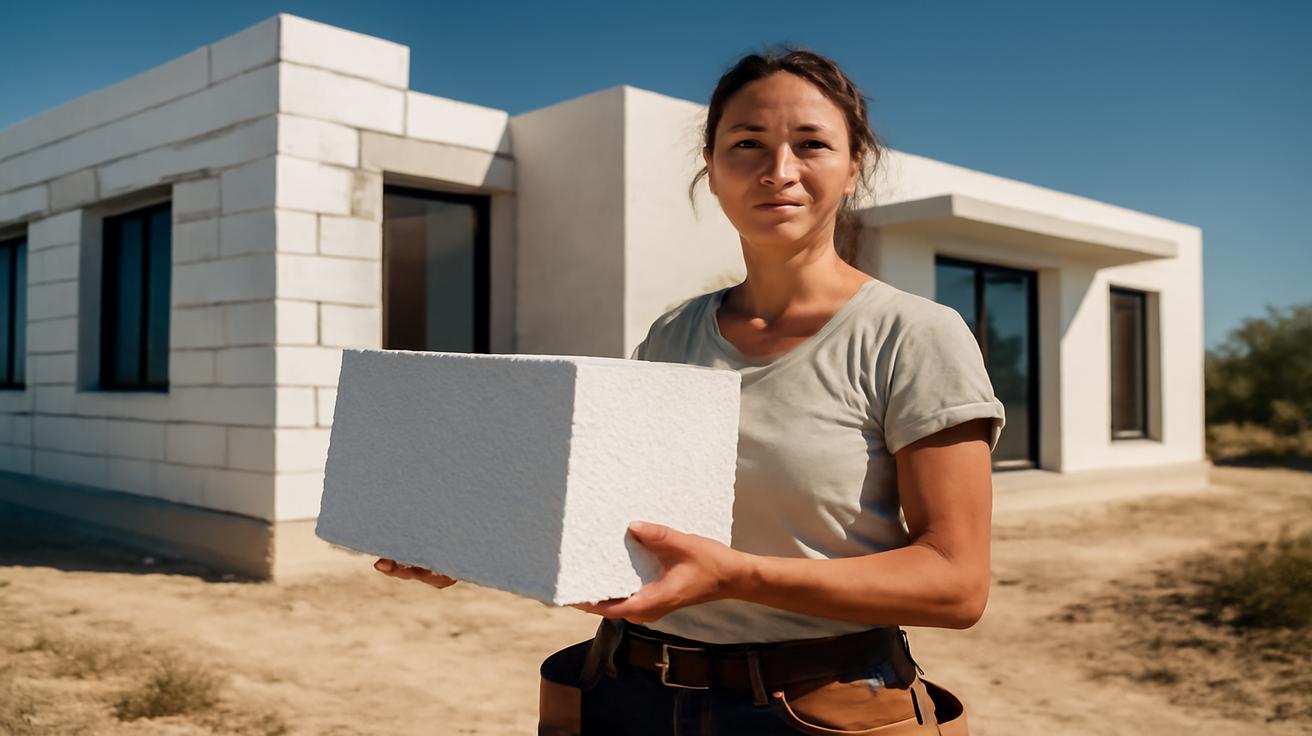
The first thing you notice is the sound. Not the high whine of a circular saw or the thud of heavy bricks, but the soft, crisp rasp of a handsaw sliding through something that sounds almost… delicate. It’s early, the air still wet with dawn, and a woman in worn jeans and a faded sunhat stands beside a growing stack of white polystyrene blocks. They look absurdly light, like oversized sugar cubes. She grips one block, presses it against a rough wooden guide, and pulls the saw again. White curls drift to the ground like artificial snow.
A Different Kind of House
By mid-morning, the sun is sharp and unforgiving. This is the kind of heat that bakes clay, warps wood, and makes fresh concrete cure too fast and crack. But the woman, Lena, works almost casually, as if she has all the time in the world. There is no cement mixer humming, no clouds of brick dust. No piles of sand, no pallets of concrete blocks. Just her, a few buckets, a couple of steel bars, a roll of mesh, and those strangely clean white blocks.
She pauses to wipe sweat from her neck with the back of her wrist. Around her, the land is raw and honest: patchy grass, a few shrubs stooping under the sun, a line of trees that barely remember rain. In a place where traditional brick and mortar houses slowly crumble under humidity, heat, and neglect, Lena’s half-finished structure looks like it was air-dropped from another planet.
It’s not, of course. It’s the result of stubbornness and curiosity, of having too little money and too much imagination to accept that a “real house” must be built from heavy, earth-colored blocks. When people first heard what she was planning – to build a full-sized, livable house by herself, using polystyrene foam blocks, plaster, and light reinforcement – they did what people often do when faced with something unfamiliar. They laughed.
“Foam?” someone had said at the hardware store, eyebrows arched almost into his hairline. “For a house? Maybe for a toy.”
She smiled then, in that quiet way of people who already see something others don’t. “You’ll see,” she had replied, loading the first blocks into the back of her borrowed truck. They were so light she could lift them with one arm.
The Weight of Lightness
The first thing you learn, watching her work, is that lightness can be a kind of strength. She starts by sketching her house in the dust with a stick: a simple rectangle with a smaller rectangle that will become a porch. No architect. No complicated blueprints. Just measurements, thought through over months of sitting at a kitchen table with a notebook and a calculator.
She marks the corners with wooden stakes and string, then sets a shallow, reinforced base using just enough concrete to create a stable, level ring on the ground. This is the only moment her build resembles conventional construction at all. As soon as the base cures, the story diverges.
From the neat stack, she lifts the first polystyrene block and sets it into place on a thin bed of adhesive. It fits almost too perfectly, like a giant Lego that has finally found its stud. She slides in small steel rods where structural strength is needed – around windows and doorways, along corners, threading them through the hollow cores or pre-cut channels of the blocks.
“The secret,” she says, resting her foot lightly on a block she’s just placed, “is not to fight the material. You let it be what it is – light, easy to cut, insulating – and then you give it the armor it needs.”
The armor will come later: a skin of mesh and plaster that will turn these fragile-looking blocks into a weather-hardened shell.
For now, she moves quickly. There is no heavy lifting that requires two people. No precarious towers of bricks that might topple over. If a block is the wrong size, she doesn’t swear or reach for a hammer. She picks up her saw. The blade glides through the foam, releasing a faint, squeaky hiss. She trims a sliver off the end, brushes away the crumbs, and sets the block in place.
By the end of the first day, there is already a waist-high outline of her home. Rooms begin to suggest themselves: the cool quiet of a future bedroom, the shared warmth of a kitchen. The house rises like a story being told aloud.
When Walls Remember the Weather
There are places in the world where walls must remember two things: heat and water. Lena’s land is one of those places. Summers here are like an ongoing argument with the sky. The sun flares, the ground cracks, and roofs glow with stored heat well into the night. Then the season turns, and the rains arrive like someone has torn open a seam in the clouds. Water rushes down walls, seeps into hairline cracks, creeps into foundations. Humidity lingers for weeks, making everything feel slightly damp and vaguely tired.
“I wanted a house that wouldn’t suffer every time the weather changed moods,” she explains, stirring a bucket of plaster with a wooden stick. “And I wanted something I could actually build myself.”
Polystyrene foam is, in one sense, an unlikely hero. It’s associated with disposable coffee cups, packing materials, the white squeaky shapes you peel off new appliances. It’s been cursed for its environmental footprint, its stubborn refusal to decompose. But what if, she wondered, instead of tossing it away after one quick use, we turned it into something that would last decades? A shell that protects, insulates, and resists the very elements that destroy traditional walls?
The foam blocks she chose are dense and designed for construction, not the fragile flakes that crumble under a fingernail. They lock together, forming a continuous layer of insulation that doesn’t crack when the sun scorches or the rain soaks. Wrapped in plaster and reinforced mesh, they become rigid, weather-resistant panels.
Inside such walls, temperatures stay more stable. The midday sun rages outside; indoors, the air remains calm. Later, during the wet season, when roofs drum and roads turn to slick mud, these walls do not drink water. They shrug it off.
“People think strength has to be heavy,” Lena says, pressing mesh into a fresh layer of plaster along a wall. “But what if strength is also about not letting the weather own you?”
Building with Hands, Not Machines
At the core of her experiment is an almost radical simplicity. She is building with what she can carry, shape, and lift alone. No team of laborers, no towering scaffolds, no diesel machines idling in the yard. Just hand tools, a borrowed ladder, and a set of materials carefully chosen for their manageable weight and forgiving nature.
On a typical day, her rhythm feels almost meditative. She cuts, fits, and places the foam blocks like pieces of a puzzle. She embeds light steel reinforcements where doors will hang and where the roof will rest. She anchors everything into the modest concrete base and ties it together with thin but strategic rods and ties.
Where windows will be, she leaves clean, framed gaps; later, she’ll fit them with salvaged glass and simple wooden frames. She stands in one such opening now, hands on the sill made of plastered foam and mesh, looking out at the broad, open land. It is not lost on her how the act of building alone shifts something else, something quieter and more internal.
“When you grow up,” she says, “you kind of absorb the idea that some things are too big for you. A house is one of those. It’s supposed to be a man’s job, or a team’s project, or a contractor’s world. But when the materials are light enough for your own hands, the story changes.”
Her house becomes more than shelter. It becomes a quiet rebuttal to every time she was told to stay on the safe side of difficulty.
| Aspect | Foam & Plaster House | Traditional Brick/Concrete |
|---|---|---|
| Material Weight | Very light; easy to carry alone | Heavy; often needs multiple workers |
| Tools Needed | Handsaw, buckets, trowel, basic reinforcement | Concrete mixer, heavy cutting tools, scaffolding |
| Climate Resistance | Excellent insulation; plaster shell resists rain and humidity | Strong, but can crack, absorb water, transfer heat |
| Build Time | Fast wall assembly due to lightweight blocks | Slower, labor-intensive masonry work |
| Cost | Lower materials and labor; minimal heavy equipment | Higher material and labor costs |
Rain Tests and Sun Trials
The first serious test comes months later, wrapped in a sky the color of wet slate. The air smells electric, like metal and leaves. She has just finished the last full coat of exterior plaster, smoothing it over the white foam until not a hint of it shows. The mesh underneath sits like hidden muscle beneath skin, tying panels together and giving the walls strength.
When the storm finally breaks, it’s not gentle. Water hammers the roof, lashes the walls, races off the eaves in sudden, muddy waterfalls. The ground around the house turns to churned clay. Lena stands under the porch she has just finished, watching the way the rain moves across the plaster. It beads, runs, but can’t find a point of entry. No dark patches bloom on the walls. No fine cracks open like spiderwebs as the temperature shifts.
Inside, the difference is startling. While the world outside roars with water, the interior swallows sound. The foam core and plaster skin turn the storm into a distant backdrop, a muted percussion instead of a direct assault. The floor remains dry. The air smells of lime and new beginnings.
Weeks later, when the rains have turned again to brutal sun, the house passes its second trial. On days when nearby brick homes glow with stored heat and metal roofs practically shimmer, Lena’s interior remains almost stubbornly calm. The foam blocks lock in coolness from the night, refusing to exchange it too quickly with the harsh midday temperatures. With the windows slightly open, a quiet draft slides through, keeping the air breathable.
Hot. Wet. Hot again. Humidity wrapping around everything like a second skin. The cycle continues. Her walls do not buckle, flake, or grow the faint green fuzz of mold. Their resistance is quiet, unassuming. But it’s there, offering her something most people chase for years: a small, stable climate of her own.
The Price of Reinvention
None of this came free. Not in money, and certainly not in patience. Yet the cost, on balance, is startlingly low. Foam blocks are cheaper to transport and install. There is less need for skilled bricklayers, less waste, fewer delays waiting for moisture-heavy walls to dry enough for the next step.
When she tallies her receipts in a worn notebook, she sees it clearly in the tight columns of numbers: the material cost undercuts a traditional build, and the labor cost – mostly her own time – has been transformed into something more like investment than expense. What would have funded a few weeks of a construction crew has instead bought her months of learning.
But there is another, less obvious price she has paid: the social cost of doing something differently. People talk. They worry. They wonder what will happen in five years, ten, twenty. Will the foam still hold? Will the plaster last? Will the resale value be there if she ever decides to leave?
She shrugs at most of these questions. “We already know what happens to many traditional houses here,” she points out. “Cracks. Leaks. Damp walls. Heat you can’t escape. If I’m going to take a risk, I’d rather it be for something that might work better, not just for what everyone else already does.”
Her risk is also a quiet bet on a different relationship with materials. Instead of treating polystyrene as disposable, she locks it into a long-term role. Instead of pouring tons of concrete, she uses just enough structural reinforcement where it actually matters – foundations, joints, roof supports. The rest of the house is lighter, more efficient, and built on a human scale.
A House You Can Carry Piece by Piece
There is something deeply human about building with things that move when you touch them. Traditional bricks are unforgiving; drop one on your foot, and you remember it for days. Foam blocks, in contrast, are almost gentle. They invite you to experiment, to adjust, to shape them to your will with simple tools.
That accessibility has larger implications than just Lena’s story. In a world where housing shortages intensify every year, where disasters erase neighborhoods overnight, the idea of a house that one or two people can assemble without heavy machinery feels almost revolutionary. Imagine temporary shelters upgraded to long-term homes, walls that can be quickly erected and then armored with mesh and plaster into durable structures. Imagine disaster zones where rebuilding doesn’t require waiting for fleets of trucks and armies of workers.
Of course, none of this is simple. Safety standards must be met. Proper reinforcement is non-negotiable where earthquakes or strong winds are part of the landscape. Fire resistance must be engineered into every layer, from treated foam to fire-rated plaster. But the concept itself – a house that begins as something light enough to be carried and ends as something strong enough to be lived in for decades – has already taken root in small corners of the building world.
Lena’s house is one of those corners. It stands not as a finished product to be copied exactly, but as a question posed in solid form: What if we’ve been weighing ourselves down with tradition more than with necessity?
Living Inside an Experiment
When the house is finally finished enough to live in – the plaster dry, the windows in, the door hung on its neat, reinforced frame – the first night feels almost unreal. She moves her few belongings in: a narrow bed, a simple table, a chair with a scar down one leg, a battered bookshelf. The house smells faintly of lime and paint and something else: relief.
She cooks with the door open, steam escaping into the evening. The interior surfaces catch the fading light, softening it. When she turns off the solitary bulb and lies down, the darkness is calm, not heavy. No noises of expanding brick, of creaking rafters straining under weight. Just the distant sounds of night insects and the occasional bark of a dog.
Days pass. She grows accustomed to the way the house buffers her from the outside world – how it holds coolness, how it resists damp, how it never quite feels like it’s collapsing in on her when the rain won’t stop. She discovers small, practical joys: hanging shelves is easy when you know where the reinforcement strips lie; screwing in hooks for plants doesn’t risk sending cracks down plastered masonry. Even drilling to add a new fixture feels less intimidating.
Sometimes neighbors stop by, mostly curious. They tap on the walls, surprised by their solidity. They ask the same questions again and again. “But is it strong?” “What about storms?” “What about the heat?” She answers patiently, sometimes inviting them to stay through the hottest part of the day just to feel the difference.
A few, you can tell, are beginning to imagine their own versions of this. A small studio. An extension at the back of an existing house. A single room for an aging parent who can’t climb stairs. The idea slides quietly under their skepticism, makes a home in the part of the mind that collects possibilities.
Beyond Bricks, Beyond Permission
In the end, this is not just a story about a house made of polystyrene foam, plaster, and simple reinforcement. It is a story about what happens when the tools of making a life become light enough to be held in one person’s hands – when building stops being the guarded territory of professionals and becomes, at least in part, a field of shared experimentation.
Lena doesn’t claim to have invented anything. Others have used foam and plaster, experimented with insulated panels, challenged the hegemony of brick and concrete long before she ever picked up a handsaw. But what makes her story compelling is its scale. This is not a corporate prototype or a government pilot project. It’s one woman on a modest piece of land, making choices about how she will be sheltered – and in doing so, quietly refusing to wait for permission.
Her house is not a manifesto. It doesn’t shout. It simply stands in the sun and the rain and the humidity, doing its job with a kind of understated competence. It proves, hour by hour, that a wall can be both light and strong, that a shelter can be both inexpensive and resilient, that “the way we’ve always done it” is not the same as “the only way it can be done.”
As the seasons keep folding over one another, as vines find the trellis on the porch and birds learn the pattern of the eaves, the house settles deeper into its environment. It becomes less an oddity and more a quiet, sturdy fact.
One evening, as the light thins and the earth exhales the heat it has stored all day, Lena sits on her steps, bare feet on the cool plaster. There is paint under her nails and tiny foam crumbs forever caught in the seams of her boots. She looks at the walls she raised alone, the roofline she measured and checked a dozen times, the interior she’s still slowly filling with color and fabric and life.
“It’s funny,” she says, half to herself. “People see foam and think fragile. I see it now and think freedom.”
Frequently Asked Questions
Is a foam block and plaster house really strong enough to live in long-term?
Yes, when built correctly. The foam itself is not structural, but when combined with proper reinforcement (steel bars, mesh) and high-quality plaster, the system forms a rigid, durable shell. It can withstand normal residential loads and, when designed to local building standards, can perform comparably to traditional walls.
How does this kind of house handle rain and high humidity?
The foam core does not absorb water, and the exterior plaster layer acts as a protective skin. With good detailing (eaves, proper drainage, and quality plaster work), the walls resist rain penetration and do not soften or rot. In humid climates, the non-absorptive foam and well-sealed plaster help reduce problems like damp walls and mold.
Is it cooler inside compared to a brick or concrete house?
Often, yes. Polystyrene foam provides strong thermal insulation, reducing heat transfer through the walls. That means less heat entering during hot days and less warmth escaping at night. In practice, this can create a noticeably more stable and comfortable indoor temperature, especially in places with intense sun.
Can one person realistically build such a house alone?
A small, simple house can be built by one determined person, particularly because the blocks are light and easy to handle. However, help is usually needed for certain stages like lifting roof elements, pouring the concrete base, or handling large window and door units. The major advantage is that much of the wall construction can be done solo with basic tools.
What about the environmental impact of using polystyrene?
Polystyrene has environmental drawbacks if used as a disposable material, but using it in long-lasting construction changes the equation. When locked into a durable building, it is not single-use waste but a long-term component that improves energy efficiency by insulation. Responsible design, minimizing offcuts, and ensuring long service life are key to making this approach more sustainable.