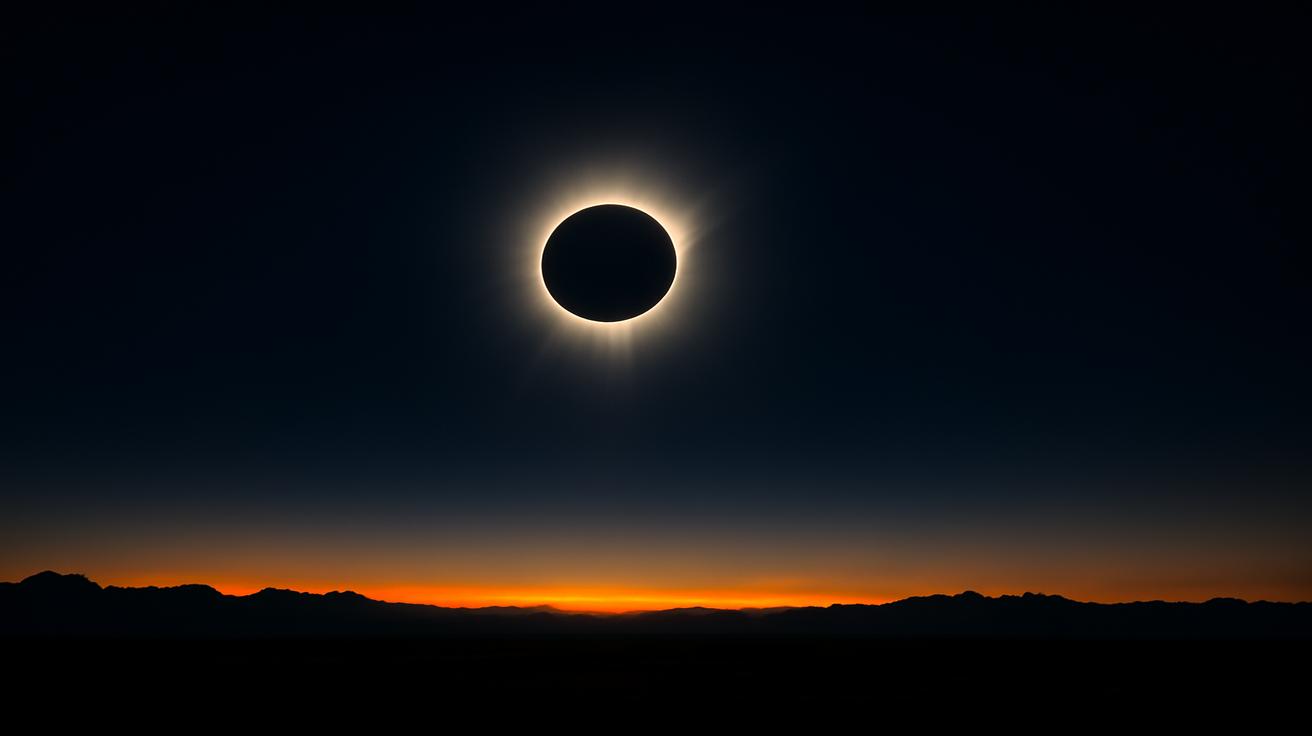
The first thing you notice is the silence. Not the ordinary, passing quiet of a lazy afternoon, but a hush that seems to sink down from the sky itself. The air cools against your skin. Birds cut their songs in mid-phrase and vanish into hedges and treetops. The light around you—once full, golden, ordinary—starts to take on a strange, metallic cast, as if someone has turned the dimmer switch on the whole world. You glance up. The sun, that unwavering, everyday blaze, has grown a bite on its edge. It is vanishing, one careful, celestial mouthful at a time.
A Day That Decides to Become Night
This is the moment when time loses its balance. One by one, familiar rules retire from duty. Shadows sharpen into unnaturally crisp outlines, as if drawn with ink. Colors flatten and fade, grass turning from bright green to a muted, haunted shade. The warmth that had been soaking into your clothes only minutes ago slips quietly away, climbing back into the thinning sky.
There’s conversation around you—neighbors, strangers, children asking questions—but it feels like everyone’s voices have been turned down, edited out of the foreground. What fills that space instead is anticipation, the sensation that something immense and invisible is moving into position above your head. The sun is shrinking, the moon’s invisible edge drifting across that bright disc with such measured grace that you can almost believe you can hear it.
Scientists call this event a total solar eclipse, but that name feels too compact, too small, for what it does to the human nervous system. This is not just alignment; it’s an encounter. Earth, moon, and sun are sliding into a straight celestial sentence, and you, quite improbably, are standing on one of the few commas where the meaning is revealed in full.
As more of the sun disappears, the temperature drops further. A faint wind stirs, cold and oddly insistent. The world begins to resemble a photograph taken with the exposure turned down: familiar, but uncanny. Your hands look like your hands, but not in your usual universe. You know, on some rational level, that nothing truly dangerous is happening, that the moon is simply casting its shadow on the Earth like a passing cloud writ large. Yet some older, quieter part of your brain is not convinced. That part remembers, across uncounted generations, what it means when the sky changes its mind.
The Moment When Physics Becomes Feeling
If you were to step out of your own awe and stand beside a scientist in this moment, they could point to the geometry unfolding overhead. They’d describe the moon’s shadow—called the umbra—racing across the planet at thousands of kilometers per hour. They might tell you that this alignment is precise to a degree that boggles the imagination: the moon is both about 400 times smaller than the sun and about 400 times closer to the Earth, making them appear almost exactly the same size in our sky. It’s a coincidence so neatly tuned that, in astronomical terms, it might as well be a magic trick.
But even that word—coincidence—seems to fall short when the last fraction of the sun is about to vanish. The light has thinned to twilight. The landscape looks like the world just before a storm, except there are no clouds, no ominous wall of weather approaching. Instead, the sky above is a smooth, pale gradient, and near the horizon a band of orange and pink encircles you: a 360-degree sunrise and sunset happening at once.
Your heartbeat speeds up. The crowd, wherever you are—on a city rooftop, in a farm field, on a quiet hillside—grows restless in the way gatherings do just before something shared and unforgettable happens. Some people point glasses and filters toward the shrinking sun, others just stare at the changing light, waiting, counting down the seconds with a kind of reverence that doesn’t need words.
And then, as though someone has reached up and pinched the last glowing thread of daylight… it goes dark.
When the Sun Becomes a Black Hole of Light
Totality, they call it. It’s a tidy word for such a disorienting experience. The sun is no longer the sun. In its place hangs a black circle surrounded by a wild, white halo—the solar corona, usually invisible, now thrown into sudden and glorious relief. Streamers of pearly light spill outward, delicate and fierce at once, like ghostly petals blown back by some unseeable wind.
Stars emerge, unsure at first, then more confidently as your eyes adjust. Planets you’ve only known as small dots on charts become visible, bright jewels on the sudden night. Venus often appears first, a sharp point of brilliance. Somewhere out there, Jupiter may follow, maybe even Mercury—small worlds revealed because our own has stepped briefly into the shadow of its neighbor.
The world reacts. Some people gasp or cry. A few laugh, high and breathless, as if they’ve just jumped into icy water. Others are silent, hands unconsciously pressed to their chests. There is an animal edge to the quiet of birds and insects, a sense that the natural world is holding its breath with you. It isn’t just that the light is gone. It’s that, for a fleeting stretch of minutes, you can see the sun for what it truly is: not a perfect, golden circle on children’s drawings, but a living star with a crown of fire and plasma that spans millions of kilometers.
It is, as many scientists have said without exaggeration, one of the most powerful astronomical moments of modern times—not because the physics are more dramatic now than they were centuries ago, but because we understand what we’re seeing. Above your head is a fusion furnace turning hydrogen into helium, lighting your world and every world in the solar system. Around it, that shimmering corona, twisting into loops and arcs, is shaped by magnetic forces that can fling charged particles across the void. On ordinary days, it’s too bright to observe directly; during totality, the universe lifts the veil for just a moment.
Why This Eclipse Matters So Much
To astronomers, this rare alignment is a laboratory. With the sun’s blinding face blocked, they can train telescopes and instruments on the corona and watch how it moves, changes, breathes. Each eclipse becomes a data-rich chapter in a long, patient story about our star’s behavior—how it gives off solar wind, how it stores and releases energy, how it might one day affect communication systems and power grids on Earth.
In an era of space telescopes and satellites, you might think an eclipse wouldn’t matter as much as it once did. But some of the finest measurements of the corona’s structure and temperature still happen when the sky itself lends a hand, dimming the sun just enough for our instruments—and our eyes—to catch the finer details. During one historic eclipse in 1919, starlight bending around the sun confirmed Einstein’s theory of general relativity, reshaping our understanding of gravity. Today, eclipses still offer opportunities to test new equipment, refine models, and ask fresh questions.
Yet numbers and graphs can only explain part of the story. The rest lives in how this event rearranges something deep inside the human psyche. In modern life, the sun is a constant, a given. It rises, sets, and powers up every screen, every crop, every breath of wind and weather pattern. We rely on its predictability in ways we rarely think about. When it goes away in the middle of the day, even briefly, a door opens in the mind: if this can change, what else might be not as fixed as it seems?
How the World Prepares for a Moving Shadow
Long before the day arrives, the path of this shadow—the narrow track of totality—is mapped to the kilometer. Astronomers, space agencies, and observatories run their models, tracking the moon’s orbit and the Earth’s spin with exquisite precision. They can say, years in advance, which towns, rivers, deserts, and city streets will fall under the full, plunging darkness and which will watch only a partial bite taken from the sun.
As the date nears, maps circulate. Routes are highlighted. Travelers book cabins and campsites, hotels and borrowed couches along that slim, coveted line. It is, in its own way, a migration. Families pack eclipse glasses next to sunscreen and snacks. Amateur astronomers load telescopes and cameras into cars, hoping to outrun weather forecasts and find a patch of clear sky. For some, it becomes a pilgrimage repeated eclipse after eclipse, chasing totality across continents and oceans.
Communities along the path prepare too. Some plan festivals and viewing events; others quietly brace for crowds in places that rarely see them. Schools schedule outdoor lessons; power companies plan for shifting energy demands as the sudden drop in sunlight briefly cools solar panels. Doctors and educators remind people to protect their eyes, to resist the instinct to stare at the shrinking sun until the very last safe moment.
Technology hums in the background: live broadcasts, high-altitude balloons, drones, scientific campaigns coordinated across hundreds of kilometers. And yet, when the moment comes, none of that matters as much as the simple act of standing under the sky and watching. The oldest form of science—looking up—is still the heart of this experience.
| Phase | What You See | What You Feel |
|---|---|---|
| First Contact | The moon takes its first tiny “bite” out of the sun. | Curiosity, a sharpened awareness, light still bright. |
| Partial Eclipse | Sun becomes a crescent, light turns strangely dim. | Cooling air, uneasy calm, growing anticipation. |
| Totality | Sun fully covered; corona blazes around a black disc. | Awe, disbelief, emotional jolt as day becomes night. |
| Return to Day | Light rushes back, crescent sun reappears. | Relief, exhilaration, a strange longing for the darkness. |
Preparing Your Senses for the Experience
To witness this rare solar phenomenon fully, you prepare not just your equipment, but your senses. You learn when it’s safe to look and when it’s not. Before and after totality, the sun is still powerful enough to damage your eyes; eclipse glasses or filters become your passport to curiosity. During totality itself—those precious minutes when the sun’s face is fully covered—you can lower the glasses and simply look. That brief window becomes a memory you’ll revisit for the rest of your life.
Think beyond sight, though. Listen to how the world changes as the light falls away. Hear the shift in birdsong, the stir of leaves, the collective inhale from people around you. Feel the temperature drop on your arms, the goosebumps rising on your skin. Notice how your own body reacts: the quickening pulse, the prickle at the back of your neck that no amount of scientific understanding quite erases.
Some people choose open fields where they can see the shadow racing toward them across distant hills. Others find higher ground, hoping to catch the horizon’s band of twilight that circles the world like a low, glowing ring. A few watch from cities, where skyscrapers and streetlights offer a strange, urban echo of old-world eclipses—ancient wonder translated into a modern skyline.
What the Darkness Leaves Behind
When the first bead of sunlight reappears at the edge of the moon, it does so explosively—at least visually. A sudden flare of brilliance, like a diamond on a ring, bursts into view. This “diamond ring” effect marks the end of totality. Instantly, the spell breaks. Birds begin to stir. The sky brightens with surprising speed. People exhale, clap, shout, call friends, or simply collapse into stunned laughter. The ordinary world returns, as if it had only briefly stepped out of the room.
But something has been rearranged. You’ve seen your own planet differently—not as a flat, quiet stage for human stories, but as a turning, tilting participant in a larger choreography. You’ve watched a shadow drawn across continents, felt your smallness and your belonging in a single breath.
For many, the hours and days after an eclipse carry a subtle afterglow. You might find yourself scrolling through photos that fail utterly to capture what you saw. You might feel a strange restlessness, an urge to look up more often, to pay attention to sunsets and moonrises, to the slow, quiet movements of light across familiar spaces. The sky has revealed itself as dynamic, not fixed—a ceiling that can shift and surprise, even now.
Scientists go back to their data: terabytes of images, spectral lines, measurements of coronal temperature, and magnetic fields. They will spend months and years teasing secrets from what they recorded in those few minutes of darkness. Articles will be written; models will be refined; our understanding of the sun’s rhythms will deepen. In labs and observatories around the world, the eclipse continues long after the last shadow has left the Earth.
A Shared Story Written in the Sky
What lingers for everyone else is the story. You remember who you stood next to when the sun disappeared: the child squeezing your hand, the stranger who offered you a spare pair of glasses, the friend who drove all night to make it in time. You remember the way people gathered—not for a concert or a game or a screen, but for the sky itself. No ticket, no subscription, no replay button.
In a time when so much of life happens indoors, filtered through glass and silicon, a total solar eclipse demands that you step outside and look up. It is one of the last truly un-monetizable spectacles, an event that belongs equally to everyone under its path. No one can own the shadow; no one can fence off the corona.
Across cultures and centuries, eclipses have been omens, prophecies, divine messages, dreadful signs. Today, with orbital mechanics and astrophysics at our fingertips, we know when they’ll happen, how long they’ll last, what shape the sun will take as the moon moves across it. But knowing the script doesn’t make the performance any less staggering. If anything, it deepens it. You understand that above you, the clockwork of the solar system is ticking precisely, relentlessly, and yet with just enough wobble and wonder to allow for miracles like this.
Frequently Asked Questions
Is it really safe to look at a total solar eclipse?
It is only safe to look at the sun with the naked eye during the brief period of totality, when the sun is completely covered by the moon and only the corona is visible. Before and after totality, even when the sun appears as a thin crescent, you must use proper eclipse glasses or a certified solar filter. Ordinary sunglasses are not safe for direct viewing of the sun.
Why do scientists call this one of the most powerful astronomical moments of modern times?
Because a total solar eclipse combines a rare and precise alignment with an unparalleled research opportunity. It allows detailed study of the solar corona, tests of solar and space-weather models, and public engagement with astronomy on a massive scale. The emotional impact on observers, combined with the scientific value, makes it uniquely powerful.
How often do total solar eclipses happen?
Total solar eclipses occur somewhere on Earth roughly every 18 months, but any given spot on the planet will only see totality about once every 300–400 years on average. That rarity in one location is why people often travel long distances to stand in the path of totality.
What’s the difference between a partial and a total solar eclipse?
In a partial eclipse, the moon covers only part of the sun, and daylight remains, though dimmed and oddly colored. In a total eclipse, the moon fully covers the sun’s bright face for a few minutes, revealing the corona and turning day into a temporary twilight or near-night. The difference in experience between high partial coverage and totality is dramatic.
Why does the light look so strange during an eclipse?
As the sun’s disc is gradually covered, the intensity and quality of sunlight change. The light passing through the atmosphere is reduced and scattered differently, creating sharper shadows, flatter colors, and an eerie, metallic or silvery tone. Near totality, the contrast between the darkening sky overhead and the brighter horizon adds to the otherworldly effect.
Can animals sense the eclipse?
Many animals respond to the sudden change in light and temperature. Birds often stop singing and head to roost; insects that usually appear at dusk may emerge; farm animals sometimes move as if evening has arrived. These behaviors reflect their sensitivity to environmental cues rather than an understanding of what is happening in the sky.
Why should someone travel to see totality instead of just watching a partial eclipse at home?
A partial eclipse is interesting; a total eclipse is transformative. The appearance of the corona, the sudden plunge into darkness, the visible planets and stars, and the collective emotional reaction simply do not occur outside the path of totality. Many who have experienced it describe it as one of the most unforgettable natural events of their lives—and often plan to see another.