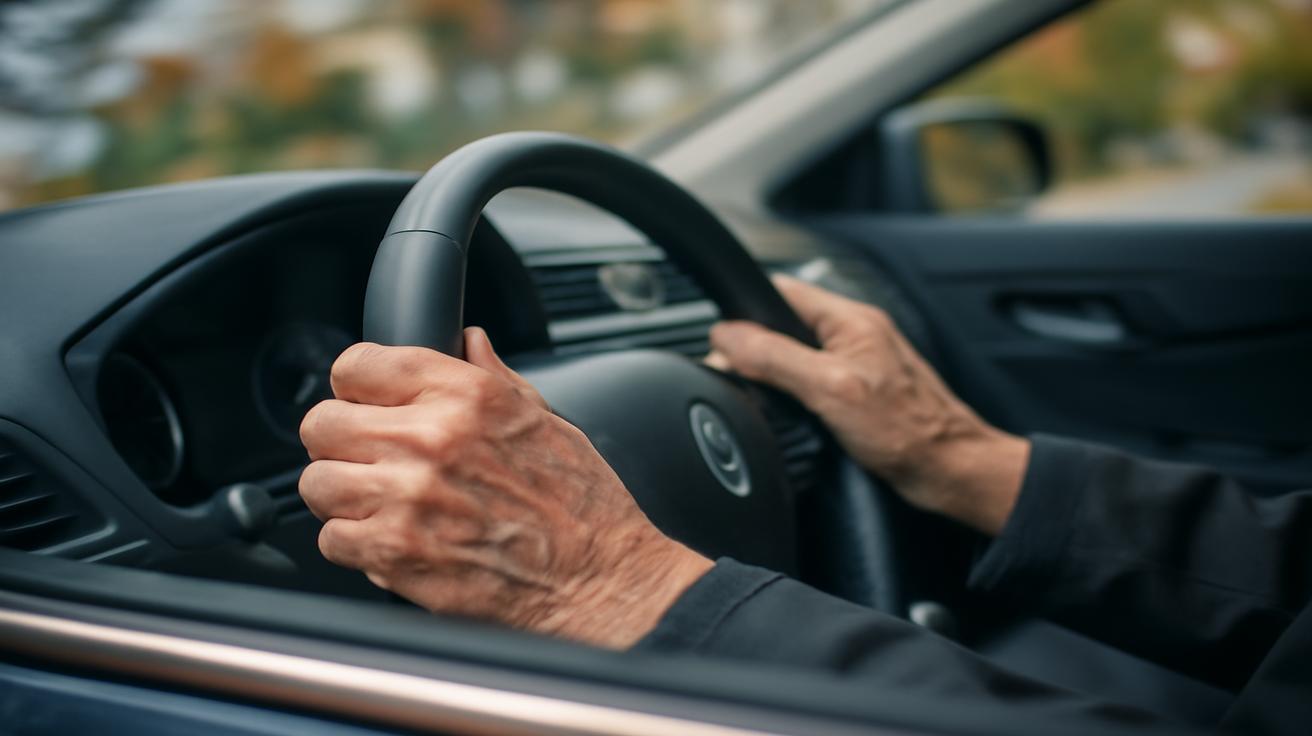
The old man in the blue cap had the windows of his silver hatchback rolled all the way down. Early autumn light fell in loose gold on the village road, and the scent of woodsmoke drifted in through the open glass. He drove slowly, almost ceremonially, humming to a crackling classic-rock station. From the sidewalk, you might have thought: there goes someone who has spent a lifetime behind the wheel, someone for whom driving is less a chore than a thread stitched through every major memory. The first kiss in a parked car. The late-night hospital dash. The long holiday drives with squabbling kids in the back. Freedom, compressed into a steering wheel and two pedals.
At the next intersection, a young cyclist in a neon helmet raised a cautious hand, waiting for eye contact. The old man squinted into the light. A tiny hesitation, barely a heartbeat—and then he waved the cyclist through. Nothing happened. No screech of brakes, no thud of metal on bone. The moment dissolved into the everyday murmuring of traffic.
But somewhere in that unremarkable pause lives an uncomfortable question: when, if ever, does age turn from experience into risk? And should a birth date printed on a plastic card decide whether someone like the man in the blue cap is allowed to keep driving at all?
The Quiet Fear at the Intersection
Conversations about elderly drivers rarely happen in polite tones. They slip out in muttered complaints after a near miss, in whispered family debates over dinner, or in the uneasy silence that falls when a parent fumbles the car keys. Behind the statistics and policy proposals lies something deeply personal: the slow erosion of independence, measured in miles.
Imagine a retired woman named Brigitte. Seventy-eight, widowed, living at the edge of a small town where the bus comes twice in the morning and once, maybe, in the afternoon—if the driver isn’t sick. The supermarket, her doctor, and the weekly knitting group that keeps her from drifting into loneliness are all a short drive away. Without her little car, those places might as well be on another planet.
Now picture her standing at the kitchen window, mug cooling in her hands, staring at the vehicle that has carried her through five decades. The news is full of talk about “mandatory licence withdrawal after a certain age.” Anchors trade grim headlines about crashes involving senior motorists, interspersed with footage of crushed bumpers and flashing blue lights. The proposal, they say, is simple: once you pass a defined age—70, 75, maybe 80—your right to drive expires, automatically.
For policymakers, it’s a tidy solution, clean and numerical. For Brigitte, it feels like a line drawn through the middle of her life.
When Numbers Tell Only Half the Story
Road safety lives and dies in numbers. Every proposal about senior drivers is backed by charts and statistics that look tidy on a slide but messy in reality. Are elderly motorists actually more dangerous? The answer is complicated, and that complexity often gets flattened into slogans.
Older drivers, on average, tend to drive fewer miles and more cautiously. They avoid night driving, heavy traffic, and bad weather. They keep greater following distances, brake earlier, and often stick religiously to speed limits. On many safety metrics, that caution works in their favor.
Yet, there is another side. Physical changes—slower reaction times, reduced vision, hearing loss, stiff joints—can turn a sudden situation into a crisis. In collisions, seniors are physically more fragile, more likely to be seriously injured or killed even in moderate impacts. On paper, this can make them appear dangerously overrepresented in fatality statistics.
But those same numbers need context. Many studies show that per kilometer driven, very young drivers—especially those under 25—are frequently involved in more crashes than the elderly. Impulsivity, distractions, and inexperience play their part. Still, we rarely talk about mandatory licence withdrawal at 25. We talk about training, probationary periods, graduated licences, and better education.
So why does age, that shifting, uneven measure of a human life, so quickly become a hard boundary for retirees?
Safety or Shortcut? Inside the Policy Mindset
For traffic authorities, aging populations are a genuine challenge. More seniors are on the road, and they are driving later into life than ever before. Urban streets grow busier, rural roads carry more mixed traffic—cyclists, e-scooters, farm vehicles, delivery vans weaving between all of them. Under that pressure, the urge to find one big lever—to simply say “at this age, no more”—can seem tempting.
There is a blunt efficiency in a fixed age limit. It is easy to administer, easy to explain to the public, and it produces a clear, measurable change: after a certain year of birth, no one drives. Spreadsheets love this clarity.
But life does not. One eighty-three-year-old may still be sharp-eyed, physically fit, and more cautious than a driving instructor. Another sixty-eight-year-old may already be struggling with memory lapses, uncontrolled diabetes, or medications that blur the world at the edges. Tying safety strictly to the candles on a birthday cake ignores this diversity.
When we set an age limit for driving, we are not just setting a technical rule; we are drawing a circle around a whole generation and labeling it “too risky.” For some, that may be true. For others, it becomes a quiet form of social exile.
| Approach | How It Works | Potential Upside | Potential Downside |
|---|---|---|---|
| Fixed Age Cut-Off | Licence automatically expires after a defined age. | Very simple to enforce; quick reduction in older drivers on roads. | Ignores individual ability; risks discrimination and loss of independence. |
| Regular Medical Checks | Health and vision tests required after a certain age and repeated periodically. | More personalized; can catch issues early; supports gradual adaptations. | Costs time and money; may miss fast-developing conditions. |
| On-Road Assessments | Practical driving tests tailored for seniors at set intervals. | Evaluates real-world skills; allows targeted restrictions (daytime only, local area). | Can feel intimidating; requires trained staff and infrastructure. |
| Graduated Senior Licences | Licence stays valid but with conditions: no night driving, no highways, etc. | Balances independence and safety; flexible and adaptable over time. | Complex to monitor; may be confusing for some drivers. |
The Weight of a Plastic Card
For someone who has driven for fifty or sixty years, a licence is more than permission; it is identity. To ask an elderly driver to surrender it is to ask them to redraw the map of their everyday life.
In the suburbs of a large city, this might be survivable. There are buses and trams, trains and car-sharing schemes and neighbors stacked above and below you. Remove the car and life shrinks, but it doesn’t entirely collapse.
In a rural valley, on a hillside farm, or at the end of a long coastal road, that same loss of licence can be devastating. It means calculating every outing, every medical appointment, every social visit against the goodwill and availability of others. It means deciding whether a trip to the bakery is worth asking for a favor. It can mean, very quietly, going out less—until the world beyond the front door begins to fade into memory.
Social isolation is itself a public health risk. Depression, cognitive decline, and physical frailty bloom in the quiet spaces where people no longer meet. When we talk about taking keys away for safety, we rarely place these invisible costs on the same scale as collision statistics.
Then there is dignity. The older generation, after a lifetime of voting, working, paying taxes, and adapting to decades of change, may feel suddenly treated like children—people to be managed, not heard. A rule that says “after 75, you no longer drive, no matter what” can land like a verdict on their worth.
Discrimination Wrapped in Good Intentions?
Discrimination does not always arrive wearing an insult. Sometimes it comes dressed as concern. “We’re worried about your safety,” we say, as we redraw the boundaries of a retiree’s life without asking them what they need.
Age-based rules are everywhere: minimum ages for voting, retirement ages, age limits for certain jobs. They are not always evil; often they are bureaucratic shortcuts around complex human differences. Yet when an entire group is treated primarily as a risk, the line between safety measure and prejudice begins to blur.
Stereotypes of “dangerous old drivers” are stubborn. One slow-moving car, one hesitant merging maneuver, and muttered curses erupt in the vehicles behind. We remember the wobble, the confusion. We forget the hundreds of uneventful, careful trips taken by the same population. It is easy to let isolated horror stories harden into a belief that all senior motorists are ticking time bombs.
But consider this: we do not propose banning all young adults from driving when a teenager causes a tragic crash. We do not insist that every driver with a sports car must surrender their keys because some speed dangerously. We tighten rules, we target training, we refine enforcement. We look for nuance.
With seniors, nuance often disappears. Age becomes a blunt label, and the conversation stops there. This is where “necessary safety measure” can silently slide into “shocking discrimination”—not through malice, but through the refusal to look any closer.
Listening to the Road Wisdom of Age
Step into a café near a village square on a weekday morning, and you will find them: retirees with weathered hands wrapped around coffee cups, trading stories about storms on mountain passes, snow chains and punctures, old cars and long-vanished petrol stations. They have been on the road longer than many traffic planners have been alive.
That experience is not trivial. Many older drivers have developed an instinct for danger that no simulator can teach. They read the body language of traffic: the twitch of a brake light, the hesitation of someone about to change lanes without indicating. They know which crossroads hide blind spots, which time of day the low sun will flare in the mirrors.
Of course, experience does not cancel out every risk. Reflexes slow; necks no longer swivel as easily. Yet, given support, many seniors adapt. They choose quieter routes, avoid rush hours, and hand over the wheel willingly on long journeys. These are not reckless people clinging to power—they are adults making calculations about their own capability.
What if, instead of treating seniors as problems to be removed from the road, we treated them as partners in road safety? Invitations to voluntary refresher courses, respectful medical check-ups, and honest conversations about limits could transform this debate from a top-down verdict into a shared project.
Designing Roads and Rules for Every Age
Some dangers blamed on elderly drivers are actually failures of infrastructure and design. Faded lane markings, confusing signage, split-second left turns across multiple lanes, aggressive merging zones—these challenge everyone, but especially those whose eyes and reactions need just a little more time.
A thoughtfully designed intersection, with clear signs, well-marked crossings, and simple turn patterns, protects all road users, young and old alike. Good lighting at pedestrian crossings helps an aging driver see the late-evening jogger in dark clothes. Longer green phases can make it safer for slower walkers to cross and for cautious drivers to turn without panic.
Technology, too, stands ready to help if we let it. Modern cars bristle with quiet assistants: emergency brake systems that sense an obstacle before a foot can reach the pedal, lane-keeping alerts that nudge a drifting vehicle back into place, blind-spot sensors that flash when a cyclist slides into that treacherous unseen zone. For an older driver aware of their own vulnerabilities, these features can be a lifeline, buying them a few more safe years behind the wheel.
Then there is public transport. It is easy to talk about taking licences away in cities dense with tram lines and bus stops. It is harder in regions where the last bus left ten years ago. If a society is serious about reducing car use among seniors, it must be equally serious about offering alternative ways to move—on-demand shuttle services, community ride programs, safe cycling paths designed for slower, electric-assisted bikes.
Until such systems exist, a strict age-based driving ban is not just a safety choice; it is a choice about who gets to participate in society at all.
Towards a Fairer Middle Path
Somewhere between “let everyone drive forever” and “take away all licences at 75” lies a more humane answer. It begins by admitting that risk does exist—and that denying it helps no one. There are seniors who should no longer be on the road, just as there are younger drivers who pose a danger to others. Facing that reality is an act of responsibility, not discrimination.
Equally, it requires acknowledging that age alone is an imperfect tool. A better system would weave several strands together:
- Regular, respectful health and vision checks after a certain age, focused not on punishment but on support.
- Practical driving assessments that reflect real-world conditions, with instructors trained to work sensitively with older adults.
- Graduated licences for seniors, allowing continued driving under safer conditions: daylight hours, local areas, lower-speed roads.
- Subsidies or tax benefits to help seniors access safer cars with modern assistance technologies.
- Investment in flexible, senior-friendly public and community transport to ease the pain of eventually giving up the keys.
In such a system, a licence is not torn away on a birthday; it is gradually reshaped through dialogue, testing, and shared responsibility. At some point, yes, there may come a day when the car must stay parked for good. But that day would arrive as the result of specific evidence and individual assessment, not just a date on a calendar.
Most importantly, older drivers themselves must help design this future. They are not road hazards to be managed—they are citizens with wisdom about what makes driving feel safe or frightening at their age. Listening to them may reveal small changes—larger road signs, clearer markings, better parking options near clinics—that benefit everyone.
In the Rearview Mirror and Up Ahead
Evening is falling again on the village road where the man in the blue cap drives. Headlights wink on one by one. He is on his way home from visiting an old friend, the sort of trip that would be almost impossible by bus. He signals early at every turn, slows for every crossing. When a car behind him grows impatient and pulls out to overtake with a burst of engine noise, he lets it go without resentment. Once, he too drove like that.
In his glove compartment lies a driving licence that has survived countless renewals. One day, someone may ask him—gently or not—to give it up. When that moment comes, the way we have shaped our rules and our roads will matter. Was he treated as a number on a chart or as a human being whose independence still has value? Did we offer him tools to stay safe as long as possible, or did we simply decide on his behalf that his time on the road was over?
Calling for automatic licence withdrawal after a certain age may feel like the bold, responsible choice in the face of tragic headlines. But unless it is paired with nuance, support, and alternatives, it risks becoming something else: a quiet act of exclusion against those who have spent a lifetime building the very world we now navigate.
The real challenge is not to decide between “safety” and “discrimination” as opposite poles. It is to build a system where protecting lives on the road does not require erasing the independence and dignity of the old. Between the hard edges of fear and fairness, there is room for a more generous kind of traffic policy, one that sees every driver, of every age, as part of the same long, human journey.
FAQ
Do older drivers cause more accidents than younger drivers?
Per kilometer driven, very young drivers often have higher crash rates due to inexperience and risk-taking. Older drivers tend to be more cautious but are physically more vulnerable, so accidents involving them can lead to more serious injuries. The picture is mixed and depends heavily on how you measure risk.
Is a mandatory age limit for driving automatically discriminatory?
A strict age cut-off treats all people in a certain age group the same, regardless of their actual abilities. Many experts argue this is a form of age discrimination, especially when safer, more individualized alternatives—like medical checks and driving assessments—are available.
What are better alternatives to automatic licence withdrawal?
Alternatives include regular health and vision exams after a certain age, practical on-road tests, graduated senior licences with specific conditions (daytime only, local area), and wider use of driver-assistance technologies. These options balance safety with continued independence.
How can families talk to an elderly relative about unsafe driving?
Start with empathy, not accusation. Share concrete observations, suggest a medical or driving assessment, and discuss alternatives such as ride-sharing within the family, taxis, or community transport. Offer to accompany them to appointments rather than simply insisting they give up the car.
What role does public transport play in this debate?
Where public and community transport are reliable and accessible, giving up driving is much easier and safer for seniors. In rural or poorly served areas, a strict age-based driving ban can lead to severe isolation. Improving transport options is essential if society expects more retirees to stop driving.