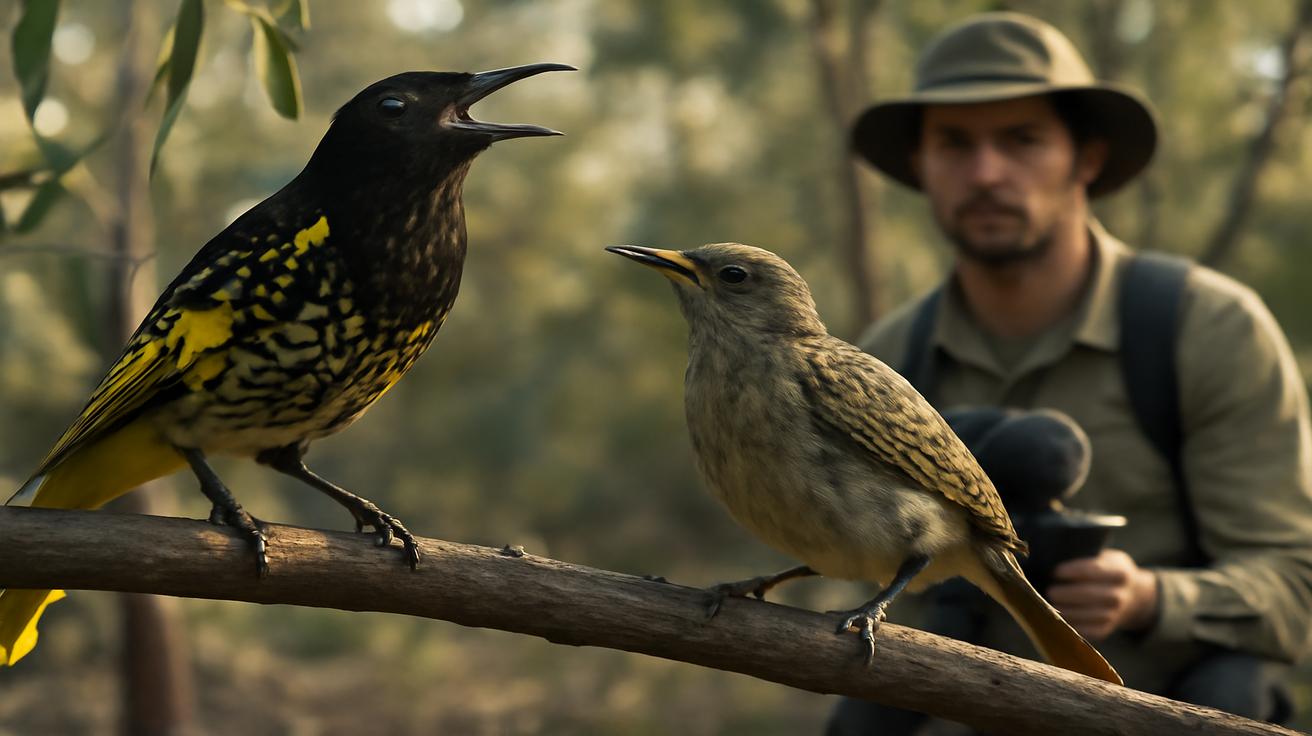
The young bird opens his beak, but nothing comes out that sounds quite right. Around him, the eucalyptus woodland hums with life – cicadas buzz, leaves whisper, a distant kookaburra cackles – yet the song inside his chest is a jumble of borrowed notes that don’t belong to his kind. He tries again, stringing together a magpie phrase here, a friarbird trill there, until the attempt dissolves into silence. For a regent honeyeater, one of the rarest birds on Earth, losing his song is more than embarrassing. It’s dangerous. And it might mean the end of his species.
The Bird That Forgot Its Own Voice
Regent honeyeaters once stitched sound through the woodlands of south-eastern Australia in great, bustling flocks. People described them as little flickers of sunshine in the trees: sleek black birds spattered with yellow-gold scales on their wings, tails dipped in lemon, their voices thick with complex phrases and liquid whistles. They were the soundtrack of flowering eucalypt forests – especially when the ironbarks and box trees oozed nectar.
Now, silence hangs where their chorus should be. Fewer than 300 to 400 regent honeyeaters are thought to remain in the wild, scattered like stray punctuation marks across a heavily edited landscape. Woodland has been cleared, hollow-bearing trees have fallen, and the great nectar flows that once drew hundreds of honeyeaters together have thinned to a trickle. With the land went the birds. And with the birds went something no one had expected to lose: the regent honeyeater’s song itself.
Bird songs are not simply written in DNA. Many species learn to sing the way we learn language: by listening, imitating, practicing, and refining. Young regent honeyeaters used to grow up in bustling acoustic cities, surrounded by older males throwing out intricate, warbling riffs that could be heard hundreds of metres away. Those songs were cultural treasures, passed from generation to generation.
But when a species shrinks to a few lonely survivors, the song network collapses. Fledglings, instead of being immersed in a rich chorus of their own kind, grow up in a patchwork of other species. And so, they copy what they hear: red wattlebirds, little wattlebirds, noisy friarbirds. Researchers listening to the thin chorus of regent honeyeaters began to notice something unsettling. Many young males were no longer singing regent honeyeater songs at all.
The Day Scientists Realised the Music Was Gone
On an autumn morning in a patch of New South Wales woodland, ecologist Ross Crates stands very still beneath a scribbly gum, microphone lifted to the canopy. A male regent honeyeater is perched above him, bright-eyed, chest puffed. It’s the sort of bird you’d expect to be belting out the avian equivalent of an aria. Instead, the bird delivers a halting string of notes that sounds, to Crates, unmistakably like a different species.
The moment lands with a thud. If a male regent honeyeater can’t sing like a regent honeyeater, how will a female recognise him as a suitable mate? Song is more than background music in the bird world. It’s a neon sign: “I am healthy, I am strong, I am one of your kind.” A mistaken tune is like showing up to a black-tie event in someone else’s uniform.
Crates and his colleagues begin to collect recordings across the bird’s remaining range. The pattern is stark. The rarer the honeyeaters are in a region, the more likely the males are to sing the wrong thing. A few individuals never sing at all. The species is not just critically endangered in number – it is culturally endangered.
That realisation pushes the conservation team into a new frontier. Saving habitat, protecting nests, and running a captive breeding program – these were all critical. But suddenly, another question loomed: how do you save a song?
When Captive Birds Needed Wild Teachers
Inside aviaries at breeding centres, regent honeyeaters sit in neat rows of tussock grass and eucalyptus branches, their yellow flashes dulled slightly by wire mesh and shade cloth. These birds are a living insurance policy. When wild numbers dip too low, captive-bred birds can be released to boost the population. Yet by the late 2010s, conservationists noticed that some of their carefully raised honeyeaters were making the same mistakes as those in the wild.
Captive juveniles, kept far from the last wild songmasters, sometimes invented simplified tunes or, in an eerie echo of their cousins outside, copied the species next door. The team could play recordings of wild regent honeyeater songs over speakers – and they did – but something was missing. It’s one thing to hear a disembodied voice. It’s another to watch, in the flesh, as an adult bird throws his entire body into performance, throat vibrating, wings flicking, posture shifting with every note.
So the scientists tried a bold experiment that sounds almost like a children’s story: they recruited wild-born birds as music teachers.
When wild birds were caught for health checks or when injured individuals were brought into care and recovered fully, some stayed on – not as permanent captives, but as cultural custodians. These wild-born males, who still carried fragments of the “old language,” were housed near younger, captive-bred birds. Mesh separated them, but the air between was thin and electric with sound.
In those aviaries, early in the morning when mist still clung to the wire, you could hear the first, tentative notes of mimicry. Young males practiced under their breath, almost shyly at first, their songs slowly bending toward the wilder, more complex patterns drifting across from the teacher’s perch. The goal was simple and wildly ambitious at once: to restore a song tradition in real time.
How Do You Teach a Bird to Be a Bird?
The training process is patient, almost meditative. Keepers arrange the aviaries so that young birds have a clear line of sight and sound to their wild-born tutors. They reduce competing noise wherever possible, keeping other species at a distance. At dawn and dusk – prime song hours – staff often pause their work to simply listen, making quiet notes on who is singing what.
Researchers record the birds and later analyse the songs spectrographically, turning sound into visual patterns of pitch and timing. From these visual signatures, they can see whether young birds are approximating wild regent honeyeater syntax – not just individual notes, but the phrasing, the rises and falls that form a true dialect.
In some cases, tutors are given the best of both worlds: they sing live and their voices are also recorded, becoming part of a growing library of reference songs. Those libraries are then played to other captive birds that can’t be housed nearby, spreading the cultural repair project across different facilities.
It is, in essence, a school – complete with role models, homework (practice, practice, practice), and testing. Only the tests happen when the birds are finally released into the wild, and their examiners are female honeyeaters waiting to judge whether a suitor sounds like home.
The High Stakes of a Love Song
For a regent honeyeater, courtship is an art form. Picture a male in a flowering ironbark tree, nectar glistening at his feet. He puffs his chest, smooths his feathers, and breaks into song. The call is rich and liquid, rolling through the branches. Nearby, a female pauses. She knows that song. It has the right structure, the right accent. It tells her that this male is one of her dwindling kind, that he has learned correctly despite the shrinking chorus around him.
A male singing the wrong song faces a double problem. Females may simply ignore him, unable to interpret his muddled repertoire as a mating signal. Or they may be attracted to the “wrong” call altogether, drawn instead to the more robust populations of other honeyeater species. Either way, the regent honeyeater’s own lineage falters. Even a healthy, genetically valuable male is effectively muted if his culture has frayed.
This is why the song-training program is not some charming side project; it’s core survival work. When captive-bred birds that have learned from wild-born tutors are released into the bush, conservationists watch and listen closely. Do the males sing full, species-typical songs? Do females approach them? Do they pair up, build nests, feed chicks?
In recent years, the answer has been encouraging. Males that trained with wild tutors are more likely to produce strong, recognisable regent honeyeater songs. Some of them have been observed forming pairs and successfully breeding in the wild, threading their reclaimed music back into the fragile population.
What Song Loss Tells Us About Culture in Animals
The regent honeyeater’s story unsettles a comfortable assumption: that culture – the passing on of learned behaviours, traditions, and communication – is a human monopoly. Here is a bird whose future may hinge on whether elders can still show youngsters “how we do things here.”
In whales, we know that distinct pods have signature calls, hunting techniques, and travel routes passed down through generations. Some primates teach their young specific ways of cracking nuts or fishing for termites. Songbirds demonstrate that culture doesn’t require hands or tools; it can live in the air, shaped as sound.
When a species becomes rare, it doesn’t just lose numbers. It can lose its instructions for being itself. A small, scattered population can forget where to migrate, what to eat, how to court, even how to raise young. The regent honeyeater shows this in sharp focus. Its crisis is not just ecological but cultural.
Conservationists are now paying more attention to these invisible threads. Protecting habitat and genes remains crucial, but protecting knowledge – songs, migrations, foraging tricks – is emerging as an equally vital frontier. In this light, importing wild-born tutors into captive facilities is not a quirky side note, but a deliberate act of cultural rescue.
Inside the Classroom: A Snapshot of Song Recovery
Imagine walking down a narrow path between aviaries just after sunrise. Cool air carries the smell of damp soil and eucalyptus oil. From one enclosure, a jumble of calls erupts – bellbirds, rosellas, a scrappy chorus of everyday woodland life. And then you hear a thread of something rarer: a looping, fluted sequence that seems to pour rather than pulse. A wild-born regent honeyeater is warming up.
Inside his aviary, he flicks his wings and arcs his body, repeating the sequence with subtle variations. In the next enclosure, a juvenile male cocks his head. His feathers are still a little uneven, his movements not quite as sure. He tries to repeat the phrase, and what comes out is warped, tentative. He stops, listens again, tries once more. Day after day, the exchange continues, notes tightening into recognisable patterns.
Technicians move quietly among the aviaries, topping up nectar feeders, hanging blossom-laden branches, checking nest boxes. Their notebooks fill with observations: which birds sing most at dawn, who responds to whom, when a new phrase appears. Over months, the soundscape shifts. More and more juveniles begin to sound less like their noisy neighbours and more like their dwindling wild counterparts.
To capture and track this delicate progress, researchers often summarise their observations and outcomes in clear, simple formats. One way of visualising the program’s impact is through a compact overview like the table below.
| Aspect | Before Wild Tutors | After Wild Tutors Introduced |
|---|---|---|
| Song accuracy in juveniles | Often simplified or copied from other species | Closer match to wild regent honeyeater song patterns |
| Female response to captive-bred males | Inconsistent; some males largely ignored | Higher interest where songs are species-typical |
| Release success indicators | Mixed pairing and breeding outcomes | Improved pairing rates and observed nesting |
| Cultural continuity | Song traditions fragmenting or vanishing | Key song elements actively preserved and passed on |
Each row in that table represents months of early mornings, careful listening, and tiny, hopeful corrections. It also hints at something more profound: the idea that culture, once broken, can sometimes be mended – if someone is still around who remembers the tune.
Listening as an Act of Conservation
Out in the field, conservationists and volunteers perform another kind of quiet labour: they listen. Armed with binoculars, notebooks, and recorders, they spread out through flowering woodlands, straining for the faintest threads of song. Often, what they hear are the loud, familiar calls of common species. But now and then, a subtle, liquid phrase slides through the din.
Finding a regent honeyeater by ear can feel like discovering a relic from another age. Every sighting, every recording, is logged with coordinates and details about behaviour and habitat. These data build a map of where the last wild singers still hold on, which patches of forest produce fledged chicks, and where future releases of trained, captive-bred birds might stand the best chance of success.
The work doesn’t come with trumpets or fanfare. Often, it’s just a handful of people standing under a grey sky, necks craned, fingers stiff from the cold, waiting. Yet this patient listening is as crucial as planting trees or fencing off remnant woodland. Without knowing where the wild singers are, you can’t place their pupils. Without tracking the songs that echo after each release, you can’t know if your teaching worked.
The Fragile Future of a Repaired Chorus
It’s tempting to wish for a neat ending: wild-born tutors pass on their knowledge, captive-bred birds step into the trees singing perfectly, the population rebounds, and the regent honeyeater’s golden flicker becomes common again. Reality is less tidy. The species remains on a razor’s edge, its fate tethered to decisions about land clearing, climate change, and long-term funding as much as to the songs themselves.
Yet the story unfolding in aviaries and remnant woodlands offers something rare in conservation: genuine, evidence-based hope. We now know that some aspects of animal culture can be deliberately supported, even revived. We know that a bird’s song, once thought of as a pleasant side effect of its biology, is in fact a core part of its survival strategy. And we know that humans can, with humility and patience, act not only as habitat stewards but as facilitators of cultural continuity in other species.
Somewhere right now, in a stand of flowering eucalypts, a male regent honeyeater is singing. Maybe he learned from a wild father. Maybe he learned from a tutor who once knew only the scattered echoes of a larger chorus. Maybe he learned from a bird that grew up behind mesh, listening intently each dawn. To a passing walker, the song may register as just another pretty sound in the bush. But contained in those notes is a remarkable act of rescue – not just of a species, but of its voice.
FAQs
Why did regent honeyeaters start losing their song?
As regent honeyeater numbers declined and birds became more scattered, young males had fewer adult role models of their own species to learn from. Growing up surrounded by other, more common birds, they began copying the wrong songs or producing simplified versions, leading to a gradual loss of traditional regent honeyeater song culture.
How can a “wrong” song affect the species’ survival?
Females use song as a key signal for choosing mates. If males sing the wrong song, females may not recognise them as suitable partners, which can reduce successful breeding. In a critically endangered species, even small drops in breeding success can have serious long-term effects.
What does it mean that wild-born birds are recruited as tutors?
Wild-born regent honeyeaters that still sing species-typical songs are brought into captive breeding facilities, often temporarily, and housed near younger, captive-bred birds. These experienced males act as live role models, allowing juveniles to hear and imitate authentic regent honeyeater songs.
Is playing recordings not enough to teach the song?
Recordings help, but live tutors provide richer, more dynamic learning. Young birds can observe the full performance – posture, timing, and social context – not just the sound. Combining recordings with wild-born tutors appears to produce more accurate, natural song learning.
Has the song-teaching program shown results?
Early evidence suggests that captive-bred males who trained with wild-born tutors are more likely to sing recognisable regent honeyeater songs. Some of these males have successfully formed pairs and bred in the wild after release, indicating that song restoration is improving their chances of contributing to the population.
Can this approach help other endangered species?
Yes. The regent honeyeater case highlights the importance of culture – including song and learned behaviours – in conservation. Similar approaches might support other species that rely heavily on learned communication or traditions, such as whales, other songbirds, and some primates.
What is the biggest challenge the regent honeyeater still faces?
Even with song restoration, the species remains critically endangered due to habitat loss and fragmentation. Protecting and restoring suitable woodland, maintaining nectar-rich flowering trees, and ensuring long-term support for both habitat and cultural conservation are all essential for the regent honeyeater’s future.