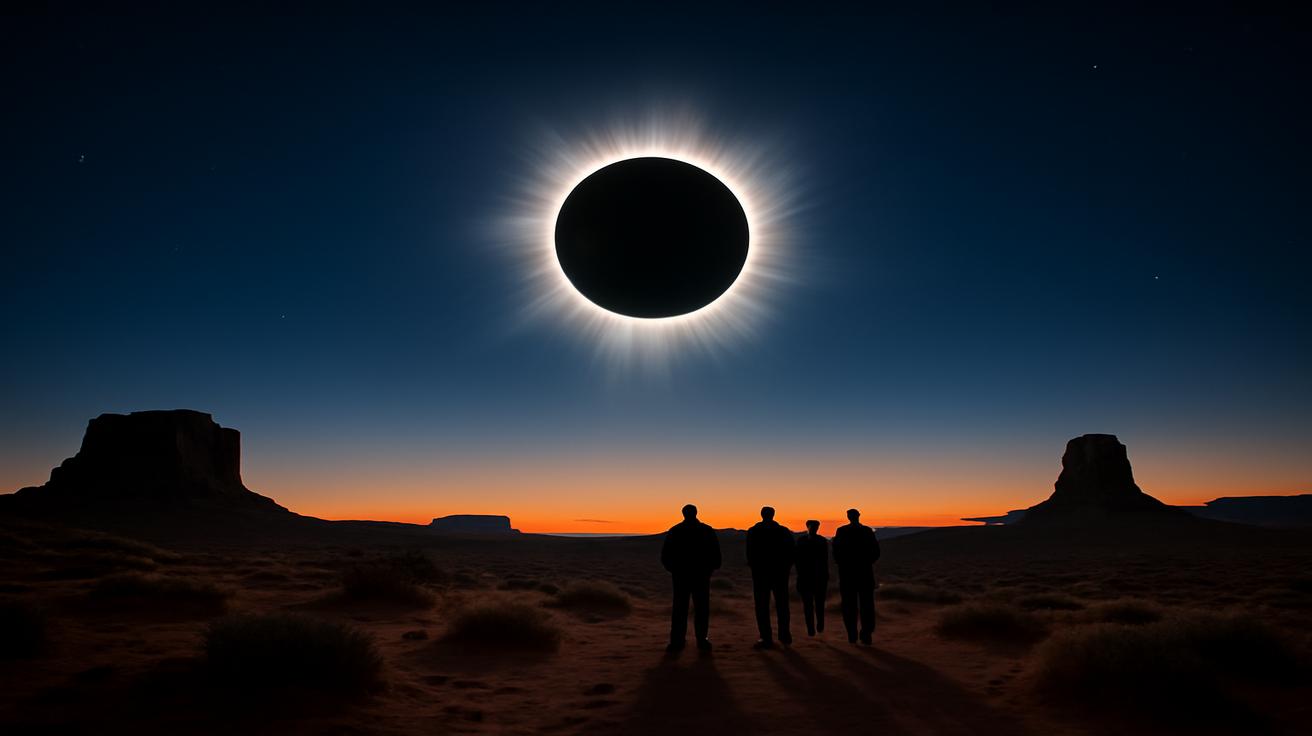
The first thing you notice is the hush. Not silence, exactly, but a soft lowering of the world’s volume, as if someone has rested a gentle finger on the planet’s dimmer switch. Birds reshuffle on their branches. A dog, three yards over, lifts its head and turns in a slow, puzzled circle. You look down at your watch, then back at the sky, and your brain insists you must be wrong: it cannot be getting dark at this hour. But it is. In a matter of minutes, in the middle of the day, the brightest thing you know will wink out—and for a few impossible heartbeats, day will turn to night during the longest total solar eclipse of the century.
The Longest Blink of the Century
Most of the time, eclipses are like celestial sleight-of-hand: impressive, fleeting, and gone before you’ve fully understood what you’ve just witnessed. But this time is different. This eclipse is being called the longest total solar eclipse of the century, a rare arrangement of cosmic geometry that will draw a dark line across the Earth and hold it there, just a little longer than usual.
On the ground, that means something astonishing. Instead of the typical two or so minutes of totality—that eerie, open-mouthed moment when the Moon fully covers the Sun—some locations along the path will sink into an uncanny, bruised twilight for several long minutes. Not long in human clocks, perhaps, but in the language of our bodies and our instincts—creatures that have evolved to trust the Sun’s steady rise and fall—it will feel endless.
Imagine standing in a field or on a rooftop or in the middle of a small city street. The air is warm and ordinary. People have gathered with paper glasses and homemade pinhole projectors. Maybe you had to travel to get here—driving overnight, catching a train, sharing a ride with strangers who didn’t feel like strangers by the end. The anticipation has been building for months: news stories, diagrams, animated simulations. You’ve seen the maps of the “path of totality,” that narrow, serpentine track across the globe where the eclipse will be complete and not just partial.
Now you’re in it. Right in the path. You’re a tiny dot on a spinning sphere, lining up perfectly with the only two celestial bodies that have ever truly ruled your days and nights. And as the Moon slides between you and the Sun, that long, improbable alignment becomes something you can feel on your skin.
Why This Eclipse Lasts So Long
To understand why this particular eclipse will linger, you have to picture an enormous clockwork system, all gears and quiet precision. The Sun blazes at the center. The Earth circles it, tilted just so. The Moon circles the Earth in an orbit that is slightly oval, not a perfect circle. Sometimes the Moon is closer to us (at perigee), sometimes farther (at apogee). It’s this subtle change in distance that’s crucial.
When a total solar eclipse happens while the Moon is near its closest point to Earth, its apparent size in the sky grows just enough to cover the Sun more fully and for a little longer. At the same time, the Earth’s own distance from the Sun matters. When the Earth is near its farthest point from the Sun, our star appears a hair smaller to us. A big-looking Moon and a slightly smaller-appearing Sun make for a deeper and longer eclipse.
Layer on top of that the angle of the Moon’s shadow, the curvature of the Earth, and exactly where that shadow traces across our planet, and you get a rare sweet spot: a solar eclipse that doesn’t just race past in a dramatic sprint, but stretches into a long, slow, breathless exhale of darkness.
For observers within the path of totality, the difference between two minutes and, say, six or seven minutes of darkness is the difference between a gasp and a full, stunned contemplation. Those extra minutes will give you time to notice things you would otherwise miss—and time, perhaps, to feel a quiet, unsettling awe.
How the World Changes When the Sun Goes Out
As the Moon begins to eat into the Sun’s bright disc, the light around you starts to change in ways your language doesn’t quite know how to handle. It’s still daytime, but not the right kind of daytime. Shadows sharpen like knife edges. Colors wash into peculiar, silvery versions of themselves. The air cools, a soft-rolling wave across fields, parking lots, city parks.
Animals feel it first. Birds fall silent or burst into confused calls. Bees hurry home. Cows, in some places, will wander back toward their barns as if evening has come early. You might see flowers that close at night begin to fold their petals. The eclipse confuses them, a temporary lie told to their inner clocks.
There is, too, a shift in human behavior that is hard to describe until you’ve been inside it. People who have spent the morning making small talk fall quiet. Phones, raised to the sky, lower a little. When the last sliver of Sun narrows, the world around you takes on the feel of a stage just before the curtain comes down—a held breath shared by thousands of lungs.
And then the light goes strange. Not gone yet, but thin. Your brain whispers that something is wrong, wrong with the physics you’ve trusted since childhood. You put on your eclipse glasses and watch the final arc of the Sun narrow to a crescent as sharp and bright as a scythe. Wind picks up, or seems to. A ring of darkness tightens across the land. Day becomes dusk, then something darker than dusk.
The Moment of Totality
In the instant the Moon fully covers the Sun, you are allowed—finally, safely—to take off your glasses and look up with bare eyes. What you see in that first heartbeat might stay with you for the rest of your life.
The Sun, which has always been a flat, blunt brightness you cannot stare at, becomes suddenly intricate. A perfect black circle hangs in the sky, not empty but full, edged with wild white fire. This white fire is the solar corona, a silky, ghostly halo of plasma that usually hides behind the Sun’s overwhelming glare. During totality, the corona stretches outward in pearled streamers, bending and fluttering according to the Sun’s magnetic moods.
Stars wink into view. Planets you know only as dots on classroom posters appear, small but sharp. Venus may blaze near the horizon. The sky overhead deepens to a color that is not quite night, but not any shade of day you’ve seen. All around you, in a 360-degree circle, the horizon glows like a false sunset, a ring of orange and pink encircling the darkened dome of sky.
The longest total solar eclipse of the century means you’ll have time—precious, extended seconds—to trace these details. To follow the delicate arcs of the corona with your eyes. To notice faint pink flares along the Sun’s edge, called prominences, curling into space like petals of electric rose. To drop your gaze to the land and see the faces around you lit by strange, theater-like light.
Some people laugh. Others cry, quietly, surprised by their own tears. You might feel your skin prickle, the hairs on your arms lifting as if reacting to some ancient alarm coded deep in your body: the Sun has vanished. For a moment, you stand in a world unmoored from its usual assurances. And in that disorientation, many people report the same thing: a sudden, profound connectedness. To the sky, to the ground, to the strangers standing next to them, all of you small under the same improbable shadow.
Where and How Long: The Path of Shadow
Eclipses are not democratic; they do not share themselves equally. To experience totality, you must step into the Moon’s narrow shadow, a path that can be only a few hundred kilometers wide. Outside that band, you may still see a partial eclipse—an impressive bite taken from the Sun—but not the full plunge into midday night.
For this longest eclipse of the century, the exact path has been mapped with exquisite precision by astronomers. They can tell you which towns and cities will taste the full darkness and how many seconds of totality each place will receive. Those numbers might look cold on paper, rows of figures marching across a page. But to the people beneath them, they will be measured in shouts, gasps, and trembling fingers pointing skyward.
Below is an example of how viewing experiences can differ depending on where you stand along the path of totality. (Times are illustrative, not location-specific.)
| Location Position Along Path | Approx. Duration of Totality | Experience in the Sky |
|---|---|---|
| Near Western Edge | 2–3 minutes | Rapid darkening and brightening, brief glimpse of corona |
| Central Path (Maximum Eclipse Zone) | 6–7+ minutes | Extended twilight, detailed corona structure, multiple planets visible |
| Near Eastern Edge | 3–4 minutes | Noticeable temperature drop, quick but dramatic shadow movement |
| Outside Path (Partial Eclipse) | No totality | Sun becomes crescent, light dims but sky never turns fully dark |
If you live far from the path, you may find yourself tempted into an impromptu pilgrimage. People cross continents for eclipses. They fill remote motels, camp on mountain ridges, and trade weather forecasts like gossip. It might feel excessive—until you’ve stood in the shadow yourself.
Chasing the Shadow: The Human Eclipse Migration
Long before modern astronomy could predict them, eclipses were omens. The sudden disappearance of the Sun was read as anger from gods, warnings to kings, ruptures in the normal fabric of existence. Today, we know exactly why and when they happen. Yet the emotional undercurrent hasn’t gone away. If anything, knowledge has sharpened the hunger to witness them.
In the months before this longest eclipse, a quiet migration will begin. Amateur astronomers polish their telescopes and check their solar filters. Families plan road trips along the shadow’s path, drawing thick lines across paper maps or tapping waypoints into their phones. Photographers obsess over lenses, timers, and exposure bracketing, wondering how to capture something that never fully translates into pixels.
Then there are the eclipse chasers, a worldwide tribe of people who shape their lives around these brief encounters with shadow. They count their eclipses the way mountaineers count summits. For them, this event is not just another date on a calendar; it’s a rare, deep chapter in a personal story that stretches from continent to continent. They will be there—on ship decks, desert plateaus, high ridges, and quiet farmland—watching the same Moon draw its traveling curtain of darkness across the Sun.
Preparing for Your Glimpse of Midnight Noon
If this eclipse falls within your reach, even remotely, it is worth preparing for—not just logistically, but emotionally. Because for all the science, an eclipse is also an encounter with your own smallness and your own curiosity.
First, the practicalities. You will need proper eye protection for every moment except totality itself. Certified eclipse glasses or handheld viewers are not suggestions; they are non-negotiable. Looking directly at the Sun, even when most of it is covered, can permanently damage your vision. The same goes for telescopes, cameras, or binoculars: they require special solar filters designed for safe viewing.
Next, choose your location with care. Cloud cover is the merciless wildcard of eclipse-watching. A town with a slightly better weather record, even 50 or 100 kilometers down the road, can change everything. Arrive early; traffic jams and crowded parking lots are near-certainties along the path. Bring more water, snacks, and layers of clothing than you think you’ll need. As the Sun’s warmth dims, temperatures can drop quickly.
Then, consider how you want to experience the eclipse itself. Photographs are wonderful, but they can also steal your attention from the raw presence of the moment. Many veteran eclipse hunters recommend a compromise: set up your camera in advance, automate as much as you can, and when totality comes, step away from the equipment. Look up. Feel the darkness happen to you.
What to Watch For, Moment by Moment
If you know what to look for, the eclipse becomes even richer. When the Sun is mostly covered but not yet total, glance at the ground beneath trees: the small gaps between leaves act as pinhole projectors, scattering hundreds of tiny crescent Suns across sidewalks and walls. In the last seconds before totality, watch for the “diamond ring” effect—a single brilliant bead of sunlight flaring at the Moon’s edge, like a jewel on a darkened band.
During totality, after you’ve gasped at the corona and swept your eyes across the sky, look quickly at the horizon. You may see that strange ring of sunset color circling the world. Pay attention to how your body feels: the cooler air, the shift in wind, the goosebumps. Listen for the sounds—or the absences of sound—around you. Somewhere nearby, a rooster might crow at the wrong time.
As the Sun begins to reemerge, the experience plays in reverse. Light leaks back into the world, tentative at first, then bolder. Time, which felt briefly suspended, resumes its usual forward stride. People cheer, clap, hug each other. Some stand quietly, hands still on their chests. The spell breaks, but something subtle has shifted in you. The ordinary Sun overhead seems, oddly, like a returned friend you’d almost taken for granted.
When the Lights Come Back On
By the time evening rolls around for real, many hours after the shadow has moved on, you might find yourself replaying the day in fragments. The way the light drained from the landscape. The ring of fire in the sky. The hush. The way absolute darkness arrived and then receded, all according to a pattern humans have now mapped centuries into the future.
That might be one of the most humbling parts: knowing that while this eclipse feels deeply personal—your experience, your memory—it is also just one act in a cosmic choreography that has been repeating for eons. Long before humans could speak, the Moon’s shadow was racing across oceans and forests. Long after we are gone, it will still be there, carving its temporary rivers of night across other eyes, other worlds of watchers.
In that sense, the longest total solar eclipse of the century is both a rarity and a reminder. Rare because of its length, its geometry, its perfect alignment within our particular lifetime. A reminder because it shows us, nakedly, that we live on a planet that moves, spins, tilts, and dances through space, whether we acknowledge it or not. It is a physical proof that we are in motion, part of a system, not the center of it.
When day turns to night in the middle of your afternoon, you are given a brief audition for a new perspective. The office deadlines, the traffic lights, the to-do lists—they all shrink under a sky that can, with one sweeping gesture, rearrange the meaning of “normal.” For a few breaths, the universe leans close and whispers: This is bigger than you, and you are still a part of it.
And then the Sun returns, as it always does, bright and indifferent and utterly necessary. You pack up your chair, fold your glasses into a pocket, brush dust from your shoes. Life goes on. But somewhere inside, the memory of midday midnight glows like a secret ember. You were there when day became night and back again, under the long, dark hand of the Moon. You watched the sky open and close. You felt, however briefly, the turning of the world.
Frequently Asked Questions
Is it safe to look at a total solar eclipse?
It is safe to look at the eclipse with your naked eyes only during the brief period of totality, when the Sun is completely covered by the Moon. At all other times—before and after totality—you must use proper, certified eclipse glasses or solar viewers. Never look at the partially covered Sun through regular sunglasses, cameras, binoculars, or telescopes without special solar filters.
Why is this eclipse considered the longest of the century?
This eclipse earns that title because the alignment of the Earth, Moon, and Sun allows the Moon’s central shadow to linger over some locations for several minutes longer than typical total eclipses. The Moon will be near its closest point to Earth, the Earth will be relatively far from the Sun, and the path of the shadow will cross regions that maximize the duration of totality.
Will everyone on Earth see day turn to night?
No. Only people within the narrow path of totality will experience the Sun being completely covered and the sudden deep twilight of midday darkness. Others outside that path may see a partial eclipse, where the Sun looks like a bitten disc or crescent, but daylight never fully gives way to night.
Do animals really behave differently during an eclipse?
Yes. Many animals respond to the rapid darkening as if night is arriving. Birds may roost or fall silent, insects that sing at night might begin calling, and livestock can start moving toward their evening shelters. These behaviors vary by species and location but are commonly reported during total eclipses.
How often do total solar eclipses happen?
Somewhere on Earth, a total solar eclipse happens roughly every 18 months on average. However, any given spot on the planet might wait hundreds of years between total eclipses. That’s why people often travel long distances to step into the Moon’s shadow.
What’s the difference between a total and an annular solar eclipse?
In a total solar eclipse, the Moon appears large enough to completely cover the Sun, revealing the Sun’s corona and turning day briefly to night. In an annular eclipse, the Moon is slightly farther from Earth and appears smaller, so it never fully covers the Sun; instead, a bright ring of sunlight remains visible around the Moon’s dark disk, and the sky never gets as dark as in totality.
Why do people travel so far to see eclipses?
For many, a total solar eclipse is a once-in-a-lifetime experience—a visceral, emotional event that photographs and videos cannot fully convey. The sudden darkness, the visible corona, the eerie light, and the shared reaction of everyone around create a powerful, unforgettable moment. That combination of rarity and intensity is what draws people across countries and oceans to stand, for a few minutes, beneath the Moon’s moving shadow.