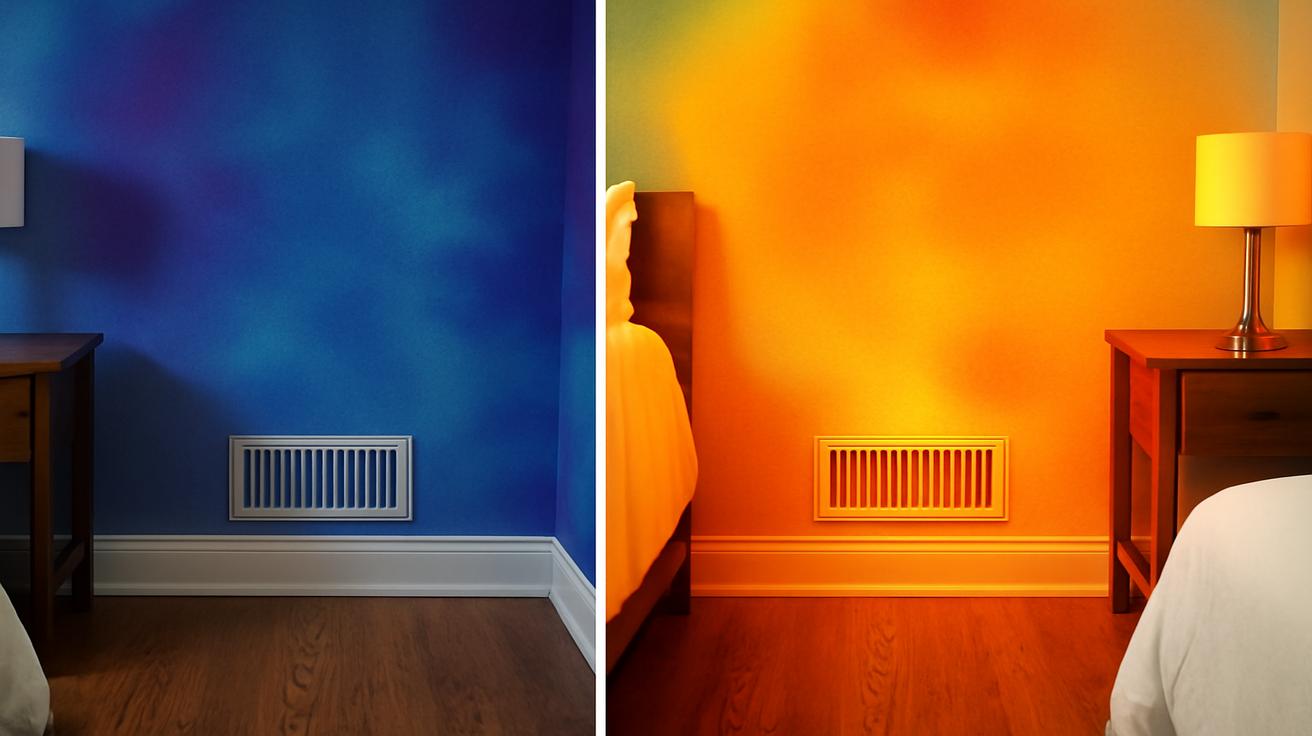
The first time I heard someone say, “Just close the vents in the guest room—no sense heating it in winter,” I was standing in a dim hallway that smelled faintly of dust and laundry detergent. A baseboard creaked as the furnace kicked on somewhere below our feet, pushing warm air through the hidden veins of the house. The homeowner, bundled in a thick sweater, twisted the metal vent cover with the satisfaction of someone who believed they’d just outsmarted their utility company.
It sounded logical, almost elegant in its simplicity: shut off the heat to the rooms you hardly use, and your home will stay warmer where it matters—while your energy bill shrinks. This idea has spread quietly from neighbor to neighbor, from parent to child, riding along with winter as reliably as frost on the windows.
But when you follow that logic down into the basement, past the paint cans and holiday decorations, to where the furnace hums and the ductwork sprawls like a gleaming metal octopus, the story begins to change. Talk to HVAC pros—the people who spend their days crawling through crawl spaces and attics, fixing the consequences of our well-meaning “hacks”—and you’ll hear a different tale entirely.
The Cozy Illusion: Why Closing Vents Seems Like a Good Idea
The myth often starts in that one chilly room at the end of the hallway—the seldom-used guest bedroom, maybe, or the craft room that sees more dust than hobbies. You stand in the doorway, feel the cool air, and look down at the vent in the floor or along the wall. You picture all that heat pouring into a space no one uses. It feels like waste.
In your mind, the house becomes a kind of pie chart. If you “turn off” 20% of the house by closing vents, doesn’t that mean the remaining 80% gets more heat, more quickly, and with less effort? It’s such a tidy mental image that your hand moves almost automatically to the vent lever.
Many people do this with a touch of secret pride, like discovering a loophole in an energy bill no one wants to pay. Friends reinforce it: “Oh, we always close the vents in the back bedrooms. Saves us a ton.” And because no disaster happens immediately, the myth settles in deeper, wrapped in the invisible comfort of confirmation bias.
But a forced-air heating system is not a faucet you can just “turn off” in one room and expect the rest to gush more generously. It’s a carefully balanced system—pressure, airflow, temperature—designed as a whole. And when you start closing vents, you’re not just changing where the heat goes; you’re changing how the entire system has to move and work.
What Your Furnace Is Actually Trying to Do (And Why Vents Matter)
An HVAC technician once described a house’s ductwork to me this way: “Imagine lung passages made of metal.” Your furnace is the beating heart and lungs combined, drawing in cool air, warming it up, and pushing it back out along a loop designed for a specific size of home and number of open vents.
Every vent was accounted for when the system was installed—whether that installation was careful and professional or rushed and imperfect. The blower inside your furnace is sized to move a particular volume of air, called airflow, through a particular amount of ductwork resistance, called static pressure.
When all the vents are open, the furnace is like a runner jogging at a steady pace on a flat path. Closing vents is like suddenly blocking part of that path and expecting the runner to just “try harder” without consequence. In reality, that runner will start to strain.
Here’s where the science quietly trumps the myth: when you close vents, you’re not turning the furnace “down” in that area. You’re just making it harder for the furnace to move air. The blower still tries to move the same amount of air it was designed for—but now it encounters more resistance. Static pressure increases. Airflow through the system changes in ways the designer never intended.
The result can be counterintuitive. Instead of protecting your system and saving energy, you might be causing it to run longer, less efficiently, and under more stress. In some cases, you may even be shortening the furnace’s life.
The Hidden Costs: What HVAC Pros See After Years of Closed Vents
Ask an HVAC pro about closed vents, and you’ll likely trigger a flood of stories: burned-out blower motors, furnaces short-cycling, evaporator coils freezing up on the AC side, cracked heat exchangers, or hot and cold spots that no amount of thermostat fiddling can fix.
One veteran technician described a home where almost half the vents had been closed “to save money.” The furnace was roaring like a wind tunnel in the basement. Ducts rattled. Upstairs, some rooms were hot while others were still oddly cold. The system’s static pressure was so high that air was whistling through the smallest gaps it could find, forcing dust deeper into the home and leaking conditioned air into the walls and attic.
The homeowners thought the closed vents were helping them. In reality, their furnace was straining against a chokehold they’d unknowingly created. It had been running hotter, working harder, and failing more often—all while they patted themselves on the back for being “energy efficient.”
What HVAC pros see, over and over, is that closing vents doesn’t magically “redirect” heat. Instead, it unbalances an already delicate system, sometimes in irreversible ways.
Why Closing Vents Usually Doesn’t Save Energy
To understand the energy myth, picture this: your furnace cycles on when the thermostat senses the air temperature has fallen below a set point. Its job is to raise the temperature of the air in your home—on average—back to that target. Whether a few vents are closed doesn’t change what the thermostat feels in the main living space.
If the thermostat is in your hallway, living room, or main bedroom, that’s what the furnace is trying to please. The blower speed and fuel consumption are based on how long it takes to get that central space up to temperature, not whether your guest room is “turned off.”
When vents are closed and static pressure goes up, several subtle things can happen:
- The furnace may move less air overall, even though it’s burning the same amount of fuel.
- The air coming out of the supply vents may get hotter, but in a reduced volume.
- Heat can build up inside the furnace, causing limit switches to trip and shut the burner off early (short-cycling).
- The system may compensate by running longer to satisfy the thermostat.
All of these reduce efficiency. So while you might have “saved” some air from going into that unused room, you’re often forcing the system to run in a less efficient, more stressed state. It’s a bit like blocking half the car’s exhaust pipe and then wondering why the engine sounds angry and drinks more gas.
There’s another subtle side effect: closed-off rooms don’t just sit there politely. They start to drift out of balance with the rest of the house—sometimes getting drastically colder. Cold rooms can pull heat from adjacent spaces through walls and floors, like a quiet thermal tug-of-war you never see but definitely feel. Ironically, your heated rooms may have to work harder to compensate.
Comfort Isn’t Just About Heat—It’s About Airflow and Balance
Comfort isn’t a simple number on a thermostat. It’s the combination of air temperature, surface temperature (how cold the walls or windows feel), humidity, and airflow. Closing vents disrupts one of those pillars: the movement of air itself.
When a vent is closed, less conditioned air moves through that duct branch. The air inside cools faster, sometimes allowing condensation in certain conditions. Long-term, that can encourage dust buildup or even mold in duct runs routed through damp basements or humid crawlspaces.
Meanwhile, rooms designed to receive a steady trickle of warm air become stagnant pockets. Air stratifies; cold sinks toward the floor. If you’ve ever stepped into a “shut-off” room in midwinter and felt that particular dead chill, you know the feeling. The house stops acting as one breathing organism and becomes a patchwork of microclimates.
On the return side of the system, closed doors and closed vents can starve the furnace of the air it needs to pull back for reheating. Some HVAC pros will tell you: they’d rather see a barely used room with its vent open and the door slightly ajar than a sealed, stale, frigid box slowly pulling drafts from wherever it can.
What You Can Do Instead of Closing Vents
If you’re tempted to close vents because certain rooms always feel too warm or too cold, your house is sending you a message. But it’s usually not the message you think. Instead of “shut me off,” it may be saying “I’m out of balance” or “I was never properly designed.”
There are more effective—and safer—ways to improve comfort and reduce energy use without stressing your HVAC system:
- Use dampers in the ductwork (if available): Many systems have manual dampers on the trunk lines in the basement. These are made to adjust airflow more gradually than snapping a vent fully shut.
- Consider a zoning system: Professionally installed zoning uses dedicated dampers, thermostats, and control boards to safely direct air where it’s needed.
- Seal and insulate: Often, the coldest rooms aren’t underheated—they’re under-insulated or leaky. Windows, attic hatches, wall cavities, and rim joists can all leak heat like a sieve.
- Balance the system: An HVAC pro can measure airflow and static pressure and adjust dampers or registers to even out the temperatures room-by-room.
- Upgrade the thermostat: Smart or programmable thermostats can fine-tune run times and schedules so you’re not blasting heat when no one is home.
These approaches work with your system instead of against it. They respect the realities of airflow and pressure that a simple vent lever ignores.
A Quick Comparison: Closed Vents vs Better Strategies
| Approach | Short-Term Effect | Long-Term Impact |
|---|---|---|
| Closing Supply Vents | May slightly warm nearby rooms, leaves others colder and stuffy | Increased static pressure, stress on blower, potential for higher bills and repairs |
| Balancing Duct Dampers | More even airflow and temperatures | System remains within design limits, improved comfort and efficiency |
| Adding Insulation & Sealing | Rooms feel less drafty, maintain temperature longer | Lower heat loss, reduced load on furnace, lasting energy savings |
| Installing Proper Zoning | Different parts of the house can be set to different temperatures | Customized comfort with controls designed to protect HVAC equipment |
When (and How) Slight Vent Adjustment Might Be Okay
There is nuance here. Many HVAC pros will tell you that partially adjusting a few vents—emphasis on few and partially—isn’t always catastrophic, especially in oversized systems or homes where design wasn’t ideal to begin with. The key is moderation and awareness of the whole system.
If you’re determined to tweak vents, consider these guardrails often suggested by professionals:
- Never close more than about 10–20% of the vents in your home.
- Avoid fully shutting any vent; keep air moving by leaving them at least partially open.
- Pay attention to new noises: whistling vents, louder ductwork, or frequent furnace cycling are red flags.
- Keep doors in low-traffic rooms slightly open to maintain return airflow and pressure balance.
- If your system is already noisy or struggles to keep up, resist the urge to close vents and call a pro instead.
Think of your furnace like a living thing—it needs to breathe. Vents aren’t on-off switches; they’re part of a respiratory system that works best when all its parts are in quiet, steady motion.
The Bigger Picture: A House as an Ecosystem
When winter settles in, we tend to think of our homes as defensive shells against the cold. But in reality, they’re more like ecosystems, always seeking balance—thermal, structural, mechanical. Every gap in the weatherstripping, every attic void of insulation, every long, snaking duct run tugs on that balance.
The “close the vents” myth is appealing because it offers a shortcut. No climbing into the attic with rolls of insulation, no scheduling an energy audit, no talking to an HVAC company. Just flick a few levers and feel clever. But shortcuts get exposed for what they are when you zoom out and look at how the entire system behaves over seasons and years.
Your furnace, if you could hear its side of the story, might say something like this: “Give me open pathways. Give me balanced pressure. Keep my filters clean, my ducts mostly free, and your expectations realistic. Do that, and I’ll keep your winter nights quiet and warm for a long time.”
So the next time you feel that little surge of thriftiness and reach down to snap a vent shut in a forgotten room, pause for a moment. Remember the furnace in the basement, humming away, designed to serve the whole house, not a pie chart. Remember the technicians who spend their days undoing the damage of small, well-meaning decisions repeated for years.
The path to a warmer, more efficient home usually doesn’t run through closed vents. Instead, it winds through better insulation, smarter controls, thoughtful balancing, and sometimes, a conversation with someone who’s spent decades listening to the language of moving air.
Frequently Asked Questions
Does closing vents in unused rooms actually save money?
In most modern forced-air systems, closing vents does not reliably save money. It often increases static pressure, can reduce system efficiency, and in some cases makes the furnace run longer or wear out faster.
Can closing vents damage my furnace?
Yes, if you close too many vents or fully shut off airflow to parts of the system, you can raise static pressure enough to stress the blower motor, cause short-cycling, or contribute to premature wear and component failure over time.
Is it okay to partially close a few vents?
Moderate adjustment of a small number of vents is sometimes acceptable, especially if your system is oversized. Avoid closing more than 10–20% of vents, don’t fully shut them, and watch for new noises or performance issues.
Why are some rooms in my house always colder?
Common reasons include poor insulation, air leaks to the outdoors, long or poorly designed duct runs, or inadequate airflow. Closing vents elsewhere usually doesn’t fix this and can make overall system performance worse.
What’s the best way to reduce heating costs in winter?
Focus on improving insulation and air sealing, using a programmable or smart thermostat, maintaining your furnace (filters, tune-ups), and having ducts balanced or sealed by a professional. These strategies work with your HVAC system instead of fighting it.
Do I need a zoning system to control different areas?
You don’t necessarily need zoning, but in multi-story or large homes it can be a big comfort upgrade. A professionally designed zoning system uses dampers and multiple thermostats to safely direct heating or cooling to specific areas.
Should I keep doors open or closed in winter?
For the best airflow and pressure balance, keep interior doors at least partially open, especially in rooms with supply vents but no dedicated return. Completely closed rooms are more likely to become pressure imbalanced and uncomfortable.