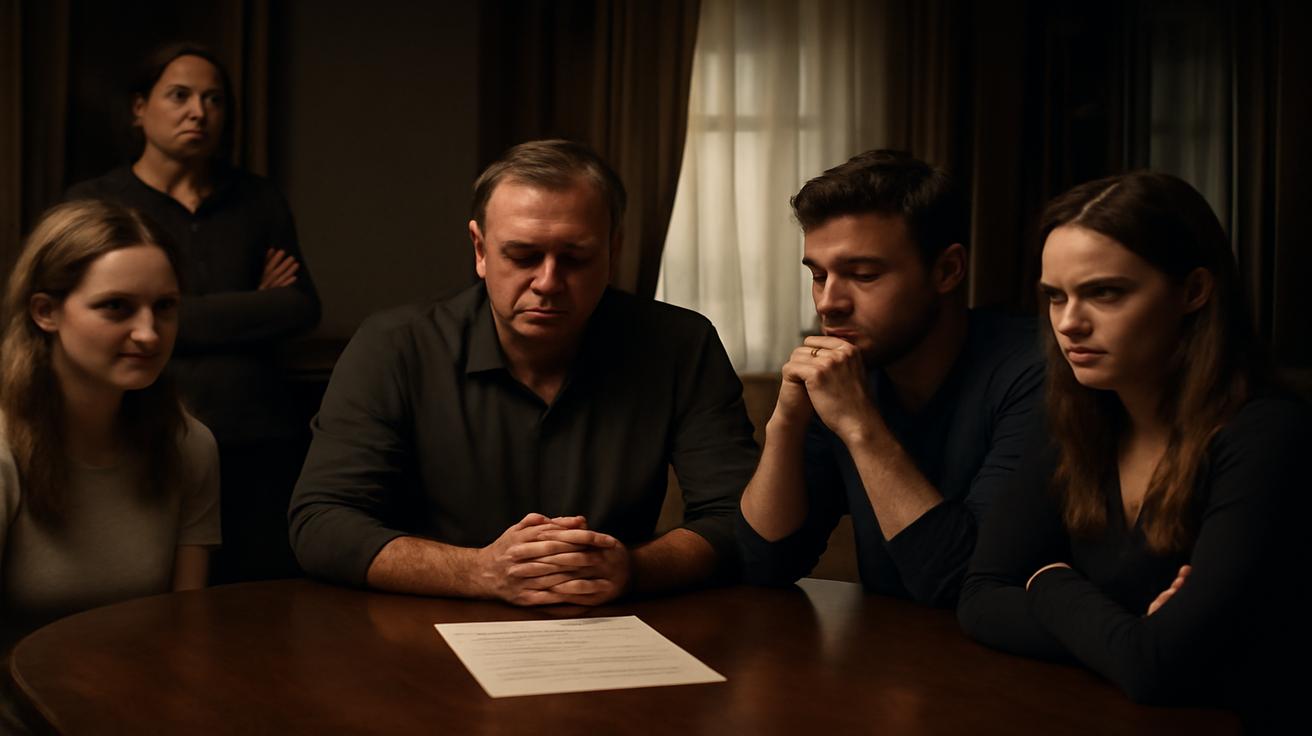
The letter arrived on a Tuesday, in the soft blue light just before dinner, when the house smelled of onions and garlic and the television murmured in the background. Maya found it wedged between a supermarket flyer and a glossy gardening catalog, the kind her father used to leaf through and dog-ear, dreaming about roses that never quite grew the way the pictures promised. The envelope was heavy, thick cream paper with her father’s lawyer’s name printed in tight black font across the top. She felt the weight of it before she even slit it open—felt the way a life, reduced to words and numbers, could fit inside so little space.
The Reading of the Will
The lawyer’s office, two days later, smelled of old carpet and brewed coffee that had cooled and thickened into something bitter on the tray by the door. The blinds were half-closed, stripes of pale sunlight stretching across the polished table. Dust drifted lazily in the beams, like the air itself was pausing to listen.
Maya sat at one end of the table, her brother Arjun at the other, their younger sister Nisha between them, twisting a tissue into soft paper threads. Their mother, Anjali, perched in a leather chair slightly apart, hands folded like she was holding something fragile and invisible between them. On the wall hung framed degrees and a sepia photograph of the city in the 1950s, a frozen memory of streets their father once walked as a young man with empty pockets and impossible dreams.
“Your father was a very organized man,” the lawyer began, his voice quiet but rehearsed. “He wanted things to be clear.”
Clear, Maya thought. Her father had always chased clarity: labeled jars in the pantry, color-coded files, instructions written out for the most obvious of tasks. And now here he was again, reaching out of the silence with labeled plans for what he was leaving behind.
The lawyer unfolded a document. The paper crackled. Words began to fill the room.
“To my beloved wife, Anjali,” he read, “who carried me through every storm, I leave our family home for her lifetime, with the right to live there and make it her own for as long as she chooses.”
Maya felt a small exhale move around the table, like air finally let go of its grip. Her mother nodded, eyes fixed on her lap.
“The remainder of my assets,” the lawyer continued, “including savings, investments, and other property, I leave to my three children, to be divided equally among them: my daughters, Maya and Nisha, and my son, Arjun.”
Silence followed the sentence, fuller than any words. The ticking wall clock suddenly seemed too loud. In that narrow space between syllables, everyone’s thoughts shot off in different directions.
Equal, Maya thought. That sounded so clean. So reasonable. So… right.
Then she saw her mother’s jaw tighten, just the slightest clench, like a door closing without a sound.
When “Equal” Doesn’t Feel Fair
They didn’t argue in the lawyer’s office. Grief still hung too fresh and raw around them. They signed their names where sticky yellow tabs instructed, and shook the lawyer’s hand, and said the polite sentences people are supposed to say when a legal form declares the official end to a life.
They waited until they got home, until the shoes were taken off and the kettle was put on and the house, still smelling faintly of their father’s aftershave, wrapped itself around them like an old cardigan. Only then did Anjali let the words spill out.
“It’s not fair,” she said, standing at the kitchen counter, hands braced on the cool granite. Outside, the late light fell across the garden where their father used to kneel on a cushion, coaxing tomatoes out of reluctant soil. “Equal is not fair. Not for you. Not for your sisters.”
“Ma,” Arjun began, but she held up a hand.
“No, let me say it. Your father meant well—your father always meant well. But he lived inside his own ideas of justice.”
She turned toward them, the three children she had raised in the same house, with the same rules and the same bedtime stories. Yet even from across the table, Maya could see the invisible numbers hovering around each of them: salaries, savings, inherited expectations.
“Look at you,” Anjali said softly. “You, Arjun. You have the company, the apartment, the bonuses. You married into money. The world has always opened doors for you.” She spoke with no cruelty, just flat recognition. “Your sisters, they have worked just as hard, maybe harder. But what do they have?”
Maya felt her face heat, not from shame but from recognition. She thought of her cramped rental, of her contract-based job in environmental education, the paycheck that vanished into rent and small, essential things. She thought of Nisha, still paying off student loans, her work in social services leaving her with more emotional bruises than financial security.
“He gave us all the same amount,” Arjun said, frustration creeping into his voice. “How is that not fair?”
“Because you are not starting from the same place,” their mother replied, the words steady as stones. “Equal slices of a pie do not feed the same hunger.”
Three Children, Three Realities
That night, sleep dodged Maya like a shy animal. She lay in her old bedroom, the ceiling a soft blur above her, the distant hum of traffic drifting through the open window. Somewhere in the house, a pipe knocked gently, like a remembered knock on a long-closed door.
On the floor beside her, the folder from the lawyer sat half-open, the neat columns of figures visible under the lamp’s glow. Numbers that used to live only in her father’s careful notebooks were now lined up like soldiers on parade.
She picked up a pen and, almost without thinking, began to sketch a small chart on the back of an envelope—something to make sense of what felt so tangled.
| Family Member | Current Wealth / Stability | Share from Father’s Will | Impact of Inheritance |
|---|---|---|---|
| Maya (Elder daughter) | Moderate income, insecure housing, minimal savings | 1/3 of remaining assets | Major boost; could secure home and savings |
| Nisha (Younger daughter) | Lower income, student debt, no property | 1/3 of remaining assets | Transformational; could clear debt and create safety net |
| Arjun (Son) | High income, owns property, strong investments | 1/3 of remaining assets | Additional comfort; marginal change to lifestyle |
Staring at the table, she could almost hear her mother’s earlier words: You are not starting from the same place.
On paper, equality looked simple. Three boxes, three shares, neat division. But in her mind, the numbers felt heavier or lighter depending on who held them. For Arjun, the inheritance would be another layer of padding on a bed already soft with security. For her and Nisha, it was more like a bridge over a chasm, something that could change the terrain of their lives.
The human mind, she thought, wasn’t built for pure math when it came to love and justice. It counted years of unpaid caregiving, the thousand quiet sacrifices of motherhood, the way daughters were expected to bend and sons to rise. It remembered which resumes had been read twice and which had been tossed aside because of a name, or a gap in employment, or a choice to care for a child or an ailing parent. It remembered closed doors.
Her father had chosen the language of numbers: equal shares, clear and defensible. Her mother was speaking another language entirely: the grammar of history and imbalance, of invisible labor and unspoken expectations.
The Quiet Arithmetic of Care
The next morning, sunlight pooled on the kitchen tiles like cooled honey. Anjali brewed tea slowly, filling the strainer with loose leaves the way her own mother had taught her. The kettle’s whistle rose and fell, a small, familiar lament.
“When your father and I first married,” she began, not quite looking at Maya, “we had nothing. One suitcase. One mattress. He swore if he ever had anything, he would divide it fairly.”
Maya watched the steam curl upward from the cups. “And you don’t think he has?”
“He divided what he could see,” her mother said. “He looked at your names and tried to be fair to his children. He forgot to add the life you have each lived.”
She set a cup in front of Maya, the porcelain warm against her palms. Outside, a bird called from the hedge, high and insistent, as if announcing something important to anyone who would listen.
“When you were small,” Anjali went on, “I stayed home. Your father worked late. He used to say, ‘My job is to earn, your job is to care.’ We agreed. It made sense at the time.” She smiled, but there was a tiredness there. “But years later, when raises came, when promotions came, he was rewarded for that choice. I was not. His wealth grew on top of my unpaid work.”
She looked around the kitchen, at the handmade curtains, the cabinets she had painted herself on a rainy weekend. “This home, this life—my work is inside it. Where is that counted? And now, when he is gone, who needs this money more? The child who already has a building in his name? Or the daughters who held my hand in the hospital after every surgery, who take unpaid days off work to bring me to my appointments?”
The bitterness in her words wasn’t about the money alone. It was about all the ways the world had quietly ranked her and her daughters below salaries and titles and the simple fact of being born a son.
“He wanted to be just,” she whispered. “But sometimes justice is not equal. Sometimes it is tilted on purpose, to balance what has long been uneven.”
A Family Conversation About Fairness
They called a family meeting that evening. No lawyers this time, no polished table. Just the old dining room, with its tiny wobble in one leg and the faint ring from a forgotten hot dish many Christmases ago. The air felt charged, as if the room itself understood that something delicate was about to be weighed.
“Look,” Arjun started, fingers drumming lightly on the table. “I know what Ma is saying. I do. But I also don’t want to feel like I’m being punished for… working hard. For the life I’ve built.”
“You’re not being punished,” Nisha said quietly. “You’ve done well. That’s great. But you have safety nets. I don’t. A single medical emergency, and I’m underwater.”
Maya sat between them, feeling like the rope in a tug-of-war, fraying slowly. “This isn’t about punishing anyone. It’s about noticing reality. We can agree that Baba loved us equally and still say that in practice, equal shares don’t have equal effects.”
Arjun exhaled sharply. “So what are you saying? That I give up my share?”
The room held its breath.
“Not necessarily,” Maya replied. “But maybe we can choose to do what he could not see. Maybe we can adjust, as a family. Not because the will forces us, but because we want fairness, not just equality.”
Anjali watched them, her eyes moving from one face to another, like she was reading a language she knew too well. “Your father grew up believing the son must be provided for, that his duty would be to support me. He thought giving equally was already radical. He did not see that the world has shifted under his feet. That you two”—she nodded at her daughters—“are as likely to be my caretakers, my advocates, the ones who sit beside me in the waiting rooms.”
They talked late into the evening. Voices rose, fell, softened. Memories were pulled out and set on the table along with the biscuits and cups of tea: the time Arjun got into trouble at school and their father took him away for a weekend “to straighten him out,” leaving the girls behind to manage the house; the way Nisha’s decision to study social work was met with polite concern instead of celebration; how proud their father had been when Maya gave her first public lecture, even though her paycheck would never match her brother’s.
By the time the streetlights outside had flickered on, exhaustion had gentled the edges of their words.
“What if,” Maya suggested slowly, “we agreed that Ma keeps more than just the house? That part of what comes to us goes back to her. As repayment for all the unpaid work that made Baba’s assets possible in the first place.”
“And,” added Nisha, glancing at Arjun, “if you’re willing, you could voluntarily pass a portion of your share to us. Not because anyone is forcing you. Just… as recognition. As a way of balancing things that have been unbalanced for a long time.”
Arjun looked down at his hands. For a long moment, he said nothing. The only sound was the ticking of the old clock and the distant passing of a train, a low rumble moving through the dark.
Finally, he spoke. “I don’t like the idea that Baba got it wrong,” he said. “I’ve always seen him as so fair. So careful.”
“He did his best with what he knew,” Anjali replied. “This isn’t about proving him wrong. It’s about going further than he could see. That is what children are supposed to do, no?”
Beyond the Numbers
A week later, they were back in the lawyer’s office. The coffee was just as bitter, the blinds still half-closed. But something in the room felt looser, as if the tension had exhaled a little.
This time, they weren’t there to dispute the will. They were there to supplement it—with their own choices, their own informal, handwritten agreement. Within the legal frame their father had left, they were carving out space for a different kind of fairness.
Arjun signed first. He had decided—after much pacing and sleeplessness and long, late-night talks with his wife—to allocate a portion of his inheritance to his sisters. Not half, not all, but enough to narrow the canyon between their starting points. Enough to say: I see this imbalance, and I am not comfortable standing on the higher ground while pretending the valley is flat.
The sisters, in turn, agreed to gift part of their shares back to their mother, beyond the life interest in the home. It was, in Anjali’s words, not charity but settlement—a quiet, personal acknowledgment that her decades of unpaid labor had grown the very wealth they now divided.
On the lawyer’s desk, the papers looked unimpressive. A few extra signatures. Some numbers altered. But beneath those faint black lines lay something harder to quantify: a family’s attempt to wrestle with the tangled roots of fairness in a world where wealth seldom grows in straight, equal lines.
Afterward, they walked out into the afternoon. The city hummed around them: buses sighing at curbs, shop doors chiming open and shut, a child somewhere crying then laughing as the sound faded. Life, carrying on.
They stood on the pavement for a moment, the four of them, uncertain of what to do next. They were bound now by more than blood and paper. They were bound by a shared decision to look directly at something many families spend years avoiding: the way money, love, duty, and history are never really separate conversations.
“He would have been proud of you, you know,” Anjali said, touching each of their arms in turn. “Not because you followed his exact words. Because you understood his heart and then went a step further.”
In the weeks that followed, the practical work began: accounts to be closed, keys to be sorted, drawers to be emptied. Grief shifted from a sharp edge to a dull, persistent ache. Yet beneath it ran a quieter sense of rightness, like a river finally redirected toward its natural course.
Maya found herself thinking often about that first moment in the lawyer’s office, the way the word “equally” had hung so heavily in the air. She realized now that equality, in its purest form, was almost theoretical—a clean line drawn on a messy landscape. Fairness, on the other hand, was rooted in mud and memory, in who had been held up and who had been held back.
A will, she thought, is often seen as the last word of a life. But perhaps it could also be an invitation—a starting point for the living to ask braver questions. Not just: Who gets what? But: Who has always gotten more? Who has quietly given more? And how do we honor that, not only in our feelings, but in the way we divide what remains?
On a quiet Sunday, as dusk bled slowly into the garden her father once tended, Maya stood by the kitchen window and watched a pair of birds pick at the feeder. The seeds were scattered equally. But one bird, larger and faster, grabbed more; the smaller one waited for what fell.
She thought of her father, of his love for diagrams and fairness, of how he would stand here, too, mug in hand, watching the same scene.
“We did our best, Baba,” she whispered to the empty room. “We tried to make it fair where life had not.”
FAQs
Why might an equal division of assets feel unfair?
Equal division doesn’t account for different starting points or needs. If one child is already financially secure while others struggle with debt, low income, or unstable housing, the same amount of inheritance can have very different impacts on their lives. What looks equal on paper can deepen existing inequalities in practice.
Is it wrong for a parent to split assets equally among children?
Not necessarily. Many parents choose equal division to avoid conflict or to show love without favoritism. However, some families later realize that strict equality doesn’t reflect real-life circumstances—like differing levels of wealth, caregiving responsibilities, or sacrifices made by certain children.
Can family members change how a will is effectively distributed?
In many places, beneficiaries can voluntarily redistribute or “gift” parts of their inheritance to each other after the will is executed, as long as it’s done legally and with clear documentation. The will itself remains valid, but the family may decide on a different arrangement among themselves.
How does unpaid caregiving factor into inheritance decisions?
Unpaid caregiving—often done by spouses or daughters—contributes significantly to a family’s stability and wealth, yet it rarely appears on balance sheets. Some families choose to recognize this by leaving more to the primary caregiver or ensuring they have long-term security, especially if their own earning capacity was limited by years of care work.
What’s the difference between equality and fairness in inheritance?
Equality means giving everyone the same amount. Fairness considers context: past opportunities, current wealth, future needs, and invisible labor. In inheritance, fairness may involve intentionally giving more to those who have less or who have sacrificed more, to balance out long-standing inequalities.