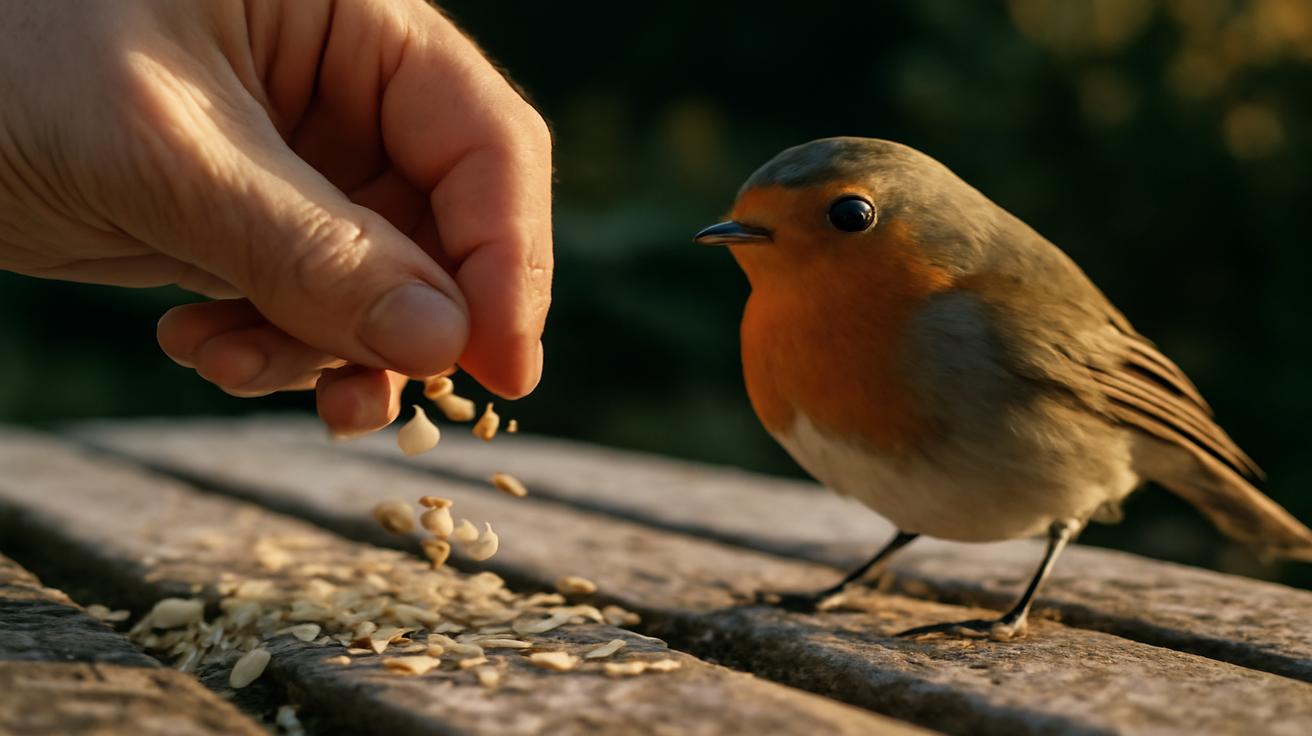
The first robin appears just as the day folds in on itself. Its chest catches the last light – a spark of ember-red in the dimming garden – and for a moment, the whole scene seems to hold its breath. You might be standing at the back door with a mug cooling in your hands, half-thinking about emails and tomorrow’s commute, when that small, round bird lands on the fence and looks straight at you, head tilted, eyes bright, as if asking a question.
What it’s really asking is simpler and more urgent than it seems: Is there anything to eat?
The Evening Rush Hour in Your Garden
Step outside at dusk and listen. Beyond the traffic hum and human noise, there’s another rhythm gathering pace. Leaves whisper as something small darts between them. A blackbird clocks off with a final, fluted phrase. Sparrows quarrel in the hedge, then settle. And robins — those bold, flame-breasted gatekeepers of the garden — begin their evening patrol.
This is the tightest window of their day. Night is coming, the temperature is dropping, and every gram of body weight suddenly matters. For a bird that weighs about the same as a £1 coin, a cold night can be the difference between surviving and not waking up at all. They need fuel. Fast.
In the thinning light, the ground grows hard and glossy with dew, and worm-hunting becomes trickier. Insects tuck themselves away. What used to be a moving buffet turns into a closed kitchen. That’s where you, and a very ordinary kitchen staple, come in.
The 3p Secret Waiting in Your Cupboard
Most people think of fat balls, seed mixes, and fancy feeders when they picture “feeding the birds.” But for robins, one of the best, cheapest, and most readily available foods is probably sitting in your cupboard right now: plain porridge oats.
Not the instant fruit-flavoured sachets, not the sugary multi-grain medleys — just simple, unadorned rolled oats. The sort that costs pennies per handful. In many UK supermarkets, a big bag of basic oats works out at roughly 3p for the small scattering a pair of robins will happily clear in one evening.
To a robin, those pale, humble flakes are dense little parcels of energy: light, bite-sized, and easy to swallow. They mimic, in their own quiet, processed way, the soft-bodied invertebrates robins naturally pick from the soil. And crucially, they’re available exactly when natural food is running short — winter, late autumn, and those bleak early spring weeks when everything looks green but insects haven’t truly woken up.
If you put them out this evening — not tomorrow, not “when I get around to it” — you could turn your garden into a crucial refuelling stop for a bird that may already be struggling.
The Night-Time Gamble: Why Timing Matters
Robins are restless little optimists. They’ll sing long after other birds have gone quiet, their liquid, melancholic notes threading right into the blue hour. That song, strangely human in its wistfulness, is more than just a soundtrack for washing up or taking the bins out. It’s an act of defiance against the cold wall of the night ahead.
As darkness thickens, your garden becomes a different world. What felt cosy and familiar in daylight takes on unfamiliar edges: the outline of the shed goes black and hard, shrubs blur into a fuzz of shadow, and anything moving is just a suggestion. For robins, this is when the clock is most unforgiving. Their daytime foraging must carry them through up to sixteen hours of darkness in the colder months.
That’s why evening feeding is a quiet act of mercy. Put food out in the morning and you’ll still help them, of course — but a carefully timed offering in the late afternoon or early dusk, around the time you’d think about putting the kettle on, has a special kind of power. It gives them a last, concentrated hit of calories just before the lights go out.
You don’t need to create a grand feeding station. A shallow plant saucer, an upturned dustbin lid, a worn paving stone by the shrubbery — anywhere that’s relatively sheltered and visible will do. A tablespoon or two of plain oats, scattered with an almost careless hand, is often enough to draw them down from the fence with that quick, dainty hop they do, cocking their heads between each peck.
Why Plain Oats Work So Well
Robins are ground feeders. Unlike finches that prefer hanging feeders, robins are wired to look down, to scan soil, bark, dead leaves. Rolled oats sit right in that sweet spot — they lie flat, don’t roll away, and are easy to snag in a single, sharp peck. The texture is soft but not mushy when dry; it mimics grubs more than hard seed.
And here’s an important detail: never cook the oats. Cooked porridge clumps, sticks to beaks and feathers, and can spoil quickly. Dry, uncooked oats are safer, cleaner, and better suited to the delicate mechanics of a robin’s beak and crop.
Building Trust, One Evening at a Time
The first evening you scatter oats, the robins might not show up immediately. Or they may watch you from the low branch of a shrub, weighing up your intentions. Robins are bolder than many garden birds, but their bravery is still wrapped around an instinct for self-preservation.
So you start small. Same time each evening, same quiet ritual. Open the back door, feel the cool brush of air on your face, and listen. Maybe there’s a soft ticking call from the fence, a kind of polite tek-tek-tek that says, “I’m here, but I’m not sure about you yet.”
You step out anyway. Scatter your oats in a loose crescent on the chosen spot. Step back, and wait.
The waiting becomes part of the pleasure. In those few minutes, your thoughts rearrange themselves. Instead of spinning through lists and obligations, you’re watching the last light slip down the neighbour’s roof. You notice the faint, metallic tang of cold air in your nostrils, the smell of damp soil, the distant bark of a dog echoing flatly across the houses.
And then — there — a flick of movement. The robin drops from the fence with that soft, almost weightless bounce. It lands, stares straight at you again, then — with a decision so quick it looks like pure reflex — it bends and takes the first oat.
Where to Scatter Your Evening Oats
Placement can make the difference between a casual nibble and a life-saving feast. Robins need two things when they feed: a quick escape route and a sense of cover. They like edges — the place where lawn meets hedge, where low branches overhang a patch of bare soil.
Choose a spot like this:
- Close to a shrub, hedge, or dense plant where the robin can dart if startled.
- Far enough from thick cover that lurking cats can’t launch a surprise attack in a single pounce.
- Visible from a perch — a fence, low branch, or pot — so the robin can assess the area first.
In smaller gardens or on balconies, a wide plant pot saucer can become a little island of safety. Put it near climbing plants or a wall, not in the open middle of a patio where the robin feels exposed. The difference you’ll see in their body language — from tense, stop-start pecks to relaxed, steady feeding — is surprisingly clear once you begin to notice it.
| Food Option | Suitable for Robins? | Notes |
|---|---|---|
| Plain, uncooked porridge oats | Yes – excellent | Cheap, high-energy, easy to eat; offer in small amounts |
| Cooked porridge | No | Clumps and sticks to beaks; can spoil quickly |
| Mixed bird seed (hard grains) | Limited | Robins prefer soft foods; small seeds often ignored |
| Meaty dog/cat food (in small pieces) | Yes – occasionally | Use sparingly and keep the area clean |
| Salted or flavoured snacks | No | Salt, sugar, flavourings and oils can be harmful |
Small Bird, Big Story
It’s easy to underestimate just how knife-edge a robin’s life can be. They look so self-possessed: that bright eye, that confident posture on the fork handle or fence post. But survival statistics tell a starker tale. Many robins never see their second winter. A single prolonged cold snap, a few nights of hard frost when natural food is locked out of reach, can scythe through local populations.
Yet, they remain. They nest in coiled hoses, in forgotten kettles, in the strange sheltering scoops of hanging baskets. They follow gardeners, watching intently as the spade turns over soil, darting in for exposed worms. They’ve threaded themselves so thoroughly into our shared spaces that it’s hard to say who belongs to whom. Whose garden is it, really, when a bird you could cradle in your hand sings with such authority from the top of your apple tree?
Feeding a robin with a handful of oats is not going to repair habitat loss or instantly reverse insect declines. But it is a stitch in a much larger fabric — the small, everyday kindness that runs through a thousand ordinary gardens. When multiplied, these gestures matter more than we easily grasp.
Turning a Habit into a Haven
Once you’ve started the evening oat ritual, you might notice your sense of the garden subtly shift. You’re no longer just the owner of a lawn or a patio or a cluster of pots; you’re the host. You begin to scan the borders with different eyes — eyes that think in terms of shelter, cover, places to perch.
Other ideas might follow naturally:
- Leaving a patch of your garden a bit wild, where insects can thrive.
- Allowing leaf litter to sit under shrubs over winter rather than sweeping it all away.
- Planting berry-bearing shrubs or leaving seed heads on perennials into the cold months.
None of this needs to be grand or expensive. In fact, the spirit of that 3p handful of oats runs right through it: small changes, quiet generosity, a willingness to share what’s already there.
And in return? You’re offered front-row access to some of the most intimate moments of wild life: courtship feeding in spring, when a male offers food tenderly to his mate; frantic, comical dashes in summer as parents cram insects into open-mouthed fledglings; and those winter evenings when a solitary robin fluffs itself up against the cold, feeds gratefully on your offering, and then vanishes into the darkness, just as the first star appears.
Act Tonight: The Window Is Narrow
All of this comes down to a very simple, very immediate invitation. Not a project for next month, not a resolution for “when the weather improves.” Just one small act: this evening, when the light is bruising gently towards dusk, step outside with a spoonful of plain porridge oats.
Let the back door ease shut behind you. Feel the temperature drop a degree or two as you move out into the open. Walk to that edge — the border, the pot by the wall, the corner beneath the lilac — and sprinkle your oats. Don’t overthink it. Don’t fuss.
Then step back. Wait. You might have to be patient for a few evenings before the robin learns your timing and your route. But once it does, you’ll feel the shift: that subtle sense that your garden has a heartbeat you can almost set your watch by. A flutter of brown and ember-red landing exactly where you hope it will, exactly when the day needs one last small miracle.
For the price of a few pennies, you’ll have bought more than just a moment of entertainment. You’ll have bought a night’s worth of warmth and strength for a bird that has chosen, in its own watchful way, to share its world with you.
FAQs About Feeding Robins with Porridge Oats
Can I use any type of porridge oats?
Stick to plain, unsweetened, uncooked rolled oats. Avoid instant sachets with added sugar, salt, fruit, or flavourings, and steer clear of muesli-style mixes that may contain dried fruit or nuts coated in oils.
How much should I put out each evening?
A tablespoon or two is usually enough for one or two robins. It’s better to offer small amounts that get eaten quickly than large piles that sit, spoil, or attract unwanted visitors.
Is it safe to feed oats every day?
Yes, in moderation. Plain oats are a good supplementary food, especially in colder months or when natural food is scarce. They should sit alongside other options like natural insects, suet, and soft foods, not replace them entirely.
Can I mix oats with other foods for robins?
You can mix plain oats with small pieces of suet or specialist softbill food to increase energy content. Just avoid salt, seasoning, cooking fats, and anything sticky or heavily processed. Keep mixtures dry and crumbly rather than wet or clumped.
What time of day is best for putting out oats?
Late afternoon to early dusk is ideal, especially in colder months. This gives robins a last, valuable energy boost before they face a long, cold night. Morning feeding also helps, but the evening window is particularly important.
Will other birds eat the oats too?
Yes, other ground-feeding birds such as dunnocks, blackbirds, and even sparrows may help themselves. That’s fine — you’re supporting a small community. If the food disappears too quickly, you can adjust the quantity slightly or add a second small feeding spot.
Are there any risks to feeding robins?
The main risks come from unsuitable foods and poor hygiene. Never offer salted, sugary, or mouldy food, and avoid cooked porridge. Keep feeding areas reasonably clean, and place food where cats and other predators are less likely to ambush your visitors.