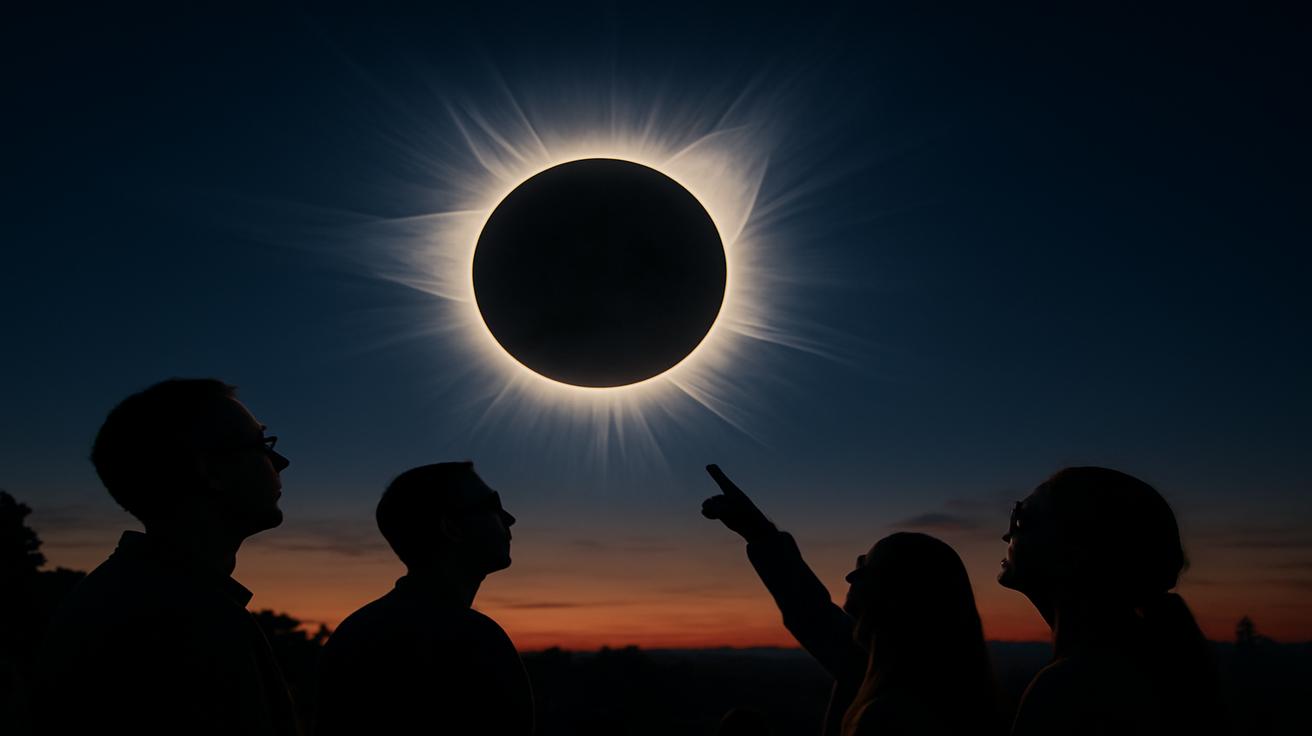
The first hint will be a chill you can’t quite explain. One moment the afternoon feels ordinary—bright, familiar, safely anchored in daylight—and then, almost imperceptibly, the light begins to thin. Shadows sharpen. Colors flatten. Birds go quiet in the trees. You look up, eyes shielded by dark glasses, and see the impossible beginning: the Moon taking one slow, deliberate bite out of the Sun. In a matter of minutes, day will fold into night as the longest total solar eclipse of the century brushes its shadow across our spinning world.
A Shadow Crossing Continents
It’s easy to think of an eclipse as a local curiosity—something that happens “over there,” to people in other countries, on other continents. But this one is different. This eclipse will be a global event, a moving river of shadow stretching across large parts of the planet, uniting crowds of strangers underneath the same fleeting darkness.
A total solar eclipse occurs when the Moon slides exactly between Earth and Sun, casting a narrow, racing shadow across Earth’s surface. Normally, totality—those few precious minutes when the Sun’s bright disk is completely hidden—lasts just long enough for the human brain to reel and reset. But this eclipse is no ordinary blink of cosmic alignment. Astronomers have calculated that in its longest stretch, totality will linger for several minutes longer than almost any other eclipse this century. In some regions, people will stand under a false midnight sky for what feels like an eternity compared with the usual brief plunge into darkness.
Imagine a line, maybe 150 or 200 kilometers wide, drawn across the globe. Inside that line lies the path of totality, the only place where the Sun will vanish entirely. Outside it, the eclipse will still be visible as a partial event, where the Moon takes a great curved bite but never fully devours the light. Planes will race to chase the shadow. Research ships will linger at sea in exactly the right place. On mountaintops and rooftops, in city squares and quiet farm fields, millions will turn their faces to the sky.
The Strange Weather of Darkness at Noon
Long before we understood orbital mechanics, our ancestors watched the Sun disappear and saw omens written in the sky. Even now, with all our models and simulations, a total solar eclipse still feels uncanny. It bends not just light, but time, temperature, and the familiar rhythms of the day.
As the Moon’s disk slides deeper over the Sun, light changes character. It doesn’t simply dim; it becomes metallic, almost stage-like, casting razor-edged shadows that make your own hand look like a prop on a set. The air cools, sometimes by several degrees in just minutes. A soft wind can sweep across a landscape, following the advancing shadow at hundreds of kilometers an hour. Animals misread the signs: birds whirl and settle as if it’s dusk, crickets start their nighttime chorus, farm animals wander toward barns, confused.
In the last 30 seconds before totality, a subtle, rising turbulence seems to ripple through crowds. People fumble with camera settings, shout for friends to hurry, call for children to look up. Along the lunar edge, the Sun’s last rays sparkle through valleys on the Moon, creating what astronomers call Baily’s beads—tiny, brilliant pearls of sunlight that pop and wink in the thinning crescent. Then, for one brief, dazzling breath, a single intense bead remains: the “diamond ring.” And then: night.
The Moment the Sun Grows a Halo
Totality is not simply the absence of the Sun. It’s the revelation of what we almost never see: the solar corona, a delicate crown of white fire that blossoms around the black disk of the Moon. You can stand beneath it, head tilted back, and feel as if the sky has unscrewed itself and opened.
Unlike the harsh glare of the everyday Sun, the corona glows with a soft, ghostly light. It’s not smooth. On good days, under clear air and steady winds, it stretches into streamers and plumes, shaped by the Sun’s magnetic fields. Filaments seem to twist and reach; faint, silky rays spread outward like hair floating in water. Planets step into view—Venus, bright and steady, often appears first, joined by Jupiter and perhaps even Mars or Mercury if they’re near enough in the sky. Stars pop out against a dome that’s turned twilight-blue or even deep indigo.
For once, you can look directly at the Sun—only during totality, when its blinding surface is completely blocked—without the desperate squint of self-preservation. Many people cry, though they can’t quite explain why. Others fall silent or laugh nervously. You might find your own emotions lagging behind your senses, struggling to catch up with the raw fact that the world has just turned upside down in the middle of the day.
Following the Path of Totality
Months before the Moon’s shadow even touches Earth, its exact course is mapped in detail. The path of totality is the most coveted real estate on the planet for a few short hours. Towns lying dead center beneath the shadow’s track will receive the longest duration of totality; those near the edges experience a shorter, more fleeting darkness.
Travelers will plot journeys based on a few precious seconds. Move 50 kilometers off the centerline, and you might lose an entire minute of totality. A single ridge of mountains or a coastal cloud bank could rob you of the moment entirely. That’s why eclipse chasers—those dedicated souls who cross oceans for a few minutes of darkness—study weather patterns, historical cloud cover, and topography as obsessively as astronomers study orbital paths.
To imagine how people might choose where to stand, consider how dramatically the experience changes with just a little movement across Earth’s surface:
| Location Relative to Path | What You See | Duration of Totality (Approx.) |
|---|---|---|
| Center of Path | Longest, darkest eclipse; corona fully visible; deep twilight sky | 4–7 minutes (depending on region) |
| Near Inner Edge | Short but dramatic totality; corona visible, rapid onset and end | 1–3 minutes |
| Outer Band (Partial Only) | Sun partially covered; daylight dims, but no full darkness or corona | 0 minutes (partial eclipse lasts 1–3 hours) |
| Far Outside Path | Little to no visible change; normal daylight | 0 minutes |
In some cities, hotels will sell out years in advance. Campgrounds along the shadow’s route may turn into pop-up villages of tripods, telescopes, and lawn chairs. Local communities will host eclipse festivals, blending science talks with music, food, and old stories about dragons and sky-wolves. Schools might pause classes so students can crowd into playgrounds, clutching cardboard eclipse viewers fashioned from cereal boxes and tape.
How to Watch the Day Turn to Night
Standing beneath this celestial event without preparation would be like arriving at a once-in-a-lifetime concert and forgetting to bring your ears. The magic of a total solar eclipse lies not just in those few minutes of darkness, but in the slow dance leading up to them and the careful, respectful way you look.
First, there’s safety. Before and after totality, even when the Sun looks like a thin crescent, its light can damage your eyes. You’ll need proper eclipse glasses that meet international safety standards, or a solar filter fitted securely over binoculars or telescopes. Sunglasses, no matter how dark, are not enough. Many people skip looking through optics entirely and instead use pinhole projectors—simple devices that let sunlight stream through a tiny hole to cast the Sun’s image onto a sheet of paper. Under trees, you might see hundreds of little crescent Suns projected naturally through leaves onto the ground.
Then there’s intention. Make a plan not just for gear, but for presence. Decide in advance: Will you photograph the event or simply watch? Cameras are welcome, of course, but many seasoned eclipse chasers will tell you that your first totality is better spent with your naked eyes and whole attention, not with your face pressed to a viewfinder. Bring something warm to wear; temperatures can drop surprisingly quickly. Pack water, snacks, perhaps a notebook to capture the slippery feelings and odd details that are so easy to forget afterward.
Science in the Shadow
While you’re standing in the field, awestruck, there’s another layer of activity unfolding in the skies and labs around you. Total solar eclipses are more than spectacles; they’re rare opportunities for science. For a few minutes at a time, the Moon acts as a perfect, movable shade, allowing instruments to study the Sun’s outer atmosphere and the way its light filters through Earth’s own air.
Researchers will aim spectrographs at the corona, dissecting its light to measure temperature, composition, and magnetic structures. High-speed cameras may capture subtle waves and ripples in the corona’s shape. Others will watch how the sudden dimming of sunlight affects the upper atmosphere, tracking how temperatures and ionization levels change as the shadow races by. Amateur observers, too, play a role—logging animal behavior, weather shifts, and the fine-grained timing of the eclipse at different locations.
History is stacked with stories of eclipses nudging science forward. In 1919, photographs taken during a total solar eclipse helped confirm Einstein’s general theory of relativity by showing starlight bent by the Sun’s gravity. Today, satellites orbiting far above us can stare at the Sun all day, but eclipses still offer something unique: a chance to tie space-based measurements to what’s happening closer to home, where people, clouds, and ecosystems actually live.
Eclipses in Memory and Myth
Long after the last fragment of sunlight slides back into full blaze, memories of a total solar eclipse linger in surprising ways. People remember the color of the grass, suddenly dulled as if seen through a tinted lens. They remember the chorus of birds stopping mid-song, as though someone turned down the volume of the world. They remember the quickening of their own heartbeat in the hush before the diamond ring appeared again.
Across cultures, eclipses have been woven into myths of struggle and renewal. In some traditions, a celestial creature devours the Sun only to release it again, a cosmic drama of loss and restoration. In others, an eclipse is a moment when doors between worlds briefly open or when gods turn their faces away. Even in a world steeped in data and prediction charts, those old stories cling gently to the edges of experience. When your midday sky tears open to reveal a crown of pale fire, it’s hard not to feel that you’ve stepped into a story older than language.
Perhaps what a total solar eclipse gives us most intensely is perspective. In the span of a single hour, you can feel both tiny and astonishingly connected—to strangers on distant shores, to ancestors who stood under different skies with the same upturned gaze, and to the vast, clockwork grace of a universe in motion.
Waiting for the Shadow
In the weeks and days leading up to the eclipse, anticipation swells like a tide. Weather forecasts become talismans. Friends trade plans: which hilltop, which park, which stretch of lonely road might offer the clearest skies and the widest horizon. For some, it will be a once-in-a-lifetime pilgrimage across borders and oceans. For others, it will arrive on their doorstep, asking only that they step outside and look up.
On the morning of the eclipse, life will begin normally. Coffee will steam in kitchen mugs. Buses will groan to a stop at familiar corners. People will scroll through news feeds filled with maps and countdowns. But as the Moon moves inexorably into position, a different kind of clock starts to tick—a celestial one, older than cities, older than any human eye that ever watched it.
When the first bite appears at the edge of the Sun, there might be a murmur, a ripple of realization spreading through a crowd. If you’re alone in a quiet place, it might feel like a private secret between you and the sky. As the light thins, time itself seems to grow thick and strange, as if you’re walking underwater. Then comes that sudden edge of cold, the turning of leaves, the slow panic of birds—and the last dazzling flash before the world goes briefly, magnificently dark.
And then, astonishingly quickly, the spell breaks. The diamond ring flares on the opposite side of the Moon. Light rushes back into the world, oversaturated and sharp. People shout, sob, applaud, or simply stand in stunned silence. The shadow moves on, racing ahead across oceans and borders, leaving behind a planet momentarily changed—not in its orbits or its physics, but in the quiet interiors of those who stood and watched.
Day will turn to night, and then to day again, as it always has. But if you are lucky enough to stand beneath this eclipse—the longest total solar eclipse of the century—you may find that, for a few unforgettable minutes, the universe feels less like an abstract diagram in a textbook and more like a living, breathing theater all around you. A place where, every so often, the lights dim, the sky draws a curtain, and the greatest show on Earth and beyond begins.
FAQ
What exactly is a total solar eclipse?
A total solar eclipse happens when the Moon passes directly between the Earth and the Sun, completely covering the Sun’s bright disk for observers along a narrow path on Earth’s surface. During totality, the sky darkens, stars and planets can become visible, and the Sun’s outer atmosphere—the corona—appears as a glowing halo around the black silhouette of the Moon.
Why is this eclipse considered the longest of the century?
The duration of totality depends on the precise alignment of the Sun, Earth, and Moon, as well as the distances between them. During this event, the Moon will be near the point in its orbit where it appears slightly larger in the sky, and the Earth–Sun distance will also favor a longer shadow. Combined with the geometry of the eclipse path, this produces an unusually long maximum totality compared with other eclipses this century.
Is it safe to look at the eclipse with my eyes?
You can only look with your unaided eyes during the brief period of totality, when the Sun’s disk is fully covered. At all other times, you must use proper eclipse glasses or approved solar filters. Looking directly at the Sun without protection, even when it is partially covered, can cause serious eye damage.
What will I see if I am not in the path of totality?
If you are outside the narrow totality path but still within the broader eclipse zone, you will see a partial solar eclipse. The Moon will take a visible “bite” out of the Sun, and daylight will dim somewhat, but it will not become fully dark and the corona will not be visible. The experience is still fascinating, but much less dramatic than totality.
How long will the eclipse last overall?
The entire event—from the first moment the Moon begins to cross the Sun’s face (first contact) to the final moment it departs (fourth contact)—typically lasts a couple of hours at any given location. However, the period of totality, when the Sun is completely covered, will last only a few minutes, with this particular eclipse offering one of the longest totalities of the century for those on the centerline.
Do animals really react to an eclipse?
Yes. Many observers report noticeable changes in animal behavior during totality. Birds may fly to roost or fall silent, insects associated with dusk or night can begin to call, and domesticated animals sometimes behave as though evening has arrived. These responses vary with species and environment, but the sudden change in light and temperature clearly confuses the usual day–night cues.
What’s the best way to prepare to watch this eclipse?
Choose a spot within the path of totality if possible, check historical cloud cover and local weather, and arrive early. Bring certified eclipse glasses or solar viewers, any photography gear you plan to use, warm clothing, water, and snacks. Most importantly, plan to spend at least some of totality simply watching with your own eyes instead of through a lens. This is a rare experience; being fully present will make it far more memorable than any photograph.