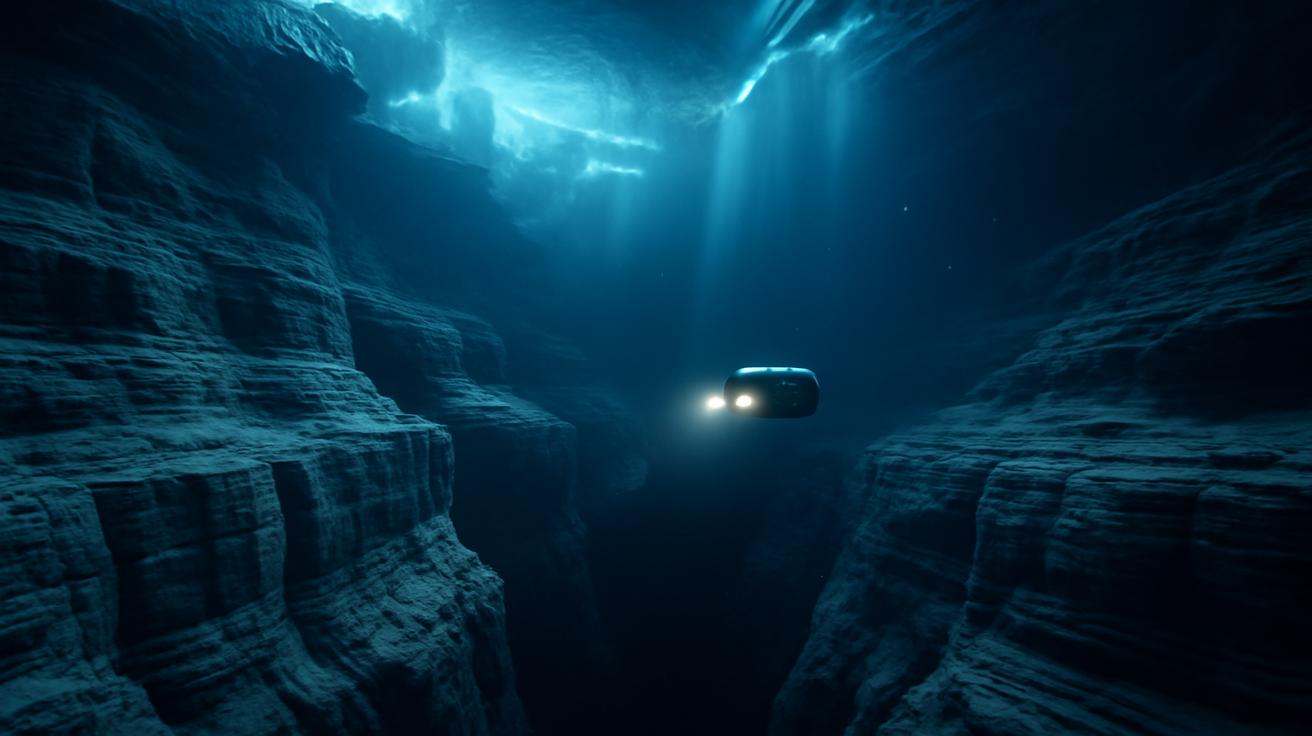
The ship’s bow cut a thin, white scar across the sea ice as if someone had dragged a fingernail through fresh paint. On deck, the air bit at exposed skin, the kind of cold that doesn’t just sting but settles deep in the bones, patient and relentless. The sun hung low and sideways, smearing the horizon in cold gold while small, shattered ice floes clinked and knocked against the hull like loose porcelain. Somewhere beneath this silent, glittering surface, satellites whispered of something vast and hidden: canyons—hundreds of them—carved into the seafloor under Antarctica’s frozen skirts. And not just any canyons, but submarine chasms big enough to redirect oceans and, perhaps, nudge the future of our climate.
The Moment the Seafloor Spoke Back
It started, as many new stories about our planet do these days, with a data glitch—or what looked like one. In an office thousands of kilometers away from the ice, a researcher stared at a screen that refused to behave. Radar and sonar readings from beneath Antarctic ice shelves kept revealing sharp, plunging shapes where the team expected smoother slopes and gentle depressions. The lines on the screen didn’t flow. They dropped.
At first, the assumption was mundane: calibration issues, interference, another day wrestling with temperamental instruments that don’t care how urgent the work is. But the anomalies wouldn’t go away. Instead, they multiplied, mapping out long, twisting troughs, stacked and braided like ghost rivers graven into stone. When the data from different satellites and ship-based echo sounders were layered and cleaned, a picture emerged that felt like science fiction: a vast network of submarine canyons hidden beneath the ice fringe of Antarctica.
Some stretched for hundreds of kilometers, others branched and wound like drowned mountain valleys. A few were deeper than the Grand Canyon. All of them had been invisible to the human eye, masked by ice and distance, until the seafloor decided to speak back through the language of reflected sound and returning signals.
“We kept asking what was wrong,” one scientist later recalled. “Eventually we realized nothing was wrong with the data. What was wrong was our assumptions.”
What Exactly Is a Submarine Canyon?
Picture standing on the edge of a cliff in the desert, looking down into a deep sandstone canyon. Now drown that canyon under hundreds of meters of seawater, shove it up against the foot of a continent wrapped in ice, and stretch it out further than the eye can follow. That’s the essence of a submarine canyon—only the ones around Antarctica come with an extra twist.
Submarine canyons are steep-sided valleys carved into the ocean floor, often beginning near the continental shelf and plunging down into the deep sea. Around many continents, they act like conveyor belts, transporting sediments, nutrients, and even organic matter from coastal shallows to abyssal depths. They’re highways of motion in a world that looks flat and featureless from above.
In Antarctica, these canyons sit at the boundary where ancient ice meets the restless Southern Ocean. Some of them seem to have been carved long ago, during times when sea levels rose and fell and glaciers advanced and retreated. Others may be continually reshaped by powerful currents and under-ice meltwater streams, like invisible rivers flowing in permanent twilight.
To imagine their scale, consider this:
| Feature | Approximate Scale | Comparison |
|---|---|---|
| Deepest Antarctic canyons | Over 2,000–3,000 m deep | Rivaling or exceeding Grand Canyon depths |
| Canyon lengths | Hundreds of km in some systems | Comparable to major river systems |
| Number of newly mapped canyons | Several hundred across the Antarctic margin | A hidden network beneath ice shelves |
| Water flowing through some canyons | Millions of cubic meters per second | Comparable to the outflow of major world rivers |
These are not simple scratches on the seabed. They are corridors, pipes, and funnels all at once—routes through which heat, salt, and life itself move between the continent and the open ocean.
The Secret Tunnels of Warmth and Ice
Why do these canyons matter so much? The answer lies in something the Antarctic ice sheet has always feared: warm water.
Antarctica might look like a frozen fortress, but its defenses are more delicate than they appear. Many of the continent’s glaciers don’t end on land; they flow out over the ocean, forming floating ledges of ice called ice shelves. These shelves act like architectural buttresses, holding back the colossal rivers of ice behind them. Take away a shelf, and the glacier it supports can accelerate, thinning and flowing faster into the sea, raising global sea levels in the process.
Now imagine relatively warm, salty water from the deep ocean—just a few degrees above freezing, but warm enough to melt ice—finding a secret route underneath those shelves. The newly mapped submarine canyons provide exactly that: deep, shadowy access paths that allow this water to creep in where it was once thought unlikely to reach.
In some places, dense, warm water follows the canyon floors like a heavy liquid rolling down a tilted maze. When it encounters the underside of an ice shelf, it licks away at the ice from below, carving hollows and thinning the floating edge. Scientists have now realized that many of the fastest-thinning ice shelves in Antarctica sit directly above these canyon pathways. The geometry of the seafloor is quietly redrawing the geometry of the ice above.
To grasp how intimate this connection is, you have to think three-dimensionally. The ocean is not a flat blue lid. It’s a layered, moving fabric. By reshaping the way warm and cold layers mix and travel, the canyons can decide how fast ice melts, how much fresh water pours into the sea, and where that water will go next.
Rewriting the Story of the Oceans
The Old Map and the New Reality
Until recently, large swaths of the Antarctic seafloor were little more than guesswork, filled in on global maps with broad, smoothed-out contours—cartographic placeholders more than real geography. Ocean models, the digital simulations that scientists use to understand and forecast climate, relied on those blurred outlines. The ice sheet at the bottom of the world was resting on a stage whose shape we barely knew.
The discovery of hundreds of hidden canyons changes that script dramatically. With sharper, higher-resolution maps feeding into these models, the stage is suddenly bristling with detail: ridges, troughs, chasms, sills. Instead of water simply sloshing in broad, predictable loops, it is now seen threading along precise routes, squeezed here, accelerated there, blocked or redirected someplace else. This is more than cartographic housekeeping; it alters our sense of risk and timeline.
Regions once thought relatively insulated from warm water intrusions now appear exposed, their undersides open to attack along unseen corridors. Conversely, some areas assumed to be vulnerable might benefit from natural topographic barriers that divert or dilute incoming warmth. Each new canyon adds nuance to the climate’s unfolding drama.
A Shock to Climate Models
When scientists plug these canyon systems into their models, some of the projections shift. In scenarios where greenhouse gas emissions remain high, warm water can penetrate farther and faster along these channels, boosting melt rates under certain ice shelves beyond previous estimates. In more moderate emission pathways, the detailed topography helps refine where protective cold-water layers may still hold the line—at least for a while.
This doesn’t overturn the broad strokes of climate science. The direction is the same: warming oceans, thinning ice, rising seas. What changes are the contours of expectation—the “where first, how fast, how uneven” of sea-level rise. Coastal planners, from low-lying Pacific islands to crowded river deltas, suddenly have a more intricate, more urgent story to contend with.
Life in the Shadow of Ice
Hidden Habitats and Silent Drifters
It’s tempting to see these canyons only through the lens of physics and ice. But canyons everywhere, terrestrial and submarine alike, are often cradles of biodiversity. The same may be true here, in these shadowy chasms beneath one of the harshest edges of our planet.
Where canyon currents rush upward, they can haul nutrients from the deep—ancient, slow-settling dust and organic debris—back toward the surface. In the dim green under-ice waters around Antarctica, such nutrient pulses can spark blooms of phytoplankton: tiny drifting plants that tie sunlight to carbon, feeding everything from microscopic grazers to krill. And krill, in turn, feed penguins, seals, whales—a whole theatre of life that depends on invisible chemistry and hidden geography.
Within the canyon walls themselves, rocky ledges and sediment slopes may host communities of cold-water corals, sponges, and other invertebrates, forming slow-growing cities in perpetual night. Many of these organisms live for decades or centuries, recording changes in water temperature and chemistry in their skeletons like tree rings of the deep. We have barely glimpsed them.
As climate warms and ice retreats, some of these canyons may gain more light, more open water, more ship traffic. Others could be disrupted by shifts in currents and sediment flow. The canyons are not just corridors of melt; they are living landscapes whose stories we are only beginning to read.
Sound, Silence, and Exploration
There is a strange intimacy to studying a place you cannot see. Scientists send sound into the deep and listen for its echo, teasing out the shape of these canyons from the delay and strength of returning signals. Autonomous underwater vehicles, shaped like torpedoes or miniature submarines, slip beneath floating ice shelves and glide through the darkness, mapping walls and floors with sweeping sonar beams.
On the surface, the ship’s hull hums softly as engines and winches work. Below, there is only the crackle of ice and the remote, alien ping of instruments. The canyons, timeless and unmoved, absorb these brief visits as they have absorbed currents for millennia.
Each new survey adds another layer of detail, filling in blank spaces on charts that, not long ago, still carried the quiet confession: “Here be unknowns.”
A Planet That Keeps Surprising Us
Perhaps the most unsettling—and oddly hopeful—part of this discovery is what it reveals about our relationship with Earth. We live in an age of high confidence, of high-resolution everything, where we can zoom from continent to city block with a flick of the finger, and it feels as though nothing big could still be hiding. And yet, here is an entire network of deep canyons, tucked beneath the world’s largest ice sheet, only now emerging fully into view.
It’s a humbling reminder that our maps are not the territory, that the planet’s interior workings still hold secrets big enough to shake our understanding of the oceans and climate. Humbling, too, is the fact that these revelations come at a moment when we need them most, when decisions about energy, emissions, and adaptation carry unprecedented weight.
The hidden canyons do not tell us what to do. They merely strip away another layer of ignorance. There is no comfort in their story—only clarity. We now know more precisely how and where warm water can undermine the Antarctic ice sheet. We can no longer pretend the seafloor under the ice is a smooth, passive platform. It is a sculpted, active participant in the drama of melting and rising seas.
And still, there is wonder. To know that such immense architecture exists under the most remote waters on Earth is to feel the old thrill of exploration, scratched with the edge of anxiety that defines our century. It’s as if the planet is revealing both its beauty and its leverage points at once.
Where We Go From Here
In the years ahead, the newly mapped canyons of Antarctica will be folded into global climate models, ship routes, conservation plans, and the quiet, relentless accrual of human knowledge about the world we inhabit. More expeditions will push farther under ice shelves, mapping canyon branches down to fine scales. Oceanographers will track the pathways of heat and salt along these chasms with drifting instruments and sophisticated simulations.
At the same time, the ice above the canyons will continue to change. Crevasses will widen, bergs will calve and drift away, and shelves will thin or thicken depending on the interplay between atmosphere, ocean, and those newly appreciated channels carved into the seafloor. Coastal cities thousands of kilometers away may not know these canyons by name, but they will feel their influence in the shape of tide lines, storm surges, and the redraw of familiar coastlines on future maps.
Standing again on the deck of a ship near the Antarctic margin, you might not think of all this at once. You’d be too busy rubbing warmth into your hands, watching the strange mint-green of icebergs rolling in the slanting light, listening to the distant boom of breaking floes. But if you closed your eyes and let your mind fall downward, through the cold water and the long blue dim, you could imagine yourself drifting out over a vast, drowned escarpment, down-winding along the spine of a canyon larger than any valley you’ve walked.
The discovery of these hidden structures doesn’t just change what scientists know about the oceans; it reshapes the story we tell about our planet. Earth is not fully mapped, not fully known, not yet reduced to a finished diagram. Under the ice, in the deep, the world is still carving itself, still setting the terms of our shared future.
Frequently Asked Questions
What exactly did scientists discover beneath Antarctica?
Scientists used satellite data, ship-based sonar, and underwater vehicles to reveal hundreds of previously unmapped submarine canyons carved into the seafloor around Antarctica, especially beneath and in front of floating ice shelves. These canyons are deep, long, and structurally complex—some rival major terrestrial canyons in depth and extent.
Why are these submarine canyons important for climate change?
The canyons act as pathways that allow relatively warm, deep ocean water to flow toward and beneath Antarctic ice shelves. This warm water can melt the ice from below, thinning the shelves that buttress inland glaciers. As those glaciers speed up and lose mass to the ocean, global sea levels rise more quickly.
How were the canyons discovered if they’re under ice and deep water?
Researchers combined several techniques: satellite measurements of gravity and ice surface height, ship-based echo sounding where sea ice allowed, and sonar from autonomous underwater vehicles that could travel beneath floating ice shelves. By integrating all these data, they constructed much higher-resolution maps of the Antarctic seafloor.
Do these canyons affect marine life?
Yes. Submarine canyons often concentrate currents and nutrients, creating hotspots of productivity. Around Antarctica, canyon systems likely help fuel plankton blooms and may host unique deep-sea communities, including cold-water corals and sponges. However, detailed biological surveys are still limited, so many of these ecosystems remain largely unstudied.
Does this discovery change sea-level rise predictions?
The basic expectation of ongoing sea-level rise remains the same, but the discovery refines our understanding of how fast and where Antarctic ice may be lost. By improving the representation of seafloor topography in climate and ice-sheet models, scientists can make more accurate regional and global projections of future sea-level change.
Are more hidden landscapes like this still waiting to be found?
Almost certainly. Large parts of the global seafloor, especially under polar ice and in remote ocean basins, are still poorly mapped. As technologies improve and more data are collected, it’s likely that additional canyons, ridges, and other major features will emerge from obscurity, further refining how we understand Earth’s oceans and climate system.