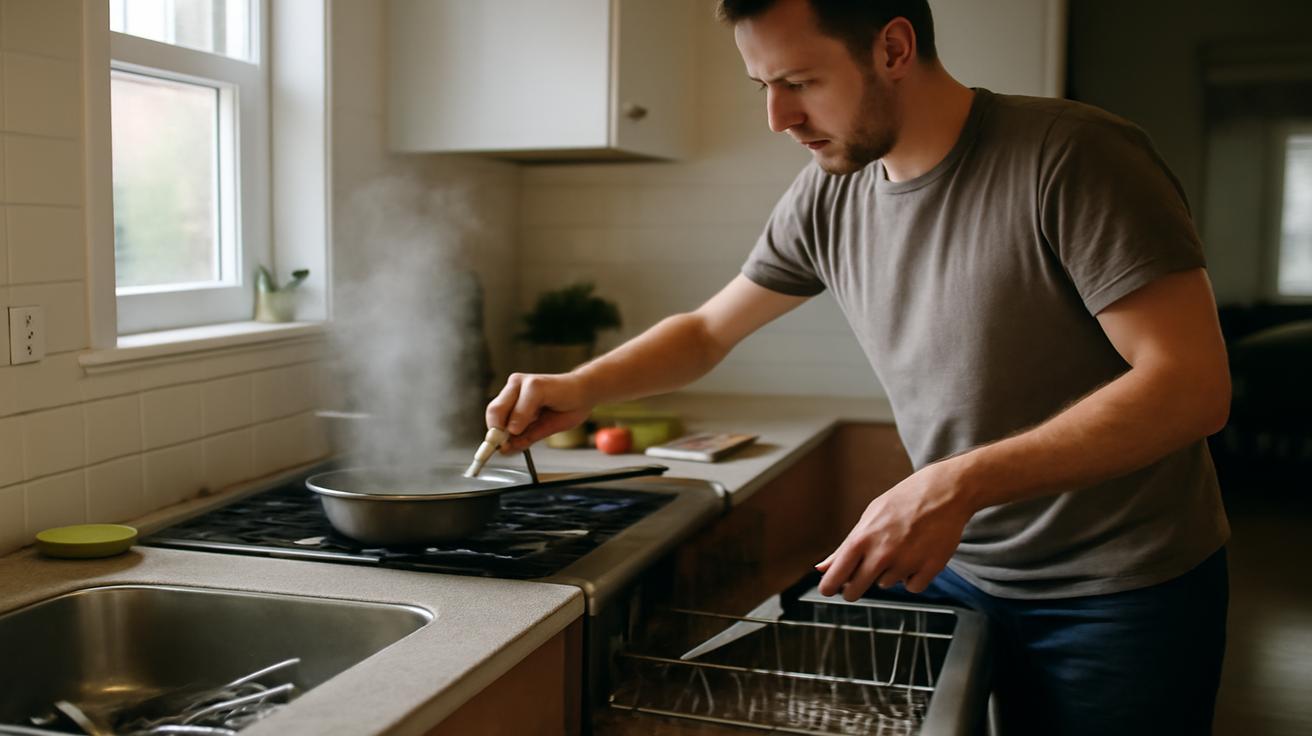
The pan hisses, the onions surrender to the heat, and the first curl of steam rises, fragrant with garlic and olive oil. You reach for the wooden spoon with one hand—and with the other, almost without thinking, you nudge the salt back into its corner, slide the cutting board scraps into the compost bowl, wipe the tiny constellation of chili flakes off the counter. The kitchen is alive, but it isn’t chaotic. The meal is in motion, and so are you, in this quiet choreography of stirring and rinsing and stacking and wiping. For some people, this is just “how you cook.” For psychologists, it’s something more: a behavioral fingerprint, a window into deeper traits that shape how you move through the rest of your life when you’re nowhere near a stove.
The Quiet Psychology of a Wiped-Down Counter
On the surface, “clean as you cook” looks like a practical habit—less mess, fewer dishes staring you down when all you want is dessert and bed. But habits rarely exist alone. They grow out of patterns in how we think, feel, and make decisions. If you watch people who automatically rinse the pan while the pasta boils, who tuck ingredients back into the fridge between steps, you’ll notice they tend to share a cluster of psychological traits that don’t just live in the kitchen.
Psychologists would call it a behavioral indicator: a small, consistent action that reflects a broader style of relating to the world. That moment when you pause to wipe the knife before chopping the herbs, or stack bowls in the sink in neat, rinsed rows, is often linked with things like emotional regulation, future orientation, and even how we navigate uncertainty.
You might think you’re simply avoiding a pile of dishes. In reality, your brain is doing something much more complex: managing sensory input, controlling impulses, and keeping you grounded in the present while thinking ahead to the future. Below are eight distinctive traits that people who clean as they cook tend to share—with each one simmering beneath the surface like a quiet psychological flavor.
1. A Natural Lean Toward Executive Function and Planning
Executive function is the brain’s internal project manager. It keeps track of what’s happening now, what needs to happen next, and how not to trip over your own shoelaces in between. People who clean as they cook are often running multiple little plans in parallel without even naming them.
While the soup simmers, they’re not just waiting—they’re rinsing the colander, putting away the spices, loading the dishwasher. Their brain is automatically asking: “What can I finish now so I don’t have to deal with it later?” That’s executive functioning in everyday clothing: prioritizing, sequencing, time management.
This kind of cooking looks almost like a dance—stir, rinse, flip, wipe, taste, stack. The same mental skills that make this feel natural often show up in other areas: the coworker who finishes a project with the file names already organized, the friend who plans a trip with packed bags and labeled snacks, not frantic last-minute laundry.
It’s not always about rigid control. It’s about a gentle relationship with time: an awareness that what you do in this minute can make life in the next ten minutes easier.
2. Comfort With Micro-Structure (Without Needing Total Control)
Walk into the kitchen of someone who cleans as they cook, and you’ll often notice something: there’s a sense of gentle order. Not perfection, not showroom minimalism—just a quiet assurance that everything has a place, even if it moves around during the chaos of dinner.
Psychologically, this points to a comfort with micro-structure. These are people who understand that a little bit of structure makes freedom easier, not harder. They might not plan every day down to the minute, but they enjoy small anchors: keys in the same bowl, notebooks stacked by use, spices more or less grouped.
In the sensory storm of cooking—the pop of oil, the clutter of ingredients, the smell of browning butter—a bit of structure acts like a soft boundary. Putting a used measuring cup into the sink instead of leaving it under the bag of flour isn’t about being fussy; it’s about keeping the environment readable to their brain.
This often connects to lower stress levels. Research consistently shows that physical clutter can increase cognitive load. People who clean as they go are unconsciously protecting their own mental bandwidth. They’re not chasing a spotless kitchen; they’re chasing a kitchen that doesn’t shout at their nervous system.
3. A Strong Future Orientation (Even in Tiny Moments)
Future orientation isn’t just about retirement plans or five-year goals. It lives in the smallest choices: Do I leave this knife on the counter and deal with it later, or do I rinse it now while the rice cooks?
Those who clean while they cook tend to favor tiny acts of “future self kindness.” They don’t always frame it that way, but that’s what’s happening. They picture the later version of themselves—tired, full, maybe a little sleepy—and they send that person a small gift: a kitchen that doesn’t feel like a crime scene.
This micro-anticipation often appears in other domains. They’ll charge their phone before bed because they imagine tomorrow’s commute. They’ll print the boarding pass the day before, pack the umbrella when the weather app says “maybe,” leave gas in the car so Monday morning isn’t a panic.
In psychology, this is related to delayed gratification and prospection—the ability to mentally travel forward in time and make decisions that take that future into account. Cleaning as you cook turns a theoretical concept into something deeply physical: wet hands, hot water, the clink of a rinsed glass. The future isn’t abstract when you’re literally clearing a path toward it.
4. Emotional Regulation Through Physical Environment
For many people, mess is more than visual. It’s emotional. The sight of a sticky counter or a pile of greasy pans can trigger a subtle sense of heaviness: I still have to do that. It’s like background noise you can’t quite turn off.
People who clean as they cook often have an intuitive understanding that their emotional state is tied to the environment around them. They can feel their shoulders drop when the counters are wiped, the sink is clear, the cutting board rinsed. It’s not about impressing anyone. It’s about soothing their own nervous system.
Psychologically, this is a form of self-regulation. Instead of trying to calm themselves purely from the inside—through thought alone—they also work from the outside in. They use the physical act of rinsing a bowl or sweeping crumbs into their hand as a small ritual of control, of closure, of completion.
This trait often spills into how they handle stress. When something big feels overwhelming, they’ll start small: tidy the desk before starting the hard email, make the bed before facing the day, organize a single drawer in a stormy week. It isn’t procrastination; it’s building a foundation of calm.
| Kitchen Behavior | Underlying Trait | How It Shows Up In Life |
|---|---|---|
| Rinsing dishes while food simmers | Executive function & planning | Breaking big projects into small, timed steps |
| Putting spices away between steps | Comfort with micro-structure | Keeping workspaces or schedules loosely organized |
| Wiping counters before sitting down to eat | Future orientation | Doing small tasks now to ease tomorrow’s load |
| Clearing clutter to “enjoy cooking” | Emotional self-regulation | Using environment to manage mood and stress |
5. An Eye for Sequences, Not Just Ingredients
Watch a “clean as you go” cook for a few minutes and you’ll notice something subtle: they think in sequences. They rarely treat each action as isolated. Instead, they feel how this action leads to that one, like a row of dominos they’re carefully lining up.
The cutting board doesn’t just appear; it’s placed near the sink because it will need rinsing. The trash bowl isn’t an afterthought; it’s set out before chopping starts. The pot of boiling water isn’t dead time; it’s a window to scrub the pan they just finished using.
This kind of mind is comfortable with process. It doesn’t just ask, “What do I need for this?” but also, “What will this create next?” That question lives underneath all sorts of life skills: moving apartments, managing finances, planning a garden, navigating a career change.
In cognitive terms, this blends working memory with procedural thinking. They can hold the recipe steps in mind while also tracking the physical reality—how many clean bowls are left, whether the knife will be needed again, whether the stovetop is getting crowded. Cleaning while cooking isn’t just about neatness; it’s about orchestrating a sequence that feels fluid rather than frantic.
Not Perfectionism—Something Quieter and Kinder
It’s easy to mistake this way of cooking for perfectionism, but psychologically, they’re not the same. Perfectionism tends to carry a tightness with it—anxiety about getting things exactly right, fear of being judged, harsh self-criticism when reality doesn’t match the inner standard.
The people who quietly rinse and wipe between sizzles often aren’t chasing “perfect.” There are still drips on the stove and a rogue spoon somewhere under a towel. What they’re really chasing is manageability. They want to be able to enjoy the meal without the dread of an overwhelming aftermath.
In that sense, this trait can be surprisingly gentle. It says, “You don’t have to suffer later if you can soften the edge now.” It isn’t about earning rest through spotless productivity. It’s about giving themselves permission to rest more fully because the environment won’t demand more from them the second they sit down.
That gentleness can extend beyond the kitchen. You’ll often see it in how they talk to themselves: less all-or-nothing, more, “What’s one small thing I can do that will help?” They may still struggle with stress, but they give themselves stepping stones rather than cliffs.
When the Kitchen Becomes a Mirror
Of course, not everyone who leaves a mountain of dishes is disorganized, impulsive, or living in rebellion against their future self. Sometimes you’ve had a long day, you’re exhausted, the kids are melting down, and survival dinner is the only thing on the menu. Psychology deals in tendencies, not ironclad rules.
But if you notice that you’re one of those people who almost can’t not clean as you cook—that your hand reaches for the dishcloth as automatically as the salt—it might be worth seeing your kitchen as a mirror.
Maybe you’re the kind of person who:
- Finds peace in small, steady actions more than dramatic, once-a-week scrubbing.
- Feels better when your environment and your mind are in quiet conversation.
- Values your future self enough to make tiny investments on their behalf.
- Relies on subtle structure so creativity and chaos can safely coexist.
- Uses everyday routines as a soft technology for staying emotionally steady.
And if that doesn’t sound like you—but you wish it did—your kitchen is also one of the easiest places to experiment. Not with grand resolutions, but with microscopic shifts that slowly shape how your brain sees tasks, time, and care.
Try rinsing just one thing while the water boils. Try wiping one square of counter before you plate the food. Try putting the spice jar back on the shelf before you open the next one. These aren’t chores as much as neural experiments: “What happens to my mood if I make this five-second choice?”
Over time, those seconds start to stack. They don’t just change your kitchen. They change your sense of yourself: someone who can nudge chaos back a little, who doesn’t have to be swallowed by the aftermath of every effort.
8 Distinctive Traits Simmering Beneath the Surface
When you zoom out from the stove and look at the psychology, people who clean as they cook consistently tend to share these eight intertwined traits:
- Strong executive function: They naturally juggle multiple tasks, time them, and keep track of what needs doing without losing the thread.
- Comfort with gentle structure: They like loose systems—places for things, sequences for tasks—that make life run more smoothly.
- Future-oriented thinking: They routinely do small things now that make the next moment easier, even when no one’s watching.
- Environmental self-regulation: They use their surroundings—tidy counters, clear sinks—to help manage stress and stay calm.
- Process-focused mindset: They think in sequences instead of isolated steps, which helps them move through complex tasks fluidly.
- Capacity for delayed gratification: They’re willing to endure a tiny inconvenience (rinsing, wiping, putting away) for a later sense of ease.
- Respect for limits: They intuitively protect their later energy by not leaving everything for a moment when they’ll be more tired.
- Quiet self-compassion: Underneath it all, they’re often kinder to their future selves than they realize, leaving small pockets of relief along their own path.
None of these traits require a perfect kitchen. They don’t demand color-coded cabinets or a minimalist countertop. They live in the small, almost invisible gestures: the spoon that gets rinsed instead of abandoned, the pot that soaks while you eat, the cutting board that’s wiped before dessert.
Every kitchen tells a story, not about morality or worth, but about how we handle time, sensation, and care. In some kitchens, the story is loud and joyful and chaotic, with piles of dishes standing as monuments to a good night. In others, the joy is braided with a softer thread—a desire to land gently, to close the loop as they go, to arrive at the table with not only a hot meal, but a mind already halfway at rest.
So the next time you’re stirring a pot and your hand drifts toward the sponge, notice it. Feel the warm water, the slip of soap on ceramic, the way your shoulders lower a fraction of an inch when the sink looks a little less demanding. That, too, is part of the meal. The psychology of how you care for the mess is also the psychology of how you care for yourself.
Frequently Asked Questions
Is cleaning while cooking always a sign of “being organized”?
Not necessarily. It’s a clue, not a diagnosis. Many people who clean as they go are reasonably organized in other areas, but context matters—someone might be tidy in the kitchen and chaotic with paperwork, or vice versa. The habit points more to certain tendencies (like future-thinking and self-regulation) than to a universally organized personality.
Can you learn to clean as you cook if it doesn’t come naturally?
Yes. This habit is highly trainable because it’s built from tiny, repeatable actions. Starting with one or two simple rules—like “rinse knives immediately” or “wipe the counter before plating”—can slowly shift your default behavior without requiring a complete personality overhaul.
Does leaving a mess mean something is wrong with me psychologically?
No. Mess is not a moral failure or a psychological diagnosis. It can be influenced by mood, energy level, upbringing, neurodivergence, stress, and time pressure. Psychology uses behavior like this as information, not judgment. A messy kitchen might simply mean you were prioritizing connection, rest, or survival over tidiness that day.
Is this the same thing as being a perfectionist?
Cleaning as you cook can overlap with perfectionism, but they’re different. Many people who clean while cooking are not seeking flawlessness; they’re just trying to make the experience manageable and more enjoyable. Perfectionism is more about fear of mistakes and judgment, while “clean as you go” is often about kindness to your future self.
How can this habit affect my stress levels outside the kitchen?
When you practice small, timely actions that reduce future stress in the kitchen, you’re effectively training a mindset you can apply elsewhere. You may find it easier to send the quick email now instead of dreading it later, fold laundry before it becomes a mountain, or prepare for Monday on Sunday night. Over time, these micro-habits can noticeably lower background stress and increase your sense of control.