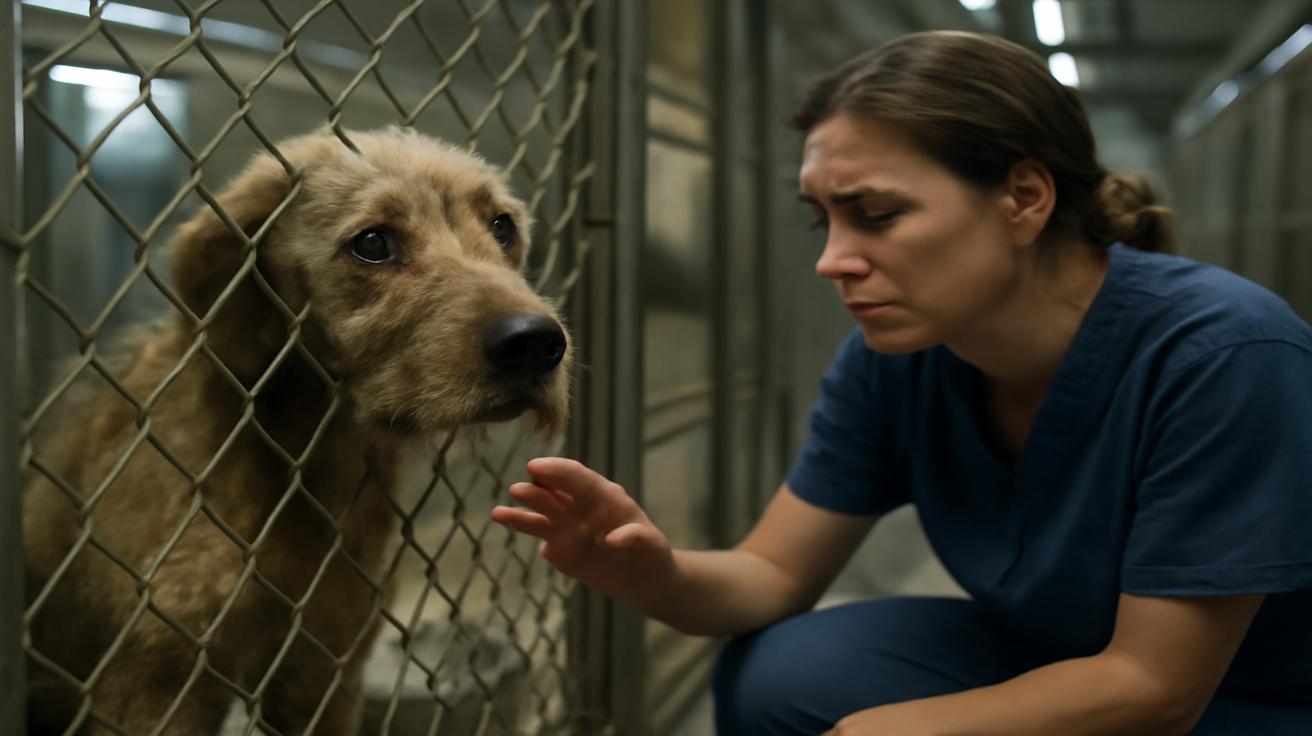
The first thing you notice is the sound. Not the barking—that’s the background music of any animal shelter—but the spaces between the barks. The pauses. The held breaths. The way the air itself seems to listen.
On the third row of kennels, in the spot close to the back door where a draft curls under the concrete, there is a dog named Willow. She has the kind of eyes that stop you in the middle of your day, that make you forget the smell of disinfectant and the cold of the metal railing beneath your fingers. Her coat is the soft brown of wet leaves and her ears fold forward like she’s perpetually halfway between curiosity and apology.
They promised to come back for her. That’s how this story begins—like so many shelter stories do—not with abandonment, but with a promise.
The Day They Said “Just for a Little While”
It was raining the day Willow was brought in. Not a dramatic storm, just a persistent drizzle that turned the parking lot into a mirror of gray sky. The automatic door wheezed open and a young couple stepped inside, carrying Willow between them on a worn blue leash. She trotted uncertainly, toenails clicking on the slick tile, glancing back at the door as if she could still see the car she’d just left.
Emily, the intake coordinator, remembers the way the woman’s hand shook as she signed the temporary surrender form. She remembers because she watched it too closely, hoping to catch the tremor that would tell her whether this was a story that might turn out all right.
“It’s just for a couple of weeks,” the man had said, his voice too bright for the dim lobby. “We’re… between places right now. Our landlord changed the rules. No dogs. But we’re moving. We’ll be back as soon as we can. We just need a little time.”
Emily nodded, not because she believed him, but because you have to give people something to hold onto when they feel like they’re failing someone they love. She slid the clipboard over, answered the practical questions, measured the weight of Willow’s body language instead of the words filling in the lines.
Willow sat when asked. Took treats gently. Flinched when another dog barked from down the hallway but recovered quickly. Housebroken, good with kids, loves car rides, the form said. Eighty pounds of muscle softened by a lifetime of sleeping at the foot of someone’s bed.
“We’ll call every day,” the woman said, tears gathering but not yet spilling. She bent down, wrapped her arms around Willow’s neck, pressing her face into the dog’s fur. The smell of damp wool and rainwater hung in the air.
“We’ll come back for you, okay?” the man whispered into Willow’s ear when he thought no one was listening. “You’re our good girl. Just a little while.”
They left in a hurry, as if lingering might make them reconsider. The door sighed closed behind them. Willow kept her gaze fixed on the glass long after the car had disappeared, her breath leaving faint clouds on the cool surface.
The Waiting Days
The shelter works in cycles. Morning cleaning, breakfast, first walk rotation, laundry, afternoon feeding, evening checks. Outside, the weather changes: a run of clear days, a sudden cold snap, a stretch of wind that scatters leaves into the parking lot. Inside, the air always smells faintly of bleach and something softer—kibble, wet fur, the plastic sweetness of donated toys.
Willow slipped into the rhythm quickly. On the first night, she refused to lie down until the last staff member had left the kennel row, watching each person leave with a puzzled tilt of her head. On the second, she ate only half her dinner. By the third, she had discovered that if she pressed her body close enough to the front of the kennel, she could catch the corner of the hallway where people appeared from the lobby.
“They’ll be back,” the volunteers told each other in the break room, stirring cream into coffee gone cool from neglect. “They seemed sincere.”
Sincerity, though, is a thin blanket against reality.
On day four, the couple called. Emily recognized the woman’s voice immediately: that brittle determination that comes when hope is already starting to fray.
“We’re still getting things sorted,” she said. “It’s just taking a little longer. Can you… is she okay?”
Emily looked down the hallway. From where she stood at the front desk, she could just see Willow’s paws, planted patiently at the kennel door.
“She’s okay,” Emily said. “She’s safe here. Take the time you need, but keep us updated, okay?”
The call ended. The rain outside had stopped. In the kennel, Willow circled her blanket three times before lying down, her face turned toward the direction of the lobby.
| Day | Willow’s Routine | Staff Observations |
|---|---|---|
| 1–3 | Stands at kennel door, waits after every sound from lobby | Alert, curious, eating lightly but consistently |
| 4–7 | Runs to front of kennel at footsteps, whines softly at closing doors | More vocal, starts pacing, still hopeful—tail wags at visitors |
| 8–14 | Sleeps more, gets up quickly when someone passes, then lies down again | Eating less, showing signs of kennel stress, clinging on walks |
| 15+ | Waits only at certain times of day; spends longer in back of kennel | Withdrawn between visits, brightens only with familiar staff |
The Quiet Shift from Hope to Habit
The calls came less frequently. A week and a half in, Emily found herself checking the missed call log in the evenings, thumb hovering over numbers with unfamiliar area codes, just in case. Twice she dialed back a likely candidate only to find wrong numbers, the awkward pause on the other end filled with someone else’s life.
Hope, in a shelter, is both currency and liability. You trade in it every day, but you also watch it break people—and animals—when it’s stretched too thin.
Still, promises have their own gravity. The staff added a note to Willow’s chart: “Temporary surrender. Owners intend to reclaim.” It changed things. They didn’t move her profile to the adoption board. They didn’t start drafting the kind of listing that tries to compress a whole soul into three paragraphs and a flattering photo.
Instead, they focused on making time bearable. Volunteers took Willow to the small play yard out back, where a scrawny maple cast a thin slice of shade over the gravel. She didn’t play fetch, not really. She would chase the ball, nose it once, then bring her gaze back to the parking lot gate, as if every creak of its hinges might contain the moment she’d been waiting for.
“She’s such a good dog,” one of the teenage volunteers, Marco, said one afternoon as Willow leaned heavily into his legs. “If they don’t come back… she won’t be here long. Someone will fall in love with her.”
Emily wanted to believe that. Most days, she could. But that if had started to loom larger, a shadow stretching over every shift.
The Call That Changed Everything
It was a Tuesday when the shelter director, a compact woman named Joyce with permanently ink-stained fingers from signing forms, called an all-staff meeting in the break room. The coffee pot was empty, which was how everyone knew it was serious. Even the volunteers hovering between tasks felt the shift in the air, that dense stillness that presses on ears and gut alike.
“I got a call from County Animal Control this morning,” Joyce began, standing by the microwave like a professor about to deliver bad news about final grades. “It’s about Willow’s owners.”
Emily’s stomach tightened. She hadn’t realized until that moment just how much she’d been stitching pieces of their story together in her mind: They’d found an apartment. They were saving for pet fees. They’d call any day now. They’d walk back through those glass doors, voices bright with relief, and Willow would launch herself against the leash in a full-body greeting.
Reality arrived instead, clipped and bureaucratic.
“There was a car accident about ten days ago,” Joyce continued, her voice gentler now, the words rounding with something like sorrow. “A two-car collision on the state highway. The couple who brought Willow in… they were both in one vehicle.” She paused, giving the room a chance to fill in the rest. “Neither survived.”
The fluorescent lights hummed overhead. Somewhere down the hallway, a dog barked twice, sharply, then fell silent.
“Animal Control went to their last listed address. The landlord gave them our number from the intake paperwork.” Joyce looked around the room, her gaze catching on each face. “We’re now Willow’s legal custodians. There’s no family stepping in. We’ll need to move her to adoptable status.”
Bad news comes in different flavors at a shelter. There’s the acute kind—the emergency intake of a cruelty case, the late-night call about a distemper outbreak. And then there’s this: the quiet, slow-crushing realization that the story you’d been silently rooting for has ended offstage, without your witness or consent.
Emily felt her throat close. In her mind she saw again the woman’s shaking hand, the man’s whispered promise: We’ll come back for you. She pictured the blank stretch of highway, the sudden violence of metal and glass, the way time must have folded on itself in those final seconds, tearing the future they’d planned clean in half.
“Does she know?” Marco asked quietly from the back of the room, eyes wet in that unashamed way only some teenagers manage. A few people almost smiled—some reflex of tenderness at the question—but no one laughed.
“Not like we do,” Joyce said. “But she knows they’re not here. She’s been waiting for people who aren’t coming.”
What Dogs Understand About Absence
There’s a temptation to romanticize it, to say Willow felt some seismic shift the moment the accident happened, that she lifted her head from her kennel floor at the exact second their car left the road. The truer version is both simpler and, in its way, more devastating.
Dogs understand routine. They understand patterns, the reliable choreography of doors opening and closing, keys in locks, footsteps on stairs. They measure time not in hours but in absences—how many naps between meals, how long a sunbeam takes to crawl from one side of the room to the other.
For Willow, waiting had a shape and a schedule. Afternoons were when they might come. The days when rain slicked the parking lot were good candidates; that’s what it had been like before. The sound of the lobby door wheezing open, the note the front-desk bell made when someone pressed it—that was her clock.
What she understood, in the wordless calculus of her mind, was that the pattern had broken. The absences had stacked up, one on top of the other, until they formed a wall she couldn’t see past.
Still, as Emily walked down the kennel row after the meeting, keys jingling softly at her hip, Willow rose when she saw her. Ears forward. Tail giving a small, hopeful sweep.
“Hey, girl,” Emily murmured, voice thick. She pressed her hand to the cool metal of the kennel door. “I am so, so sorry.”
Turning Grief into a New Beginning
Mourning looks different in a shelter. There are no formal rituals, no candles or quiet church pews. Instead there are notes added to digital files, names spoken a little more softly than before, a certain reverence in the way staff approach the animals whose stories have just taken a sharp, irreversible turn.
Willow’s file changed that afternoon. The line “Temporary surrender” disappeared, replaced now with “Owner deceased. Available for adoption.” Her photo—taken on her first day, damp from rain and stress, eyes wide—moved from the intake database to the adoption listings. A volunteer fetched a camera to get better pictures, coaxing Willow into the yard when the sun finally broke through the clouds.
“Can you sit for me?” the volunteer asked, backing up with the camera poised. Willow sat, of course. She’d been someone’s loved dog; she knew all the basic commands. But instead of looking into the lens, she turned her head toward the sound of a car door slamming in the parking lot, gaze sharp and searching.
They tried again. And again. Eventually, they got one good shot—Willow’s head tilted, eyes bright, the ghost of the maple’s shadow striping her back. In the photo you can’t see the way she kept glancing back at the gate, the restlessness in her paws as if she were half a second away from motion.
The write-up was clinical but kind: “Meet Willow, a gentle, affectionate companion with a calm disposition and a loyal heart. She came to us when her owners could no longer care for her, and through heartbreaking circumstances, she’s now in need of a new forever home. She walks beautifully on leash, loves quiet time with her people, and is ready to share her love with a new family.”
They didn’t mention the accident. Not because it wasn’t part of her story, but because grief—human or canine—doesn’t always translate neatly to the brief space under a shelter photo.
The People Who Never Knew They Were Needed
The couple who would eventually stand in front of Willow’s kennel had never heard of her owners. They would not know about the rain-soaked day, or the trembling signature, or the promise spoken into Willow’s fur. They would not know about the Tuesday meeting or the way the room went silent when the news was delivered.
They would just see a dog sitting quietly on her blanket, lifting her head when they approached, ears pricking at the sound of their voices.
That’s the strange, almost unfair thing about these stories: the people who cause the breaking are not always the ones who get to witness the mending. Sometimes, through no fault of their own, they vanish from the narrative right when it’s most precarious.
In the weeks after the bad news, the shelter staff carried both sides. They were the ones who whispered apologies into Willow’s fur. They were also the ones who, when visitors came, learned to tell a simplified version of her story—true, but gentle, shaped to fit inside the boundaries of what a stranger can take in on a casual Saturday afternoon visit.
“She’s been through a loss,” Emily would say, crouching beside the kennel as Willow pressed close. “She needs someone patient, someone who understands that she might take a little time to trust that this home is forever.”
In the evenings, when the last adoption appointments had ended and the lobby lights were dimmed, Willow’s hallway settled into quiet. One by one, the staff would pause by her kennel. A hand through the bars. A soft word. The small, everyday rituals of reassurance.
The Weight and Gift of Showing Up
Stories like Willow’s ripple outward. They change the way the staff hears certain phrases: “We’ll be back.” “Just a little while.” “She’s our baby, we’d never really give her up.” The words are the same, but the weight behind them feels different now, threaded with all the unseen variables that can yank a life sideways in a heartbeat.
In a world where everything can change at the turn of a steering wheel or the ring of a phone, the shelter becomes something more than a holding place. It’s a safeguard for promises people meant to keep and couldn’t. A quiet insurance policy against the random cruelties of fate.
Weeks after the call from Animal Control, Willow still pricked her ears at the sound of the front door. But the intensity of it softened. The sharp edge of anticipation dulled into a more general curiosity. She learned the shapes of new faces, the cadence of new voices. She took to sleeping not right at the door of her kennel, but a few steps back, where she could still watch the hallway but didn’t have to spring to her feet at every passing shadow.
The staff, for their part, carried on the way people in shelters always do: by moving forward without forgetting. They made space on the bulletin board for new success stories—polaroids of adopted animals pressed between magnets and handwritten notes. When Willow’s photo eventually joined them, pinned in the corner under the caption “Found her new family,” there would be a quiet moment of recognition: not just for the home she’d gained, but for the ghosts standing just out of frame.
Until then, they showed up. For morning walks and evening feedings, for nail trims and vet visits, for the small, unremarkable minutes that make up a day in a shelter dog’s life. They showed up knowing that sometimes, despite every careful plan, they would be the ones left holding the leash when the world looked away.
They could not bring Willow’s people back. They could not explain to her why the car doors she heard were not the ones she wanted. But they could, day after day, be there at the end of the kennel row, hand on the latch, saying with actions what they could never quite translate into words:
You were promised a future. It will not look the way it was meant to. But you will not face it alone.
Frequently Asked Questions
Do dogs really wait for their owners at shelters?
Many dogs show clear signs of waiting and searching after being surrendered. They may fixate on doors, perk up at familiar sounds, or become excited whenever someone passes by. While dogs don’t understand the full story, they do feel the abrupt loss of their routine and relationships, and they look for what used to anchor their days.
What happens legally when a pet’s owner dies unexpectedly?
Laws vary by location, but usually animals become part of the owner’s “estate.” If there’s no clear plan in a will or no family able or willing to step in, local animal control or shelters may take custody. From there, shelters work to provide care, assess the animal, and place them up for adoption as soon as it’s appropriate.
Can shelters tell adopters the full backstory of an animal?
Shelters share as much as they ethically and legally can, balancing transparency with privacy and the animal’s best interest. They may summarize difficult histories in gentler terms, focusing on what the animal needs going forward—patience, structure, medical care—rather than on graphic or overwhelming details.
How do shelter staff cope with emotionally difficult cases?
Staff and volunteers develop coping tools over time: debriefing with each other, setting boundaries, celebrating every successful adoption, and focusing on the tangible help they can provide day to day. Many shelters also encourage mental health support, breaks, and rotating duties to avoid burnout and compassion fatigue.
What can I do to protect my own pets if something happens to me?
You can name a trusted caregiver in your will, set aside funds for your pets’ care, and talk to family or friends about your wishes. Some people also create formal pet trusts or register backup caretakers with their vet or microchip company. Planning ahead helps ensure that if the unexpected happens, your animals have a clear path to safety and a new home.